


Ask ChatGPT to recommend a project management tool, and it might describe your brand with attributes you never claimed, next to competitors you didn’t authorize. That’s brand drift, and it’s happening thousands of times a day across every major LLM. AI perception monitoring has become the fastest-growing category in martech because nobody was watching this problem eighteen months ago, and now it’s a board-level risk.
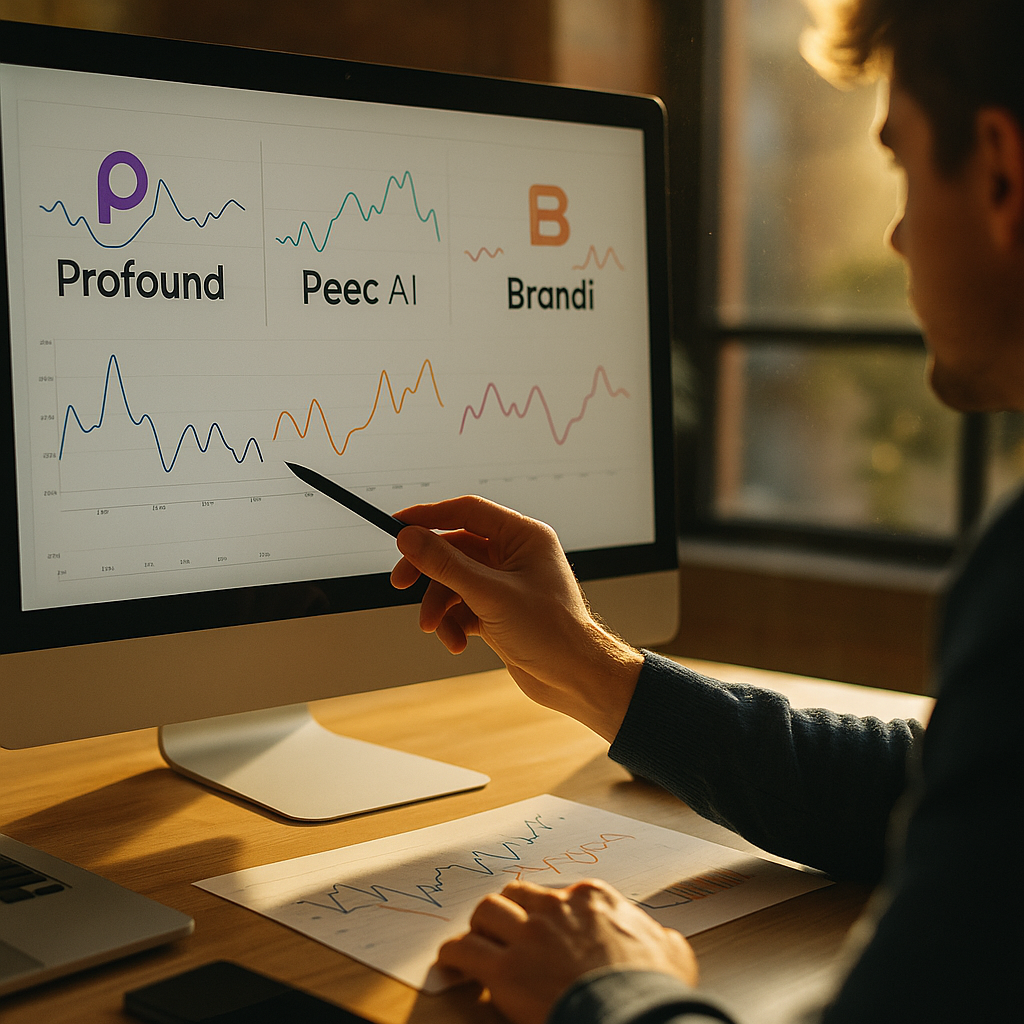
The premise is simple: large language models generate a version of your brand that lives independent of your website, your press releases, and your paid media. That version shifts as models retrain, as competitors optimize their content, and as the web itself gets noisier with AI-generated junk. Three vendors have emerged as the category leaders for tracking this drift: Profound, Peec AI, and Brandi AI. Each takes a meaningfully different approach, and picking the wrong one means flying blind on the channel that increasingly decides purchase consideration before a human ever hits your site.
Why Brand Drift Became a Budget Line Item
Marketers spent a decade obsessing over search rankings. Now the ranking is a paragraph, generated on the fly, and it changes based on the prompt, the user’s location, and which model answered. A model might describe your SaaS product as “enterprise-only” when you’ve spent two years building a self-serve motion. It might cite a discontinued feature. It might just quietly omit you from a comparison list where you belong.
None of this shows up in traditional analytics. Your organic traffic dashboard won’t flag it. Your brand tracking survey, run once a quarter, won’t catch it either. That’s the gap these tools exist to close, and it overlaps heavily with the broader shift toward generative engine optimization as a discipline distinct from SEO.
Brand perception in LLMs isn’t static content you can audit once a quarter — it’s a moving target that shifts with every model update, making continuous monitoring a operational necessity rather than a nice-to-have.
Consider the mechanics. Retrieval-augmented generation pulls from live web sources, so a single negative review or an outdated Wikipedia edit can reshape how a model frames your brand within days. Meanwhile, model providers push updates without much warning. OpenAI, Anthropic, and Google all ship changes that can silently alter your brand’s footprint in outputs. If you’re not measuring before and after, you won’t know what moved or why.
What “AI Perception Monitoring” Actually Measures
Strip away the marketing copy and these platforms generally track four things: share of voice across model responses, sentiment and framing accuracy, citation sources (where the model is pulling its facts from), and competitive positioning within comparison-style prompts. Some layer on hallucination detection, flagging when a model states something factually wrong about your product or pricing.
This is distinct from answer engine optimization tools that focus on getting cited in the first place. Perception monitoring assumes you’re already showing up, and asks: how are you being described, and is that description drifting in a direction that hurts you? For a deeper look at the citation-focused side of this ecosystem, see our buyer’s guide to answer engine optimization platforms.
Profound: Built for Enterprise Scale and Attribution
Profound positions itself as the enterprise answer to this problem, and the product reflects that ambition. It runs large volumes of simulated prompts across ChatGPT, Perplexity, Gemini, and Copilot, then maps how brand mentions correlate with actual traffic and conversion data pulled from your analytics stack.
The standout feature is its attempt to connect LLM visibility to downstream business outcomes. Rather than just reporting “you were mentioned in 34% of relevant prompts,” Profound tries to show whether those mentions correlate with referral traffic spikes or pipeline movement. That’s a meaningful step beyond vanity share-of-voice metrics, and it’s why the platform has found traction with larger B2B and SaaS marketing teams that need to justify GEO spend to finance.
The tradeoff is complexity and cost. Profound is built for teams with dedicated resources to interpret dashboards and act on findings, not for a solo marketer checking in once a week. It also leans heavily on integration with existing analytics infrastructure, which means implementation takes real engineering time. If your team is already navigating attribution complexity from agentic search, adding another data pipeline is a real consideration, not a checkbox.
Peec AI: The Lean, Fast-Moving Challenger
Peec AI took a different bet: speed and accessibility over enterprise depth. It’s a lighter-weight tool, faster to set up, and priced for mid-market teams that want visibility without a six-week onboarding process. You plug in your brand and competitors, define a set of tracked prompts, and get a dashboard showing mention frequency, sentiment, and competitive share across major models within days.
Where Peec AI earns its reputation is prompt customization. Marketers can build out realistic buyer-journey prompts, not just generic “best X tools” queries, which matters because real users rarely type queries that clean. A B2B buyer researching accounting software might ask a model something specific and messy, like “which invoicing tool integrates with QuickBooks and supports multi-currency for a 50-person agency.” Generic tools miss this nuance. Peec AI is built to capture it.
The limitation is depth on the attribution side. Peec AI tells you what’s being said and how it’s shifting, but it doesn’t natively connect that to revenue the way Profound attempts to. For teams that just need a reliable early-warning system for drift, that’s often enough. For teams that need to build a CFO-ready ROI case, it’s a gap worth flagging before you sign a contract.
Brandi AI: Narrower Focus, Sharper Sentiment Lens
Brandi AI carves out its own niche by going deep on sentiment and narrative framing rather than breadth of coverage. It tracks fewer models by default but applies more granular sentiment classification, distinguishing between neutral factual mentions, subtly negative framing, and outright misinformation. For consumer brands worried about reputational drift, especially around sensitive topics like ingredient safety or data privacy claims, that granularity matters more than raw mention volume.
Brandi AI also offers alerting that’s genuinely built for non-technical stakeholders. Instead of a dashboard requiring interpretation, it pushes plain-language summaries: “Gemini now describes your return policy as ‘restrictive,’ a shift from neutral framing last month.” That’s the kind of insight a communications team can act on without a data analyst translating it first.
The catch is scale. Brandi AI’s model coverage and prompt volume trail both Profound and Peec AI, which makes it a weaker fit for global enterprises needing comprehensive tracking across dozens of markets and languages. It’s a scalpel, not a net.
Side-by-Side: Where Each Tool Actually Wins
- Best for enterprise attribution: Profound, thanks to its analytics integration and revenue-correlation approach.
- Best for fast implementation and prompt customization: Peec AI, ideal for mid-market teams needing signal without heavy setup.
- Best for sentiment nuance and non-technical alerting: Brandi AI, strongest for consumer and reputation-sensitive brands.
- Best model coverage breadth: Profound and Peec AI both track the major model providers; Brandi AI is more selective.
- Best for lean teams without a data function: Brandi AI or Peec AI, both far less resource-intensive than Profound.
None of these tools operate in a vacuum. They sit alongside the broader governance stack brands are building for AI-era marketing, including the kind of vendor claims audits we’ve covered around agentic AI media buying and the hallucination checks discussed in our AI hallucination detection protocol. Perception monitoring is one layer of risk management, not the whole system.
What Should Actually Drive Your Decision
Start with a blunt question: what happens when you find bad drift? If your answer is “we’d escalate to legal or comms immediately,” you need Brandi AI’s alerting clarity or something comparable. If your answer is “we’d adjust our content and GEO strategy,” you need Profound’s or Peec AI’s depth on source citation and competitive framing.
Budget matters too, obviously. Enterprise tools like Profound typically run into five or six figures annually depending on prompt volume and model coverage, according to vendor pricing pages and industry commentary tracked by outlets like eMarketer. Peec AI and Brandi AI both offer more accessible entry points, which matters if you’re testing this category for the first time rather than committing to a multi-year platform.
Don’t buy perception monitoring as a standalone tool. Buy it as the input layer for a governance process that already includes content review, legal escalation paths, and a clear owner who acts on the alerts.
One more practical note: procurement teams evaluating any of these platforms should ask about MCP support now, not later. As model providers standardize on protocol-based integrations, tools without native support will require workarounds that add latency and cost to every data pull. It’s a forward-looking question, but one that’s already separating serious vendors from ones playing catch-up.
The Data Quality Question Nobody Asks
Here’s something vendors don’t advertise: prompt sampling methodology varies wildly between these tools, and it changes what “share of voice” even means. A tool running 500 prompts weekly against a narrow set of templated queries will report different numbers than one running 5,000 prompts with dynamic, buyer-journey-style variation. Neither is wrong, exactly, but they’re not comparable.
Before you sign anything, ask each vendor for their raw prompt logs, not just the dashboard summary. Ask how often they refresh their prompt sets to reflect actual buyer language rather than SEO-style keyword lists. This is the same rigor HubSpot’s research teams apply when validating any new measurement category, and it should apply here too. A tool that looks impressive in a sales demo can still be measuring the wrong thing at scale.
Run a 90-day pilot with your top two candidates before committing to an annual contract, and weight the decision toward whichever platform’s alerts actually change what your content and comms teams do each week.
FAQs
What is AI perception monitoring?
AI perception monitoring tracks how large language models like ChatGPT, Gemini, and Perplexity describe a brand across generated responses, flagging shifts in sentiment, accuracy, and competitive positioning over time.
How is this different from traditional brand tracking?
Traditional brand tracking surveys human perception periodically, often quarterly. AI perception monitoring tracks machine-generated perception continuously, catching drift caused by model updates or changes in source content days or weeks after it happens.
Which tool is best for a small marketing team?
Peec AI and Brandi AI both offer faster setup and lower cost than Profound, making them more accessible for lean teams without a dedicated data or analytics function.
Can these tools stop brand drift, or only detect it?
They detect and alert. Fixing drift requires separate action, usually content updates, source correction, or in serious cases legal or PR escalation, which is why monitoring tools work best paired with a clear response process.
Do these platforms cover all major LLMs?
Coverage varies. Profound and Peec AI track most major models including ChatGPT, Gemini, Perplexity, and Copilot. Brandi AI covers fewer models by default but offers deeper sentiment granularity on the ones it tracks.
How often should brands run perception audits?
Continuous monitoring is ideal given how frequently models update, but at minimum, brands should review LLM perception monthly, with deeper audits after any major model release from OpenAI, Google, or Anthropic.
Top Influencer Marketing Agencies
The leading agencies shaping influencer marketing in 2026
Agencies ranked by campaign performance, client diversity, platform expertise, proven ROI, industry recognition, and client satisfaction. Assessed through verified case studies, reviews, and industry consultations.
Moburst

-
2

The Shelf
Boutique Beauty & Lifestyle Influencer AgencyA data-driven boutique agency specializing exclusively in beauty, wellness, and lifestyle influencer campaigns on Instagram and TikTok. Best for brands already focused on the beauty/personal care space that need curated, aesthetic-driven content.Clients: Pepsi, The Honest Company, Hims, Elf Cosmetics, Pure LeafVisit The Shelf → -
3

Audiencly
Niche Gaming & Esports Influencer AgencyA specialized agency focused exclusively on gaming and esports creators on YouTube, Twitch, and TikTok. Ideal if your campaign is 100% gaming-focused — from game launches to hardware and esports events.Clients: Epic Games, NordVPN, Ubisoft, Wargaming, Tencent GamesVisit Audiencly → -
4

Viral Nation
Global Influencer Marketing & Talent AgencyA dual talent management and marketing agency with proprietary brand safety tools and a global creator network spanning nano-influencers to celebrities across all major platforms.Clients: Meta, Activision Blizzard, Energizer, Aston Martin, WalmartVisit Viral Nation → -
5

The Influencer Marketing Factory
TikTok, Instagram & YouTube CampaignsA full-service agency with strong TikTok expertise, offering end-to-end campaign management from influencer discovery through performance reporting with a focus on platform-native content.Clients: Google, Snapchat, Universal Music, Bumble, YelpVisit TIMF → -
6

NeoReach
Enterprise Analytics & Influencer CampaignsAn enterprise-focused agency combining managed campaigns with a powerful self-service data platform for influencer search, audience analytics, and attribution modeling.Clients: Amazon, Airbnb, Netflix, Honda, The New York TimesVisit NeoReach → -
7

Ubiquitous
Creator-First Marketing PlatformA tech-driven platform combining self-service tools with managed campaign options, emphasizing speed and scalability for brands managing multiple influencer relationships.Clients: Lyft, Disney, Target, American Eagle, NetflixVisit Ubiquitous → -
8

Obviously
Scalable Enterprise Influencer CampaignsA tech-enabled agency built for high-volume campaigns, coordinating hundreds of creators simultaneously with end-to-end logistics, content rights management, and product seeding.Clients: Google, Ulta Beauty, Converse, AmazonVisit Obviously →