


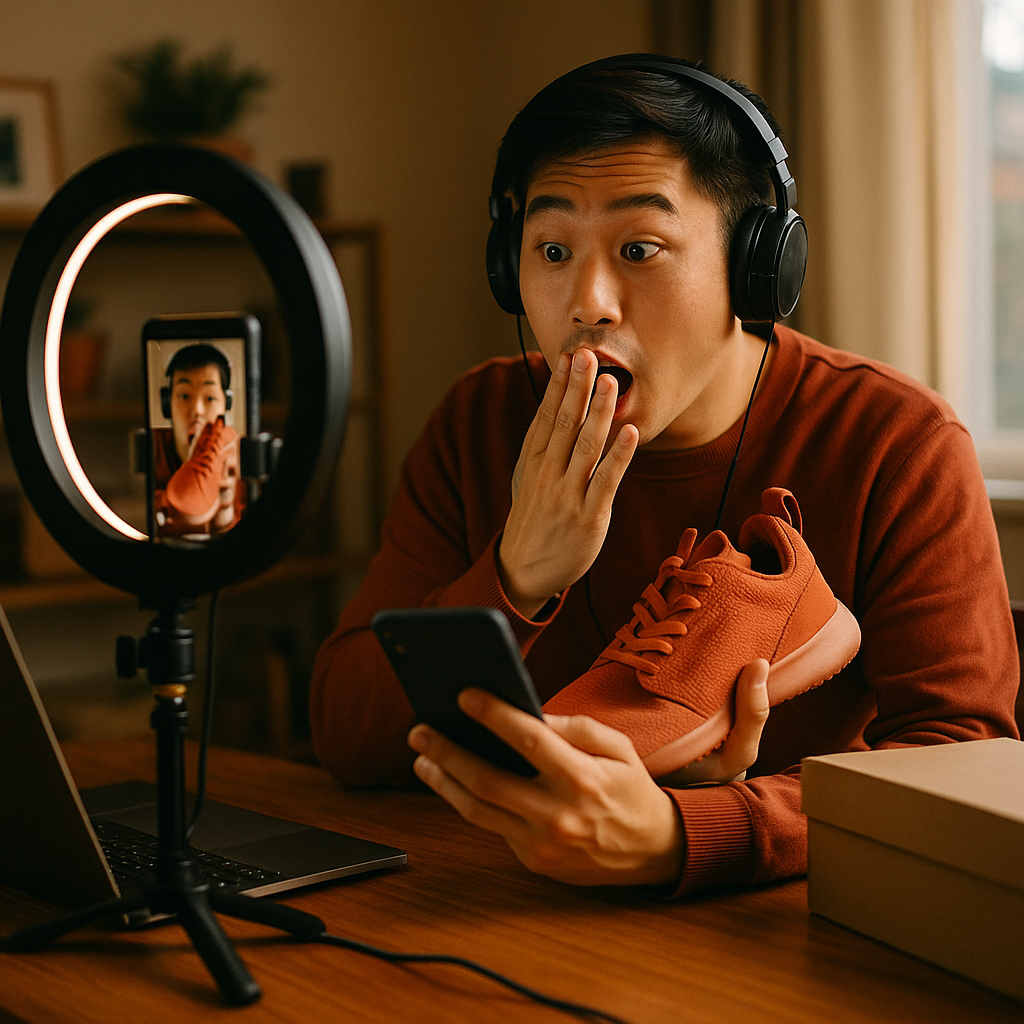
Reaction Livestreams Are the Format Brands Keep Underestimating
Brands that co-opt cultural moments in real time generate up to 3x more earned media than those relying on pre-planned content alone, according to data from Sprout Social. The reaction livestream format puts that principle on steroids. It is simultaneous, it is shoppable, and when briefed correctly, it turns a creator’s authentic commentary into a revenue-generating brand event. Yet most brands still treat it as an afterthought rather than a strategic format worth dedicated briefs, budgets, and briefing frameworks.
What a Reaction Livestream Actually Is (and Isn’t)
A reaction livestream is not a creator simply going live and talking about your product. That is a paid testimonial with a live audience. A true reaction livestream is a structured, real-time commentary event where a creator watches, responds to, or unpacks a trigger moment, whether that is your new product reveal, a competitor announcement, a cultural event like an awards show, or a breaking industry story, while their community participates alongside them in the chat.
The distinction matters for your brief. You are not buying a 30-minute advertisement. You are commissioning a live editorial moment with commerce infrastructure attached. Think of it as a sports broadcast model: there is a main event, a commentator with genuine opinions, and a live audience with money to spend.
Platforms where this format performs strongest right now: TikTok Live, YouTube Live, Twitch (increasingly used outside gaming), and Instagram Live for smaller, higher-engagement audiences. If you are already building livestream commerce briefs, the reaction format slots in as a higher-context, event-driven variant.
Choosing the Right Trigger Moment
The trigger is everything. A weak trigger produces a creator staring at a screen with nothing to say. A strong trigger generates genuine emotional reaction, audience chat participation, and natural product integration points.
Three trigger categories work consistently for brands:
- Product launches: Your own reveal event, unboxing stream, or first-look. The creator reacts as a peer and opinion leader, not a spokesperson. They can be watching your keynote live and responding in real time.
- Cultural moments: Awards shows, sporting finals, major fashion weeks, viral news cycles. The brand integration is contextual, not the center of the story, which is exactly what makes it land.
- Competitor news: A rival’s product announcement, pricing change, or PR stumble. This requires careful guardrails in the brief (more on that shortly), but done well, it positions your brand without a single direct attack.
For reactive content built around live cultural events, the briefing logic overlaps with what we cover in our guide to reactive content briefs. The core principle is the same: brief ahead, react live.
The best reaction livestreams are not spontaneous. They are meticulously pre-planned to appear spontaneous. Your brief is the invisible architecture behind the creator’s authentic commentary.
How to Write the Brief
This is where most brand teams lose the plot. They either over-script the creator (killing authenticity) or under-brief them (producing off-brand chaos). The brief for a reaction livestream needs to operate in layers.
Layer 1: The event context. Give the creator a full factual briefing on the trigger moment. If it is your product launch, share specs, key claims, pricing, and the three messages you want associated with the brand. If it is a cultural event, give them the background, the stakes, and your brand’s thematic connection to it. They cannot react authentically to something they do not understand.
Layer 2: The commerce integration plan. Map out exactly when and how product mentions, affiliate links, promo codes, or shoppable overlays should appear. Reaction livestreams perform best when commerce integration feels triggered by the commentary, not dropped in every 10 minutes on a timer. Example: “When you try the product for the first time on camera, that is the moment to drop the discount code.”
Layer 3: Community engagement choreography. This is underused but high-value. Brief the creator on specific chat prompts, poll questions, and call-to-action moments that pull the audience into the event. “Ask your audience which feature they care most about” is a brief instruction that generates thousands of chat interactions and signals to the algorithm to push the stream. For more on structuring creator briefs across multiple content formats and platforms, the multi-format brief framework offers a useful structural reference.
Layer 4: Guardrails, not scripts. Define what the creator cannot say. Especially for competitor reaction streams, this means clear guidelines on comparative claims, FTC disclosure requirements, and anything that could create legal exposure. The FTC’s endorsement guidelines apply fully to livestream formats; disclosure must be verbal and on-screen, not buried in a pinned comment.
Competitor Reaction Streams: High Reward, Real Risk
When a major competitor launches something, your audience is already watching and forming opinions. A creator reaction stream lets your brand insert itself into that conversation without running a comparison ad. The risk is that creators, in the heat of live commentary, say something legally actionable or brand-damaging.
The fix is specificity in the brief. Provide a short “response card” with approved talking points around the competitor moment. Something like: “You can express genuine opinions about the product category. You cannot make specific performance claims that our legal team has not verified. You can mention our product as a point of personal preference. You cannot position it as objectively superior.” Creators who handle this well tend to be those with media or journalism backgrounds, because they understand the line between editorial opinion and false advertising.
Before commissioning competitor-adjacent content, it is worth reviewing how other reactive and entertainment-led formats handle creative boundaries. Our coverage of shoppable entertainment briefs addresses the approval workflow tension that becomes even more acute in live formats.
Metrics That Actually Matter for This Format
Do not evaluate a reaction livestream on the same metrics as a static post. Peak concurrent viewers matters more than total views. Chat velocity (messages per minute) is a proxy for genuine engagement. Add-to-cart events during the live window, not just the 24-hour post-stream period, tell you whether the commerce integration worked in-context. And clip performance, how many short clips from the livestream perform on short-form feeds afterward, is increasingly a primary ROI driver rather than a secondary one.
eMarketer data indicates that livestream commerce conversion rates consistently outperform standard influencer post formats, particularly when the viewer is present during the live event rather than watching the replay. That real-time urgency is the core asset of this format. Your brief should actively protect it: by specifying time-limited offers, live-only promo codes, and event language (“this drops in 10 minutes”) that cannot be replicated in a VOD clip.
Clip performance is no longer a bonus metric for reaction livestreams. It is increasingly the primary distribution channel, turning a 90-minute live event into a week of short-form content across TikTok, Reels, and YouTube Shorts.
Pre-Production Logistics Brands Consistently Skip
Technical failure kills live credibility. Your brief must include: minimum upload speed requirements, backup streaming setup, platform-specific latency expectations (TikTok Live and YouTube Live behave differently under load), and a comms protocol for the 30 minutes before go-live. Who is the brand-side point of contact during the stream? What is the escalation path if something goes wrong on air?
Brief the creator on repurposing rights upfront. Reaction livestream content often produces the most usable organic clips of any format, but the rights landscape is complicated if the stream contains third-party IP (competitor footage, broadcast content, music). Define in the contract what can be clipped, captioned, and reposted before the stream happens. The operational rigor around repurposing content across platforms is directly applicable here.
For measurement infrastructure, TikTok’s commerce tools and Meta’s live shopping features both offer in-stream attribution that most brand teams underuse. Set up tracking parameters before go-live, not after.
Finally: rehearse the triggers. A creator who has never seen your product reveal before going live might react authentically, or might say something you cannot walk back. For product launch streams specifically, a private pre-brief session where they experience the product and the reveal sequence in advance produces better commentary, not worse. Authenticity in live content comes from genuine familiarity, not genuine surprise.
Your next step is straightforward: identify one upcoming trigger moment in your brand calendar (a launch, a cultural event, or a category news cycle) and build a test brief using the four-layer framework above. Run one creator. Measure clip performance, live conversion, and chat velocity. The format scales quickly once you have a single data point that proves it works for your category.
FAQs
What types of creators are best suited for reaction livestreams?
Creators with established live audiences and strong commentary-style content perform best. Look for creators who already host regular livestreams, have experience with audience chat interaction, and can speak fluently in your product category without heavy scripting. Media-literate creators with journalism or commentary backgrounds handle competitor reaction content most safely.
How far in advance should you brief a creator for a reaction livestream?
For planned events like product launches, brief creators at least two to three weeks in advance to allow time for product familiarization, technical setup, and contract finalization. For reactive cultural moments, you should have pre-approved creator relationships and templated briefs ready to activate within 24 to 48 hours of the trigger event occurring.
Does FTC disclosure apply to reaction livestreams?
Yes. If a creator is paid, gifted, or has any material connection to the brand, FTC guidelines require clear and conspicuous disclosure. For livestreams, this means verbal disclosure at the start of the stream and at regular intervals, plus on-screen text. A pinned comment alone does not satisfy the requirement. Review the current FTC endorsement guidelines directly at ftc.gov for the most current standards.
How do you handle competitor mentions in a reaction livestream brief?
Include a specific response card in the brief that defines approved talking points, prohibits unverified comparative performance claims, and outlines the escalation protocol if the creator receives chat questions about competitors. Frame the guardrails as protecting the creator’s credibility, not just the brand’s legal exposure. Creators respond better to guardrails when they understand the rationale.
What platforms are most effective for reaction livestream commerce?
TikTok Live currently leads on in-stream commerce conversion, particularly for consumer goods and beauty categories. YouTube Live offers superior clip longevity and higher average viewer dwell time. Instagram Live performs best for brands with highly engaged, smaller-scale creator partners. Twitch is worth considering for tech, gaming, and lifestyle brands targeting male-skewing 18-34 audiences.
Can reaction livestream content be repurposed after the live event?
Yes, and it should be planned for from the brief stage. Clip rights, music licensing, and third-party content inclusion all need to be addressed contractually before the stream. The most valuable clips are typically the genuine reaction moments and the commerce integration sequences, which perform strongly as short-form content on TikTok, Reels, and YouTube Shorts in the 72 hours following the live event.
Top Influencer Marketing Agencies
The leading agencies shaping influencer marketing in 2026
Agencies ranked by campaign performance, client diversity, platform expertise, proven ROI, industry recognition, and client satisfaction. Assessed through verified case studies, reviews, and industry consultations.
Moburst

-
2

The Shelf
Boutique Beauty & Lifestyle Influencer AgencyA data-driven boutique agency specializing exclusively in beauty, wellness, and lifestyle influencer campaigns on Instagram and TikTok. Best for brands already focused on the beauty/personal care space that need curated, aesthetic-driven content.Clients: Pepsi, The Honest Company, Hims, Elf Cosmetics, Pure LeafVisit The Shelf → -
3

Audiencly
Niche Gaming & Esports Influencer AgencyA specialized agency focused exclusively on gaming and esports creators on YouTube, Twitch, and TikTok. Ideal if your campaign is 100% gaming-focused — from game launches to hardware and esports events.Clients: Epic Games, NordVPN, Ubisoft, Wargaming, Tencent GamesVisit Audiencly → -
4

Viral Nation
Global Influencer Marketing & Talent AgencyA dual talent management and marketing agency with proprietary brand safety tools and a global creator network spanning nano-influencers to celebrities across all major platforms.Clients: Meta, Activision Blizzard, Energizer, Aston Martin, WalmartVisit Viral Nation → -
5

The Influencer Marketing Factory
TikTok, Instagram & YouTube CampaignsA full-service agency with strong TikTok expertise, offering end-to-end campaign management from influencer discovery through performance reporting with a focus on platform-native content.Clients: Google, Snapchat, Universal Music, Bumble, YelpVisit TIMF → -
6

NeoReach
Enterprise Analytics & Influencer CampaignsAn enterprise-focused agency combining managed campaigns with a powerful self-service data platform for influencer search, audience analytics, and attribution modeling.Clients: Amazon, Airbnb, Netflix, Honda, The New York TimesVisit NeoReach → -
7

Ubiquitous
Creator-First Marketing PlatformA tech-driven platform combining self-service tools with managed campaign options, emphasizing speed and scalability for brands managing multiple influencer relationships.Clients: Lyft, Disney, Target, American Eagle, NetflixVisit Ubiquitous → -
8

Obviously
Scalable Enterprise Influencer CampaignsA tech-enabled agency built for high-volume campaigns, coordinating hundreds of creators simultaneously with end-to-end logistics, content rights management, and product seeding.Clients: Google, Ulta Beauty, Converse, AmazonVisit Obviously →