


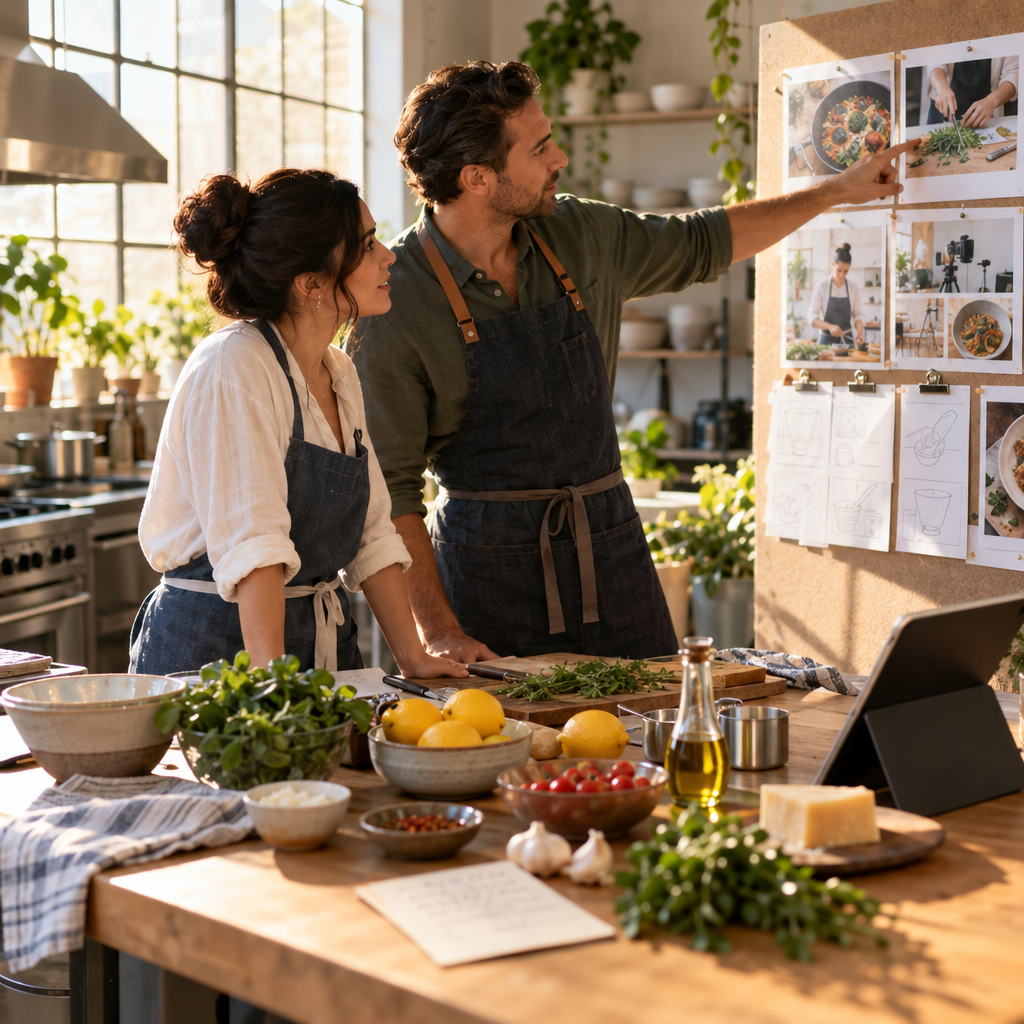
Food and beverage is now the fourth-largest category on YouTube, growing 32% year-over-year, according to Pixability data cited by The Grocer. Audiences are clearly hungry for cooking content. Recipe-tutorial hybrids are how CPG brands feed that appetite without running a 30-second ad nobody asked for. The hard part is the brief.
What a recipe-tutorial hybrid actually is
It is a creator video that teaches a transferable skill while using your product as a working ingredient. Think “how to get a crisp crust on any weeknight chicken” where your breadcrumb brand is the tool, not the punchline.
A plain recipe says “make this dish.” A tutorial says “here is why it works, so you can do it again.” The hybrid does both. The recipe gives the viewer something to save. The lesson gives them a reason to trust the person teaching it. The product earns its place by making the lesson easier.
That is a different job from a straight sponsored mention. If your brand is already running longer episodic formats, the rights questions in our guide to branded cooking series apply here too, scaled down to a single asset.
Why CPG teams keep getting the ratio wrong
Most failed briefs share one flaw: they ask for education and promotion in equal measure. Equal is the wrong target. Viewers can smell a 50/50 split in about four seconds.
A better rule of thumb is to brief for a lesson-first structure, with the product appearing as a functional step. If you cut the product from the video, the technique should still hold up. If it collapses, you have built an ad with a spatula in it.
Here is the structure I give creators:
- Hook (first 3 seconds): a problem or a payoff, not a brand name. “Why does your rice always clump?” beats “Today I’m using Brand X.”
- Technique lesson: one skill, taught clearly, with a visible before and after.
- Product moment: the product shown doing a specific job, in context.
- Payoff shot: the finished dish, with a repeatable takeaway.
- Soft call to action: save the recipe, find the full method, shop the ingredient.
Test every hybrid brief with one question: if the product were removed, would the viewer still learn something? If not, the education is decoration and the audience will treat it that way.
Write the brief like a production document
Creators resent vague briefs, and vague briefs produce vague content. Be specific on the things that protect you, and loose on the things that make the creator good.
Lock these
- Product facts: exact name, variant, preparation requirements and any storage or allergen information that must be shown correctly.
- Claims: a short approved list and a “do not say” list (health, “natural,” “healthy,” nutritional benefits).
- Disclosure placement: where and how, written into the script, not left to the edit.
- Usage rights: recipe ownership, paid amplification windows, cutdowns, and whether you can repost on retail media.
- Deliverables: hero video, cutdowns, stills of the finished dish, and a written recipe for your own site.
Leave these open
- The creator’s voice, humor and pacing.
- The specific dish, within a brand-safe category you define.
- The teaching angle, because they know what their audience struggles with.
What about the written recipe? Decide upfront who owns it. A creator’s original recipe is their intellectual property unless the contract says otherwise, and a brand that quietly republishes it on packaging or a microsite is asking for a dispute.
Disclosure is part of the format, not a footnote
Hybrids blur editorial and ad content on purpose, which is exactly why regulators pay attention. In the US, the FTC’s Endorsement Guides, revised in 2023, say a connection between endorser and marketer that a significant minority of consumers wouldn’t expect should be disclosed clearly. Free product counts. So does a fee, a commission or an affiliate link.
Send the guidance to every creator. Do not assume creators have read it.
Practical rules we write into CPG briefs:
- Put the disclosure in the video itself (spoken and on-screen), not only in the caption.
- Place it early, before the product moment, not after the viewer has scrolled away.
- Do not rely on a vague tag in a hashtag pile.
- Require a screenshot or draft review before posting.
Because so many viewers watch without audio, make sure on-screen disclosure and key ingredient callouts survive muted playback. Our piece on sound-off video captions covers that in detail.
The UK twist for food brands
If you sell in the UK, there is a bigger issue than disclosure. TLT also reports that the ASA has treated influencer content as paid-for advertising where a commercial arrangement exists, and has been skeptical of “brand-led” arguments when individual products are visually prominent.
For a recipe-tutorial hybrid, that matters. Close-ups of a product, enthusiastic commentary and the finished dish can all make a specific product identifiable. Run every UK brief past legal and check the product against the Nutrient Profiling Model before you commission a single video.
Claims that a recipe can and cannot carry
Tutorials invite claims. “This keeps you full longer.” “It’s the healthier swap.” “Ready in five minutes.” Each one is a statement you may have to substantiate.
Timing claims are the sneakiest. If the video says “ready in 10 minutes,” someone should have timed it with the product as specified. Show the real process, including the boring parts, or cut the claim.
For visible transformation claims (a crisper crust, a smoother sauce), the same discipline applies as in before-and-after content: unedited footage, consistent conditions, no filters that alter the result.
Making the video findable after the launch week
A good tutorial has a long tail. People search “how to make crispy tofu” months from now. Your brief should help that happen.
- Ask for a clear, searchable title that names the technique and the dish.
- Request chapter markers on YouTube so viewers (and search engines) can jump to steps. See shoppable video chapters for how tagging pays off.
- Have the creator say the ingredient names aloud and show them on screen.
- Publish the written recipe on your own site with the video embedded.
Structured, plainly narrated content is also easier for AI systems to parse. That is the logic behind formats AI crawlers can index, and a step-by-step recipe fits it naturally.
How to measure a hybrid
Views are the wrong headline metric. A tutorial’s value shows up in behavior that signals intent to cook.
- Saves and shares: the clearest proxy for “I’ll make this.”
- Completion rate: did viewers stay through the product moment?
- Branded search lift: any rise after publication.
- Retail signals: shoppable link clicks, retailer page traffic, and store-level sales where you can match them.
- Recipe page engagement: time on page and add-to-cart on the recipe.
Set the success definition before the shoot. A creator who knows saves matter more than likes will teach differently.
FAQs
What is a recipe-tutorial hybrid in influencer marketing?
It is a sponsored creator video that teaches a cooking technique while featuring a brand’s product as a functional ingredient or tool. The education carries the content, and the product supports the lesson rather than interrupting it.
How much of the video should be promotional?
Aim for a lesson-first structure where the product appears as one step, not the star. A useful check is whether the viewer still learns something if the product is removed. If they don’t, the format has drifted into straight advertising.
Do creators need to disclose free product in a recipe video?
Generally yes when the relationship could affect how viewers weigh the endorsement. The FTC’s Endorsement Guides address connections a significant minority of consumers wouldn’t expect. When in doubt, disclose clearly in the video and the caption.
Who owns the recipe in a sponsored video?
It depends on your contract. Unless the agreement transfers or licenses it, assume the creator keeps their original recipe. Specify whether the brand can republish the written recipe on its site, packaging or retail pages, and for how long.
Are there extra rules for food and drink brands in the UK?
Yes. Since 5 January 2026, paid-for online advertising of identifiable “less healthy” food and drink products is prohibited under the CAP Code, and influencer content with a commercial arrangement can fall within scope. Check products against the Nutrient Profiling Model before commissioning.
Which metrics matter most for tutorial-style CPG content?
Saves, shares, completion rate, branded search lift and recipe-page engagement tell you more than views. Add retailer-side signals such as shoppable clicks where available.
Next step: take your last CPG creator brief, apply the “remove the product” test to it, and rewrite the disclosure and claims sections before the next shoot is booked.
Top Influencer Marketing Agencies
The leading agencies shaping influencer marketing in 2026
Agencies ranked by campaign performance, client diversity, platform expertise, proven ROI, industry recognition, and client satisfaction. Assessed through verified case studies, reviews, and industry consultations.
Moburst

-
2

The Shelf
Boutique Beauty & Lifestyle Influencer AgencyA data-driven boutique agency specializing exclusively in beauty, wellness, and lifestyle influencer campaigns on Instagram and TikTok. Best for brands already focused on the beauty/personal care space that need curated, aesthetic-driven content.Clients: Pepsi, The Honest Company, Hims, Elf Cosmetics, Pure LeafVisit The Shelf → -
3

Audiencly
Niche Gaming & Esports Influencer AgencyA specialized agency focused exclusively on gaming and esports creators on YouTube, Twitch, and TikTok. Ideal if your campaign is 100% gaming-focused — from game launches to hardware and esports events.Clients: Epic Games, NordVPN, Ubisoft, Wargaming, Tencent GamesVisit Audiencly → -
4

Viral Nation
Global Influencer Marketing & Talent AgencyA dual talent management and marketing agency with proprietary brand safety tools and a global creator network spanning nano-influencers to celebrities across all major platforms.Clients: Meta, Activision Blizzard, Energizer, Aston Martin, WalmartVisit Viral Nation → -
5

The Influencer Marketing Factory
TikTok, Instagram & YouTube CampaignsA full-service agency with strong TikTok expertise, offering end-to-end campaign management from influencer discovery through performance reporting with a focus on platform-native content.Clients: Google, Snapchat, Universal Music, Bumble, YelpVisit TIMF → -
6

NeoReach
Enterprise Analytics & Influencer CampaignsAn enterprise-focused agency combining managed campaigns with a powerful self-service data platform for influencer search, audience analytics, and attribution modeling.Clients: Amazon, Airbnb, Netflix, Honda, The New York TimesVisit NeoReach → -
7

Ubiquitous
Creator-First Marketing PlatformA tech-driven platform combining self-service tools with managed campaign options, emphasizing speed and scalability for brands managing multiple influencer relationships.Clients: Lyft, Disney, Target, American Eagle, NetflixVisit Ubiquitous → -
8

Obviously
Scalable Enterprise Influencer CampaignsA tech-enabled agency built for high-volume campaigns, coordinating hundreds of creators simultaneously with end-to-end logistics, content rights management, and product seeding.Clients: Google, Ulta Beauty, Converse, AmazonVisit Obviously →