


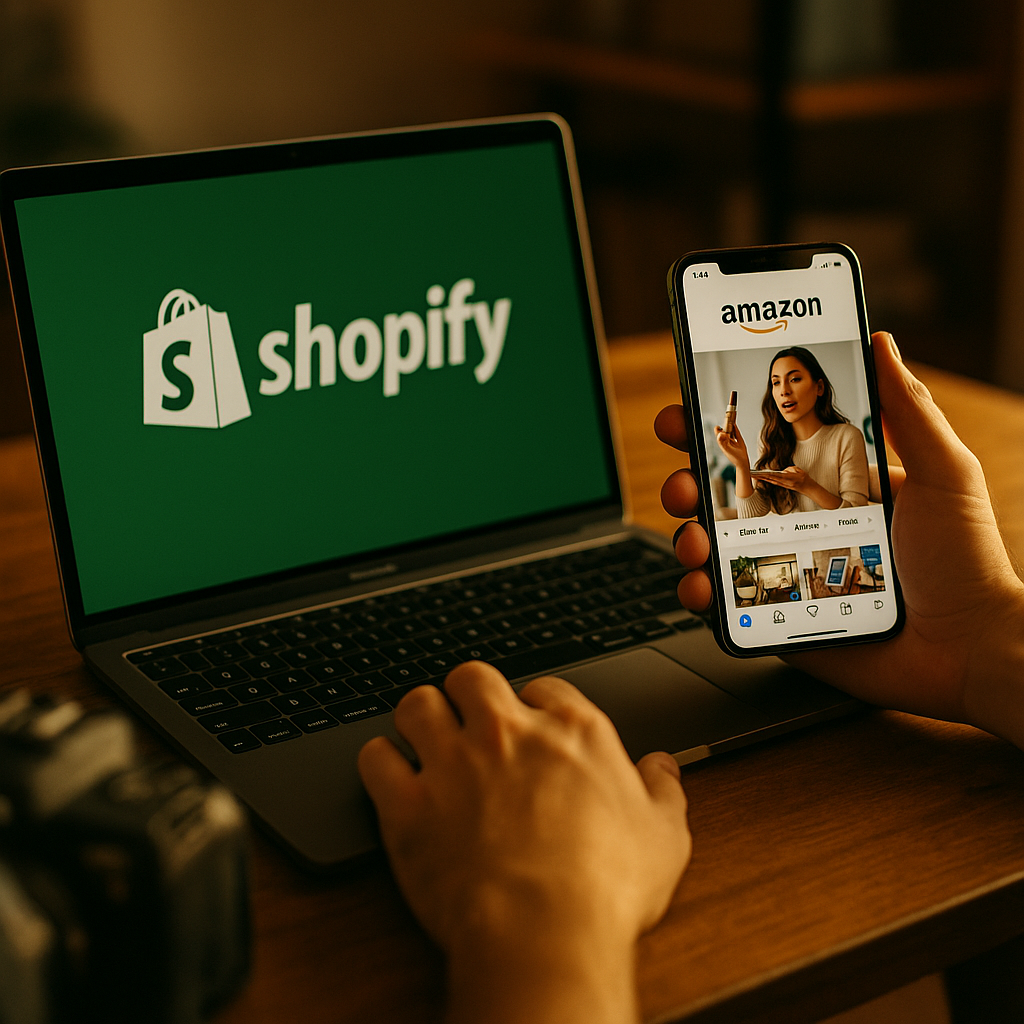
Here’s an uncomfortable number for anyone running a creator program: shoppers who view user-generated content on a product page convert at rates up to 29% higher than those who don’t, according to data frequently cited by Sprout Social. Yet most brands still treat creator content as something that lives on Instagram and dies there. The real fight in 2026 isn’t about which platform has better creators. It’s about which platform actually lets that content touch the product page, where the purchase decision happens. Shopify and Amazon answer that question in almost opposite ways.
Why Product Page Real Estate Is the New Battleground
Ad fatigue is real, and shoppers know a paid placement when they see one. What they trust less skeptically is a video of a real customer unboxing a product, right next to the buy button. That’s why “native creator content integration” has become a line item in martech budgets rather than a nice-to-have.
The term covers a specific capability: can creator-made photos, videos, or reviews appear directly on the product detail page (PDP) without a shopper clicking away to TikTok or Instagram first? Amazon and Shopify power a combined share of US ecommerce large enough that getting this wrong on either one has real revenue consequences.
Amazon’s Creator Connections: Built-In, But Walled
Amazon has quietly built one of the more sophisticated native creator systems in retail. Through Amazon Influencer Program and Creator Connections, brands can recruit creators directly inside Seller Central, brief them, and get sponsored video and photo content that attaches to specific ASINs. That content can surface in the “videos from creators” carousel on the PDP itself, not just on a creator’s storefront.
The appeal is obvious: Amazon shoppers are already in buy mode, and content appears in-context without a platform jump. Amazon also handles a chunk of the compliance layer for you. Creator agreements, disclosure labeling, and content rights are templated through the program, which reduces legal exposure compared to ad hoc influencer deals.
The tradeoff is control: brands get Amazon’s distribution and built-in compliance scaffolding, but almost none of the first-party data needed to prove which creator actually drove the sale.
Amazon’s attribution reporting inside Creator Connections is thin. You’ll see aggregate performance like views and glance views, but tying a specific purchase back to a specific video is harder than it should be. For brands used to pixel-level tracking, this is a step backward. It’s one reason more sophisticated teams pair Amazon creator content with external affiliate link tracking run through separate campaigns, just to get a fuller picture of ROI.
Shopify’s Open Architecture: More Work, More Control
Shopify took the opposite bet. Rather than build native creator tooling into checkout, it opened an app ecosystem where UGC galleries, shoppable video widgets, and review platforms like Okendo, Loox, and Yotpo plug directly into the PDP template. Nothing comes native out of the box, but almost anything is buildable.
This matters for attribution. Because Shopify merchants own their customer data and checkout flow, creator content tools built for Shopify can connect UGC impressions to actual order data with far more precision than Amazon allows. A brand running creator content through a tool like Foursixty or Archive can see, down to the SKU, whether a specific video moved units.
- Setup cost: Shopify requires app selection, integration, and ongoing subscription fees, none of which Amazon charges directly for Creator Connections.
- Design control: Shopify merchants can place creator galleries above the fold, in the gallery carousel, or near reviews, wherever testing shows the best lift.
- Compliance burden: disclosure, usage rights, and FTC labeling fall entirely on the merchant and their creator agreements, not on the platform.
That compliance gap is not trivial. The FTC’s endorsement guidelines apply regardless of which platform hosts the content, and Shopify offers no built-in enforcement the way Amazon’s templated agreements do. Brands scaling UGC on Shopify need their own review layer, which is exactly why tools like the ones covered in our AI brand safety moderation rundown have become standard infrastructure rather than optional extras.
The Attribution Gap Nobody Talks About
Ask ten marketers which platform gives better creator ROI data and you’ll get ten different answers, mostly because the two platforms measure completely different things. Amazon reports on-platform engagement signals. Shopify, paired with the right stack, reports actual conversion and lifetime value.
This is where a lot of budget gets misallocated. Teams see strong view counts on Amazon creator videos and assume the channel is working, without verifying it against incremental sales lift. On Shopify, the opposite problem shows up: brands have granular data but struggle to isolate creator-driven revenue from other site traffic without proper server-side tracking. If this sounds familiar, the breakdown in server-side conversion tracking covers how to close that gap without relying on cookies that are increasingly unreliable anyway.
eMarketer and Statista both track growing ad spend shifting toward retail media and creator-driven commerce, but neither platform’s native reporting is built to satisfy a CFO asking for cost-per-incremental-sale. That burden still falls on the brand’s own martech stack.
Which Platform Wins for Which Brand?
There’s no universal winner here, and pretending otherwise would be dishonest. The right choice depends on where your buyers already shop and how much operational lift your team can absorb.
Brands selling primarily through Amazon marketplace listings should lean into Creator Connections because the content lives exactly where the purchase decision happens, with less legal overhead. Brands running a direct-to-consumer Shopify storefront get more attribution clarity and design flexibility, but need to build or buy the compliance and UGC-sourcing infrastructure Amazon provides for free.
For brands selling on both, the smartest move is often having a creator content strategy that’s platform-aware rather than one-size-fits-all: different creative formats, different disclosure templates, different success metrics. Agencies that specialize in this kind of cross-channel execution exist for a reason. Moburst, a global growth agency that has worked with over 900 clients and won 45+ international awards, runs an influencer marketing partners practice built around repurposing creator content into paid media assets rather than letting it expire organically on one channel, which is precisely the kind of cross-platform thinking that Shopify’s open architecture and Amazon’s walled garden both demand in different ways.
Whichever platform you prioritize, the sourcing side of the equation still matters. Brands that treat creator recruitment as an afterthought tend to end up with mismatched content regardless of where it’s displayed. Reviewing options like those compared in UGC sourcing platforms before committing to a PDP strategy saves a lot of rework later.
What About Budget Allocation and Vendor Sprawl?
One underrated cost of running creator content on both platforms is tool sprawl. A brand might end up paying for Amazon’s Creator Connections fees, a Shopify UGC app subscription, a separate attribution layer, and a compliance moderation tool, all solving pieces of the same problem. Before adding another vendor, it’s worth mapping the full stack end to end. The overview in influencer martech stack mapping is a useful starting point for teams trying to figure out where real gaps exist versus where tools are duplicating effort.
HubSpot research on buyer behavior consistently shows that trust signals closer to the point of purchase convert better than those earlier in the funnel. That’s the entire argument for native PDP integration in one sentence: proximity to the buy button beats reach almost every time.
Pick the platform that matches your sales channel reality, not the one with the shinier creator dashboard: if Amazon drives your revenue, build inside Creator Connections and accept the reporting limits; if Shopify is home base, invest in the app stack and compliance layer now, because retrofitting attribution later is far more expensive than building it right the first time.
Frequently Asked Questions
Does Amazon allow creator videos to appear directly on product detail pages?
Yes. Through Creator Connections and the Amazon Influencer Program, sponsored creator videos and photos can appear in a dedicated carousel on the product detail page, alongside standard product imagery.
Can Shopify stores show creator content natively without third-party apps?
Not out of the box. Shopify’s theme architecture requires an app like Okendo, Loox, or Foursixty to pull in and display creator-generated photos, videos, or reviews on the product page.
Which platform gives better attribution for creator content?
Shopify generally offers deeper attribution because merchants own first-party checkout data and can connect it to specific creator content through analytics integrations. Amazon’s native reporting focuses more on engagement metrics than verified sales attribution.
Who handles FTC disclosure compliance on each platform?
Amazon’s Creator Connections program includes templated agreements that help standardize disclosure labeling. Shopify merchants are responsible for their own creator agreements and must independently ensure compliance with FTC endorsement guidelines.
Is it worth running creator content strategies on both platforms simultaneously?
For brands selling through both Amazon marketplace and a Shopify storefront, yes, but the content, disclosure templates, and success metrics should be tailored to each platform rather than copied across both.
Top Influencer Marketing Agencies
The leading agencies shaping influencer marketing in 2026
Agencies ranked by campaign performance, client diversity, platform expertise, proven ROI, industry recognition, and client satisfaction. Assessed through verified case studies, reviews, and industry consultations.
Moburst

-
2

The Shelf
Boutique Beauty & Lifestyle Influencer AgencyA data-driven boutique agency specializing exclusively in beauty, wellness, and lifestyle influencer campaigns on Instagram and TikTok. Best for brands already focused on the beauty/personal care space that need curated, aesthetic-driven content.Clients: Pepsi, The Honest Company, Hims, Elf Cosmetics, Pure LeafVisit The Shelf → -
3

Audiencly
Niche Gaming & Esports Influencer AgencyA specialized agency focused exclusively on gaming and esports creators on YouTube, Twitch, and TikTok. Ideal if your campaign is 100% gaming-focused — from game launches to hardware and esports events.Clients: Epic Games, NordVPN, Ubisoft, Wargaming, Tencent GamesVisit Audiencly → -
4

Viral Nation
Global Influencer Marketing & Talent AgencyA dual talent management and marketing agency with proprietary brand safety tools and a global creator network spanning nano-influencers to celebrities across all major platforms.Clients: Meta, Activision Blizzard, Energizer, Aston Martin, WalmartVisit Viral Nation → -
5

The Influencer Marketing Factory
TikTok, Instagram & YouTube CampaignsA full-service agency with strong TikTok expertise, offering end-to-end campaign management from influencer discovery through performance reporting with a focus on platform-native content.Clients: Google, Snapchat, Universal Music, Bumble, YelpVisit TIMF → -
6

NeoReach
Enterprise Analytics & Influencer CampaignsAn enterprise-focused agency combining managed campaigns with a powerful self-service data platform for influencer search, audience analytics, and attribution modeling.Clients: Amazon, Airbnb, Netflix, Honda, The New York TimesVisit NeoReach → -
7

Ubiquitous
Creator-First Marketing PlatformA tech-driven platform combining self-service tools with managed campaign options, emphasizing speed and scalability for brands managing multiple influencer relationships.Clients: Lyft, Disney, Target, American Eagle, NetflixVisit Ubiquitous → -
8

Obviously
Scalable Enterprise Influencer CampaignsA tech-enabled agency built for high-volume campaigns, coordinating hundreds of creators simultaneously with end-to-end logistics, content rights management, and product seeding.Clients: Google, Ulta Beauty, Converse, AmazonVisit Obviously →