


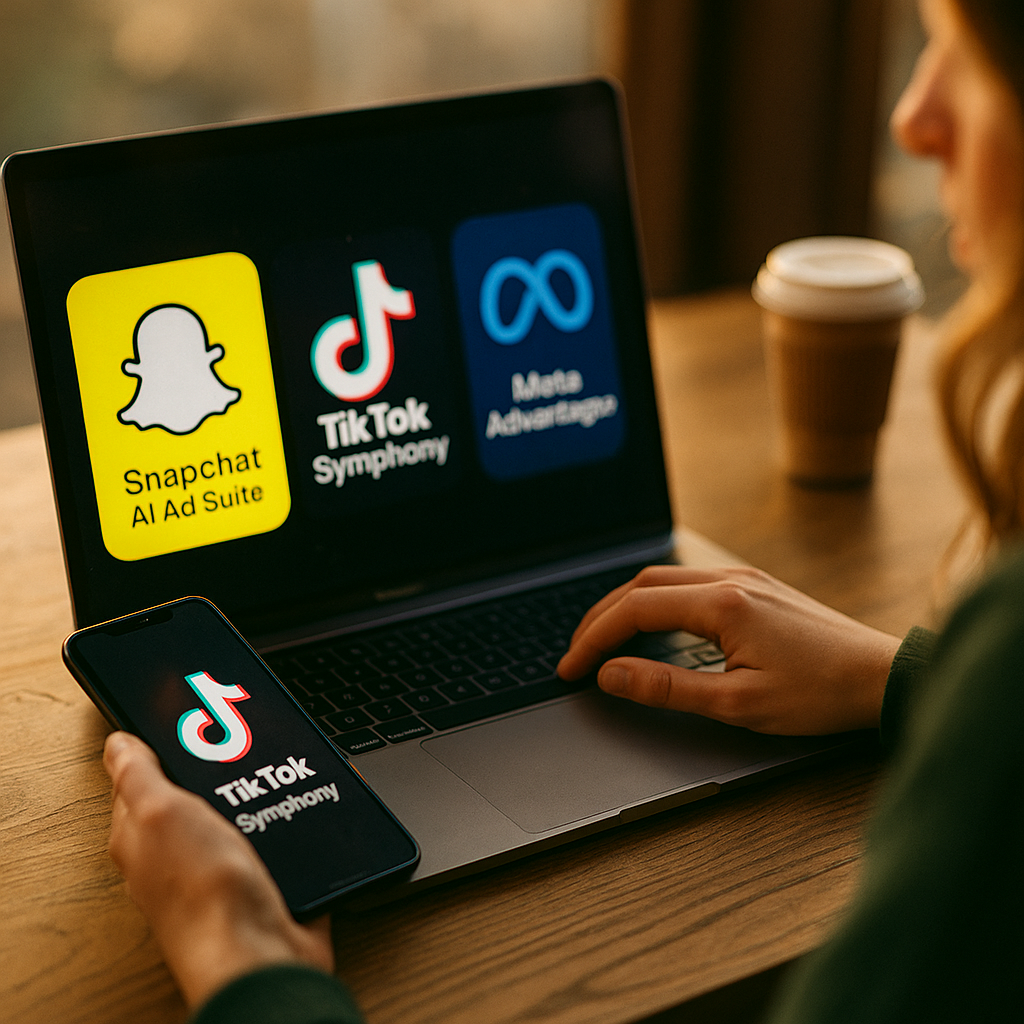
Brands running social commerce creator campaigns are now choosing between three competing AI automation systems, and picking the wrong one could quietly drain budget for quarters. The Snapchat AI Ad Suite, specifically its Smart Assistant Goal-to-Campaign feature, enters a space already occupied by TikTok Symphony Agent and Meta Advantage+. Each promises to reduce campaign overhead. None of them is neutral on your data.
What Snapchat’s Smart Assistant Actually Does
Snapchat’s Smart Assistant is a goal-to-campaign automation layer sitting inside Ads Manager. You input a business objective — say, driving app installs or product purchases — and the system generates ad creatives, selects placements, sets bidding parameters, and activates creator-amplified content within Snapchat’s inventory. Think of it as a brief-to-launch pipeline that collapses what used to take a media buyer and creative team several days into minutes.
The specific hook for brand teams running creator programs is the integration with Snapchat’s Creator Marketplace. When you amplify a creator’s organic Snap through the Smart Assistant, the tool can automatically A/B test multiple creator assets, allocate budget toward higher-performing variants, and adjust delivery targets mid-flight. For brands already working with creators on agentic campaign automation, this architecture will feel familiar — though Snapchat’s execution has distinct constraints.
Key limitation: Smart Assistant’s creative generation capabilities are still tightly scoped to Snapchat-native formats. If your creator content lives primarily on TikTok or Instagram, repurposing it into Snaps requires manual reformatting. The automation does not bridge platforms.
TikTok Symphony Agent: The Benchmark Your Buyers Will Reference
TikTok’s Symphony Agent is the most mature of the three systems when it comes to creator content integration. It can ingest existing creator videos, generate AI-assisted script variants, produce synthetic assets using licensed creator likenesses, and push those into paid amplification automatically. The agentic orchestration is more expansive than Snapchat’s current offering.
Brands working with agencies like Dentsu on TikTok Symphony deployments are reporting significant reductions in creative production timelines — but the data rights provisions in Symphony’s terms require explicit legal review before any creator likeness is licensed into AI generation workflows.
For a detailed breakdown of what brands should contractually demand from Symphony deployments, the analysis in this piece on TikTok Symphony Agency requirements is required reading before any procurement conversation. The short version: Symphony’s power creates proportional data governance risk, and most brands are not asking the right questions at contract stage.
For social commerce specifically, TikTok’s native checkout integration gives Symphony a structural advantage. The path from creator content to purchase to attribution is shorter on TikTok Shop than on any Snapchat commerce surface right now. If your primary KPI is direct-to-consumer revenue per creator post, Symphony is operating on better infrastructure.
Meta Advantage+: The Proven Volume Play
Meta Advantage+ Shopping Campaigns have been running at scale for several years and the performance data is the most robust of any AI-driven ad system in social commerce. Meta’s own data suggests Advantage+ Shopping campaigns drive a 22% lower cost per purchase compared to standard campaigns, though independent verification of this figure varies by vertical and audience maturity.
For creator campaign amplification specifically, the relevant Advantage+ feature is the ability to run creator-tagged partnership ads with AI-driven audience expansion and budget optimization. You give Meta an approved creator post, set a purchase objective, and Advantage+ handles everything downstream — including lookalike expansion, placement selection across Facebook, Instagram, and Audience Network, and creative fatigue management.
The operational advantage is maturity. Meta’s attribution infrastructure, even post-iOS privacy changes, is more developed than Snapchat’s. Brands already running creator commerce attribution stacks will find Meta easier to integrate with existing CRM and CDP infrastructure. For brands exploring how Meta’s live commerce surfaces interact with Advantage+, the comparison of Meta live commerce platforms for creator programs offers useful context on where AI amplification intersects with live selling formats.
Evaluating the Three Systems: A Framework for Brand Teams
Stop evaluating these platforms on feature lists. Evaluate them on four operational dimensions: audience overlap with your target, creator content compatibility, attribution depth, and data governance exposure.
Audience overlap. Snapchat’s user base skews Gen Z with strong penetration in the 13-24 demographic. If your product category is beauty, gaming, or apparel targeting under-25 consumers, Snapchat’s Smart Assistant is reaching an audience the other two platforms access less efficiently. Meta has the broadest reach but faces saturation in younger cohorts. TikTok sits between the two on age distribution but has stronger purchase intent signals in certain verticals like fashion and food.
Creator content compatibility. All three systems support creator-to-paid-amplification workflows, but the friction varies. Meta’s partnership ads are the most straightforward if your creators have already granted ad permissions. TikTok Symphony requires more setup for AI-assisted content generation workflows. Snapchat’s Smart Assistant is the most opinionated — it works best when you let it generate or reformat creative rather than feeding in polished external assets.
Attribution depth. Meta wins here, but the gap is narrowing. Snapchat has invested in its conversion API and pixel infrastructure, and for brands running unified CRM attribution across creator campaigns, Snapchat’s signals are now usable — they just require more configuration than Meta’s equivalent setup. TikTok’s attribution is improving with TikTok Shop data but remains weaker for off-platform conversion tracking.
Data governance exposure. This is where most brand teams are underinvested in scrutiny. Each platform’s AI system trains on your campaign data to improve its own models. The terms differ meaningfully. Snapchat’s Smart Assistant data usage clauses are less publicized than Meta’s, which have been extensively analyzed. Before activating any AI automation system, your legal and privacy teams should review the platform’s data processing agreements against your organization’s first-party data policies. The FTC’s guidance on AI and data usage in advertising is a useful baseline for that review.
Social Commerce Amplification: Where Each Platform Has a Genuine Edge
For social commerce creator campaigns specifically, the evaluation narrows considerably.
- Snapchat Smart Assistant is the right choice when your audience is predominantly Gen Z, your creative assets are already Snapchat-native, and you want automated optimization with lower CPMs than Meta in that demographic.
- TikTok Symphony Agent is strongest when you need scaled creative variation from a single creator asset and your products benefit from TikTok Shop’s in-app purchase funnel. The TikTok for Business platform provides the infrastructure documentation brands need before committing to Symphony workflows.
- Meta Advantage+ delivers the most reliable ROAS data across the broadest audience and integrates most cleanly with existing measurement stacks. For brands running creator programs at enterprise scale, Meta Business suite tooling is more mature than either competitor.
The most sophisticated brand teams are not choosing one AI ad system — they are allocating creator assets across all three based on audience segment and creative format, then using a unified attribution layer to assess true incremental lift per platform.
Running parallel tests across Snapchat, TikTok, and Meta with identical creator content (reformatted for each platform) is the only way to generate defensible comparative data for your specific category. Generic benchmarks will mislead you. Your category’s audience behavior on Snapchat may look nothing like the average advertiser’s results. For teams building out the measurement infrastructure to support this kind of cross-platform creator testing, reviewing attribution, lock-in, and governance considerations for AI-driven marketing systems is worth doing before committing budget.
One practical consideration that often gets skipped: creator consent and transparency requirements differ by platform. The FTC’s endorsement guidelines apply uniformly, but each platform’s AI amplification features interact with disclosure requirements differently, particularly when AI-generated creative variants are derived from a creator’s original content. Build that into your creator contracts before activating any automation feature. Platforms like Sprout Social have published updated guidance on AI-amplified creator post compliance that is worth reviewing alongside platform-specific terms.
Start with a 60-day controlled test: one product, one creator cohort, equal budget split across all three systems, unified attribution. The data you generate will be more valuable than any vendor case study.
FAQs
What is Snapchat’s Smart Assistant Goal-to-Campaign feature?
Snapchat’s Smart Assistant is an AI-powered automation tool within Snapchat Ads Manager. It takes a business goal as input and automatically generates ad creatives, selects placements, sets bidding strategies, and activates creator-amplified content. It integrates with Snapchat’s Creator Marketplace to test and optimize creator assets at scale, reducing manual campaign setup time significantly.
How does Snapchat Smart Assistant compare to Meta Advantage+ for social commerce?
Meta Advantage+ has a more mature attribution infrastructure and broader audience reach, making it stronger for brands with established measurement stacks and diverse demographics. Snapchat Smart Assistant performs better when targeting Gen Z audiences natively on Snapchat, often with lower CPMs in that demographic. For social commerce ROAS reliability and CRM integration, Meta currently leads. Snapchat is a stronger choice for specific audience segments and Snapchat-native creative formats.
Is TikTok Symphony Agent more advanced than Snapchat’s AI ad tools?
In terms of creator content AI capabilities, yes. TikTok Symphony Agent can generate AI-assisted script variants, produce synthetic assets from creator likenesses, and automate amplification with tighter integration to TikTok Shop’s in-app purchase funnel. Snapchat’s Smart Assistant is more constrained in its creative generation scope but is sufficient for brands whose goal is automated campaign optimization rather than AI-generated creative production.
What data governance risks should brands assess before using AI ad automation platforms?
All three platforms use campaign data to train and improve their AI models. Brands should review each platform’s data processing agreements to understand how first-party and creator data is used, stored, and shared. Legal teams should assess these terms against internal data policies and applicable regulations. FTC guidelines on AI-generated advertising content also apply to AI-amplified creator posts and should be built into creator contracts before automation features are activated.
Should brands run all three AI ad systems simultaneously for creator campaigns?
Advanced brand teams often allocate creator assets across Snapchat, TikTok, and Meta simultaneously, segmenting by audience age, creative format, and commerce objective. Running a controlled parallel test with equal budget allocation across all three platforms for 60 days, using a unified attribution layer, provides defensible comparative data specific to your category and audience rather than relying on generic platform benchmarks.
Top Influencer Marketing Agencies
The leading agencies shaping influencer marketing in 2026
Agencies ranked by campaign performance, client diversity, platform expertise, proven ROI, industry recognition, and client satisfaction. Assessed through verified case studies, reviews, and industry consultations.
Moburst

-
2

The Shelf
Boutique Beauty & Lifestyle Influencer AgencyA data-driven boutique agency specializing exclusively in beauty, wellness, and lifestyle influencer campaigns on Instagram and TikTok. Best for brands already focused on the beauty/personal care space that need curated, aesthetic-driven content.Clients: Pepsi, The Honest Company, Hims, Elf Cosmetics, Pure LeafVisit The Shelf → -
3

Audiencly
Niche Gaming & Esports Influencer AgencyA specialized agency focused exclusively on gaming and esports creators on YouTube, Twitch, and TikTok. Ideal if your campaign is 100% gaming-focused — from game launches to hardware and esports events.Clients: Epic Games, NordVPN, Ubisoft, Wargaming, Tencent GamesVisit Audiencly → -
4

Viral Nation
Global Influencer Marketing & Talent AgencyA dual talent management and marketing agency with proprietary brand safety tools and a global creator network spanning nano-influencers to celebrities across all major platforms.Clients: Meta, Activision Blizzard, Energizer, Aston Martin, WalmartVisit Viral Nation → -
5

The Influencer Marketing Factory
TikTok, Instagram & YouTube CampaignsA full-service agency with strong TikTok expertise, offering end-to-end campaign management from influencer discovery through performance reporting with a focus on platform-native content.Clients: Google, Snapchat, Universal Music, Bumble, YelpVisit TIMF → -
6

NeoReach
Enterprise Analytics & Influencer CampaignsAn enterprise-focused agency combining managed campaigns with a powerful self-service data platform for influencer search, audience analytics, and attribution modeling.Clients: Amazon, Airbnb, Netflix, Honda, The New York TimesVisit NeoReach → -
7

Ubiquitous
Creator-First Marketing PlatformA tech-driven platform combining self-service tools with managed campaign options, emphasizing speed and scalability for brands managing multiple influencer relationships.Clients: Lyft, Disney, Target, American Eagle, NetflixVisit Ubiquitous → -
8

Obviously
Scalable Enterprise Influencer CampaignsA tech-enabled agency built for high-volume campaigns, coordinating hundreds of creators simultaneously with end-to-end logistics, content rights management, and product seeding.Clients: Google, Ulta Beauty, Converse, AmazonVisit Obviously →