


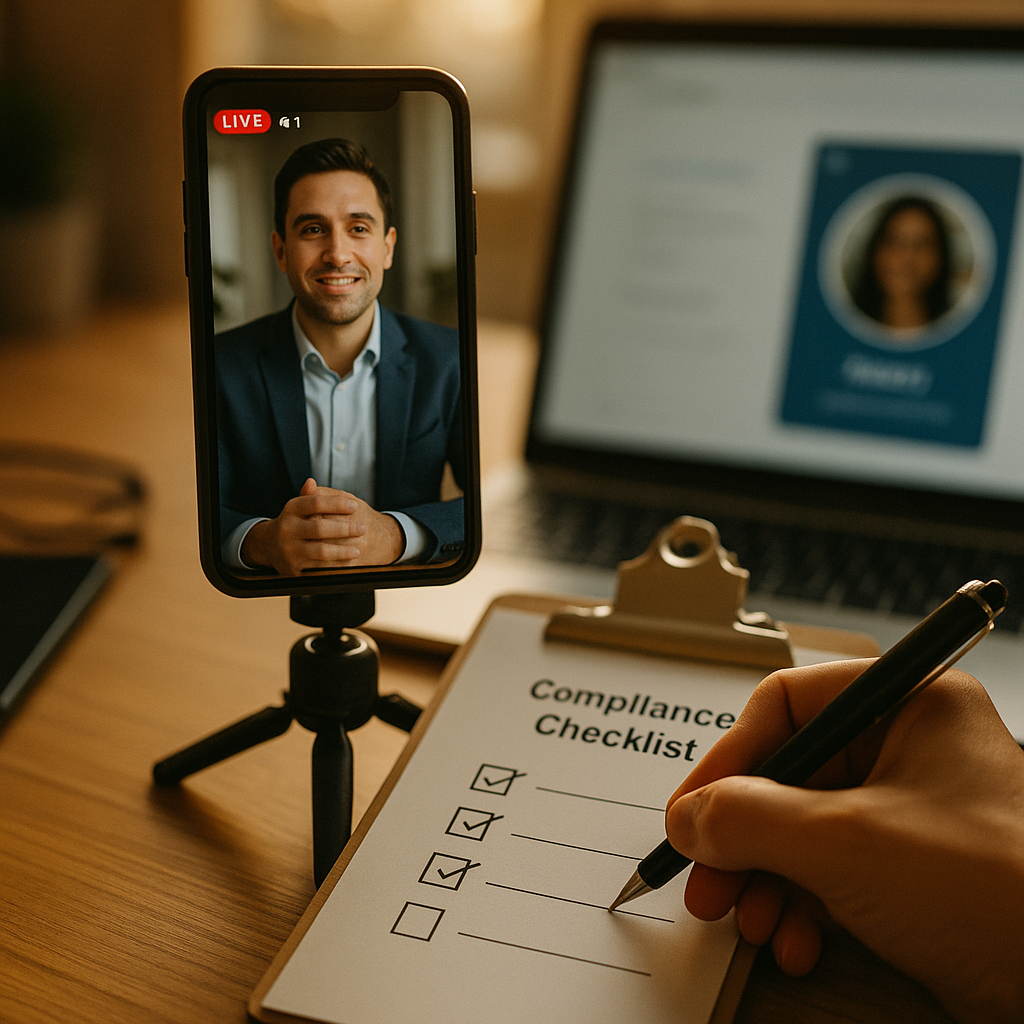
Ninety-two percent of B2B marketers now use LinkedIn for organic content, but almost none of them have a written policy for how paid influencers disclose on Live streams and Stories. That gap is where FTC complaints, ASA rulings, and client trust problems quietly incubate. A LinkedIn compliance checklist isn’t bureaucratic overhead here — it’s the difference between a defensible program and a liability sitting in your content calendar.
LinkedIn’s ephemeral and live formats behave differently than a static sponsored post. There’s no algorithmic pause for a caption edit. There’s no undo. Once a Live stream airs or a Story cycles through its 24-hour window, the disclosure either happened at the right moment or it didn’t. That’s the operational reality brand and legal teams need to plan around, not the theoretical one from a policy PDF nobody reads.
Why LinkedIn Live and Stories Break Standard Disclosure Habits
Most influencer compliance programs were built for feed posts and Instagram Reels. Those formats give you editing windows, pinned comments, and persistent captions. LinkedIn Live and Stories give you neither. A viewer who joins a Live stream four minutes late may never see the verbal disclosure you made at the top. A Stories viewer swiping fast might miss a disclosure sticker shown for only three seconds.
This isn’t a hypothetical risk. The FTC’s Endorsement Guides explicitly state that disclosures must be “unavoidable” — clear and conspicuous regardless of when a viewer tunes in. Live and ephemeral formats make “unavoidable” a much harder bar to clear than a static caption ever was.
There’s also a context problem specific to LinkedIn. It’s a professional network where audiences expect thought leadership, not commerce. A paid demo dressed as a “candid take” from an industry voice reads as more deceptive here than the same tactic on TikTok, precisely because the platform’s implicit contract is credibility over content. Brands that treat LinkedIn disclosure like an Instagram afterthought are misreading the platform entirely — see our breakdown of LinkedIn product demo disclosure risk for how this plays out with sponsored demo content specifically.
A disclosure that appears once, for three seconds, in a 20-minute Live stream is not a disclosure — it’s a compliance liability waiting for a screenshot.
The Core Compliance Checklist
Build this into your creator brief template, not a separate document nobody opens. Here’s the baseline for any paid B2B influencer appearing on LinkedIn Live or Stories:
- Verbal disclosure at stream open, midpoint, and close. For Live content longer than ten minutes, repeat the disclosure at least every ten minutes. Late joiners need to hear it too.
- On-screen disclosure text or sticker, persistent where possible. LinkedIn Live supports overlay graphics through most streaming tools (StreamYard, Restream, Ecamm). Use a persistent lower-third banner reading “Paid Partnership” or “Sponsored,” not a one-time pop-up.
- Stories disclosure sticker on every frame of the sequence, not just the first. If a paid segment spans four Story frames, all four need the disclosure, because viewers can jump between frames non-sequentially.
- Plain language, not hashtag-only disclosure. “#ad” buried at the end of a caption doesn’t satisfy FTC guidance for platforms where hashtags aren’t the primary navigation mechanism. LinkedIn viewers don’t scan hashtags the way Twitter or Instagram users do.
- Disclosure language matched to relationship type. “Sponsored,” “Paid Partnership,” and “Ambassador” mean different things legally. Don’t let creators freelance the wording.
- Pre-approved disclosure script embedded in the contract, not left to creator discretion. This closes the gap our creator contract audit for script control risk piece covers in depth.
- Screen recording or archive of every Live and Stories asset, retained for at least the FTC’s typical lookback window. If the content disappears in 24 hours, your evidence trail can’t.
None of this is exotic. It’s the same logic that governs TV infomercial disclosure rules, just adapted to a platform where the “channel” is a creator’s personal profile.
Where Placement Actually Matters
Placement isn’t just about visibility — it’s about timing relative to attention decay. LinkedIn Live viewership tends to spike in the first 90 seconds and again near the end when a host teases a CTA. If your only disclosure lands in minute 12, you’ve missed both attention peaks.
For Stories, the math is blunter: Stories-style formats across platforms see completion rates drop sharply after the second or third frame, per data platforms like Sprout Social have tracked in similar formats. If your paid segment is frame three of five, you need the disclosure baked into that frame directly — not just frame one.
A practical placement rule: disclosure has to appear at every entry point a viewer could reasonably start from. That means stream open, any point after a mid-roll ad break, and stream close for Live. For Stories, that means every single frame that contains paid content, full stop.
If a regulator or journalist can find one entry point without a visible disclosure, your program has a gap — regardless of how thorough the rest of the campaign was.
Contract Language That Actually Prevents Problems
The checklist only works if your contracts force compliance instead of hoping for it. Three clauses matter most:
- Mandatory disclosure timing clause. Specify exact intervals (every 10 minutes for Live, every frame for Stories) rather than vague “clear and conspicuous” language creators can interpret loosely.
- Pre-flight review for Live overlay graphics. Require creators to submit their streaming software setup or overlay template before the first broadcast. Confirm the disclosure banner is actually configured, not just promised.
- Archive and retention obligation. Creators must save raw footage or screen recordings for a defined period post-broadcast. This protects both parties if a dispute arises later.
These aren’t radically different from the terms brands should already have in place for scripted UGC. Our FTC liability risks of script approval analysis covers how far brands can go in dictating creator language without triggering additional liability exposure — the same tension applies to Live disclosure scripting.
One nuance specific to B2B: many LinkedIn “influencers” are also current or former employees, customers, or advisors. That dual relationship — paid creator plus subject-matter source — creates a disclosure requirement most brands miss entirely. If someone is both a paid spokesperson and an unpaid customer testimonial in the same Live session, both relationships need separate, clear disclosure. The FTC’s updated guidance on endorsements and testimonials treats these as distinct material connections, not one blended disclosure.
What Happens When You Get This Wrong
The consequences aren’t hypothetical. FTC enforcement actions against livestream commerce and undisclosed endorsements have accelerated, and the agency has signaled particular interest in formats where disclosure timing creates gaps for late-joining viewers. Our coverage of livestream disclosure rules clashing with countdown formats shows how quickly this scrutiny has moved from theory to actual case activity on other platforms. LinkedIn hasn’t seen a headline enforcement case yet — but “yet” is the operative word, and B2B brands with larger deal sizes and more sophisticated legal teams watching competitors are arguably higher-risk targets, not lower-risk ones.
There’s also a reputational dimension unique to LinkedIn. A hidden sponsorship on TikTok gets a shrug from most audiences. A hidden sponsorship on LinkedIn, discovered by a competitor’s comms team or a journalist covering B2B marketing ethics, becomes a credibility story that follows the brand into sales conversations. Buyers researching a vendor read LinkedIn content as a proxy for trustworthiness. Undisclosed paid content undermines exactly the asset B2B brands are trying to build.
Cross-border complexity adds another layer. If your paid influencer’s LinkedIn audience spans the US, UK, and EU, you’re not just managing FTC exposure — you’re managing ASA and DSA disclosure standards simultaneously, and they don’t align perfectly on placement or wording. The cross-border disclosure matrix we built for exactly this scenario is worth reviewing before any Live stream with international reach goes out.
Building This Into Your Workflow, Not Just Your Contract
Checklists fail when they live in a PDF instead of a process. The brands getting this right treat LinkedIn Live and Stories compliance as a pre-broadcast gate, not a post-publication audit:
- Disclosure script reviewed and approved during creator onboarding, before the first session is scheduled.
- Overlay graphics tested in a dry run, confirming they render correctly on both desktop and mobile viewing experiences.
- A named internal owner — usually brand or legal, not the creator — responsible for confirming disclosure compliance before the stream goes live.
- Post-broadcast archive stored in a shared compliance folder, tagged with campaign name and date, retrievable within minutes if needed.
This is the same operational discipline platforms like LinkedIn Marketing Solutions recommend for brand safety generally, just applied specifically to disclosure rather than content quality. It’s not more work. It’s the same work, done earlier in the process, where it’s cheaper to fix mistakes.
FAQs
Frequently Asked Questions
Does LinkedIn have a built-in disclosure tool for Live and Stories like other platforms do?
Not a dedicated branded-content toggle in the way Instagram or TikTok offer. LinkedIn relies on manual disclosure through captions, verbal statements, and overlay graphics added via third-party streaming tools, which puts more responsibility on brands and creators to build disclosure into the broadcast itself rather than a platform feature.
How often does a disclosure need to repeat during a LinkedIn Live stream?
A reasonable standard is at stream open, at least every ten minutes throughout, and again at close. Longer streams with natural segment breaks should repeat disclosure at each segment transition, since viewers commonly join partway through.
Is a disclosure in the video description enough for LinkedIn Live?
No. The FTC’s clear-and-conspicuous standard generally requires disclosure within the content itself, not buried in a description viewers may never open. Verbal and on-screen disclosure during the actual broadcast is the safer standard.
What’s different about disclosing paid content on LinkedIn versus Instagram or TikTok?
LinkedIn’s professional context raises audience expectations around credibility and thought leadership, making undisclosed sponsorship feel more deceptive to viewers when discovered. There’s also less platform infrastructure (like Instagram’s Paid Partnership label) supporting automatic disclosure, so more falls on manual compliance steps.
Do employee advocates count as paid influencers requiring disclosure?
If an employee, advisor, or customer receives compensation, free products, or other material benefit tied to their LinkedIn Live or Stories appearance, disclosure requirements apply the same way they would for an external creator. The employment relationship alone doesn’t exempt the content from FTC endorsement rules.
How long should brands retain Live and Stories recordings for compliance purposes?
Most legal teams recommend retaining recordings for at least two to three years, aligning with the FTC’s typical statute of limitations window for enforcement actions, though specific retention periods should be confirmed with counsel based on jurisdiction and campaign risk level.
Start by auditing your last three LinkedIn Live sessions against the checklist above — if even one entry point lacked a visible disclosure, fix your streaming template before scheduling the next broadcast.
Top Influencer Marketing Agencies
The leading agencies shaping influencer marketing in 2026
Agencies ranked by campaign performance, client diversity, platform expertise, proven ROI, industry recognition, and client satisfaction. Assessed through verified case studies, reviews, and industry consultations.
Moburst

-
2

The Shelf
Boutique Beauty & Lifestyle Influencer AgencyA data-driven boutique agency specializing exclusively in beauty, wellness, and lifestyle influencer campaigns on Instagram and TikTok. Best for brands already focused on the beauty/personal care space that need curated, aesthetic-driven content.Clients: Pepsi, The Honest Company, Hims, Elf Cosmetics, Pure LeafVisit The Shelf → -
3

Audiencly
Niche Gaming & Esports Influencer AgencyA specialized agency focused exclusively on gaming and esports creators on YouTube, Twitch, and TikTok. Ideal if your campaign is 100% gaming-focused — from game launches to hardware and esports events.Clients: Epic Games, NordVPN, Ubisoft, Wargaming, Tencent GamesVisit Audiencly → -
4

Viral Nation
Global Influencer Marketing & Talent AgencyA dual talent management and marketing agency with proprietary brand safety tools and a global creator network spanning nano-influencers to celebrities across all major platforms.Clients: Meta, Activision Blizzard, Energizer, Aston Martin, WalmartVisit Viral Nation → -
5

The Influencer Marketing Factory
TikTok, Instagram & YouTube CampaignsA full-service agency with strong TikTok expertise, offering end-to-end campaign management from influencer discovery through performance reporting with a focus on platform-native content.Clients: Google, Snapchat, Universal Music, Bumble, YelpVisit TIMF → -
6

NeoReach
Enterprise Analytics & Influencer CampaignsAn enterprise-focused agency combining managed campaigns with a powerful self-service data platform for influencer search, audience analytics, and attribution modeling.Clients: Amazon, Airbnb, Netflix, Honda, The New York TimesVisit NeoReach → -
7

Ubiquitous
Creator-First Marketing PlatformA tech-driven platform combining self-service tools with managed campaign options, emphasizing speed and scalability for brands managing multiple influencer relationships.Clients: Lyft, Disney, Target, American Eagle, NetflixVisit Ubiquitous → -
8

Obviously
Scalable Enterprise Influencer CampaignsA tech-enabled agency built for high-volume campaigns, coordinating hundreds of creators simultaneously with end-to-end logistics, content rights management, and product seeding.Clients: Google, Ulta Beauty, Converse, AmazonVisit Obviously →