


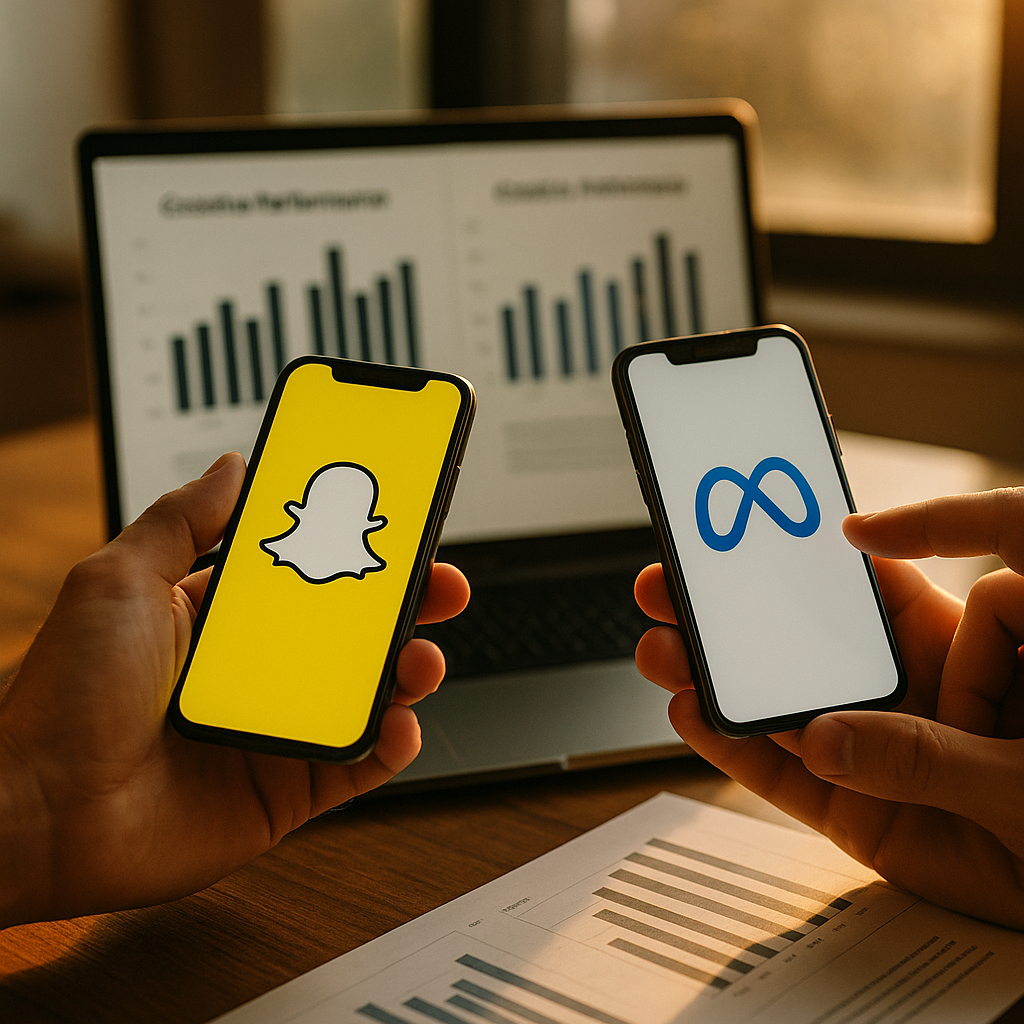
Snapchat product shots convert 22% faster in direct-response tests, but Meta’s people first creative still wins on brand lift. If your media team is reporting both platforms against the same creative scorecard, you’re measuring two different sports with one stopwatch. This playbook breaks down how to benchmark Snapchat product shots vs Meta people first creative without torching your budget on the wrong format for the wrong platform.
Two Platforms, Two Creative Philosophies
Snapchat built its ad product around speed and utility. Users open the app to talk to friends, not to browse a catalog, so the ads that work are the ones that look like they belong: clean product shots, bold pricing overlays, a single clear CTA. Snap’s own advertiser guidance leans hard into this “show the thing, state the price, add urgency” formula.
Meta went the opposite direction over the past two years. Its machine learning models now favor what internal teams call “people first” creative: UGC-style clips, testimonials, founder talking heads, and influencer content that doesn’t look like an ad. This isn’t a stylistic preference. It’s a response to how Meta’s ranking algorithm interprets watch time and completion rate on Reels inventory, where polished product shots get skipped faster than unscripted human moments.
The core benchmarking mistake brands make is applying Meta’s engagement-driven creative logic to Snapchat’s intent-driven audience, or vice versa. Same budget, same brief, wrong platform assumptions.
Why a Single Scorecard Breaks Both Channels
Most media teams still run one unified creative scorecard across paid social, tracking CTR, thumbstop rate, and CPA side by side. That works fine when platforms behave similarly. Snapchat and Meta don’t.
Snapchat’s audience skews younger, moves faster, and responds to direct commercial cues without friction. A static product shot with a discount badge can outperform a narrative video by 30-40% on swipe-up rate, according to patterns many retail advertisers report in quarterly reviews. Meta’s audience, especially on Reels and Stories placements, rewards content that feels native to the feed. Push a glossy product shot into that inventory and watch your cost per result climb as the algorithm deprioritizes it.
This is why benchmarking needs a platform-specific lens before you ever compare dollar figures. You’re not asking “which ad performed better.” You’re asking “which ad performed better relative to what that platform’s model was built to reward.”
Building the Benchmarking Framework
Here’s the structure we recommend for brands running concurrent Snapchat and Meta creator campaigns:
- Normalize by funnel stage, not platform. Compare Snapchat product shots against Meta’s direct-response formats (catalog ads, shopping tags), not against people first UGC. Compare Meta’s people first creative against Snapchat’s lens-based or AR-driven brand content instead.
- Track thumbstop separately from conversion. Meta’s people first creative often wins thumbstop and loses on immediate conversion, because it’s doing top-funnel work. Snapchat product shots often lose thumbstop but win conversion, because they skip the warm-up and go straight for the sale.
- Weight CPA by creative lifespan. Snapchat product shots fatigue fast, sometimes within a week on younger audiences. Meta’s people first creative, especially from established creators, holds up longer because the parasocial element gives it replay value. If you’re not already tracking decay curves, our creative wear out benchmarks are a useful starting reference.
- Isolate production cost per thousand impressions, not per asset. A Snapchat product shot might cost $200 to produce and run for four days. A people first UGC video might cost $1,500 and run for six weeks. Raw CPA comparisons without this context mislead budget owners every time.
What Metrics Actually Matter Here?
Forget vanity engagement for a second. The metrics that tell you whether Snapchat product shots or Meta people first creative is working harder for your budget are: cost per incremental purchase, hold rate past three seconds, and share of voice within category-specific creative formats. Statista and eMarketer both track rising CPMs across social video inventory, which makes efficiency metrics more important than raw reach numbers this year, per Statista’s social advertising data and eMarketer’s ad spend forecasts.
Don’t ignore brand lift studies either. Meta’s people first creative tends to move aided awareness and purchase intent more than Snapchat product shots do, which matters if your CMO is being asked to justify spend beyond last-click attribution. If your team is still building that financial justification internally, the structure in our partnership ads ROI model guide translates well to this comparison.
Production Reality: What It Actually Costs to Run Both
Here’s the part creative directors don’t love hearing: running both formats well means running two separate production pipelines, not one shoot repurposed two ways.
Snapchat product shots need a lightweight, high-frequency production cadence. Think weekly batch shoots, simple lighting setups, and a template-driven approach to pricing and promo overlays. You want volume and speed, not polish. Agencies that try to dress these up with cinematic lighting usually see performance drop, because they stop looking native to the platform.
Meta’s people first creative needs the opposite investment: fewer assets, more creator relationships, more time spent on casting and brief alignment so the content reads as authentic rather than scripted. This is where influencer partnerships earn their keep. If you’re setting up creator-sourced ads on Meta for the first time, our Meta Partnership Ads setup walkthrough covers the permissions and whitelisting steps that make this work without legal friction.
Budget-wise, a sensible split for a mid-sized brand running both channels looks like 60% of production dollars toward fewer, higher-quality people first assets for Meta, and 40% toward a high-frequency, low-cost product shot pipeline for Snapchat. Adjust based on which platform is carrying more of your actual revenue, not just impression share.
When Snapchat Product Shots Win
- Flash sales, limited drops, and time-sensitive promos where urgency beats narrative.
- Younger demographic targeting (Gen Z skews) where direct, unpretentious selling reads as honest rather than lazy.
- Categories with strong visual differentiation: beauty, footwear, snack and beverage, where the product itself is the hook.
When Meta People First Creative Wins
- Considered purchases where trust and social proof matter more than price, like skincare, supplements, or financial apps.
- Brands building long-term creator partnerships rather than one-off transactional deals.
- Campaigns where brand lift and awareness are KPIs alongside direct conversion.
Testing Cadence: How Often Should You Refresh Each Format?
Snapchat product shots need refreshing roughly every 7-10 days for active campaigns, given how fast the audience cycles through content. Meta’s people first creative can run 3-6 weeks before meaningful decay sets in, particularly if the creator has an engaged following that keeps resharing or commenting.
This difference should directly shape your testing calendar. If you’re applying a single monthly refresh cycle across both platforms, you’re either overspending on unnecessary Meta refreshes or underfeeding Snapchat with stale product shots. Our creator ad refresh framework, while built around a different platform, offers a cadence model you can adapt: set refresh triggers based on frequency caps and CTR decline, not arbitrary calendar dates.
Timing also matters for how you sequence posts around organic creator content. Teams running Meta people first creative in tandem with organic influencer posts should review our notes on collab post timing to avoid cannibalizing reach between paid and organic versions of the same asset.
Disclosure and Compliance Don’t Disappear Just Because It’s a Product Shot
One mistake brands make with Snapchat product shots: assuming disclosure rules only apply to influencer-style content. They don’t. If a creator or affiliate is compensated to appear in or promote a product shot style ad, FTC disclosure requirements still apply, regardless of how “ad-like” the creative looks. Review current guidance at the FTC’s endorsement guidelines page before scaling either format with paid creators. For brands running UK campaigns, the ICO’s guidance on data and marketing is worth a parallel check, especially where retargeting pools overlap between platforms.
Sprout Social’s benchmarking reports also consistently show that transparency in paid creator content correlates with higher trust scores, which reinforces why cutting corners on disclosure to make a product shot feel more “organic” tends to backfire. See Sprout Social’s social media benchmarks for category-level comparisons.
Bringing It Together
Stop forcing Snapchat product shots and Meta people first creative into the same evaluation grid. Build separate benchmarks tied to each platform’s actual algorithmic incentives, fund two distinct production pipelines instead of one stretched thin, and refresh each format on its own decay curve. Do that for one full quarter and you’ll have a clean enough dataset to defend budget allocation with your CFO, not just your gut.
Frequently Asked Questions
Is Snapchat product shot creative still effective, or has the platform moved toward UGC too?
Snapchat still rewards clean, direct product shots for direct-response campaigns, particularly for flash sales and limited drops. The platform has added support for more native-feeling creator content, but product shots remain a strong performer for conversion-focused goals.
Can I reuse Meta people first creative on Snapchat without editing it?
Technically yes, but performance usually suffers. Meta’s people first format is built for longer watch times and narrative pacing, while Snapchat audiences respond better to faster, more direct creative. Re-editing for pacing and CTA placement is worth the extra production time.
How long should a benchmarking test run before comparing results across platforms?
Give each platform at least two full refresh cycles before comparing. That means roughly two to three weeks for Snapchat product shots and five to six weeks for Meta people first creative, so both formats have time to reach stable performance before decay.
Do I need separate creators for Snapchat and Meta campaigns?
Not necessarily the same creators, but you likely need separate briefs. A creator can work across both platforms, but the brief for Snapchat should emphasize product clarity and urgency, while the Meta brief should prioritize authenticity and storytelling.
What’s the biggest reporting mistake brands make when comparing these two formats?
Comparing raw CPA without adjusting for funnel stage or production cost per impression. Snapchat product shots often look cheaper per conversion but ignore the brand-building value Meta’s people first creative delivers over a longer window.
Top Influencer Marketing Agencies
The leading agencies shaping influencer marketing in 2026
Agencies ranked by campaign performance, client diversity, platform expertise, proven ROI, industry recognition, and client satisfaction. Assessed through verified case studies, reviews, and industry consultations.
Moburst

-
2

The Shelf
Boutique Beauty & Lifestyle Influencer AgencyA data-driven boutique agency specializing exclusively in beauty, wellness, and lifestyle influencer campaigns on Instagram and TikTok. Best for brands already focused on the beauty/personal care space that need curated, aesthetic-driven content.Clients: Pepsi, The Honest Company, Hims, Elf Cosmetics, Pure LeafVisit The Shelf → -
3

Audiencly
Niche Gaming & Esports Influencer AgencyA specialized agency focused exclusively on gaming and esports creators on YouTube, Twitch, and TikTok. Ideal if your campaign is 100% gaming-focused — from game launches to hardware and esports events.Clients: Epic Games, NordVPN, Ubisoft, Wargaming, Tencent GamesVisit Audiencly → -
4

Viral Nation
Global Influencer Marketing & Talent AgencyA dual talent management and marketing agency with proprietary brand safety tools and a global creator network spanning nano-influencers to celebrities across all major platforms.Clients: Meta, Activision Blizzard, Energizer, Aston Martin, WalmartVisit Viral Nation → -
5

The Influencer Marketing Factory
TikTok, Instagram & YouTube CampaignsA full-service agency with strong TikTok expertise, offering end-to-end campaign management from influencer discovery through performance reporting with a focus on platform-native content.Clients: Google, Snapchat, Universal Music, Bumble, YelpVisit TIMF → -
6

NeoReach
Enterprise Analytics & Influencer CampaignsAn enterprise-focused agency combining managed campaigns with a powerful self-service data platform for influencer search, audience analytics, and attribution modeling.Clients: Amazon, Airbnb, Netflix, Honda, The New York TimesVisit NeoReach → -
7

Ubiquitous
Creator-First Marketing PlatformA tech-driven platform combining self-service tools with managed campaign options, emphasizing speed and scalability for brands managing multiple influencer relationships.Clients: Lyft, Disney, Target, American Eagle, NetflixVisit Ubiquitous → -
8

Obviously
Scalable Enterprise Influencer CampaignsA tech-enabled agency built for high-volume campaigns, coordinating hundreds of creators simultaneously with end-to-end logistics, content rights management, and product seeding.Clients: Google, Ulta Beauty, Converse, AmazonVisit Obviously →