


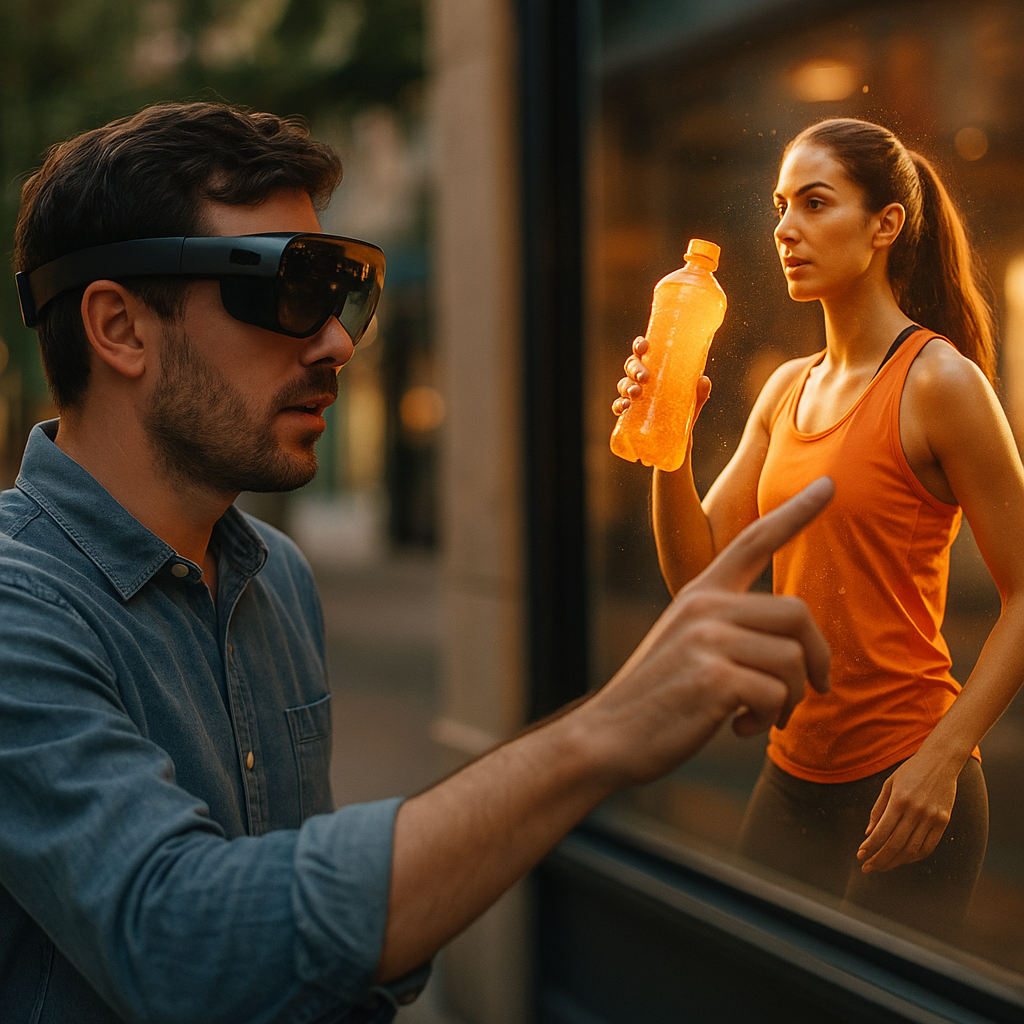
In 2025, spatial computing is reshaping how audiences experience narratives, shifting brand communication from watching to participating. Instead of flat ads, people step into interactive worlds where products, values, and communities feel tangible. This change affects strategy, creativity, measurement, and trust. Brands that treat it as a storytelling medium—not a gadget—will earn attention and loyalty. What happens when your story surrounds the customer?
Spatial computing brand storytelling: From linear messages to lived experiences
Spatial computing merges digital content with physical space using devices such as AR glasses, headsets, phones, and spatial sensors. For brand storytelling, its biggest impact is structural: stories no longer move from beginning to end in a fixed sequence. They unfold based on where a person looks, walks, or touches—turning narrative into an environment.
What changes for brands:
- Story becomes place: A brand can design a “world” with scenes, objects, and characters that reveal meaning as users explore.
- Attention becomes voluntary: Users choose what to inspect, which raises the bar for relevance and clarity.
- Context becomes part of the plot: Location, time, and surroundings can shape what the user sees, making the story feel personal without being invasive.
Traditional storytelling optimizes for reach and recall. Spatial storytelling optimizes for agency and embodiment. That means creative teams must design narrative pathways rather than single scripts. A helpful approach is to define three layers: a core story that everyone can access, optional depth for curious users, and utility moments that help people do something (try, compare, learn, share).
Follow-up question readers usually ask: “Do we need headsets?” Not necessarily. Many spatial experiences start on phones with AR and progress to head-worn devices as adoption grows. The strategy should be device-agnostic: design for spatial interaction first, then adapt for screens and headsets.
Immersive customer experience: How presence increases emotional memory and trust
Spatial experiences can create presence—the feeling of “being there.” Presence matters for storytelling because it strengthens emotional memory: people remember what they actively do more than what they passively watch. For brands, that can translate into deeper understanding of product benefits, clearer differentiation, and more confidence to purchase.
Where presence delivers real value:
- Product comprehension: Complex products (tech, appliances, vehicles, financial services) become easier to understand when features are shown at true scale and in context.
- Value demonstration: Sustainability, craftsmanship, and sourcing can be shown as interactive scenes rather than claims on packaging.
- Reduced uncertainty: Virtual try-ons, room previews, and guided setup experiences can reduce returns and support requests.
Trust grows when the experience is transparent. Brands should avoid “magic tricks” that mislead scale, color, or performance. If a fabric simulation, shade match, or performance overlay has limitations, say so in plain language. In 2025, audiences reward brands that design honestly and explain what is real, what is simulated, and what depends on user conditions like lighting or device capability.
Answering the next question: “How do we avoid the novelty trap?” Tie every spatial moment to a user goal: learn faster, choose confidently, personalize safely, or access service quickly. If a scene doesn’t support a goal, it’s decoration—and decoration rarely scales.
AR marketing strategy 2025: Designing narratives across devices, platforms, and physical spaces
In 2025, the winning approach is not “build one AR stunt.” It is to create a repeatable spatial system: reusable assets, modular scenes, and consistent interaction patterns. This lets storytelling evolve across product lines and campaigns without restarting from zero.
Practical narrative design principles:
- Start with a spatial storyboard: Map key scenes to real-world locations (store aisle, living room, event booth) and define the user’s movement and choices.
- Use progressive disclosure: Show the simplest version first, then let users tap, walk closer, or ask for deeper detail.
- Keep interactions predictable: Consistent gestures and UI cues reduce friction and improve completion rates.
- Design for interruption: People will pause, look away, or switch tasks. Save state and allow re-entry without penalty.
Platform reality: Spatial computing spans mobile AR, web-based experiences, social AR filters, in-store kiosks, and headsets. To manage cost and consistency, brands increasingly adopt a “single source of truth” for 3D assets with variants optimized for performance. That means governance: file naming, version control, licensing, and an approvals process that protects brand accuracy.
Content planning tip: Treat 3D assets as long-term brand infrastructure. A well-built 3D product library supports storytelling, commerce, support, training, and partner marketing. This is where marketing, product, and CX teams align—because spatial computing blurs the boundaries between them.
3D content production pipeline: Skills, tools, and governance for credible brand worlds
Spatial storytelling fails when execution feels cheap or inconsistent. In 2025, audiences can spot low-quality 3D, inaccurate physics, and recycled templates. High credibility requires a production pipeline that supports both creativity and correctness.
Key roles and expertise that improve EEAT:
- Subject-matter experts (SMEs): Ensure product claims and demonstrations are accurate. For regulated categories, involve compliance early.
- 3D artists and technical artists: Build optimized models, lighting, and materials that look real under varied conditions.
- Spatial UX designers: Translate brand goals into intuitive interaction, accessibility, and comfort.
- Engineers and QA: Maintain performance targets, device compatibility, privacy-safe analytics, and bug prevention.
Governance matters as much as artistry: Define what “brand-accurate” means in 3D. Approved colors, materials, typography in 3D, tone of voice for spatial prompts, and rules for using user environment data should live in a spatial design system. This keeps experiences consistent across regions and agencies.
How to keep production efficient: Build modular scene components (rooms, lighting rigs, interaction widgets) and reuse them. Optimize assets with clear performance budgets. If an experience takes too long to load, storytelling collapses—because people leave before meaning lands.
Likely follow-up question: “Should we build in-house or outsource?” Many brands use a hybrid model: core brand assets and governance in-house, specialized builds outsourced. That protects quality and reduces dependency while keeping capacity flexible.
Personalized spatial storytelling: Privacy, accessibility, and ethical engagement
Spatial computing can personalize experiences using environmental understanding and behavioral signals. That power creates ethical risk. In 2025, the strongest brands treat privacy and inclusivity as storytelling features, not legal afterthoughts.
Privacy-first practices that also improve performance:
- Data minimization: Collect only what you need to improve the experience, not what you might want later.
- On-device processing when possible: Reduce cloud dependence for sensitive signals such as room mapping.
- Clear consent flows: Explain why permissions are needed and what happens if users decline. Provide a functional fallback.
- Transparent personalization: Let users see and adjust what the system is tailoring (size, style, recommendations).
Accessibility and comfort: Spatial experiences should account for motion sensitivity, physical mobility, visual contrast needs, audio alternatives, and one-handed interaction. Provide seated and standing modes where relevant. Offer captions, adjustable text size, and clear audio cues. These choices broaden reach and reduce drop-off.
Ethical engagement: Avoid manipulative spatial mechanics such as obstructing the user’s view to force attention, hiding exits, or using overly aggressive nudges. Spatial environments feel intimate; invasive tactics backfire quickly and can damage trust.
Answering the big question: “Can personalization go too far?” Yes. If the experience feels like surveillance, users disengage. Personalization should feel like service: helping someone choose, learn, or visualize—without exposing sensitive inferences.
Spatial analytics and ROI: Measuring what matters beyond clicks
Spatial storytelling changes measurement because interactions are richer than taps and impressions. Brands can evaluate how people explore, what they understand, and where confusion happens—if they instrument experiences responsibly.
Metrics that map to business outcomes:
- Engagement depth: Time in key scenes, number of meaningful interactions, and completion of guided steps.
- Comprehension signals: Use short in-experience checks (e.g., “Compare A vs B”) to measure understanding, not just exposure.
- Decision confidence: Track saves, wishlists, size/fit confirmations, and “view in my space” repeats.
- Friction points: Drop-off at permissions, loading, or unclear interactions; heatmaps of gaze and movement where permitted and anonymized.
- Conversion influence: Link spatial sessions to downstream actions like add-to-cart, store visits, support deflection, or lead quality.
How to communicate ROI internally: Position spatial computing as a cross-functional accelerator. A single spatial asset set can support marketing, sales enablement, customer support, and training. When leaders see multi-department value, budgets stabilize and experimentation becomes disciplined rather than sporadic.
Measurement caution: More data does not automatically mean better decisions. Focus on metrics that reflect user success. If people complete tasks faster, return less often, and feel more confident, storytelling is working.
FAQs
What is spatial computing in brand storytelling?
Spatial computing uses digital content anchored to real environments so audiences can explore stories in 3D space. For brands, it turns messaging into interactive experiences where people learn and decide by moving, looking, and manipulating objects.
Do consumers need AR glasses for spatial storytelling to work?
No. Many effective experiences run on mobile AR or web-based 3D. Glasses and headsets can increase immersion, but the best strategies design the narrative to work across devices and scale up when advanced hardware is available.
Which industries benefit most from spatial computing storytelling?
Retail, automotive, home improvement, travel, beauty, healthcare, and B2B tech often see strong results because spatial experiences reduce uncertainty, explain complex offerings, and let customers preview outcomes in context.
How can brands keep spatial experiences credible and trustworthy?
Use accurate 3D models, involve product SMEs, disclose simulation limits, and avoid exaggerated effects. Make privacy and permissions transparent, and ensure the experience remains useful even if users opt out of certain data sharing.
What are the biggest production challenges?
Asset quality, performance optimization, device compatibility, and governance. Brands need a 3D content pipeline, clear approvals, and reusable components to keep costs controlled and experiences consistent across campaigns.
How do you measure success for spatial storytelling?
Track engagement depth, task completion, comprehension signals, friction points, and downstream outcomes such as conversion lift, reduced returns, or support deflection. Prioritize metrics tied to user success, not just time spent.
Spatial computing is changing brand storytelling by turning narratives into interactive places where customers learn, feel, and decide through participation. In 2025, the brands that win will treat spatial as a long-term capability: build credible 3D assets, design privacy-first personalization, and measure outcomes that reflect customer success. When your story becomes an experience people can navigate, relevance replaces interruption—will you build a world worth entering?