


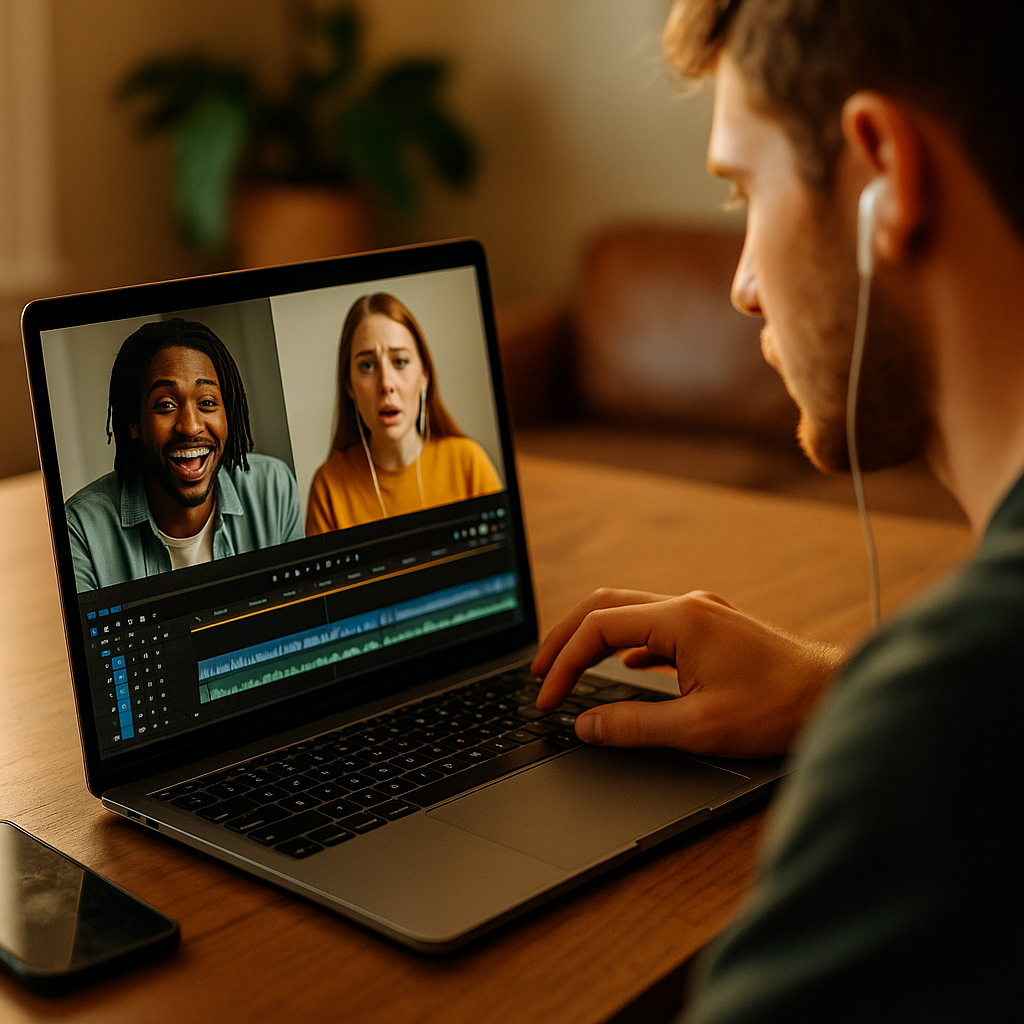
Sixty percent of a viewer’s trust decision happens before a scripted voiceover ever kicks in. That’s the working theory behind the sudden pivot toward split screen reaction videos, a format where the original content sits on one half of the frame and an unscripted human response fills the other. No narrator. No polished script. Just a face reacting in real time, and audiences are rewarding it with longer watch times and sharper conversion signals than traditional voiceover-driven edits ever managed.
Editors aren’t ditching voiceover because it’s suddenly bad. They’re ditching it because split screen reaction videos solve a trust problem that voiceover can’t.
The Voiceover Fatigue Problem Is Real
Ask any creative director running a high-volume content calendar and they’ll tell you the same thing: audiences have gotten numb to the disembodied narrator voice. It doesn’t matter how good the script is. The moment a viewer hears that smooth, produced cadence layered over B-roll, a part of their brain files it under “ad” and starts scrolling.
Split screen reaction content skips that filter entirely. The reactor’s face is right there, unedited, responding to the same thing the viewer is watching. There’s no buffer between stimulus and response. That immediacy is exactly what makes the format so sticky, and it’s why brands briefing creators are increasingly requesting it over traditional talking-head or voiceover explainer formats. For a deeper look at how briefs are evolving to support this shift, see our breakdown of split screen reaction briefs and how they borrow trust faster than scripted alternatives.
Reaction-based formats consistently outperform scripted voiceover edits on completion rate, largely because unscripted facial response reads as evidence rather than persuasion.
Why Editors Are Making the Switch
Talk to editors who’ve made the transition and the reasoning is refreshingly practical. Voiceover requires a script, a recording session, sync work, and usually a round or two of client revisions on tone and pacing. That’s hours of billable time before the edit even starts.
Split screen reaction content flips the production sequence. The reaction is captured live, often in a single take, and the editor’s job becomes arrangement rather than construction. You’re syncing two video tracks, maybe adding a caption or two, and shipping. Editors describe turnaround times cut by half or more compared to voiceover-dependent projects.
- Lower script dependency: no need to write, approve, and re-approve narration copy.
- Faster QA: authenticity is harder to fake, which means fewer rounds of “make it sound more natural” notes.
- Built-in social proof: a genuine reaction functions as a mini testimonial, even when the product isn’t explicitly endorsed.
- Reusable structure: the same reactor-plus-source format works across product drops, news commentary, and trend breakdowns.
What the Data Actually Shows
Retention curves tell the real story. Voiceover-led explainer content tends to see a steep drop-off in the first five seconds, the point where viewers decide if the narrator’s tone matches their expectations. Split screen reaction formats show a flatter curve. Viewers stick around because they’re watching a live response unfold, and the uncertainty of “what will they say next” keeps attention anchored longer than a pre-written script ever could.
Platforms have noticed too. TikTok and Instagram algorithms both weight completion rate and rewatch behavior heavily, and reaction formats tend to perform well on both metrics because the payoff (the reactor’s genuine expression) often lands in the final third of the clip. That’s a structural advantage voiceover content struggles to replicate, since scripted narration front-loads information rather than building toward a reveal. Marketers tracking this shift alongside broader editing trends should also look at how AI assisted reel editing is being used to identify these retention windows automatically, cutting the guesswork out of where reactions should peak.
Industry data from eMarketer continues to show short-form video consumption climbing year over year, with authenticity cited repeatedly as the top driver of engagement among Gen Z and younger millennial audiences. Reaction formats align directly with that preference because they remove the layer of production polish that voiceover inherently signals.
Where This Format Actually Works (and Where It Doesn’t)
Split screen reaction videos aren’t a universal replacement for voiceover. They shine in specific contexts and fall flat in others.
Where it works: product reveals, unboxings, first-time taste tests, reaction to competitor comparisons, and commentary on trending news or culture moments. Anything where the “before I knew” versus “after I saw it” contrast is the emotional hook.
Where it doesn’t: complex technical explainers, multi-step tutorials, or content that requires precise sequencing of information. You can’t react your way through a five-step skincare routine and expect the same clarity a structured voiceover would provide. For that kind of content, brands are better served by formats like comparison demo scripts, which keep narration but tighten the structure for conversion.
Brand strategists should also be cautious about overusing the format. If every piece of content on a brand channel is a reaction video, the novelty wears off fast and audiences start suspecting the “reactions” are staged, which torches the exact authenticity advantage the format is built on.
The Production and Compliance Angle Brands Need to Watch
Here’s the part that gets glossed over in creative pitches but matters enormously to anyone managing budget and legal exposure: split screen reaction content still requires disclosure when it’s sponsored or brand-briefed, even though it feels organic. The FTC’s endorsement guidelines apply regardless of format. A reaction video that features a product prominently, even unscripted, still counts as a material connection if the creator was compensated or gifted the item.
That means brief documentation matters just as much here as it does for scripted formats. Agencies should treat reaction-style briefs with the same rigor they’d apply to any sponsored content, tracking whether disclosure language appears in the caption or on-screen. Loose creative freedom is part of what makes the format work, but it can’t come at the expense of compliance. Our piece on prescriptive briefs covers how to balance creative latitude with the structure needed to stay compliant.
There’s also an approval workflow consideration. Reaction content is captured live and often posted quickly to preserve the “in the moment” feel. That timeline conflicts with brands used to multi-round creative approval. If your legal and brand safety review process takes five business days, you’ll kill the spontaneity that makes this format work in the first place. Teams struggling with this tension should read our analysis of creative approval bottlenecks and how they quietly undermine authentic formats.
How to Brief a Split Screen Reaction Video (Without Killing the Authenticity)
The biggest mistake brands make with this format is over-scripting the reaction itself. If you tell a creator exactly what facial expression to make or what words to say, you’ve recreated voiceover with extra steps. The whole value proposition collapses.
Instead, brief the setup and let the reaction happen naturally:
- Define the source content clearly. What exactly is the creator reacting to? A product demo, a competitor’s ad, a customer review? Precision here matters more than scripting the response.
- Set boundaries, not lines. Give creators topics to avoid (competitor bashing, unverified claims) rather than words to say.
- Specify disclosure placement upfront. Don’t leave FTC compliance as an afterthought added in editing.
- Request raw footage before final cut. This protects brand safety without requiring a scripted approval loop.
- Test multiple reactors. Because the format lives or dies on genuine response, one creator’s reaction won’t generalize. Run small batches and see which personalities produce the strongest completion rates.
This is where the format overlaps with multi-creator strategies. Running the same source content across several reactors and comparing performance mirrors the logic behind multi creator collab challenges, where diversified creative reduces the risk of a single underperforming asset dragging down an entire campaign’s CPM.
Is This a Passing Trend or a Structural Shift?
It’s tempting to file split screen reaction videos under “current trend, will fade.” But the underlying mechanic (juxtaposing source content with unscripted human response) isn’t really new. It’s the format equivalent of a focus group, compressed into fifteen seconds and made public. That structural logic isn’t going away because audience skepticism toward polished marketing isn’t going away either.
What will likely change is the production tooling around it. Expect editing platforms to build native split-screen sync tools, and expect more brands to formalize the format into their creator brief templates rather than treating it as an experimental one-off. Data from Sprout Social on short-form engagement patterns supports the idea that unscripted, reaction-driven formats will keep growing their share of brand content mix, not shrink it.
Frequently Asked Questions
FAQs
What is a split screen reaction video?
It’s a video format where the original source content (a product, an ad, a clip) plays on one half of the screen while a creator’s live, unscripted reaction plays on the other half, typically without any added voiceover narration.
Why are editors replacing voiceover with this format?
Voiceover requires scripting, recording, and multiple rounds of tonal approval, which slows production and often reads as “produced” to skeptical audiences. Split screen reaction content is faster to edit, cheaper to produce, and performs better on retention because it reads as authentic rather than scripted.
Does a split screen reaction video still need FTC disclosure?
Yes. If the creator was compensated, gifted the product, or briefed by the brand in any material way, standard endorsement disclosure rules still apply regardless of how unscripted the content feels.
What content types work best for this format?
Product reveals, first impressions, unboxings, and reactions to trending or competitor content tend to perform best. Complex, multi-step tutorials generally don’t translate well to reaction formats.
How do brands brief creators without scripting the reaction itself?
Brief the source content and any compliance boundaries clearly, but leave the actual reaction unscripted. Overly directive briefs tend to flatten the authenticity that makes the format effective in the first place.
If your content calendar is still leaning on voiceover for every explainer and unboxing, run a side-by-side test this quarter: same product, one scripted voiceover cut, one split screen reaction cut. Let the completion rate decide which one earns a permanent slot in your brief templates.
Top Influencer Marketing Agencies
The leading agencies shaping influencer marketing in 2026
Agencies ranked by campaign performance, client diversity, platform expertise, proven ROI, industry recognition, and client satisfaction. Assessed through verified case studies, reviews, and industry consultations.
Moburst

-
2

The Shelf
Boutique Beauty & Lifestyle Influencer AgencyA data-driven boutique agency specializing exclusively in beauty, wellness, and lifestyle influencer campaigns on Instagram and TikTok. Best for brands already focused on the beauty/personal care space that need curated, aesthetic-driven content.Clients: Pepsi, The Honest Company, Hims, Elf Cosmetics, Pure LeafVisit The Shelf → -
3

Audiencly
Niche Gaming & Esports Influencer AgencyA specialized agency focused exclusively on gaming and esports creators on YouTube, Twitch, and TikTok. Ideal if your campaign is 100% gaming-focused — from game launches to hardware and esports events.Clients: Epic Games, NordVPN, Ubisoft, Wargaming, Tencent GamesVisit Audiencly → -
4

Viral Nation
Global Influencer Marketing & Talent AgencyA dual talent management and marketing agency with proprietary brand safety tools and a global creator network spanning nano-influencers to celebrities across all major platforms.Clients: Meta, Activision Blizzard, Energizer, Aston Martin, WalmartVisit Viral Nation → -
5

The Influencer Marketing Factory
TikTok, Instagram & YouTube CampaignsA full-service agency with strong TikTok expertise, offering end-to-end campaign management from influencer discovery through performance reporting with a focus on platform-native content.Clients: Google, Snapchat, Universal Music, Bumble, YelpVisit TIMF → -
6

NeoReach
Enterprise Analytics & Influencer CampaignsAn enterprise-focused agency combining managed campaigns with a powerful self-service data platform for influencer search, audience analytics, and attribution modeling.Clients: Amazon, Airbnb, Netflix, Honda, The New York TimesVisit NeoReach → -
7

Ubiquitous
Creator-First Marketing PlatformA tech-driven platform combining self-service tools with managed campaign options, emphasizing speed and scalability for brands managing multiple influencer relationships.Clients: Lyft, Disney, Target, American Eagle, NetflixVisit Ubiquitous → -
8

Obviously
Scalable Enterprise Influencer CampaignsA tech-enabled agency built for high-volume campaigns, coordinating hundreds of creators simultaneously with end-to-end logistics, content rights management, and product seeding.Clients: Google, Ulta Beauty, Converse, AmazonVisit Obviously →