


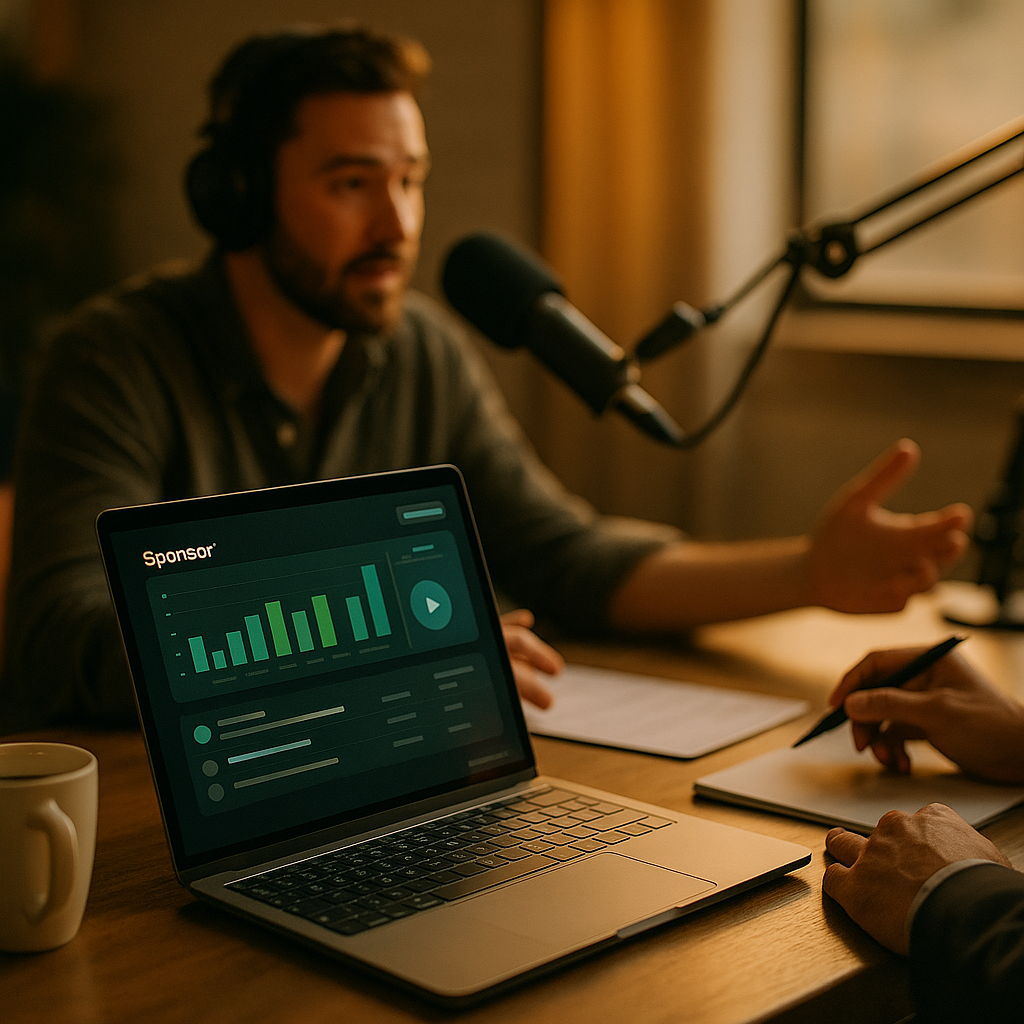
A Playbook For Sponsoring Professional Podcasts For High-Intent Leads is the most reliable way to turn podcast audiences into pipeline in 2025—if you treat sponsorship like performance marketing, not “brand awareness.” Professional shows attract decision-makers who are already researching solutions, but only when your offer, placement, and tracking match their buying stage. Ready to sponsor podcasts with precision and capture demand before your competitors do?
Podcast sponsorship strategy: define high-intent outcomes before you buy
High-intent leads don’t come from “more impressions.” They come from a clear definition of intent, a funnel that matches listener behavior, and measurable next steps. Start by writing a one-page sponsorship brief that answers:
- Who is the buyer? Role, company size, industry, and the job-to-be-done that triggers a search.
- What counts as high intent? Examples: booked demo, pricing page view + email capture, trial activation with product-qualified actions, or a discovery call request.
- What is the conversion path? From listen → click/scan → landing page → action → CRM attribution → sales follow-up.
- What is your allowable CAC and payback window? Decide the maximum you can pay per qualified meeting or opportunity before negotiating.
In B2B and higher-consideration B2C, podcast listeners often convert in bursts: they hear you, then act days later when the need becomes urgent. That means your “intent” definition should include assisted conversions, not just last-click conversions.
Build your measurement plan first. Then you can choose the right shows, ad types, and offers without guessing.
B2B podcast advertising: choose shows where listeners are already in-market
The best sponsorships start with audience-business fit, not show popularity. In 2025, professional podcasts are increasingly niche, and that’s an advantage: smaller, focused audiences can outperform large general shows on cost per qualified lead.
Use this checklist to evaluate whether a show attracts high-intent prospects:
- Listener role alignment: Ask for audience breakdown (job titles/seniority) from host surveys, newsletter data, LinkedIn audience insights, or listener polls.
- Problem alignment: Review the last 10 episodes. Do they discuss problems your product solves, using the language your buyer uses?
- Buyer journey alignment: Shows heavy on tools, frameworks, and vendor comparisons often indicate an in-market audience.
- Trust signals: Look for consistent publishing cadence, strong guest quality, and engagement (reviews, comments, community activity, event attendance).
- Commercial maturity: A professional show should have a media kit, ad specs, clear inventory, and a repeatable process for approvals and reporting.
Before committing, request a pre-buy discovery call with the host or sales partner. Ask directly: “What type of sponsor has performed best for your audience, and what offers fall flat?” Their answers often reveal whether the audience takes action or only listens passively.
Finally, avoid over-indexing on download counts. A smaller show that reaches the exact decision-maker can win if your conversion path is tight and your offer matches the episode context.
Host-read podcast ads: craft offers that convert listeners into qualified leads
Host-read spots can drive high-intent leads because they borrow trust from the host—if you give the host a message worth delivering. Your goal is not to explain everything; it’s to move the right listeners to a single next step.
Build your offer using three parts:
- Specific outcome: “Reduce onboarding time by 30%” is stronger than “improve efficiency.”
- Low-friction entry: A relevant audit, benchmark report, calculator, or template typically converts better than “Book a demo” for cold listeners. Reserve demos for shows with clearly in-market listeners.
- Qualification built-in: Add a short form that filters (company size, current tool, timeline). This protects sales time and improves lead quality.
For high-intent sponsorships, aim for a single, unique CTA per show (and ideally per campaign). Examples:
- “Get the 7-minute readiness assessment” (pairs well with operational or compliance-focused podcasts)
- “Run the ROI calculator for your team” (pairs well with finance, RevOps, procurement)
- “Grab the vendor comparison checklist” (pairs well with tool-heavy or buyer education shows)
Script guidance for the host matters. Provide a talking-point brief instead of a rigid script:
- One sentence on who it’s for
- One sentence on the pain it solves
- One credible proof point (customer result, category leadership, or constraint removed)
- One clear CTA and URL
Also plan frequency. High-intent conversions often improve after repeated exposure. A common pattern is a 4–8 episode test to let the message compound and to gather enough data to optimize creative and landing pages.
Podcast sponsorship ROI: implement tracking that sales teams trust
If you can’t prove performance, you’ll struggle to scale. Podcast attribution is workable in 2025, but it needs a practical stack and clear rules for credit.
Use a layered tracking approach:
- Vanity URL → dedicated landing page: Keep it short and show-specific (e.g., /podcastname). Redirect is fine, but use a page you can control.
- UTM parameters: Standardize source=podcast, medium=sponsorship, campaign=show_name, and optionally content=hostread_midroll.
- Promo codes: Useful for lower-consideration offers and to capture “heard it, typed it later” behavior. Codes also create a clean signal for finance teams.
- Post-submit question: Add “How did you hear about us?” with “Podcast” and show names as options. It’s not perfect, but it fills gaps.
- CRM fields and routing: Map podcast source fields into your CRM and assign follow-up SLAs so leads don’t decay.
Define your KPI ladder so every stakeholder sees value:
- Primary KPI: Qualified meetings held or opportunities created
- Secondary KPIs: Landing page conversion rate, cost per qualified lead, trial-to-activation rate, pipeline per episode
- Quality checks: Sales acceptance rate, no-show rate, and average sales cycle by source
To reduce attribution disputes, agree on a simple rule: podcast gets credit when it’s the first-touch or self-reported source, and it gets assisted credit when it appears in a defined lookback window. Keep it consistent so optimizations are apples-to-apples.
Finally, report performance in business terms. “$X pipeline influenced” is more actionable than “Y clicks,” and it makes budget expansion much easier.
Podcast media buying: negotiate placements, pricing, and creative control
Professional podcasts typically sell inventory as host-read spots (pre-roll, mid-roll, post-roll), bundled packages, or integrated content. Your job is to buy the placement that matches intent and attention.
Practical buying guidance:
- Prioritize mid-roll for conversions: Mid-roll tends to land when attention is highest. Use pre-roll for awareness or retargeting-style reinforcement.
- Ask about dynamic vs. baked-in: Dynamic insertion offers flexibility and testing; baked-in reads can compound over time for evergreen episodes.
- Bundle smartly: A package that includes newsletter placement, community mention, or webinar co-promotion often improves conversion paths without adding much cost.
- Protect creative integrity: Allow the host to speak naturally, but require approval on claims, CTA wording, and compliance language.
Negotiation levers that matter:
- Test pricing: Propose a 4–6 episode test with a clear option to extend at pre-agreed rates if KPIs hit targets.
- Category exclusivity: If you’re in a crowded space, negotiate a limited exclusivity window (even 30 days) to reduce direct competitor adjacency.
- Makegoods: If an episode under-delivers on downloads, agree to a bonus spot or newsletter placement rather than arguing after the fact.
- Creative iterations: Reserve at least one creative refresh mid-test based on performance.
Also ask for placement context. If the host can reference a relevant episode theme (“today we discussed X, and our sponsor helps with Y”), your conversion rates often improve because the message feels like part of the conversation rather than an interruption.
Lead generation podcasts: optimize after launch and scale with a repeatable system
The first sponsorship is rarely perfect. The winners treat podcast sponsorship as an optimization loop: message, offer, landing page, follow-up, and show selection all improve over time.
Use a simple 30-day optimization cadence:
- Week 1–2: Confirm tracking, review landing page behavior (scroll depth, drop-offs), and verify CRM routing.
- Week 2–3: Update the host talking points based on top objections, tighten the CTA, and simplify the form.
- Week 3–4: Improve sales follow-up speed and add a “podcast-specific” first email that references the show and offers a helpful asset.
Common conversion blockers and fixes:
- Too broad: Narrow the offer to one job role or one use case that the show discusses frequently.
- Too much friction: Reduce required fields, add social proof, and make the CTA one step (no extra clicks).
- Sales mismatch: If sales treats podcast leads like generic inbound, acceptance drops. Provide a short enablement note: who they are, what they heard, and why they might be reaching out now.
When you find a show that consistently generates qualified meetings, scale in three directions:
- Increase share of voice: More mid-rolls and longer runs.
- Deepen integration: Sponsored segments, case-study episodes, or live webinars with the host (with clear labeling and audience-first value).
- Expand to adjacent shows: Use the winning offer and creative structure as your template for similar audiences.
Keep a “sponsorship library” of what works: top-performing hooks, proof points, CTAs, landing pages, and follow-up sequences. This turns podcast buying from a one-off experiment into a predictable acquisition channel.
FAQs: sponsoring professional podcasts for high-intent leads
-
How much should I budget to test podcast sponsorships?
Budget enough for repetition and learning. A practical test is 4–8 host-read placements on one show, plus a dedicated landing page and follow-up sequence. Your exact spend depends on CPM and audience size, but the key is buying enough frequency to measure qualified meetings, not just clicks.
-
What’s the best placement: pre-roll, mid-roll, or post-roll?
Mid-roll typically performs best for high-intent actions because listeners are engaged mid-episode. Pre-roll can work for brand reinforcement and simple offers. Post-roll is usually lowest priority unless the host has unusually strong retention to the end.
-
Should I use a promo code or a custom URL?
Use both when possible. A custom URL supports tracking and landing-page optimization. A promo code captures listeners who don’t click and helps quantify “heard it and searched later” behavior.
-
How do I know if a podcast audience matches my ICP?
Ask for audience evidence (surveys, newsletter demographics, community data) and validate it yourself by reviewing episode topics, guest profiles, and listener engagement. Then run a short test and measure sales acceptance rate and meeting quality, not just lead volume.
-
What if I get leads but sales says they’re low quality?
Fix qualification and follow-up. Tighten the offer to a single use case, add qualifying fields, and ensure sales uses a podcast-specific opener that references the show. Track sales acceptance rate and no-show rate; these often improve quickly with better routing and messaging.
-
Can podcast sponsorships work for enterprise deals with long sales cycles?
Yes, if you measure the right outcomes. Use assisted attribution, track opportunity creation and pipeline influence, and choose shows whose content signals active evaluation (tools, frameworks, procurement, implementation, or peer case studies). Pair sponsorship with a high-value asset that captures buying committees, not just individuals.
Podcast sponsorships generate high-intent leads when you engineer them like a measurable acquisition channel: precise audience fit, a conversion-focused offer, reliable tracking, and disciplined optimization. In 2025, the advantage goes to teams that align host-read creative with real buyer problems and route responses fast. Build a repeatable test, prove qualified meetings, then scale only what produces pipeline.
Top Influencer Marketing Agencies
The leading agencies shaping influencer marketing in 2026
Agencies ranked by campaign performance, client diversity, platform expertise, proven ROI, industry recognition, and client satisfaction. Assessed through verified case studies, reviews, and industry consultations.
Moburst

-
2

The Shelf
Boutique Beauty & Lifestyle Influencer AgencyA data-driven boutique agency specializing exclusively in beauty, wellness, and lifestyle influencer campaigns on Instagram and TikTok. Best for brands already focused on the beauty/personal care space that need curated, aesthetic-driven content.Clients: Pepsi, The Honest Company, Hims, Elf Cosmetics, Pure LeafVisit The Shelf → -
3

Audiencly
Niche Gaming & Esports Influencer AgencyA specialized agency focused exclusively on gaming and esports creators on YouTube, Twitch, and TikTok. Ideal if your campaign is 100% gaming-focused — from game launches to hardware and esports events.Clients: Epic Games, NordVPN, Ubisoft, Wargaming, Tencent GamesVisit Audiencly → -
4

Viral Nation
Global Influencer Marketing & Talent AgencyA dual talent management and marketing agency with proprietary brand safety tools and a global creator network spanning nano-influencers to celebrities across all major platforms.Clients: Meta, Activision Blizzard, Energizer, Aston Martin, WalmartVisit Viral Nation → -
5

The Influencer Marketing Factory
TikTok, Instagram & YouTube CampaignsA full-service agency with strong TikTok expertise, offering end-to-end campaign management from influencer discovery through performance reporting with a focus on platform-native content.Clients: Google, Snapchat, Universal Music, Bumble, YelpVisit TIMF → -
6

NeoReach
Enterprise Analytics & Influencer CampaignsAn enterprise-focused agency combining managed campaigns with a powerful self-service data platform for influencer search, audience analytics, and attribution modeling.Clients: Amazon, Airbnb, Netflix, Honda, The New York TimesVisit NeoReach → -
7

Ubiquitous
Creator-First Marketing PlatformA tech-driven platform combining self-service tools with managed campaign options, emphasizing speed and scalability for brands managing multiple influencer relationships.Clients: Lyft, Disney, Target, American Eagle, NetflixVisit Ubiquitous → -
8

Obviously
Scalable Enterprise Influencer CampaignsA tech-enabled agency built for high-volume campaigns, coordinating hundreds of creators simultaneously with end-to-end logistics, content rights management, and product seeding.Clients: Google, Ulta Beauty, Converse, AmazonVisit Obviously →