


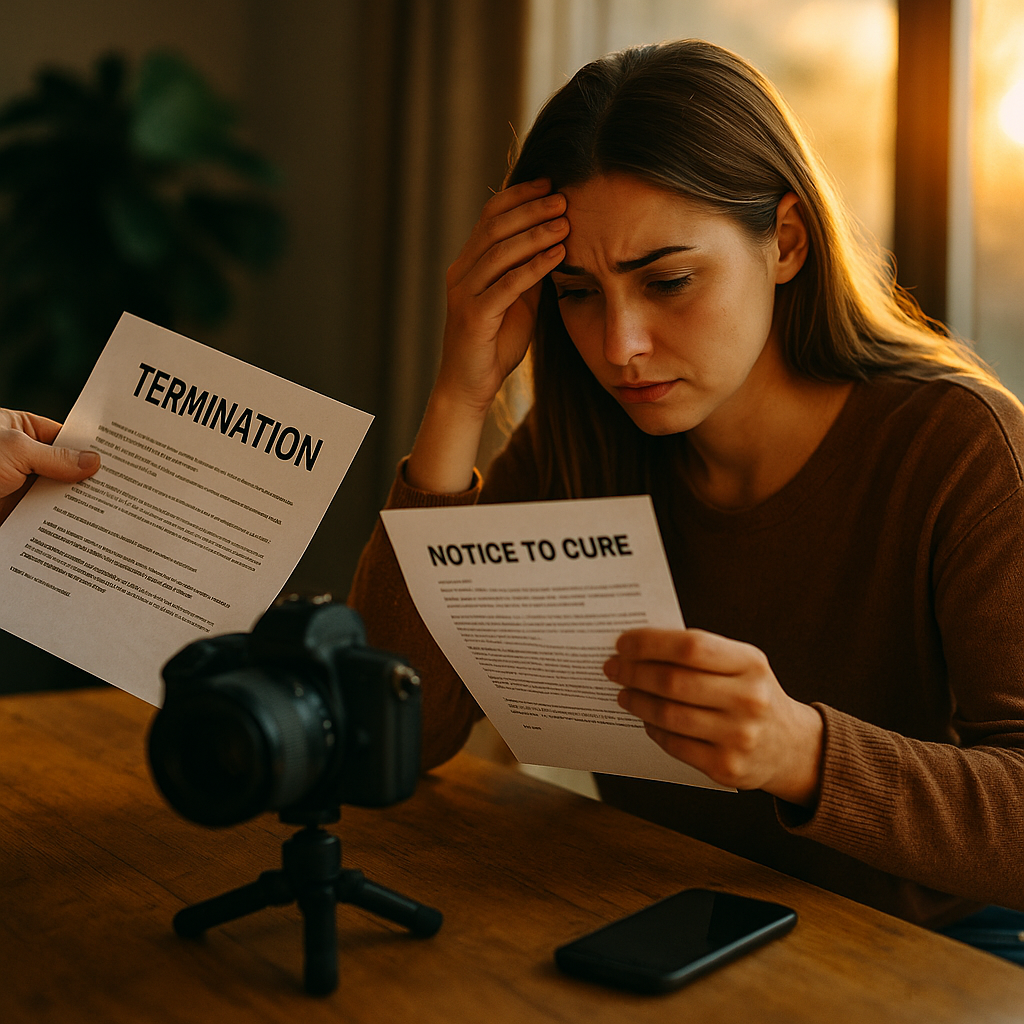
Fire an influencer for a disclosure violation without giving proper notice, and you might owe them full contract value anyway. That is not a hypothetical. It is the reality brands face as more states extend sales representative and dealer protection statutes to long-term creator relationships. Influencer agreements built on old-school “terminate at will” language are increasingly out of step with state right-to-cure requirements, and 2026 is the year that gap gets expensive.
What Right-to-Cure Laws Actually Require
Right-to-cure statutes originated in franchise and sales representative law. The logic is simple: if a business relationship depends on one party investing time, money, or exclusivity into representing another’s brand, that party deserves fair warning before getting cut off. Several states, including Wisconsin under its Fair Dealership Law and New Jersey through its sales representative statutes, require the terminating party to provide written notice of the alleged breach and a defined window (often 30 to 90 days) to fix it before termination becomes final.
These laws were written with car dealerships and manufacturer reps in mind. Nobody was thinking about a beauty creator on a 12-month retainer. But the statutory language in many states is broad enough to sweep in creator agreements that look like ongoing sales arrangements rather than one-off gigs.
If your creator agreement includes commission structures, exclusivity, or auto-renewal terms, it may already resemble the exact relationship these cure statutes were designed to protect.
Why Influencer Contracts Are Suddenly in Scope
Three shifts pushed influencer deals into this legal territory. First, retainer-plus-commission structures became standard, especially in affiliate-heavy programs, as covered in our breakdown of retainer plus revenue share deals. Second, brands started locking creators into longer terms with renewal clauses to protect campaign continuity. Third, and this is the one legal teams miss most, brands increased control over content, posting cadence, and platform selection, the same behavioral markers courts use to determine whether a relationship functions like a dealership rather than a simple services contract.
We have already flagged how tightened control over creator output creates misclassification risk under labor law. Right-to-cure exposure is the sibling problem. Both stem from the same root cause: brands treating creators like employees or dealers in practice while documenting them as independent contractors on paper.
Ambassador programs are particularly exposed. Long-term retainers with renewal options and revenue triggers increasingly resemble the sales rep relationships these statutes target, a pattern we detailed in long term ambassador retainers.
The 2026 Termination Clause Problem
Most influencer agreements still in circulation contain a standard “for cause” termination clause: brand may terminate immediately upon breach, no notice required. That clause was fine when relationships were short and transactional. It is a liability now.
Here is the practical failure mode. A creator posts an undisclosed sponsored story, violating your FTC compliance terms. Legal fires off a termination notice same day. Sounds reasonable, right? But if that creator’s home state treats the relationship as a protected sales arrangement and your contract never gave them a cure window, you may have just triggered a wrongful termination claim, complete with statutory damages that in some states multiply the unpaid contract value.
The kicker: many of these statutes cannot be waived by contract. You cannot simply write “Delaware law governs, no cure period applies” and expect that to hold if the creator resides and performs services in a state with a mandatory cure statute. Courts increasingly look at where the work happens, not just what the choice-of-law clause says.
Building a Cure-Compliant Termination Clause
Fixing this does not mean giving every underperforming creator a free pass. It means structuring termination language so it satisfies statutory notice requirements while still protecting brand safety in genuine emergencies. A workable clause typically separates breaches into two tiers.
- Curable breaches: missed posting deadlines, incomplete disclosure language, minor brand guideline deviations. These get written notice and a specific cure window, commonly 10 to 30 business days depending on the governing state.
- Immediate termination triggers: illegal conduct, reputational harm events, material misrepresentation, or safety violations. These bypass cure periods entirely, but only if your contract explicitly defines them as such upfront.
The second category is where most contracts fail. If your agreement does not clearly carve out immediate-termination scenarios in writing, a court may assume everything falls under the general cure requirement, even conduct you would consider obviously terminable.
Content-related breaches deserve extra specificity here too. Undisclosed sponsorships, AI-generated likeness misuse, or health claim violations should be named explicitly as immediate-termination events, not left to fall into a generic “material breach” bucket that a cure statute might capture. Our review of product liability exposure in health-adjacent campaigns shows how quickly an uncured claim can escalate into a brand safety event, which is exactly the kind of scenario that needs a same-day exit clause, not a 30-day notice period.
What Happens If You Skip the Cure Period?
Skip a mandatory cure period and the creator’s attorney has an easy case. Even if the underlying breach was real and serious, procedural failure on your end can convert a defensible termination into a costly settlement. Some states allow recovery of the full remaining contract value plus attorney fees when a party skips statutorily required notice. That is a brutal outcome for what might have started as a straightforward compliance dispute.
This is also an operational efficiency issue, not just a legal one. Legal teams that build cure periods into standard contract templates spend far less time firefighting individual disputes later. According to HubSpot’s research on B2B contract friction, disputes rooted in unclear termination terms take significantly longer to resolve than those with pre-negotiated cure mechanisms. Build the clarity in upfront, and you avoid the negotiation-under-duress scenario entirely.
A Practical Checklist for Contract Teams
Before renewing or drafting a new influencer agreement for the year ahead, run it against this list:
- Identify every state where active creators reside or primarily perform services, not just where your company is incorporated.
- Flag any agreement with commission, revenue share, or auto-renewal terms for closer review, since these most resemble protected dealer relationships.
- Separate breach types into curable and non-curable categories, and name specific examples in the contract language rather than relying on vague “material breach” phrasing.
- Set cure windows that satisfy the strictest applicable state law among your active creator roster, not just your headquarters state.
- Route termination decisions through legal review before notice goes out, especially for creators on retainers exceeding six months.
Pair this with a standing pre-launch review process. Our pre-launch creator ad review checklist catches disclosure and compliance issues before they escalate into termination disputes at all, which is the cheapest form of risk mitigation available.
The brands getting burned in 2026 are not the ones with bad creators. They are the ones with good termination language written for the wrong decade.
Vesting-linked agreements need the same scrutiny. If equity or bonus payouts are tied to campaign milestones, a botched termination can trigger disputes over vested value on top of the cure violation itself, a compounding risk we broke down in affiliate equity vesting clauses.
Where This Fits Into Broader Contract Hygiene
Right-to-cure compliance should not live in isolation. It sits alongside disclosure standards, tax classification, and data handling as part of a single contract modernization effort. Marketing leaders tracking eMarketer’s creator economy spend data know influencer budgets keep climbing, which means more dollars are exposed every time a termination clause fails to hold up. Treat contract language as a live risk surface, reviewed annually, not a template pulled from a folder in 2019 and never touched again.
Agencies managing multi-brand rosters face compounded exposure here. A single flawed termination template replicated across fifty creator contracts is fifty potential disputes waiting to happen. Centralize your legal review, standardize the cure language, and audit state-specific variations at least once a year as your creator roster shifts.
Next Step
Pull your current influencer agreement template and check the termination section against the state where your highest-value creators actually live and work. If it does not distinguish curable from non-curable breaches with explicit examples, get it rewritten before your next contract cycle, not after your first dispute.
FAQs
What is a right-to-cure clause in an influencer agreement?
It is contract language that requires the brand to notify a creator of a specific breach and give them a defined window to fix it before termination takes effect, mirroring requirements found in state sales representative and dealer protection statutes.
Do right-to-cure laws apply to independent contractors like influencers?
They can, particularly when the relationship includes commission structures, exclusivity, or long-term renewal terms that resemble a sales representative or dealer relationship rather than a simple one-time services agreement.
Can a brand waive right-to-cure requirements through choice-of-law clauses?
Not reliably. Many of these statutes are considered non-waivable in the state where the work is performed, meaning a choice-of-law clause pointing to a different state may not hold up in a dispute.
What breaches should bypass the cure period entirely?
Illegal conduct, serious brand safety incidents, material misrepresentation, and health or safety violations are typically written as immediate-termination triggers, but only if the contract explicitly names them as exceptions to the general cure requirement.
How long is a typical cure period?
Cure periods commonly range from 10 to 90 days depending on the state and the nature of the underlying statute, so brands with creators across multiple states should build contracts around the strictest applicable timeline.
What happens if a brand terminates without honoring a required cure period?
The creator may have grounds for a wrongful termination claim, and some state statutes allow recovery of the full remaining contract value plus attorney fees, even if the underlying breach allegation was legitimate.
Top Influencer Marketing Agencies
The leading agencies shaping influencer marketing in 2026
Agencies ranked by campaign performance, client diversity, platform expertise, proven ROI, industry recognition, and client satisfaction. Assessed through verified case studies, reviews, and industry consultations.
Moburst

-
2

The Shelf
Boutique Beauty & Lifestyle Influencer AgencyA data-driven boutique agency specializing exclusively in beauty, wellness, and lifestyle influencer campaigns on Instagram and TikTok. Best for brands already focused on the beauty/personal care space that need curated, aesthetic-driven content.Clients: Pepsi, The Honest Company, Hims, Elf Cosmetics, Pure LeafVisit The Shelf → -
3

Audiencly
Niche Gaming & Esports Influencer AgencyA specialized agency focused exclusively on gaming and esports creators on YouTube, Twitch, and TikTok. Ideal if your campaign is 100% gaming-focused — from game launches to hardware and esports events.Clients: Epic Games, NordVPN, Ubisoft, Wargaming, Tencent GamesVisit Audiencly → -
4

Viral Nation
Global Influencer Marketing & Talent AgencyA dual talent management and marketing agency with proprietary brand safety tools and a global creator network spanning nano-influencers to celebrities across all major platforms.Clients: Meta, Activision Blizzard, Energizer, Aston Martin, WalmartVisit Viral Nation → -
5

The Influencer Marketing Factory
TikTok, Instagram & YouTube CampaignsA full-service agency with strong TikTok expertise, offering end-to-end campaign management from influencer discovery through performance reporting with a focus on platform-native content.Clients: Google, Snapchat, Universal Music, Bumble, YelpVisit TIMF → -
6

NeoReach
Enterprise Analytics & Influencer CampaignsAn enterprise-focused agency combining managed campaigns with a powerful self-service data platform for influencer search, audience analytics, and attribution modeling.Clients: Amazon, Airbnb, Netflix, Honda, The New York TimesVisit NeoReach → -
7

Ubiquitous
Creator-First Marketing PlatformA tech-driven platform combining self-service tools with managed campaign options, emphasizing speed and scalability for brands managing multiple influencer relationships.Clients: Lyft, Disney, Target, American Eagle, NetflixVisit Ubiquitous → -
8

Obviously
Scalable Enterprise Influencer CampaignsA tech-enabled agency built for high-volume campaigns, coordinating hundreds of creators simultaneously with end-to-end logistics, content rights management, and product seeding.Clients: Google, Ulta Beauty, Converse, AmazonVisit Obviously →