


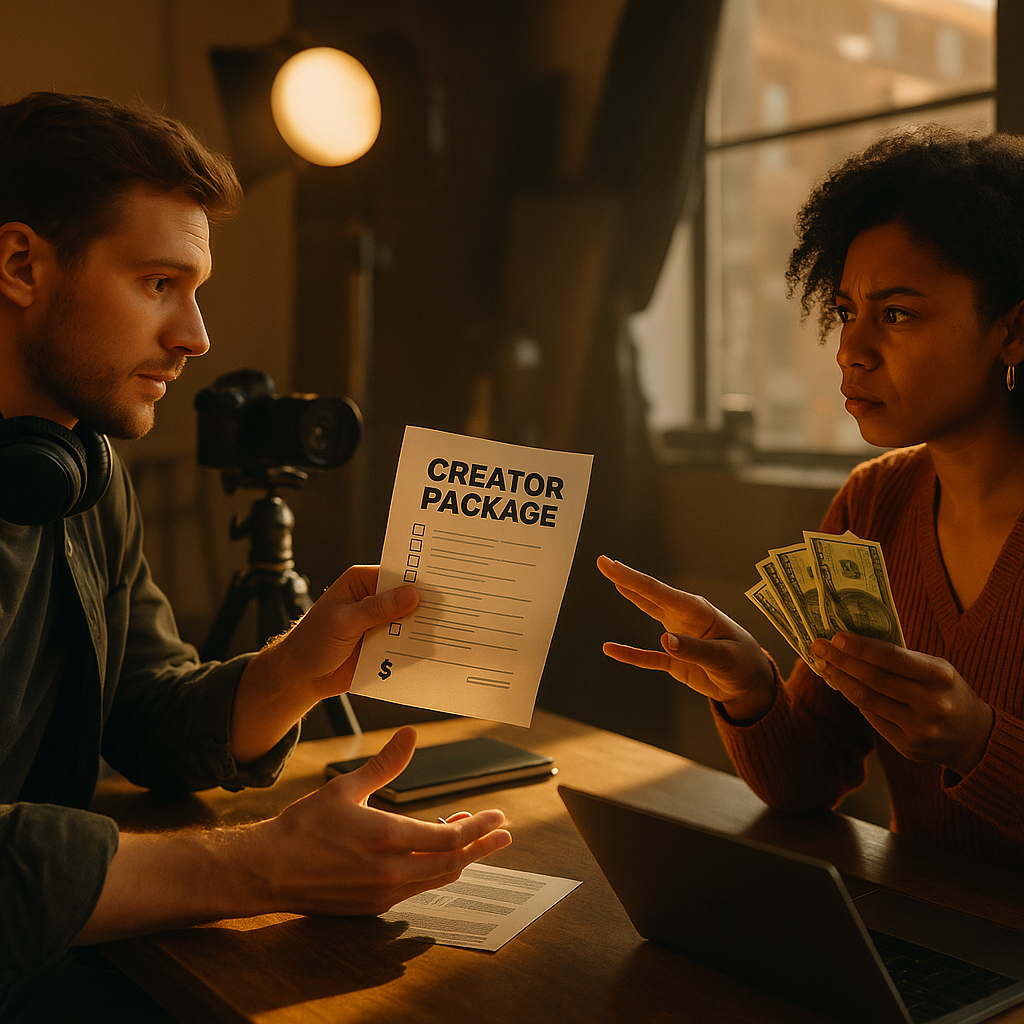
Paramount has a creator roster. So does Warner Bros. Discovery. When the studios that used to buy ad time from agencies start selling creator packages instead, the agency model has a problem. Entertainment brands reposition as content studios is no longer a trend piece, it is a budget line item competing directly with the influencer agencies that marketers have relied on for a decade.
The Studio Pivot Nobody Saw Coming
Legacy entertainment companies spent the last few years losing ground to streaming, losing ground to TikTok, and losing ground to creators who built bigger audiences than most cable networks ever reached. The response wasn’t to fight that shift. It was to join it.
Studios now have in-house creator talent, short-form production arms, and branded content divisions pitching directly to CMOs. NBCUniversal’s creator partnerships group, Warner Bros. Discovery’s social-first content teams, and a wave of similar moves from mid-size entertainment players all point the same direction: studios want the influencer marketing dollars that used to flow exclusively to specialist agencies.
This mirrors a broader pattern covered in our piece on studios bringing creator hiring in house, where IP protection and speed to market pushed entertainment companies to stop outsourcing creator relationships entirely.
Why Would an Entertainment Brand Want to Be an Agency?
Three reasons, and none of them are sentimental.
- Margin. Studios already pay for production infrastructure, editing teams, and distribution deals. Layering creator campaign management on top costs them less than it costs a standalone agency.
- Data access. A studio that owns both the content and the audience relationship gets first-party performance data an agency never sees. That’s leverage in every renewal conversation with a brand client.
- IP control. When a studio produces the creator content itself, it owns the rights outright. No licensing disputes, no usage caps, no renegotiation six months later.
Put simply, studios realized they were sitting on the production capacity to become full-service content partners without ever building from scratch. Agencies spent years building that capacity. Studios already had it.
Entertainment companies aren’t entering influencer marketing as a side hustle. They’re repositioning core production assets to compete for the same brand budgets agencies have owned for a decade.
What This Looks Like in a Brand Pitch
Picture a beverage brand shopping for a creator campaign tied to a streaming series premiere. A traditional agency pitch bundles talent sourcing, briefing, and media buying. A studio pitch now bundles all of that, plus the actual show IP, plus cross-promotion inside the platform’s existing content slate, plus production resources that an agency would have to subcontract out.
That’s a hard package to beat on price or speed. It’s also a package that didn’t exist five years ago. The studios aren’t just adding a service line, they’re restructuring entire divisions around it, a shift documented in our coverage of full-cycle agencies merging talent, content, and media buying into single offerings. Studios are copying that model, except they start with a content library and distribution channels agencies can only rent.
Production Quotas Are Becoming the New Battleground
Studios are also importing production discipline that creator agencies have had to adopt under pressure. Monthly content quotas, standardized asset counts, and repeatable production templates used to be an agency innovation born out of necessity, as we detailed in our look at how a 40-ad monthly quota turns creator content into production lines. Studios are now running similar quota systems, except with soundstages and editing bays most agencies could never afford.
That production muscle is exactly what’s letting studios undercut agency timelines. A campaign that takes an agency three weeks to produce might take a studio team five days, because the crew, the gear, and the post-production pipeline already exist on-site.
The ROI Question Brands Can’t Ignore
Here’s the uncomfortable part. Influencer marketing already has a measurement problem. Our research found that 37 percent of brands cannot prove influencer ROI at all, and that was before studios entered the picture with their own proprietary attribution claims.
Studios will tell you their first-party data is better. Maybe it is. But “better” and “verifiable by your own analytics team” are not the same thing. Brand marketers need to push studio partners for the same transparency they’d demand from an agency: raw performance data, not just a polished recap deck. Industry benchmarks from sources like eMarketer and Sprout Social remain useful cross-checks against whatever a studio reports internally.
This measurement gap compounds a trend we’ve tracked closely: short-form attention is plateauing while ROI proof still lags. Adding a new category of vendor claiming proprietary data advantages doesn’t fix that gap, it just adds another layer brands have to audit.
A studio owning both the content and the distribution channel isn’t automatically a measurement advantage for your brand. It can just as easily be a black box you have no independent way to verify.
Risk and Compliance: What Changes When Studios Run the Show
Entertainment companies bring different legal infrastructure than influencer agencies. That cuts both ways.
On one hand, studios typically have stronger contract teams and more experience with union rules, talent releases, and IP licensing than a boutique influencer agency ever will. On the other, disclosure practices built for traditional advertising don’t always translate cleanly to creator content. The FTC’s endorsement guidelines apply regardless of whether the content comes from a studio-backed creator or an independent one, and brand marketers remain on the hook for compliance even when production is outsourced to a studio partner.
Ask studio partners directly how they handle disclosure labeling, talent contracts, and usage rights before signing. Don’t assume studio polish means regulatory readiness. If anything, the scale these studios operate at, often running dozens of creators across multiple shows simultaneously, raises the stakes if disclosure practices are inconsistent. That scale problem echoes what we found in brands managing 50-plus creator rosters to cut CPM and risk, where volume without standardized compliance processes becomes a liability fast.
How Agencies Are Responding
Influencer agencies aren’t sitting still. Many are moving toward longer-term retainers instead of one-off campaigns, a shift we covered in brands ditching one-off deals for multi-quarter creator contracts. The logic: if studios are going to compete on production scale, agencies need to compete on relationship depth and strategic consistency instead.
Some agencies are also leaning into AI-assisted production to close the efficiency gap studios have through in-house infrastructure. Adoption is already high, with AI adoption hitting 88 percent among marketing teams even though efficiency gains remain unproven. Tools from HubSpot and similar platforms are helping smaller agencies automate briefing and reporting workflows that studios handle with dedicated staff.
How Brand Marketers Should Evaluate This Shift
You don’t need to pick a side between studios and agencies. You need a framework for evaluating either against your actual campaign goals.
- Ask who owns the content rights after the campaign ends, and for how long you can use it.
- Request raw performance data, not summary dashboards, especially from studio partners claiming proprietary attribution advantages.
- Confirm disclosure processes align with FTC guidance before any content goes live.
- Compare true production timelines against agency quotes. Studio speed claims should be verified with past client references.
- Check creator exclusivity terms. Studio rosters often tie talent to specific shows or franchises, which can limit creative flexibility compared to an agency’s open talent pool.
None of this is about distrust for its own sake. It’s basic vendor diligence applied to a category that’s changing faster than most procurement teams have updated their checklists for.
Where This Goes Next
Expect more entertainment brands to formalize creator divisions over the next few quarters, not fewer. The economics favor it: existing infrastructure, first-party audience data, and IP they already own make the influencer category an obvious extension rather than a new business line. Agencies that survive this shift will be the ones that compete on measurement transparency and strategic flexibility rather than trying to out-produce a studio at its own game.
Brand marketers don’t need to predict who wins. They need vendor contracts and measurement standards that hold up no matter who’s producing the content.
Frequently Asked Questions
Why are entertainment brands becoming content studios for influencer marketing?
Entertainment companies already own production infrastructure, talent relationships, and distribution channels. Extending that into influencer campaign management costs them less than it costs a standalone agency to build the same capacity from scratch, and it gives studios first-party audience data they can use to compete for brand budgets.
Is working with a studio-backed creator division riskier than an agency?
Not inherently, but the risks are different. Studios often have stronger contract and IP infrastructure, but disclosure practices built for traditional advertising don’t always translate cleanly to creator content. Brand marketers should confirm FTC-compliant disclosure processes regardless of vendor type.
How should brands measure ROI when a studio controls both content and distribution?
Request raw performance data rather than summarized recap decks, and cross-check studio-reported metrics against independent benchmarks from sources like eMarketer or Sprout Social. Proprietary data access is not the same as verifiable ROI.
Will this trend replace traditional influencer agencies?
Unlikely in the near term. Agencies are adapting by shifting toward multi-quarter retainers and deeper strategic relationships rather than competing purely on production scale, where studios currently have a structural advantage.
What should be in a vendor contract with a studio-based creator division?
Clear content ownership terms, usage rights duration, disclosure compliance commitments, and defined performance reporting access. Treat studio partnerships with the same contractual rigor as any agency engagement, not less.
Top Influencer Marketing Agencies
The leading agencies shaping influencer marketing in 2026
Agencies ranked by campaign performance, client diversity, platform expertise, proven ROI, industry recognition, and client satisfaction. Assessed through verified case studies, reviews, and industry consultations.
Moburst

-
2

The Shelf
Boutique Beauty & Lifestyle Influencer AgencyA data-driven boutique agency specializing exclusively in beauty, wellness, and lifestyle influencer campaigns on Instagram and TikTok. Best for brands already focused on the beauty/personal care space that need curated, aesthetic-driven content.Clients: Pepsi, The Honest Company, Hims, Elf Cosmetics, Pure LeafVisit The Shelf → -
3

Audiencly
Niche Gaming & Esports Influencer AgencyA specialized agency focused exclusively on gaming and esports creators on YouTube, Twitch, and TikTok. Ideal if your campaign is 100% gaming-focused — from game launches to hardware and esports events.Clients: Epic Games, NordVPN, Ubisoft, Wargaming, Tencent GamesVisit Audiencly → -
4

Viral Nation
Global Influencer Marketing & Talent AgencyA dual talent management and marketing agency with proprietary brand safety tools and a global creator network spanning nano-influencers to celebrities across all major platforms.Clients: Meta, Activision Blizzard, Energizer, Aston Martin, WalmartVisit Viral Nation → -
5

The Influencer Marketing Factory
TikTok, Instagram & YouTube CampaignsA full-service agency with strong TikTok expertise, offering end-to-end campaign management from influencer discovery through performance reporting with a focus on platform-native content.Clients: Google, Snapchat, Universal Music, Bumble, YelpVisit TIMF → -
6

NeoReach
Enterprise Analytics & Influencer CampaignsAn enterprise-focused agency combining managed campaigns with a powerful self-service data platform for influencer search, audience analytics, and attribution modeling.Clients: Amazon, Airbnb, Netflix, Honda, The New York TimesVisit NeoReach → -
7

Ubiquitous
Creator-First Marketing PlatformA tech-driven platform combining self-service tools with managed campaign options, emphasizing speed and scalability for brands managing multiple influencer relationships.Clients: Lyft, Disney, Target, American Eagle, NetflixVisit Ubiquitous → -
8

Obviously
Scalable Enterprise Influencer CampaignsA tech-enabled agency built for high-volume campaigns, coordinating hundreds of creators simultaneously with end-to-end logistics, content rights management, and product seeding.Clients: Google, Ulta Beauty, Converse, AmazonVisit Obviously →