


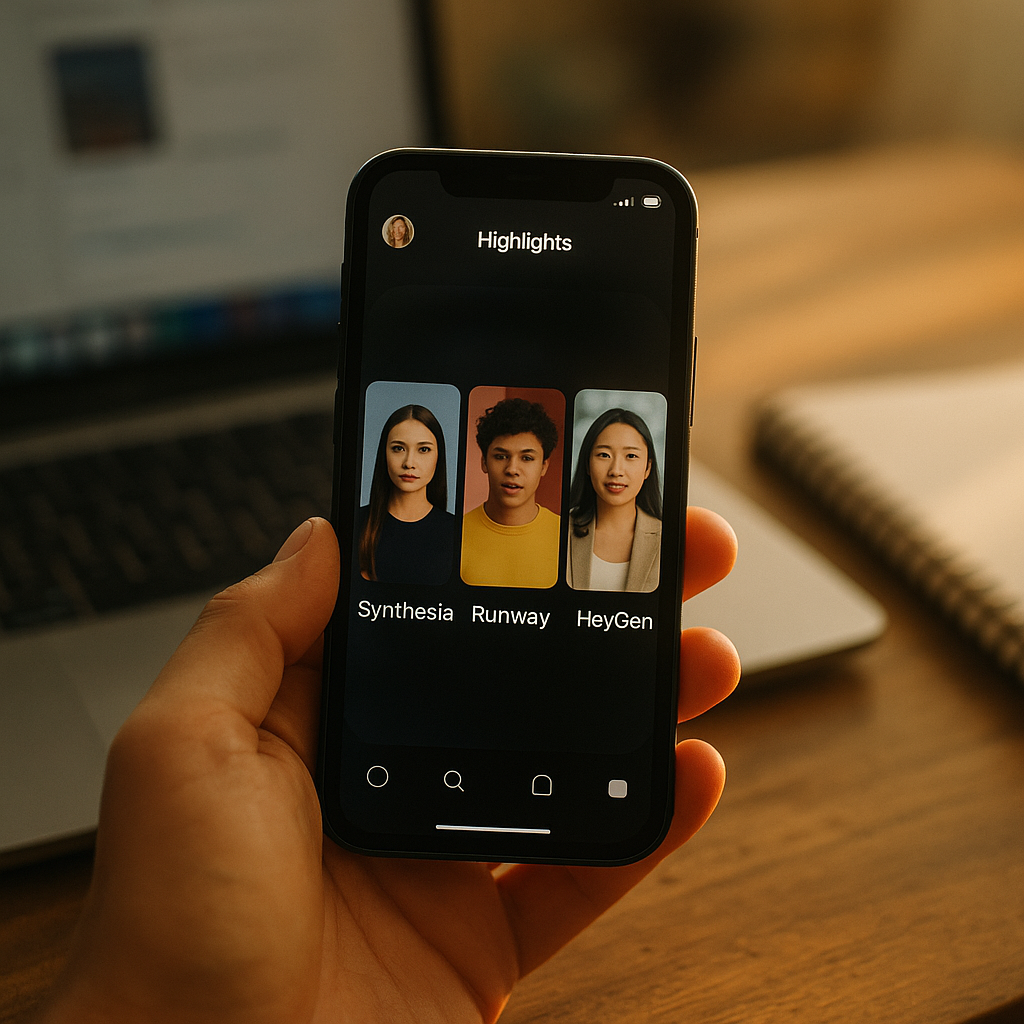
Instagram now surfaces Highlights above fresh Reels for a growing share of users. That single feed change is quietly forcing brands to rethink how much polish, personality, and speed their video content needs. If you’re evaluating AI video generation tools to keep pace, the honest answer is: Synthesia, Runway, and HeyGen solve very different problems, and picking the wrong one wastes budget you won’t get back.
Why Highlights-First Changes the Video Brief
Instagram’s algorithm update rewards content that earns a second life. Highlights aren’t ephemeral Stories anymore, they’re curated, permanent shelves sitting at the top of a profile, often the first thing a prospective follower or customer sees before a single Reel. That means the video sitting in your Highlights needs to work as evergreen brand collateral, not just a fast, disposable post chasing a trending sound.
For brand teams, this shifts the calculus. You’re no longer optimizing purely for reach velocity. You’re optimizing for a piece of content that might sit on a profile for months, get screenshotted, get linked from a bio, and represent the brand to someone doing due diligence before a purchase. That’s a fundamentally different production standard than a 12-hour trending Reel.
Highlights-first feeds mean your AI-generated video is no longer a disposable asset — it’s semi-permanent brand collateral competing with a first impression, not a fleeting scroll.
The Three Tools, Briefly
Synthesia is built for structured, presenter-led video: think avatar spokespeople delivering scripted messages at scale, in dozens of languages, with minimal production overhead. Runway leans into generative creative control, text-to-video, motion brushes, style transfer, the kind of tool a creative team uses to make something that looks nothing like stock footage. HeyGen sits between the two, avatar and voice cloning with a heavier emphasis on speed, social-native formats, and creator-style delivery.
None of these were built with “Instagram Highlights” as the primary use case. That’s exactly why comparing them through this specific lens matters more than a generic feature checklist.
Synthesia: Consistency Over Creativity
Synthesia’s real strength is repeatability. If your brand needs a Highlights cover video explaining a return policy, a product walkthrough, or an FAQ series that stays evergreen across markets, Synthesia produces a consistent presenter look across dozens of videos without booking a studio or a talent each time. According to HubSpot’s marketing benchmarks, explainer and how-to video remains one of the highest-converting content formats for consideration-stage buyers, which is precisely the job Highlights now does.
The tradeoff: Synthesia avatars still read as “corporate AI” to a sharp-eyed Instagram audience. For a Highlights tab meant to feel like an extension of a creator or founder, that polish can work against you. It’s the right tool for B2B brands, SaaS explainer content, or multi-language product support videos. It’s the wrong tool if your brand voice depends on feeling human and unscripted.
Runway: Built for Craft, Not Speed
Runway is the tool creative teams reach for when the output needs to look genuinely original, stylized backgrounds, generative b-roll, motion effects no camera could capture cheaply. For a brand launch Highlight or a flagship product reveal that needs to stop the scroll and then live permanently on a profile, Runway’s generative video quality is arguably the most cinematic of the three.
But that quality comes with a production tax. Runway workflows still require creative direction, iteration, and often a skilled operator to get outputs that don’t look uncanny. It’s not the tool for a marketing ops team that needs fifty localized Highlights covers by Friday. Think of Runway as your flagship-asset tool, not your volume tool.
HeyGen: Speed, Personality, Social-Native Feel
HeyGen has positioned itself closest to how creators actually talk on camera, casual delivery, voice cloning that sounds less like a call-center IVR, and templates built explicitly for short vertical formats. For brands trying to make Highlights feel like a real person talking directly to a follower rather than a corporate asset, HeyGen currently threads that needle better than Synthesia and faster than Runway.
This matters because Highlights-first behavior rewards parasocial trust. A visitor lands on a profile, taps a Highlight, and within seconds forms an opinion about whether this brand feels authentic. HeyGen’s avatar naturalism, while still imperfect, tends to survive that scrutiny better than more obviously synthetic presenter tools.
Head-to-Head: What Actually Matters for Highlights
- Perceived authenticity: HeyGen and Runway generally outperform Synthesia for social-native believability; Synthesia wins for polished, informational trust.
- Turnaround speed: HeyGen and Synthesia both support rapid template-based output; Runway requires more creative iteration time.
- Localization at scale: Synthesia’s multi-language avatar dubbing remains the strongest for global brands running the same Highlight across markets.
- Creative differentiation: Runway wins outright if the Highlight needs to look nothing like a templated AI video.
- Cost per asset: HeyGen and Synthesia scale more cheaply per video; Runway’s per-asset cost climbs with iteration and higher-end model usage.
None of these tools solve brand compliance automatically. If you’re pushing AI-generated video across multiple creators, markets, or product lines, you still need a review layer that checks tone, claims, and disclosure before anything hits a profile permanently. That’s a governance problem, not a rendering problem, and it’s worth reading how teams are handling it in brand compliance vetting at scale.
The Compliance Question Nobody Asks Until It’s Too Late
Synthetic presenters and voice clones sit in a legally gray zone that regulators are actively tightening. The FTC has signaled increasing scrutiny of AI-generated endorsements and undisclosed synthetic media, and the ICO has flagged similar concerns around AI-generated likeness and consent in the UK. If your Highlights video uses an avatar that could be mistaken for a real spokesperson, disclosure isn’t optional, it’s a liability question your legal team should sign off on before publishing, not after a complaint.
This is where a lot of marketing teams get sloppy. They treat AI video tools purely as a production shortcut and skip the same due-diligence rigor they’d apply to any vendor touching brand reputation. That’s a mistake worth avoiding, and the AI vendor due-diligence checklist is a useful starting point if you haven’t formalized one.
Building the Actual Decision Framework
Stop asking “which tool is best.” Ask which job the Highlight is doing. A support-and-FAQ Highlight is a Synthesia job. A flagship brand-story Highlight is a Runway job. A “meet the founder” or influencer-style Highlight is a HeyGen job. Most mature brands will end up running all three in parallel, mapped to content type rather than picking a single platform to standardize on.
Budget accordingly. A Highlights strategy that assumes one AI tool covers every use case usually produces content that’s technically fine and emotionally flat, exactly the outcome a permanent, first-impression asset can’t afford.
The brands winning the Highlights-first shift aren’t picking one AI video tool. They’re matching tool to job: Synthesia for consistency, Runway for craft, HeyGen for social trust.
It’s also worth benchmarking against how avatar-led video performs beyond Instagram specifically, since the underlying production tradeoffs are consistent across platforms. The avatar-led video buyers framework is a useful cross-check before locking in a vendor contract, especially if you’re negotiating annual terms. And if procurement is involved, don’t skip the fine print on model updates, since model substitution clauses can quietly change output quality mid-contract without renegotiation.
Measuring Whether It Actually Worked
Once a Highlight is live, resist the urge to judge it by view count alone. Highlights don’t behave like Reels, they’re browsed, not scrolled, so completion rate, tap-through to bio links, and profile-to-follow conversion are better signals. Sprout Social’s engagement benchmarking approach is a reasonable model for building this into a quarterly review, and pairing it with a broader attribution framework prevents teams from over-crediting a single video for downstream sales. For that broader lens, the influencer attribution framework is directly applicable here.
Platform-level data from eMarketer continues to show short-form video consumption climbing across demographics, which only raises the stakes on getting the format-to-tool match right rather than defaulting to whatever’s fastest to render.
FAQs
Which AI video tool is best for Instagram Highlights specifically?
There’s no single winner. HeyGen tends to perform best for social-native, creator-style Highlights; Synthesia suits informational or multi-language content; Runway suits flagship, high-craft brand moments. Match the tool to the content job, not the other way around.
Do AI-generated avatars need disclosure on Instagram?
Increasingly, yes. Regulators including the FTC have signaled that undisclosed synthetic spokespeople in ads or endorsements can violate disclosure rules. Treat any avatar that could be mistaken for a real person as a compliance question, not just a creative one.
Is Runway too slow for regular content production?
For high-volume, templated content, yes, Runway’s iteration-heavy workflow isn’t built for speed. It’s better reserved for a small number of high-impact assets rather than a weekly content calendar.
How does Highlights-first change video length or format requirements?
Highlights favor content built to be watched in full and revisited, so tighter editing, clear structure, and a strong opening few seconds matter more than they did for disposable Reels competing purely on scroll-stopping power.
Can these tools replace human-shot brand video entirely?
Not yet, and probably not soon. They’re strongest for scale, consistency, and speed on specific formats. Flagship brand storytelling still tends to benefit from human production, even when AI tools assist in post or ideation.
Pick your tool by job, not by hype: run a small pilot across all three formats, measure Highlight completion and tap-through rates for a month, then commit budget to whichever pairing actually earned trust.
Top Influencer Marketing Agencies
The leading agencies shaping influencer marketing in 2026
Agencies ranked by campaign performance, client diversity, platform expertise, proven ROI, industry recognition, and client satisfaction. Assessed through verified case studies, reviews, and industry consultations.
Moburst

-
2

The Shelf
Boutique Beauty & Lifestyle Influencer AgencyA data-driven boutique agency specializing exclusively in beauty, wellness, and lifestyle influencer campaigns on Instagram and TikTok. Best for brands already focused on the beauty/personal care space that need curated, aesthetic-driven content.Clients: Pepsi, The Honest Company, Hims, Elf Cosmetics, Pure LeafVisit The Shelf → -
3

Audiencly
Niche Gaming & Esports Influencer AgencyA specialized agency focused exclusively on gaming and esports creators on YouTube, Twitch, and TikTok. Ideal if your campaign is 100% gaming-focused — from game launches to hardware and esports events.Clients: Epic Games, NordVPN, Ubisoft, Wargaming, Tencent GamesVisit Audiencly → -
4

Viral Nation
Global Influencer Marketing & Talent AgencyA dual talent management and marketing agency with proprietary brand safety tools and a global creator network spanning nano-influencers to celebrities across all major platforms.Clients: Meta, Activision Blizzard, Energizer, Aston Martin, WalmartVisit Viral Nation → -
5

The Influencer Marketing Factory
TikTok, Instagram & YouTube CampaignsA full-service agency with strong TikTok expertise, offering end-to-end campaign management from influencer discovery through performance reporting with a focus on platform-native content.Clients: Google, Snapchat, Universal Music, Bumble, YelpVisit TIMF → -
6

NeoReach
Enterprise Analytics & Influencer CampaignsAn enterprise-focused agency combining managed campaigns with a powerful self-service data platform for influencer search, audience analytics, and attribution modeling.Clients: Amazon, Airbnb, Netflix, Honda, The New York TimesVisit NeoReach → -
7

Ubiquitous
Creator-First Marketing PlatformA tech-driven platform combining self-service tools with managed campaign options, emphasizing speed and scalability for brands managing multiple influencer relationships.Clients: Lyft, Disney, Target, American Eagle, NetflixVisit Ubiquitous → -
8

Obviously
Scalable Enterprise Influencer CampaignsA tech-enabled agency built for high-volume campaigns, coordinating hundreds of creators simultaneously with end-to-end logistics, content rights management, and product seeding.Clients: Google, Ulta Beauty, Converse, AmazonVisit Obviously →