


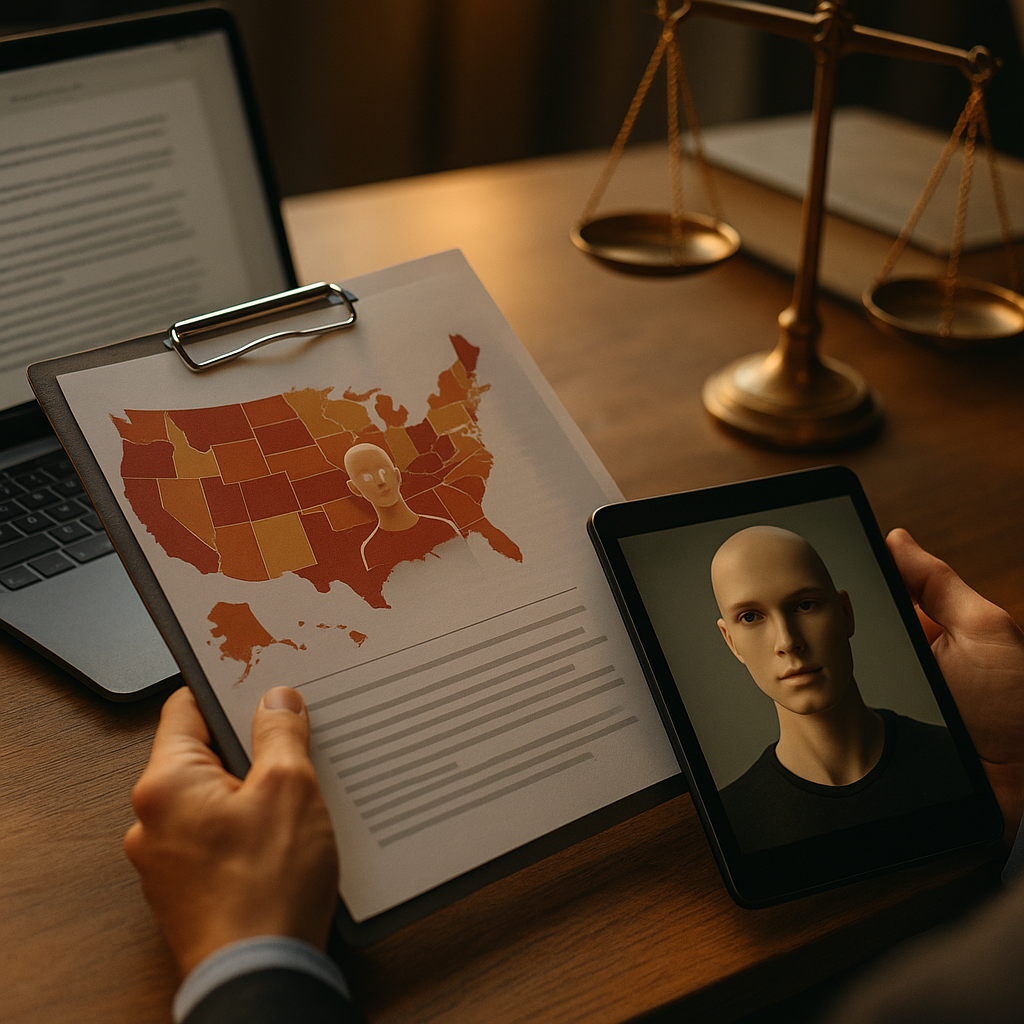
Nine states now require disclosure when a “performer” in your ad isn’t real. Three more take effect before the holidays. If your Q4 media plan includes any AI-generated spokesperson, digital twin, or synthetic influencer, synthetic performer disclosure laws are no longer a legal footnote — they’re a launch blocker. Miss one state’s labeling threshold and you’re pulling creative mid-flight.
Why This Suddenly Matters for Q4
Brands leaned hard into AI-generated spokespeople this year. Cheaper than talent contracts, infinitely scalable, no usage-rights renegotiation every six months. The catch? Lawmakers noticed at the same time marketers did.
Since New York’s synthetic performer statute took effect, at least eight other states have introduced or passed parallel legislation, each with its own definition of “synthetic,” its own disclosure trigger, and its own penalty structure. Some laws apply only to political advertising. Others cover any commercial use where a reasonable consumer might believe they’re watching a real human. That distinction determines whether your Q4 campaign needs a label, a contract amendment, or a complete creative pivot.
A campaign compliant in Texas can be a violation in California the same week, with the only difference being how “digitally created performer” gets defined in each statute.
We covered the mechanics of the first major statute in our breakdown of New York’s synthetic performer law. What’s changed since then is scale — this is no longer a one-state problem you can localize around.
The State Matrix: What’s Actually Enforceable Right Now
Track these five categories for every state where you’re running paid or organic creator content this quarter:
- California: Requires clear disclosure for AI-generated or digitally altered performers in advertising and political content. Enforcement ties into existing deceptive advertising statutes, meaning penalties can stack with false advertising claims.
- New York: The broadest definition in the country. Covers synthetic performers used in commercial endorsements, not just political ads. Disclosure must be “clear and conspicuous,” language borrowed directly from FTC guidance.
- Texas: Narrower scope, focused primarily on political and election-adjacent content, but a 2027 expansion to commercial advertising is already drafted and moving through committee.
- Illinois: Disclosure required specifically when a synthetic performer is used to make an implied endorsement or testimonial claim. This hits influencer-style AI content the hardest.
- Washington: Pending legislation with a proposed private right of action, which would let consumers sue brands directly rather than waiting on state AG enforcement.
Colorado, Minnesota, and Louisiana all have bills at various stages, and none of them use identical language. That’s the operational nightmare: there’s no federal preemption forcing a single standard, so your compliance team is chasing a moving target state by state. We’ve mapped the broader pattern of this fragmentation in our state-by-state Section 5 exposure analysis.
Where FTC Rules and State Law Collide
Here’s the part most brand teams miss: state synthetic performer laws don’t replace FTC disclosure obligations, they stack on top of them. The FTC’s Section 5 authority over deceptive endorsements still applies nationally, regardless of what a given state requires. So even if you’re running a campaign in a state with no synthetic performer statute yet, an undisclosed AI spokesperson can still trigger federal action.
This layering creates a compliance floor-and-ceiling problem. The FTC sets the floor. States set varying ceilings. Your disclosure practice needs to satisfy the strictest applicable requirement across every market where the content runs — and if you’re running paid social nationally, that’s every state with an active law simultaneously.
We broke down how to reconcile these overlapping obligations in our guide to state AI disclosure laws and FTC Section 5. Short version: build to the strictest state standard as your default, then treat looser state rules as your minimum floor rather than your target.
What Counts as a “Synthetic Performer,” Anyway?
This is where legal teams lose sleep. Definitions vary wildly:
- Some statutes only cover fully AI-generated humans with no real-world reference (pure synthetic).
- Others include digital twins or likeness clones of real people, even with consent.
- A few extend to voice cloning alone, no visual component required.
- At least one pending bill covers AI-enhanced footage of real performers if the enhancement alters expressed opinions or claims.
If your Q4 plan includes a licensed digital twin of a real creator, or an AI voiceover reading a real influencer’s script, you may trip a disclosure requirement even though a human was involved somewhere in production. Run every asset through a definitional checklist before it goes live, not after legal flags it during a platform audit.
Building Your Tracking System Before Launch
Spreadsheets break down fast here because these laws update on rolling legislative sessions, not a fixed annual calendar. A few practical fixes:
- Assign state ownership. One person or team tracks legislative status per state, updated monthly minimum, weekly during active session periods.
- Tag campaigns by geo-target, not headquarters location. If your brand is based in Ohio but the paid media targets California users, California’s law applies to that placement.
- Build disclosure language into creative templates upfront. Don’t bolt on a label after the edit is locked. Bake the strictest-state disclosure into every AI-performer asset by default.
- Loop in procurement. If you’re licensing synthetic performer tech from a vendor, your contract needs indemnification language addressing state-level violations, not just federal FTC exposure.
This is the same operational discipline we recommend for broader creator compliance tracking — see our framework for an annual compliance calendar for the underlying cadence structure.
The Contract Layer Nobody’s Fixing Fast Enough
Most influencer and AI-vendor contracts still don’t allocate liability for state-level disclosure failures. If a synthetic performer clip runs without proper labeling in Illinois, who eats the fine — the brand, the agency, or the AI tool vendor? Right now, in most standard MSAs, the answer is unclear or defaults to the brand by omission.
If your vendor contract was written before this year’s wave of state legislation, it almost certainly doesn’t address synthetic performer disclosure liability at all.
Fix this before Q4 assets go into production, not after a demand letter arrives. Our legal review checklist for AI-generated UGC disclosure walks through the specific clauses to add, and our piece on who pays when AI vendor tools fail covers the adjacent liability-allocation problem for automated buying tools, which uses similar contract logic.
Platform Rules Aren’t a Substitute for Legal Compliance
TikTok, YouTube, and Meta all have their own AI-content labeling requirements, and brand teams sometimes assume checking the platform box covers state law too. It doesn’t. Platform labels address transparency to users within that platform’s ecosystem; state statutes address consumer protection and advertising law, often with separate enforcement bodies and separate penalty structures.
We laid out exactly where these frameworks diverge in our comparison of platform AI labels versus FTC disclosure rules. Treat platform compliance and state legal compliance as two separate checklists, reviewed by two separate functions, even when the label ends up looking identical on screen.
For data on how fast marketers are adopting AI-generated creative without matching compliance investment, eMarketer’s research on AI ad adoption is a useful benchmark, as is Statista’s tracking of synthetic media usage across marketing sectors. The FTC’s own enforcement guidance on endorsements remains the baseline every state law builds from.
Next Step
Don’t wait for a unified federal standard — it isn’t coming before Q4. Pull your current media plan, flag every asset using AI-generated or digitally enhanced performers, cross-reference against the state matrix above, and route anything ambiguous to legal this week, not the week before launch.
FAQs
What is a synthetic performer under state disclosure laws?
Definitions vary by state, but generally a synthetic performer is any AI-generated, digitally cloned, or substantially altered human likeness used in advertising or endorsement content where a reasonable viewer might believe they’re seeing a real, unaltered person.
Do synthetic performer disclosure laws apply if my brand isn’t headquartered in that state?
Yes. Most statutes apply based on where the content is viewed or targeted, not where the advertiser is based. If your paid media geo-targets a state with an active law, that law applies to the placement.
Does FTC compliance mean I’m automatically compliant with state synthetic performer laws?
No. FTC Section 5 sets a national floor for deceptive endorsement practices, but state laws can impose stricter or more specific disclosure requirements. You need to meet both simultaneously.
Can platform AI labels replace legal disclosure requirements?
No. Platform-level labels address in-app transparency and are separate from state consumer protection statutes. A campaign can be fully labeled per platform policy and still violate a state disclosure law.
What happens if a synthetic performer clip runs without required disclosure?
Consequences vary by state but can include regulatory fines, cease-and-desist orders, and in states with a private right of action, direct consumer lawsuits against the brand.
Top Influencer Marketing Agencies
The leading agencies shaping influencer marketing in 2026
Agencies ranked by campaign performance, client diversity, platform expertise, proven ROI, industry recognition, and client satisfaction. Assessed through verified case studies, reviews, and industry consultations.
Moburst

-
2

The Shelf
Boutique Beauty & Lifestyle Influencer AgencyA data-driven boutique agency specializing exclusively in beauty, wellness, and lifestyle influencer campaigns on Instagram and TikTok. Best for brands already focused on the beauty/personal care space that need curated, aesthetic-driven content.Clients: Pepsi, The Honest Company, Hims, Elf Cosmetics, Pure LeafVisit The Shelf → -
3

Audiencly
Niche Gaming & Esports Influencer AgencyA specialized agency focused exclusively on gaming and esports creators on YouTube, Twitch, and TikTok. Ideal if your campaign is 100% gaming-focused — from game launches to hardware and esports events.Clients: Epic Games, NordVPN, Ubisoft, Wargaming, Tencent GamesVisit Audiencly → -
4

Viral Nation
Global Influencer Marketing & Talent AgencyA dual talent management and marketing agency with proprietary brand safety tools and a global creator network spanning nano-influencers to celebrities across all major platforms.Clients: Meta, Activision Blizzard, Energizer, Aston Martin, WalmartVisit Viral Nation → -
5

The Influencer Marketing Factory
TikTok, Instagram & YouTube CampaignsA full-service agency with strong TikTok expertise, offering end-to-end campaign management from influencer discovery through performance reporting with a focus on platform-native content.Clients: Google, Snapchat, Universal Music, Bumble, YelpVisit TIMF → -
6

NeoReach
Enterprise Analytics & Influencer CampaignsAn enterprise-focused agency combining managed campaigns with a powerful self-service data platform for influencer search, audience analytics, and attribution modeling.Clients: Amazon, Airbnb, Netflix, Honda, The New York TimesVisit NeoReach → -
7

Ubiquitous
Creator-First Marketing PlatformA tech-driven platform combining self-service tools with managed campaign options, emphasizing speed and scalability for brands managing multiple influencer relationships.Clients: Lyft, Disney, Target, American Eagle, NetflixVisit Ubiquitous → -
8

Obviously
Scalable Enterprise Influencer CampaignsA tech-enabled agency built for high-volume campaigns, coordinating hundreds of creators simultaneously with end-to-end logistics, content rights management, and product seeding.Clients: Google, Ulta Beauty, Converse, AmazonVisit Obviously →