


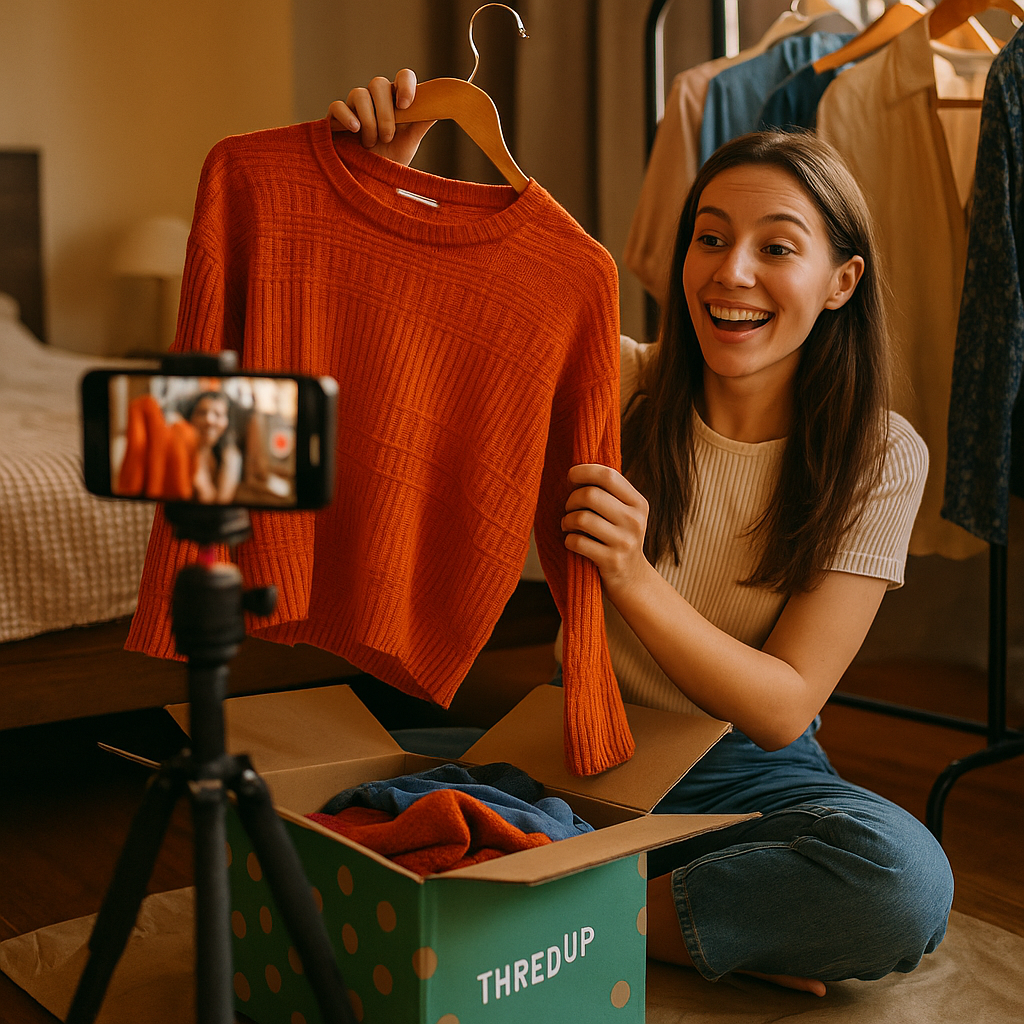
ThredUp cut its blended customer acquisition cost by pairing unpaid, nano-creator “resale haul” content with a tightly scoped seeding program — and in several tested cohorts, that content outperformed prospecting campaigns on Meta and TikTok on pure cost-per-acquisition. Can a $30 thrift haul filmed in a bedroom really beat a professionally targeted ad? The secondhand fashion market says yes.
The resale giant didn’t stumble into this. It built a deliberate creator strategy around an unglamorous truth: thrift shoppers trust other thrift shoppers, not brands. That single insight reshaped how ThredUp allocates budget between paid media and creator seeding.
The CPA Problem Every Resale Brand Faces
Resale is a trust category. Buyers want proof that used clothing doesn’t mean compromised quality, and they want to see real inventory, not a stock photo of a “curated” bundle. Paid social ads, no matter how well targeted, struggle here. They look like ads. And thrift shoppers, by nature, are skeptical of anything that smells like a sales pitch.
ThredUp’s paid social CPA had been climbing steadily as platform costs rose across the board. That’s not unique to ThredUp: eMarketer has tracked rising CPMs across Meta and TikTok for several consecutive quarters, squeezing margins for any brand relying heavily on prospecting campaigns. For a low-margin resale model, every dollar of CPA inflation eats directly into unit economics.
So the team asked a different question: what if the ad itself was the problem, not the targeting?
Why Nano-Creators, Not Macro Influencers
ThredUp didn’t chase creators with huge followings. It went the other direction, working with nano-creators, typically 1,000 to 20,000 followers, who already posted thrift and resale content organically. These weren’t polished fashion influencers. Many were college students, budget-conscious moms, or vintage-obsessed hobbyists filming hauls in cluttered bedrooms with visible laundry piles in the background.
That imperfection was the point. A resale haul that looks too produced reads as inauthentic, and inauthenticity kills conversion in a trust-driven category. Nano-creators bring something paid media structurally cannot: peer credibility. Their audience already trusts them because the relationship predates the brand deal.
ThredUp’s internal testing found that haul-style content from nano-creators converted at a lower cost-per-acquisition than lookalike-audience prospecting ads, even though the media spend behind the creator content was a fraction of the paid budget.
This mirrors a pattern showing up across categories. Liquid I.V.’s nano-creator seeding strategy rebuilt consumer trust using the same logic: smaller creators, higher believability, lower cost per conversion. Poppi ran a nearly identical playbook after facing a reputational challenge that required micro-creator trust rebuilding. Trust deficits, whether from category skepticism or brand controversy, respond to the same fix: real people, real product, real reactions.
What a “Resale Haul” Actually Looks Like
The format is simple, almost boringly so. A creator receives a ThredUp box (sometimes gifted product, sometimes a discount code, rarely a large flat fee) and films themselves unboxing it. They try on pieces. They react honestly, including when something doesn’t fit or isn’t what they expected. They mention the price paid versus retail value. Then they link out, usually through a bio link or on-screen code.
No script. No brand-approved talking points beyond basic FTC disclosure requirements. That’s deliberate. ThredUp’s brief guidance was reportedly closer to “show what you got and how you feel about it” than a traditional ad brief with mandatory messaging pillars.
This is where the format differs meaningfully from typical influencer marketing. Most brand briefs try to control the narrative. ThredUp’s approach ceded control on purpose, betting that unscripted reactions would out-convert anything scripted. The bet paid off, largely because resale shoppers can smell a script from a mile away.
The Numbers Behind the Shift
While ThredUp hasn’t published a full line-item breakdown of the program, the directional data lines up with broader industry benchmarks. HubSpot’s marketing research has repeatedly found that user-generated and creator content outperforms brand-produced ads on trust metrics, and trust is the single biggest lever in a resale purchase decision.
Three factors drove the CPA advantage:
- Lower production and media cost per asset. A haul video costs a fraction of a produced ad, and when it performs, it can be boosted with a small paid spend behind it, a tactic sometimes called creator whitelisting or spark ads.
- Higher watch-through and completion rates. Unscripted haul content holds attention longer than a 15-second product ad because viewers are curious what’s in the box, not just what the brand wants them to notice.
- Better audience-message fit. Nano-creators tend to have hyper-engaged, niche audiences already primed for thrift and value shopping, reducing wasted impressions compared to broad paid targeting.
This isn’t a ThredUp-only phenomenon. Ryobi’s nano-creator program beat big-box retail media on cost-per-sale, and separately, Ryobi’s nano-creator network outperformed paid social on ROAS in a different campaign wave. Different categories entirely, tools versus thrift fashion, but the same underlying mechanic: small creators with real audiences beat broad paid reach when trust is the conversion bottleneck.
Operational Lessons for Brand Teams
Marketers reading this shouldn’t assume nano-creator seeding is a free lunch. It requires infrastructure that most paid social teams don’t already have.
ThredUp reportedly worked with a creator management layer to handle sourcing, product seeding logistics, and disclosure compliance at scale. Managing hundreds of nano-creators individually is not a spreadsheet job past a certain volume. Brands need either an in-house creator ops function or a platform partner to handle contracting, FTC-compliant disclosure guidance, and payment at scale. The FTC’s endorsement guidelines apply regardless of creator size or whether compensation was cash or product, and enforcement risk doesn’t scale down just because the creator’s following does.
Second, measurement gets messier. Nano-creator programs don’t fit neatly into last-click attribution models built for paid social. ThredUp needed to track code-based conversions, promo redemptions, and directional lift rather than relying purely on platform-reported conversions. Brands used to Meta Ads Manager dashboards will need to build parallel tracking, unique discount codes, UTM-tagged links, or post-purchase surveys, to properly credit creator-driven sales.
The brands winning on CPA right now aren’t necessarily spending less. They’re spending differently, shifting budget from impressions bought to trust earned.
Third, volume matters more than virality. One nano-creator video rarely moves revenue. ThredUp’s advantage came from running dozens, likely hundreds, of these hauls concurrently across different niches: petite fashion, plus-size thrift, vintage collecting, sustainable fashion. That breadth let the program reach adjacent audiences that a single paid campaign’s targeting parameters would never surface.
Where This Fits in the Broader Creator Economy Shift
ThredUp’s approach reflects a wider reallocation happening across retail and DTC marketing budgets. Sprout Social’s platform data has shown declining organic reach and rising ad fatigue pushing brands toward creator-led formats that don’t read as advertising. Vessi saw something similar when one TikTok video turned into a shop referral engine, proving that a single piece of authentic content can outperform a full paid campaign cycle when the format fits the platform’s native behavior.
The resale category has an added tailwind: sustainability messaging resonates more when it comes from a peer than from a brand. A creator saying “I got this for $12 instead of $80 retail, and it kept a pair of jeans out of a landfill” lands differently than the same claim in ad copy. It’s not that the message changes. It’s who’s delivering it.
None of this means paid social is dead for resale brands. ThredUp still runs prospecting and retargeting campaigns; the shift isn’t elimination, it’s rebalancing. Paid social still does heavy lifting for retargeting warm audiences and driving app installs at scale. But for top-of-funnel trust-building, especially in categories where skepticism is the default, nano-creator content earns its budget line more efficiently than cold prospecting ads.
What Brands Should Actually Do With This
Start small. Pick one niche audience segment your brand already under-serves with paid targeting, and run a 90-day nano-creator seeding test against your current paid social CPA benchmark. Use unique promo codes for clean attribution, brief creators loosely rather than tightly, and measure completion rate alongside CPA, not just conversions.
Frequently Asked Questions
What is a nano-creator resale haul?
It’s unscripted video content, typically on TikTok or Instagram Reels, where a small creator (usually under 20,000 followers) unboxes and reacts to secondhand or thrifted clothing, often received through a brand seeding program rather than a paid sponsorship deal.
Why did ThredUp’s nano-creator content outperform paid social on CPA?
Resale purchases depend heavily on trust, and unscripted peer content builds that trust more effectively than polished ads. Lower production costs, higher completion rates, and better audience-message fit combined to lower blended acquisition cost compared to prospecting campaigns.
Is nano-creator seeding cheaper than running paid social ads?
Media and production costs are typically lower, but the hidden cost is operational: managing creator sourcing, disclosure compliance, and attribution tracking at scale requires dedicated resources or a third-party platform partner.
How do brands measure ROI from nano-creator campaigns without standard ad platform data?
Most brands use unique discount codes, UTM-tagged links, and post-purchase attribution surveys to approximate creator-driven conversions, since these campaigns don’t generate the same clean, platform-reported metrics as paid social.
Does this strategy work outside the resale and fashion category?
Yes. Similar nano-creator approaches have driven measurable cost-per-sale or ROAS improvements in categories ranging from power tools to functional beverages, suggesting the mechanic is about trust deficits and audience fit rather than being resale-specific.
Frequently Asked Questions
What is a nano-creator resale haul?
It’s unscripted video content, typically on TikTok or Instagram Reels, where a small creator (usually under 20,000 followers) unboxes and reacts to secondhand or thrifted clothing, often received through a brand seeding program rather than a paid sponsorship deal.
Why did ThredUp’s nano-creator content outperform paid social on CPA?
Resale purchases depend heavily on trust, and unscripted peer content builds that trust more effectively than polished ads. Lower production costs, higher completion rates, and better audience-message fit combined to lower blended acquisition cost compared to prospecting campaigns.
Is nano-creator seeding cheaper than running paid social ads?
Media and production costs are typically lower, but the hidden cost is operational: managing creator sourcing, disclosure compliance, and attribution tracking at scale requires dedicated resources or a third-party platform partner.
How do brands measure ROI from nano-creator campaigns without standard ad platform data?
Most brands use unique discount codes, UTM-tagged links, and post-purchase attribution surveys to approximate creator-driven conversions, since these campaigns don’t generate the same clean, platform-reported metrics as paid social.
Does this strategy work outside the resale and fashion category?
Yes. Similar nano-creator approaches have driven measurable cost-per-sale or ROAS improvements in categories ranging from power tools to functional beverages, suggesting the mechanic is about trust deficits and audience fit rather than being resale-specific.
Top Influencer Marketing Agencies
The leading agencies shaping influencer marketing in 2026
Agencies ranked by campaign performance, client diversity, platform expertise, proven ROI, industry recognition, and client satisfaction. Assessed through verified case studies, reviews, and industry consultations.
Moburst

-
2

The Shelf
Boutique Beauty & Lifestyle Influencer AgencyA data-driven boutique agency specializing exclusively in beauty, wellness, and lifestyle influencer campaigns on Instagram and TikTok. Best for brands already focused on the beauty/personal care space that need curated, aesthetic-driven content.Clients: Pepsi, The Honest Company, Hims, Elf Cosmetics, Pure LeafVisit The Shelf → -
3

Audiencly
Niche Gaming & Esports Influencer AgencyA specialized agency focused exclusively on gaming and esports creators on YouTube, Twitch, and TikTok. Ideal if your campaign is 100% gaming-focused — from game launches to hardware and esports events.Clients: Epic Games, NordVPN, Ubisoft, Wargaming, Tencent GamesVisit Audiencly → -
4

Viral Nation
Global Influencer Marketing & Talent AgencyA dual talent management and marketing agency with proprietary brand safety tools and a global creator network spanning nano-influencers to celebrities across all major platforms.Clients: Meta, Activision Blizzard, Energizer, Aston Martin, WalmartVisit Viral Nation → -
5

The Influencer Marketing Factory
TikTok, Instagram & YouTube CampaignsA full-service agency with strong TikTok expertise, offering end-to-end campaign management from influencer discovery through performance reporting with a focus on platform-native content.Clients: Google, Snapchat, Universal Music, Bumble, YelpVisit TIMF → -
6

NeoReach
Enterprise Analytics & Influencer CampaignsAn enterprise-focused agency combining managed campaigns with a powerful self-service data platform for influencer search, audience analytics, and attribution modeling.Clients: Amazon, Airbnb, Netflix, Honda, The New York TimesVisit NeoReach → -
7

Ubiquitous
Creator-First Marketing PlatformA tech-driven platform combining self-service tools with managed campaign options, emphasizing speed and scalability for brands managing multiple influencer relationships.Clients: Lyft, Disney, Target, American Eagle, NetflixVisit Ubiquitous → -
8

Obviously
Scalable Enterprise Influencer CampaignsA tech-enabled agency built for high-volume campaigns, coordinating hundreds of creators simultaneously with end-to-end logistics, content rights management, and product seeding.Clients: Google, Ulta Beauty, Converse, AmazonVisit Obviously →