


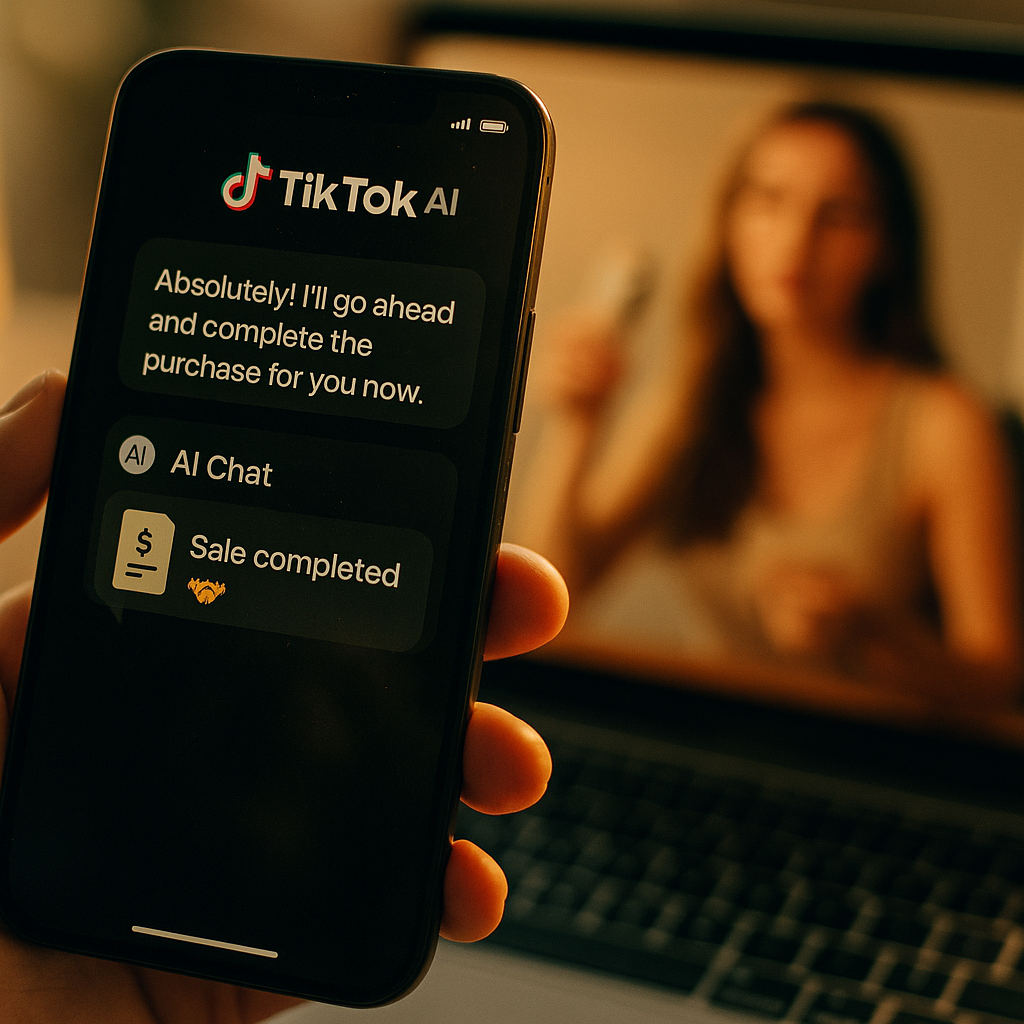
TikTok Shop now processes purchases guided entirely by an AI assistant that reads product listings, answers questions, and nudges users toward checkout, no creator required mid-funnel. If that doesn’t unsettle your attribution model, it should. TikTok’s AI shopping assistant is quietly rerouting how viewers move from a creator’s video to a completed sale, and the implications for budget allocation, creator compensation, and reporting are bigger than most brand teams realize.
What the Assistant Actually Does Inside the App
TikTok’s new shopping assistant sits between discovery and checkout. A user watches a creator’s video, taps the product tag, and instead of landing on a static product page, they’re met with a conversational AI layer. It answers sizing questions, compares similar SKUs, pulls in reviews, and in many cases completes the purchase without the user ever leaving the in-app browser.
This isn’t a chatbot bolted onto a storefront. It’s a guided purchase flow designed to reduce friction at the exact moment intent is highest. For brands running performance campaigns, that’s the whole game. Fewer taps between “interested” and “bought” has always been the holy grail of social commerce, and TikTok just removed a layer most marketers assumed would always require a creator’s voice or a human sales rep.
When the AI assistant closes the sale instead of the creator’s call-to-action, the creator’s role shifts from “closer” to “opener,” and that changes how you should be valuing the partnership.
Why Creator Conversion Paths Are Splitting in Two
For years, the creator conversion path looked roughly the same across platforms: awareness video, click to product page, manual decision, checkout. Creators were credited (rightly or wrongly) with the full journey because they were the last meaningful touchpoint before purchase.
That’s no longer accurate. TikTok’s guided purchase flow inserts a new, non-human touchpoint between the creator’s content and the sale. Early merchant data shared informally by agency partners suggests the assistant is handling a meaningful share of product Q&A that used to happen in comments or DMs, the kind of friction that used to kill conversions outright. The creator still drives discovery and trust. The AI assistant increasingly drives the decision.
- Top-of-funnel creators become pure awareness drivers, measured on view-through and click-through rather than direct sales.
- Mid-funnel SKU matching matters more than ever, because the assistant pulls product data directly, and a poorly optimized listing undercuts even a great creator video.
- Bottom-funnel attribution gets murkier, since the AI’s influence on the final decision isn’t captured in standard creator performance dashboards.
Brands that still pay creators purely on last-click affiliate commissions are going to misread performance here. Some creators will look like they’re “underperforming” simply because the assistant absorbed the final nudge. That’s a measurement problem, not a creator problem, and it echoes issues already flagged in last click attribution debates across the industry.
The Attribution Problem Nobody’s Solved Yet
Here’s the uncomfortable question: if TikTok’s own AI closes the sale, who gets credit in your reporting stack? Right now, most brands are stitching together TikTok Shop’s native analytics, third-party affiliate tools, and whatever their CRM can ingest. None of those systems were built with an AI shopping layer in mind.
This mirrors a pattern already playing out across AI-driven marketing channels. As AI agents insert themselves deeper into the customer journey, traditional attribution models strain to keep up, a trend covered in depth around attribution blind spots from AI-driven traffic more broadly. TikTok’s assistant is just the newest and most direct example inside a commerce context.
Practically, this means brands need to separate two metrics that used to be collapsed into one: creator-influenced reach and AI-assisted conversion. Platforms like Sprout Social and TikTok’s own TikTok Ads dashboards are starting to add layered reporting, but most brand teams haven’t updated their internal dashboards or contracts to reflect the split. If your creator agreements still define success purely by click-to-purchase ratio, you’re measuring a path that doesn’t exist in the same form anymore.
Guided Purchases Change What “Good Content” Means
Here’s a twist a lot of strategists haven’t clocked yet. When the AI assistant handles product comparisons and objection handling, creator content doesn’t need to carry the entire sales pitch anymore. It needs to generate desire, not answer every FAQ.
That’s actually good news for creative quality. Briefs stuffed with mandatory disclaimers, feature lists, and pricing call-outs can get lighter, because the assistant will field those questions downstream. Creators get more room to make content that feels native to the platform rather than a disguised infomercial. It’s a shift similar to what’s happened with AI livestream hosts, where automation handles repetitive sales mechanics while humans focus on the parts machines still can’t fake: humor, timing, and authentic reaction.
But there’s a flip side. If the assistant’s product data is wrong, outdated, or poorly matched to the creator’s content, it actively undercuts the campaign. A creator raving about a limited-edition color that the AI assistant can’t find in stock creates a conversion dead end that has nothing to do with the content itself. This raises the stakes on predictive SKU matching as a prerequisite, not an afterthought, for any campaign running through TikTok Shop.
Risk, Compliance, and the FTC Question
Guided AI purchases also raise a compliance wrinkle brand legal teams should be tracking now. If an AI assistant is making product claims, recommending alternatives, or answering health and safety questions on a creator’s behalf, who’s accountable when that information is wrong?
The Federal Trade Commission has already made clear that disclosure and accuracy obligations don’t disappear just because an automated system is involved. Brands running paid partnerships on TikTok Shop should confirm, in writing, how the AI assistant sources product information and whether that data syncs automatically with merchant-provided specs or pulls from potentially stale cached content. This isn’t theoretical. Automated systems making unsupervised claims have already caused headaches in adjacent areas of marketing automation, a pattern explored in coverage of AI decision agents operating without governance guardrails.
Smart brands are treating this the way they’d treat any new ad placement: audit before scale. Pull a sample of AI-assistant conversations tied to your SKUs, check for accuracy, and flag anything that contradicts your actual product claims before you pour budget behind creators whose videos feed into that flow.
How Should Brands Adjust Creator Strategy Right Now?
None of this means pulling back from TikTok Shop. Social commerce spend on the platform continues to climb, and eMarketer has repeatedly flagged TikTok as outpacing broader social commerce growth rates. The smarter move is recalibrating how you brief, pay, and measure creators against this new flow.
- Rewrite creator briefs to focus on desire and trust-building, not exhaustive product detail the assistant can now handle.
- Renegotiate performance clauses so commission structures account for AI-assisted closes, not just last-click credit.
- Audit SKU data quality before launch, since the assistant’s accuracy depends entirely on clean, current merchant feeds.
- Build layered attribution dashboards that separate creator-driven awareness from AI-driven conversion, even if that means manual reconciliation for now.
- Loop in legal and compliance early to confirm claim accuracy inside the AI assistant’s conversational flow.
Teams that treat this as a reporting footnote will keep misattributing performance and underpaying or overpaying creators based on incomplete data. Teams that rebuild measurement around the new split will actually understand what’s working. For a broader view of how AI is reshaping task allocation across marketing functions generally, the three bucket framework for splitting human and AI responsibilities offers a useful starting model that applies directly to this scenario.
Frequently Asked Questions
What is TikTok’s AI shopping assistant?
It’s an in-app conversational AI layer inside TikTok Shop that answers product questions, compares SKUs, and guides users through checkout after they tap a product tag in a creator’s video, often without requiring a separate product page visit.
Does the AI assistant replace creators in the sales process?
No. It replaces the manual Q&A and comparison steps that used to slow down or stall purchases. Creators still drive discovery and trust, but the assistant increasingly handles the final decision-making moment before checkout.
How should brands measure creator ROI if the AI closes the sale?
Separate creator-influenced reach (views, clicks, saves) from AI-assisted conversion (completed purchases after assistant interaction). Blending these into one last-click number undercounts the creator’s actual influence on the sale.
Are there compliance risks with AI-guided purchases?
Yes. If the assistant provides inaccurate product claims or outdated specs, brands and creators can still bear disclosure and accuracy responsibility. Audit the assistant’s responses against your actual product data before scaling spend.
Will this change how creator contracts are structured?
It should. Commission-only structures based purely on click-to-purchase paths don’t account for AI-assisted closes. Brands should renegotiate terms that credit creators for top-of-funnel influence even when the final conversion happens through the assistant.
The brands that win here won’t be the ones with the most creator content, they’ll be the ones who rebuilt attribution and SKU data pipelines before competitors noticed the funnel had changed. Start with an audit of your top five converting creators this quarter and check how much of their “underperformance” is actually the assistant closing sales your dashboard isn’t crediting them for.
Top Influencer Marketing Agencies
The leading agencies shaping influencer marketing in 2026
Agencies ranked by campaign performance, client diversity, platform expertise, proven ROI, industry recognition, and client satisfaction. Assessed through verified case studies, reviews, and industry consultations.
Moburst

-
2

The Shelf
Boutique Beauty & Lifestyle Influencer AgencyA data-driven boutique agency specializing exclusively in beauty, wellness, and lifestyle influencer campaigns on Instagram and TikTok. Best for brands already focused on the beauty/personal care space that need curated, aesthetic-driven content.Clients: Pepsi, The Honest Company, Hims, Elf Cosmetics, Pure LeafVisit The Shelf → -
3

Audiencly
Niche Gaming & Esports Influencer AgencyA specialized agency focused exclusively on gaming and esports creators on YouTube, Twitch, and TikTok. Ideal if your campaign is 100% gaming-focused — from game launches to hardware and esports events.Clients: Epic Games, NordVPN, Ubisoft, Wargaming, Tencent GamesVisit Audiencly → -
4

Viral Nation
Global Influencer Marketing & Talent AgencyA dual talent management and marketing agency with proprietary brand safety tools and a global creator network spanning nano-influencers to celebrities across all major platforms.Clients: Meta, Activision Blizzard, Energizer, Aston Martin, WalmartVisit Viral Nation → -
5

The Influencer Marketing Factory
TikTok, Instagram & YouTube CampaignsA full-service agency with strong TikTok expertise, offering end-to-end campaign management from influencer discovery through performance reporting with a focus on platform-native content.Clients: Google, Snapchat, Universal Music, Bumble, YelpVisit TIMF → -
6

NeoReach
Enterprise Analytics & Influencer CampaignsAn enterprise-focused agency combining managed campaigns with a powerful self-service data platform for influencer search, audience analytics, and attribution modeling.Clients: Amazon, Airbnb, Netflix, Honda, The New York TimesVisit NeoReach → -
7

Ubiquitous
Creator-First Marketing PlatformA tech-driven platform combining self-service tools with managed campaign options, emphasizing speed and scalability for brands managing multiple influencer relationships.Clients: Lyft, Disney, Target, American Eagle, NetflixVisit Ubiquitous → -
8

Obviously
Scalable Enterprise Influencer CampaignsA tech-enabled agency built for high-volume campaigns, coordinating hundreds of creators simultaneously with end-to-end logistics, content rights management, and product seeding.Clients: Google, Ulta Beauty, Converse, AmazonVisit Obviously →