


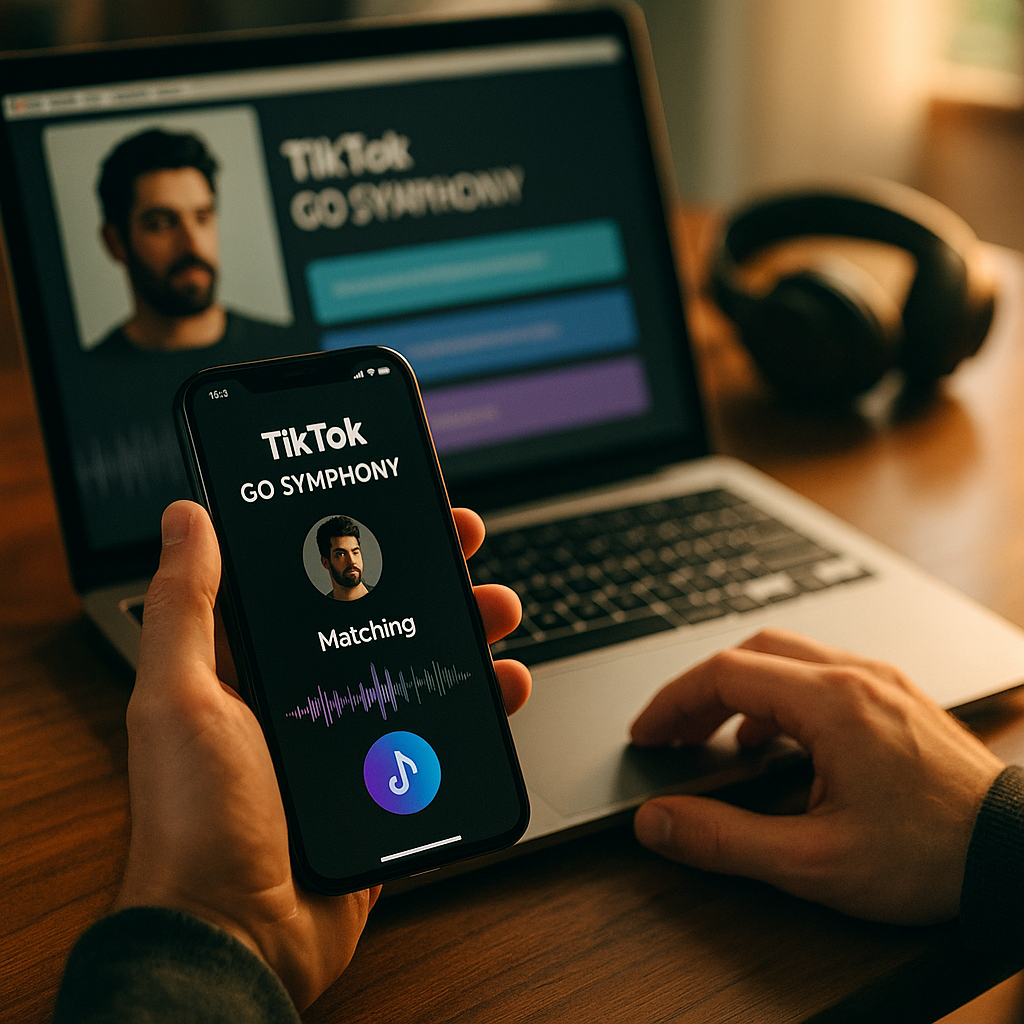
73% of marketers say finding the right creator is the single biggest bottleneck in influencer campaigns — and TikTok just bet its entire creator marketplace on solving that with an AI agent nobody outside the platform fully understands. TikTok Go’s AI-matched creator network, powered by the Symphony agent, promises to compress weeks of manual vetting into minutes. But if you’re allocating six or seven figures against its recommendations, “trust the algorithm” isn’t good enough. You need to know what’s happening under the hood.
This walkthrough breaks down how Symphony actually scores, ranks, and surfaces talent inside TikTok Go — and where brand teams still need to keep a hand on the wheel.
What Symphony Actually Is (and Isn’t)
Symphony is TikTok’s generative AI suite, originally pitched as a creative co-pilot for ad production. The creator-matching layer inside TikTok Go is a newer application of that same infrastructure: a recommendation engine trained on platform behavior data, content classification models, and advertiser performance history. It’s not a chatbot you negotiate with. It’s a scoring system that ranks creators against a campaign brief and hands brands a shortlist.
Think of it less like an assistant and more like a programmatic ad exchange, except the inventory is people, not impressions. That distinction matters, because it changes how you should evaluate the output. You’re not reviewing “suggestions” in the loose sense — you’re reviewing the results of a weighted algorithm making probabilistic bets on fit.
Symphony doesn’t recommend creators it “likes.” It recommends creators whose historical signal patterns statistically resemble your brief’s stated goals — which is a very different thing, and one worth interrogating before you sign off on spend.
The Matching Pipeline, Step by Step
Based on TikTok’s own documentation and how the tool behaves in practice, the matching process runs through four distinct stages before a creator ever appears in a brand’s dashboard.
- Brief ingestion and intent parsing. The brand inputs campaign goals, target demo, budget range, content category, and brand safety parameters. Symphony’s NLP layer parses this into structured tags — audience age band, vertical, tone, format preference (Spark Ads vs. organic-style content).
- Audience overlap scoring. Symphony cross-references the creator’s follower graph against TikTok’s first-party audience data, estimating overlap with the brand’s declared target segment. This is the same backend that powers TikTok’s ad targeting, so it’s leveraging genuinely deep behavioral data, not just follower count or engagement rate.
- Content classification and safety filtering. Every video a creator has posted gets run through TikTok’s content moderation classifiers, tagging for brand suitability, controversial topics, and past policy strikes. Creators with recent violations get down-ranked or excluded outright.
- Performance prediction. Using historical campaign data from similar briefs, Symphony generates a predicted performance range (engagement rate, estimated CPM, conversion likelihood) for each shortlisted creator.
The output is a ranked list, typically 15-30 creators, each with a fit score and a predicted performance band. Brands can filter further, but the initial ranking is entirely algorithmic.
Where the Scoring Weights Actually Live
Here’s the part TikTok doesn’t publish in plain language: how much weight each factor gets relative to the others. From testing across multiple verticals, audience overlap appears to carry the heaviest weighting, followed by content safety classification, then historical performance, with declared creator niche/category coming in as a lighter signal used mostly for initial filtering rather than final ranking.
That ordering has a practical implication. A creator with a smaller but highly-overlapping audience can outrank a bigger name with diffuse reach. Good news if you’re chasing efficiency over vanity metrics. Less good news if your brief was vague about audience definition — garbage in, garbage out still applies, even to sophisticated matching systems.
This is the same failure mode documented in AI media-buying error patterns: ambiguous inputs produce confidently wrong outputs. Symphony will give you a ranked list regardless of how well-specified your brief is. It won’t tell you the brief was weak.
Brand Safety Filtering: Stronger Than You’d Expect, Not Foolproof
TikTok has invested heavily in content classification post-2023 regulatory pressure, and it shows in Symphony’s safety layer. The system flags creators for recent policy strikes, community guideline violations, and content adjacent to sensitive categories (health claims, financial advice, political content). For pharma, finance, and regulated categories, this filtering is a genuine risk-reduction tool — similar in spirit to the compliance-first approach outlined in Bayer’s pharma compliance playbook.
But “no recent violations” isn’t the same as “brand-safe for your specific category.” Symphony’s classifiers are trained on platform-wide policy categories, not your internal brand guidelines. A creator can pass every automated filter and still be wrong for a conservative financial services brand because of tone, not policy breach. That gap is exactly why human sign-off remains non-negotiable in creator brief workflows, regardless of how good the automated shortlist looks.
How This Compares to Manual Whitelisting
Six months of comparative data on Symphony versus manual whitelisting shows a familiar tradeoff: speed versus specificity. Manual vetting by an agency team, drawing on relationship history and qualitative judgment, still edges out Symphony on niche B2B or highly technical categories where audience overlap data is thin. Symphony wins decisively on speed and on categories with abundant behavioral data — beauty, fashion, gaming, food.
The practical takeaway for brand teams: use Symphony’s shortlist as the first cut, not the final decision. Treat the algorithmic ranking the way a good media planner treats a programmatic bid list — a strong starting point that still needs a human filter for nuance the model can’t see.
Does Symphony Actually Predict ROI, or Just Engagement?
This is the question every performance marketer asks, and the honest answer is: mostly engagement, with performance prediction still maturing. Symphony’s predicted engagement bands have shown reasonable accuracy in early advertiser reports, but conversion and ROAS prediction is a harder problem — one the broader industry is still wrestling with, as covered in recent analysis of AI ad format ROAS claims.
Don’t mistake a high fit score for a guaranteed conversion lift. Treat Symphony’s performance predictions as directional, not contractual, and build your own measurement layer on top rather than reporting the platform’s predicted numbers as actuals.
If your finance team is building budget projections off Symphony’s predicted engagement scores alone, you’re one algorithm update away from an uncomfortable quarterly review.
Operational Checklist Before You Greenlight a Symphony Shortlist
- Cross-check top 5 recommended creators manually for tonal fit, not just data fit.
- Verify recent content history yourself — classifiers lag real-time posting by hours in some cases.
- Confirm audience overlap methodology aligns with your actual target segment, not TikTok’s default demo buckets.
- Set a human approval gate before contracts go out, the same governance principle covered in AI governance charters for marketing agents.
- Document the shortlist rationale for compliance records, especially in regulated categories.
None of this is about distrusting the tool. It’s about treating an AI-matched creator network the same way you’d treat any high-stakes automated recommendation system: useful, fast, occasionally wrong in ways that matter.
What This Means for Agency Workflows
For smaller agencies without dedicated influencer research teams, Symphony functions as a genuine force multiplier — similar to the efficiency gains documented in how small agencies use AI to cut RFP time. What used to take a researcher three days of manual TikTok scrolling now takes an afternoon of shortlist review. That’s real operational leverage, and it’s worth building into retainer pricing conversations with clients who still expect research-heavy timelines.
The risk is complacency. Agencies that stop doing any manual vetting because “the AI already did it” are the ones who’ll end up explaining a brand safety incident to a client next quarter. Per Sprout Social’s ongoing research into platform trust, audiences are increasingly skeptical of creator partnerships that feel algorithmically mismatched — a mismatch that’s often invisible in the data but obvious the moment a video goes live.
For deeper context on how AI agents are reshaping the broader marketing stack beyond creator matching, see this CMO sequencing guide to agentic marketing.
Next step: Run your next TikTok Go shortlist through a two-tier review — algorithmic fit score first, human tonal and compliance check second — and track how often the two disagree. That disagreement rate is your real signal for how much you can safely automate next quarter.
Frequently Asked Questions
What is TikTok Go’s AI-matched creator network?
It’s a creator discovery and ranking system inside TikTok’s Go marketplace, powered by the Symphony AI agent. It scores creators against a brand’s campaign brief using audience overlap data, content safety classification, and historical performance signals, then returns a ranked shortlist for brand teams to review.
How does Symphony decide which creators to recommend?
Symphony parses the campaign brief into structured criteria (audience, category, format, budget), scores available creators on audience overlap with the target segment, filters for content safety violations, and predicts likely engagement performance based on similar past campaigns.
Can brands override Symphony’s creator recommendations?
Yes. Symphony’s output is a ranked shortlist, not a binding decision. Brand teams and agencies retain full control to add, remove, or reorder creators before outreach and contracting.
Is Symphony’s brand safety filtering reliable enough to skip manual review?
No. It’s a strong first-pass filter for policy violations, but it doesn’t account for brand-specific tone requirements or category-specific nuance. Human review remains necessary, particularly for regulated industries.
How accurate are Symphony’s performance predictions?
Engagement predictions have shown reasonable directional accuracy in early advertiser use. Conversion and ROAS predictions are less mature and should be treated as estimates, not guarantees, when building budget projections.
How does Symphony compare to manual creator vetting?
Symphony is significantly faster and performs well in data-rich categories like beauty, fashion, and gaming. Manual vetting still holds an edge in niche or technical categories where behavioral data is sparse and qualitative judgment matters more.
Top Influencer Marketing Agencies
The leading agencies shaping influencer marketing in 2026
Agencies ranked by campaign performance, client diversity, platform expertise, proven ROI, industry recognition, and client satisfaction. Assessed through verified case studies, reviews, and industry consultations.
Moburst

-
2

The Shelf
Boutique Beauty & Lifestyle Influencer AgencyA data-driven boutique agency specializing exclusively in beauty, wellness, and lifestyle influencer campaigns on Instagram and TikTok. Best for brands already focused on the beauty/personal care space that need curated, aesthetic-driven content.Clients: Pepsi, The Honest Company, Hims, Elf Cosmetics, Pure LeafVisit The Shelf → -
3

Audiencly
Niche Gaming & Esports Influencer AgencyA specialized agency focused exclusively on gaming and esports creators on YouTube, Twitch, and TikTok. Ideal if your campaign is 100% gaming-focused — from game launches to hardware and esports events.Clients: Epic Games, NordVPN, Ubisoft, Wargaming, Tencent GamesVisit Audiencly → -
4

Viral Nation
Global Influencer Marketing & Talent AgencyA dual talent management and marketing agency with proprietary brand safety tools and a global creator network spanning nano-influencers to celebrities across all major platforms.Clients: Meta, Activision Blizzard, Energizer, Aston Martin, WalmartVisit Viral Nation → -
5

The Influencer Marketing Factory
TikTok, Instagram & YouTube CampaignsA full-service agency with strong TikTok expertise, offering end-to-end campaign management from influencer discovery through performance reporting with a focus on platform-native content.Clients: Google, Snapchat, Universal Music, Bumble, YelpVisit TIMF → -
6

NeoReach
Enterprise Analytics & Influencer CampaignsAn enterprise-focused agency combining managed campaigns with a powerful self-service data platform for influencer search, audience analytics, and attribution modeling.Clients: Amazon, Airbnb, Netflix, Honda, The New York TimesVisit NeoReach → -
7

Ubiquitous
Creator-First Marketing PlatformA tech-driven platform combining self-service tools with managed campaign options, emphasizing speed and scalability for brands managing multiple influencer relationships.Clients: Lyft, Disney, Target, American Eagle, NetflixVisit Ubiquitous → -
8

Obviously
Scalable Enterprise Influencer CampaignsA tech-enabled agency built for high-volume campaigns, coordinating hundreds of creators simultaneously with end-to-end logistics, content rights management, and product seeding.Clients: Google, Ulta Beauty, Converse, AmazonVisit Obviously →