


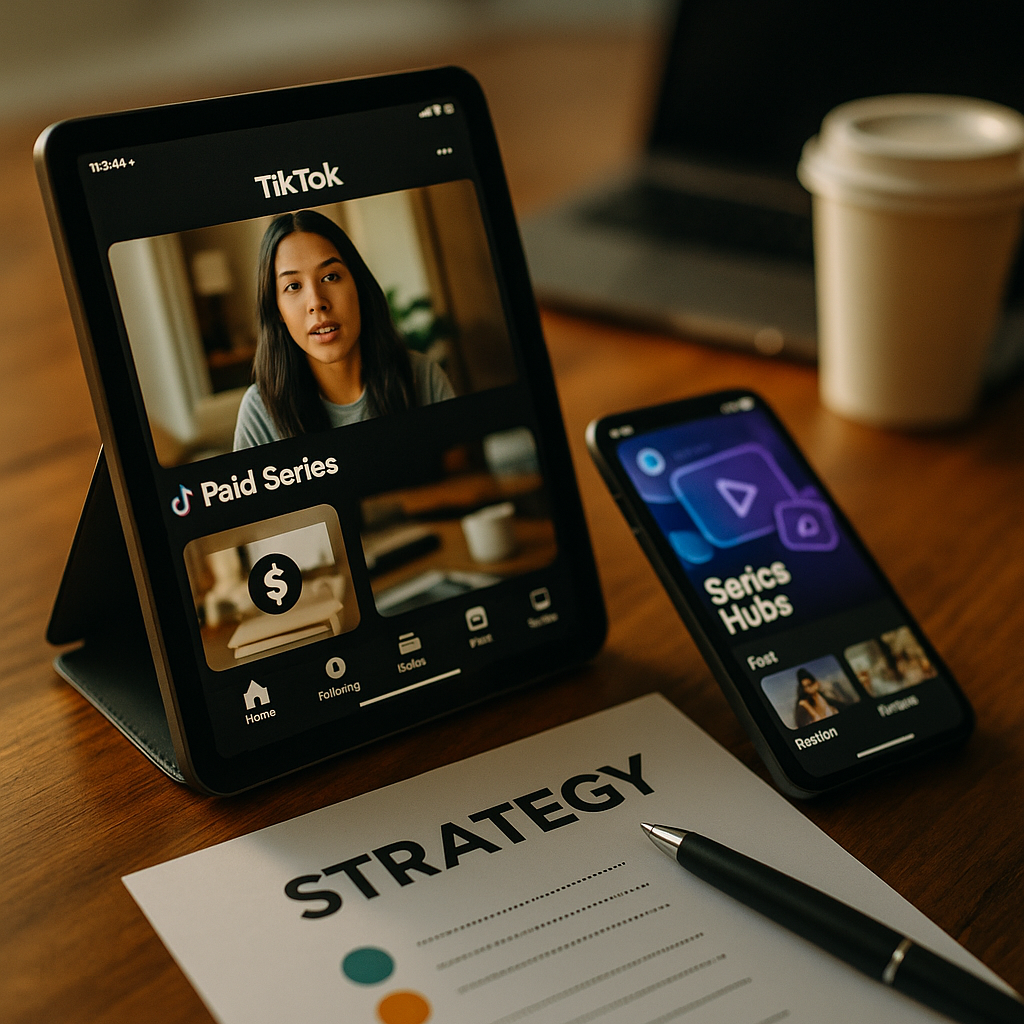
Flat-fee sponsorships are losing leverage. Brands paying $15,000–$50,000 per short-form post are increasingly asking whether that spend can generate compounding returns rather than a single traffic spike. The answer, increasingly, is yes — but only if you understand how short-form series revenue models on TikTok and Meta actually work from a brand partnership standpoint.
Why Platform-Native Monetization Changes the Negotiation
TikTok’s Paid Series feature and Meta’s Series Hubs are not simply new ad inventory. They are structural shifts in how creators monetize episodic content. When a creator gates premium episodes behind a paywall — anywhere from $0.99 to $189 on TikTok depending on series length — the economic relationship between that creator and a brand sponsor fundamentally changes.
Previously, a brand paid for reach. Now, a brand can pay for reach and participate in a revenue-sharing arrangement tied to actual content consumption. That’s a different risk profile, a different attribution model, and frankly, a different conversation with your CFO.
The TikTok Paid Series ecosystem has matured considerably, with creators in categories from finance to fitness to micro-drama fiction generating five-figure monthly revenue from subscriber access alone. For brand teams, this creates an entry point into outcome-linked sponsorship structures that don’t exist in traditional flat-fee deals.
When creator content sits behind a paywall, audience intent signals become far more reliable. A viewer who pays $4.99 to access a series is more qualified than one who passively scrolls past a sponsored post. Brands that recognize this are renegotiating how they measure and price creator partnerships.
How Each Platform Structures the Opportunity Differently
TikTok and Meta have taken divergent approaches, and brand teams need to understand both before deciding where to allocate budget.
TikTok Paid Series allows creators to charge viewers for access to exclusive multi-episode content. Brands can integrate into this format through pre-roll sponsorships on gated episodes, co-produced series where the brand funds production in exchange for prominent integration across all episodes, or revenue-share arrangements where the brand takes a percentage of subscriber fees in exchange for marketing support. The last model is emerging and still being formalized, but several talent agencies are already negotiating hybrid deals.
Meta’s Series Hubs operate differently. Rather than hard paywalling, Meta’s approach leans toward subscriber-only access through Facebook’s Fan Subscriptions and Reels Bonus programs, with Series Hubs organizing episodic content for easier discovery. The brand opportunity here is less about paywall co-investment and more about sustained presence across a serialized content arc — integration across five to twelve episodes rather than a one-off post. For brands with longer consideration cycles (automotive, B2B SaaS, financial services), this format has real advantages over the dopamine hit of a single viral post.
For context on where these models sit within broader creator partnership architecture, the shift toward episodic and subscription-backed content is part of a larger restructuring of how brands buy creator inventory.
Evaluating the Financial Structure: What to Actually Negotiate
Most brand teams approach creator deals with a flat-fee framework. That needs to evolve here. When evaluating a short-form series partnership, your deal structure should account for several variables that don’t exist in standard sponsorships.
- Episode integration depth: Are you integrated across all episodes or only select ones? Episodic familiarity builds brand recall differently than one-time placements.
- Revenue share terms: If you’re co-funding production, are you entitled to a portion of subscriber revenue? Some brands are negotiating 10–20% of net subscriber fees on co-produced series. This is non-standard but increasingly discussable.
- Exclusivity windows: Can a competing brand appear in the same series or on the creator’s channel during the series run? The answer should always be contractually defined. See current thinking on exclusivity and partnership economics for benchmarking what these protections cost.
- Performance triggers: Structure deals so that full payment is contingent on minimum episode completion rates, not just publish confirmation. A 70% episode completion rate is a reasonable floor for premium scripted or educational series.
- IP and content rights: Who owns the series content after the campaign window? This matters for paid amplification and retargeting.
If you’re moving from flat fees to blended compensation models, the frameworks outlined in creator contract renegotiation and blended cost models are worth reviewing before you open negotiations.
The Risk Side: What Brand Teams Consistently Underestimate
Revenue-sharing arrangements sound attractive until you’re on the hook for a series that doesn’t convert subscribers. Brands need to stress-test the downside before committing.
First, subscriber fatigue is real. eMarketer data consistently shows that short-form subscription products have high early churn. If a creator’s Paid Series peaks at episode two and loses 60% of subscribers by episode five, your brand integration in episodes three through eight is reaching a shrinking, increasingly disengaged audience.
Second, platform dependency risk is not theoretical. TikTok’s monetization policies have shifted multiple times. Any brand investing in a co-produced series should have contractual language that protects its investment if the platform changes payment structures or eligibility mid-run. This connects to broader vendor risk considerations that brand teams managing multi-platform programs need to manage.
Third, measurement is still catching up. Neither TikTok nor Meta currently provides brands with direct access to subscriber revenue data from creator-side accounts. You’re relying on creator-reported figures unless you negotiate for third-party verification or escrow-style payment structures. That’s not a dealbreaker, but it requires tighter contract language than most brand legal teams are used to seeing in creator deals.
The brands that will win in series-based partnerships aren’t necessarily the ones with the biggest budgets. They’re the ones whose legal and finance teams build deal structures that account for platform volatility, subscriber churn, and measurement gaps before the contracts are signed.
Budget Architecture: Where Series Deals Fit in Your Mix
Short-form series partnerships are not a replacement for your broader creator program. They’re a higher-investment, higher-attention format that should represent a defined slice of your experimental or tentpole budget.
A reasonable starting framework: allocate no more than 15–20% of your annual influencer budget to episodic or series-format deals until you have two or three completed cycles with measurable attribution. Use those learnings to expand. For brands with influencer budgets below $500K annually, one well-structured series partnership can generate more brand lift data than a dozen one-off posts — but only if you instrument it correctly from day one.
For teams trying to build the case internally, the analysis on how to pitch creator ROI to your CFO translates well to series-format arguments, especially the sustained attention and frequency-of-exposure angles.
Also worth noting: Meta’s monetization tools for creators are evolving quickly, and the Series Hub infrastructure is likely to gain paid promotion features that allow brands to amplify individual episodes as ads. Get familiar with the format now, before those capabilities fully mature and CPMs spike.
What’s Actually Working Right Now
The formats generating the most traction for brand integrations are educational series (finance, health, career development), micro-drama fiction with embedded product narratives, and behind-the-scenes business content where a brand’s product is a functional character in the story. Generic “mention the brand in episode one” integrations consistently underperform. Structural integrations — where the creator’s series premise depends on the brand’s product or service — retain viewer attention and deliver higher recall scores.
Brands in CPG, fintech, and direct-to-consumer apparel have been earliest to experiment. The learnings on CPA benchmarks for niche creator formats are beginning to apply here as episodic series build enough run history to generate conversion data.
TikTok’s own creator monetization documentation — available through the TikTok Creator Portal — confirms that Paid Series creators are seeing higher per-viewer revenue than standard ad-supported content. That delta is where brand co-investment makes financial sense: the creator has a financial incentive to promote the series aggressively, which amplifies your brand’s presence in the process.
For FTC compliance framing, all series partnerships with brand integration must carry appropriate disclosures per FTC endorsement guidelines, regardless of whether the content sits behind a paywall. This is a gap several brands have already been flagged for.
Start by identifying three to five creators in your category who already have an active Paid Series, audit their subscriber engagement and episode completion rates, and structure a pilot co-production proposal that includes a revenue-share clause. That single pilot will teach you more about this model than six months of watching from the sidelines.
Frequently Asked Questions
What is TikTok’s Paid Series feature and how can brands use it?
TikTok’s Paid Series allows creators to charge viewers for access to exclusive multi-episode content. Brands can participate through production co-investment, episode-level integrations, or emerging revenue-share structures where the brand contributes marketing support in exchange for a percentage of subscriber fees. It represents a shift from flat-fee sponsorship toward outcome-linked partnership models.
How does Meta’s Series Hub differ from TikTok Paid Series for brand partnerships?
Meta’s Series Hubs organize episodic creator content for discovery rather than hard paywalling it. Brand partnerships within Series Hubs typically involve sustained integration across multiple episodes, with monetization flowing through Facebook Fan Subscriptions and Reels Bonus programs rather than direct viewer purchase. The model favors brands that need extended narrative exposure over single-post reach.
What should a brand negotiate in a short-form series partnership?
Key negotiation points include episode integration depth, revenue share terms if co-producing, exclusivity windows to prevent competitor placement, performance triggers tied to completion rates rather than just publish confirmation, and content IP rights for post-campaign amplification. Most standard influencer contracts don’t cover these variables adequately.
What are the main risks of revenue-sharing creator series deals?
The primary risks are subscriber churn (audiences drop off after early episodes, reducing reach on later integrations), platform policy changes that can affect monetization mid-campaign, and limited measurement transparency since brands typically don’t have direct access to creator-side subscriber revenue data. Contracts should address all three before signing.
How much of an influencer budget should go toward series-format partnerships?
For teams without established benchmarks, allocating 15–20% of annual influencer budget to episodic or series-format deals during an initial pilot phase is a reasonable starting point. Expand allocation after completing two to three measurable cycles that generate attribution data and completion rate benchmarks.
Top Influencer Marketing Agencies
The leading agencies shaping influencer marketing in 2026
Agencies ranked by campaign performance, client diversity, platform expertise, proven ROI, industry recognition, and client satisfaction. Assessed through verified case studies, reviews, and industry consultations.
Moburst

-
2

The Shelf
Boutique Beauty & Lifestyle Influencer AgencyA data-driven boutique agency specializing exclusively in beauty, wellness, and lifestyle influencer campaigns on Instagram and TikTok. Best for brands already focused on the beauty/personal care space that need curated, aesthetic-driven content.Clients: Pepsi, The Honest Company, Hims, Elf Cosmetics, Pure LeafVisit The Shelf → -
3

Audiencly
Niche Gaming & Esports Influencer AgencyA specialized agency focused exclusively on gaming and esports creators on YouTube, Twitch, and TikTok. Ideal if your campaign is 100% gaming-focused — from game launches to hardware and esports events.Clients: Epic Games, NordVPN, Ubisoft, Wargaming, Tencent GamesVisit Audiencly → -
4

Viral Nation
Global Influencer Marketing & Talent AgencyA dual talent management and marketing agency with proprietary brand safety tools and a global creator network spanning nano-influencers to celebrities across all major platforms.Clients: Meta, Activision Blizzard, Energizer, Aston Martin, WalmartVisit Viral Nation → -
5

The Influencer Marketing Factory
TikTok, Instagram & YouTube CampaignsA full-service agency with strong TikTok expertise, offering end-to-end campaign management from influencer discovery through performance reporting with a focus on platform-native content.Clients: Google, Snapchat, Universal Music, Bumble, YelpVisit TIMF → -
6

NeoReach
Enterprise Analytics & Influencer CampaignsAn enterprise-focused agency combining managed campaigns with a powerful self-service data platform for influencer search, audience analytics, and attribution modeling.Clients: Amazon, Airbnb, Netflix, Honda, The New York TimesVisit NeoReach → -
7

Ubiquitous
Creator-First Marketing PlatformA tech-driven platform combining self-service tools with managed campaign options, emphasizing speed and scalability for brands managing multiple influencer relationships.Clients: Lyft, Disney, Target, American Eagle, NetflixVisit Ubiquitous → -
8

Obviously
Scalable Enterprise Influencer CampaignsA tech-enabled agency built for high-volume campaigns, coordinating hundreds of creators simultaneously with end-to-end logistics, content rights management, and product seeding.Clients: Google, Ulta Beauty, Converse, AmazonVisit Obviously →