


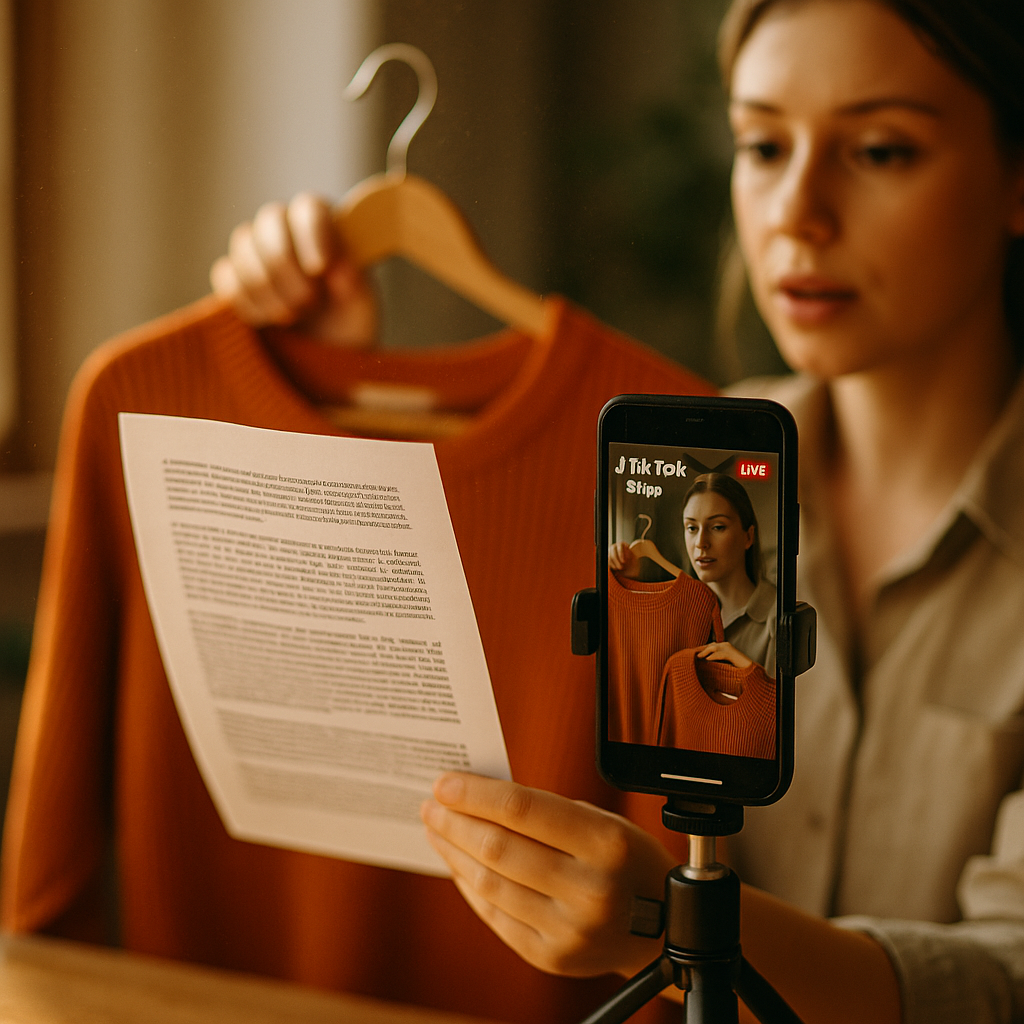
Forty-two state attorneys general now have deceptive-urgency statutes on the books. Your TikTok Shop livestream countdown timer might be violating half of them right now — while your legal team still thinks a “#ad” tag covers you. An FTC disclosure clause written for static posts won’t survive contact with a live, ticking discount clock.
That’s the gap brands keep falling into. Livestream shopping isn’t a new format wearing an old rulebook. It’s a live pricing mechanism, a sales pitch, and an advertisement happening simultaneously, and each of those triggers different legal obligations. Get the clause wrong and you’re not looking at a warning letter. You’re looking at parallel enforcement from the FTC and a state AG’s office at the same time.
Why Countdown Timers Are a Legal Trap, Not Just a Conversion Tool
Countdown timers work. That’s precisely the problem. TikTok Shop hosts use them because urgency drives impulse purchases, and the data backs it up: livestream commerce is projected to keep growing sharply across the next several years, according to eMarketer forecasts on social commerce spending. But urgency mechanics sit at the exact intersection where FTC guidance and state consumer-protection law diverge.
The FTC cares whether a reasonable consumer is misled. State deceptive-urgency statutes — California, New York, and a growing list of others — go further. They specifically target manufactured scarcity: countdown clocks that reset, “only 3 left” claims that don’t reflect actual inventory, or discounts that reappear the moment the timer hits zero.
If your livestream host says “this price disappears in 60 seconds” and then the same discount runs again in the next segment, you haven’t created urgency. You’ve created a false-scarcity claim, and in states like California that’s a statutory violation independent of any FTC action.
A disclosure clause that only addresses “material connection” language is treating a two-front legal problem as a one-front problem. Countdown timers require urgency-specific disclosure language, not just sponsorship labels.
What a TikTok Shop Livestream Disclosure Clause Actually Needs
Most influencer agreements still lean on boilerplate: “Creator agrees to disclose material connection per FTC guidelines.” That single sentence does nothing for livestream commerce. Here’s what the clause needs to cover instead.
- Real-time disclosure timing. The clause must require disclosure at stream start, after every re-entry point (viewers joining mid-stream), and immediately adjacent to any discount or urgency claim — not just once in the opening seconds.
- Scarcity verification language. Require the creator (and your brand ops team) to confirm inventory or pricing claims are accurate at the moment they’re spoken. “Only 12 left” needs to map to an actual, auditable number.
- Timer accuracy warranties. If a countdown resets or extends, the clause should require an on-screen and verbal acknowledgment that the offer has been extended, not a silent reset.
- State-specific carve-outs. Draft addenda for high-enforcement states (California, New York, Texas, Illinois) rather than assuming one national clause covers all fifty jurisdictions.
- Platform tooling documentation. Contractually require creators to use whatever native disclosure tools TikTok Shop provides, then keep records showing the tool was activated for that specific stream.
This isn’t legal theater. It’s the difference between a defensible compliance record and a brand that finds out its host improvised.
The Clause Template Brands Are Missing
Here’s roughly how the operative language should read in a creator agreement or SOW addendum for TikTok Shop livestreams:
“Creator shall verbally and visually disclose all material connections and sponsored content status at stream commencement and at intervals not exceeding ten (10) minutes thereafter. Any time-limited discount, countdown timer, or scarcity claim (‘Urgency Claim’) displayed or referenced during the livestream must reflect actual, current inventory or pricing conditions verifiable by Brand at the time of broadcast. Creator shall not represent an Urgency Claim as final or non-repeating if Brand intends to extend, repeat, or reintroduce the same or a substantially similar offer within twenty-four (24) hours. Brand reserves the right to audit stream recordings for compliance with this Section and applicable state deceptive-urgency statutes.”
Adjust the ten-minute interval and twenty-four-hour window based on your legal team’s read of the strictest state you sell into. When in doubt, draft to the most conservative standard and treat it as your national floor.
State Deceptive-Urgency Statutes: The Patchwork Problem
There’s no federal deceptive-urgency law. That means you’re managing exposure across a genuine patchwork, and it’s expanding. California’s approach under its unfair competition law treats manufactured urgency as a standalone deceptive practice. New York’s General Business Law Section 349 has been used against countdown-clock dark patterns in e-commerce. Other states are drafting similar language modeled on FTC guidance around dark patterns.
The practical challenge: a livestream airs nationally, in real time, to viewers in all fifty states simultaneously. You can’t geofence a TikTok Shop livestream the way you might restrict a paid ad campaign by zip code. So your compliance standard has to be written for your strictest jurisdiction and applied everywhere, or you accept the compliance debt.
Livestream commerce collapses your compliance timeline from “review before publish” to “live and irreversible.” Your disclosure clause is the only control you have once the stream starts.
Brands running frequent livestream programs should treat this the way they’d treat countdown timer legal checklist work: build it into pre-production, not post-incident cleanup. Our earlier coverage on state deceptive-urgency law risk goes deeper into which states have active enforcement patterns worth watching.
Where “Paid Partnership” Labels Fall Short
TikTok’s native “Paid Partnership” label is necessary but not sufficient. It tells the FTC’s disclosure box got checked. It says nothing about whether the urgency mechanics inside the stream are deceptive. Brands that treat the label as a compliance finish line are the ones getting caught flat-footed.
We’ve written before about how paid partnership labels alone no longer satisfy evolving FTC expectations, and livestream commerce is the clearest example of why. A label answers “who’s paying whom.” It doesn’t answer “is this discount real.”
Operationalizing the Clause: What Your Legal and Ops Teams Actually Need to Do
Writing the clause is step one. Enforcing it in a live environment is the harder problem. Here’s the operational layer that makes the contract language mean something.
- Pre-stream inventory lock. Confirm actual stock numbers before the host says a number on camera. If a host claims “50 units left,” someone on your ops team needs to have verified that within the hour.
- Recording retention policy. Keep full, timestamped recordings of every livestream for a minimum retention period your legal team sets (commonly 12-24 months), since state AG investigations can lag well behind the broadcast date.
- Host training on urgency language. Give creators a script or a “do not say” list. Phrases like “this will never happen again” or “last chance ever” are exactly what triggers statutory scrutiny.
- Escalation path for timer resets. If a technical issue forces a countdown restart, define who has authority to approve on-air disclosure of the reset, and make sure that happens in the moment, not after the stream ends.
- Quarterly compliance audit. Sample recent livestreams against the clause language. This mirrors the audit discipline described in AI content audit protocol work, just applied to live commerce instead of pre-published content.
None of this is exotic. It’s the same operational rigor brands already apply to influencer FTC compliance generally, extended to account for the fact that livestreams can’t be edited after the fact.
What Happens If You Get This Wrong
Two exposure paths run in parallel. The FTC can act under Section 5 for deceptive advertising, focusing on whether the material connection was disclosed clearly and conspicuously. A state AG can act separately under that state’s deceptive-urgency or unfair-practices statute, focusing narrowly on whether the scarcity claim was true. Settling with one doesn’t resolve the other.
Brands running high-volume TikTok Shop programs — beauty, supplements, fast fashion — are the most exposed simply because urgency mechanics are baked into the format. If your category already faces heightened scrutiny (see our coverage of supplement livestream compliance), the countdown timer risk compounds an already tight regulatory environment. Fast-fashion brands selling into the EU face a parallel patchwork; the comparison in EU fast-fashion ad rules is a useful sanity check for how differently jurisdictions treat the same urgency tactics.
For general FTC background on endorsement and disclosure standards that still form the federal baseline underneath all of this, the FTC’s own guidance hasn’t been rewritten specifically for livestream commerce, which is exactly why brands need to draft beyond it.
FAQs
What makes a TikTok Shop countdown timer legally risky?
The risk isn’t the timer itself, it’s whether the urgency it creates is accurate. If a discount resets, repeats, or doesn’t reflect real inventory limits, it can trigger both FTC deceptive-advertising scrutiny and state-level deceptive-urgency statutes simultaneously.
Does a “Paid Partnership” label satisfy FTC and state law requirements?
No. The label addresses disclosure of a material connection between brand and creator. It says nothing about whether scarcity or urgency claims made during the stream are truthful, which is the separate legal question state statutes target.
Which states have the strictest deceptive-urgency enforcement?
California and New York have the most active enforcement histories involving manufactured scarcity and dark-pattern urgency tactics, though additional states have introduced similar statutory language modeled on FTC dark-pattern guidance.
How often should disclosure be repeated during a livestream?
Best practice is disclosure at stream start and at regular intervals throughout, commonly every 5-10 minutes, plus immediately before or alongside any urgency or discount claim, since viewers join mid-stream continuously.
Who is liable if a creator misstates inventory numbers during a livestream?
Both parties can face exposure. Brands are typically held to advertiser-level standards for claims made in sponsored content, which is why the contract clause should require brand-side verification of any number a host states on air.
Should brands draft one national disclosure clause or state-specific versions?
Given that livestreams broadcast nationally in real time, most legal teams draft one clause calibrated to the strictest state’s requirements and apply it universally, rather than attempting to geofence compliance by jurisdiction.
Draft your countdown-timer disclosure clause to your strictest state, not your average one, and require inventory verification before any host says a number on camera. That single contractual habit closes most of the gap between an FTC-compliant label and a defensible livestream program.
FAQs
What makes a TikTok Shop countdown timer legally risky?
The risk isn’t the timer itself, it’s whether the urgency it creates is accurate. If a discount resets, repeats, or doesn’t reflect real inventory limits, it can trigger both FTC deceptive-advertising scrutiny and state-level deceptive-urgency statutes simultaneously.
Does a “Paid Partnership” label satisfy FTC and state law requirements?
No. The label addresses disclosure of a material connection between brand and creator. It says nothing about whether scarcity or urgency claims made during the stream are truthful, which is the separate legal question state statutes target.
Which states have the strictest deceptive-urgency enforcement?
California and New York have the most active enforcement histories involving manufactured scarcity and dark-pattern urgency tactics, though additional states have introduced similar statutory language modeled on FTC dark-pattern guidance.
How often should disclosure be repeated during a livestream?
Best practice is disclosure at stream start and at regular intervals throughout, commonly every 5-10 minutes, plus immediately before or alongside any urgency or discount claim, since viewers join mid-stream continuously.
Who is liable if a creator misstates inventory numbers during a livestream?
Both parties can face exposure. Brands are typically held to advertiser-level standards for claims made in sponsored content, which is why the contract clause should require brand-side verification of any number a host states on air.
Should brands draft one national disclosure clause or state-specific versions?
Given that livestreams broadcast nationally in real time, most legal teams draft one clause calibrated to the strictest state’s requirements and apply it universally, rather than attempting to geofence compliance by jurisdiction.
Top Influencer Marketing Agencies
The leading agencies shaping influencer marketing in 2026
Agencies ranked by campaign performance, client diversity, platform expertise, proven ROI, industry recognition, and client satisfaction. Assessed through verified case studies, reviews, and industry consultations.
Moburst

-
2

The Shelf
Boutique Beauty & Lifestyle Influencer AgencyA data-driven boutique agency specializing exclusively in beauty, wellness, and lifestyle influencer campaigns on Instagram and TikTok. Best for brands already focused on the beauty/personal care space that need curated, aesthetic-driven content.Clients: Pepsi, The Honest Company, Hims, Elf Cosmetics, Pure LeafVisit The Shelf → -
3

Audiencly
Niche Gaming & Esports Influencer AgencyA specialized agency focused exclusively on gaming and esports creators on YouTube, Twitch, and TikTok. Ideal if your campaign is 100% gaming-focused — from game launches to hardware and esports events.Clients: Epic Games, NordVPN, Ubisoft, Wargaming, Tencent GamesVisit Audiencly → -
4

Viral Nation
Global Influencer Marketing & Talent AgencyA dual talent management and marketing agency with proprietary brand safety tools and a global creator network spanning nano-influencers to celebrities across all major platforms.Clients: Meta, Activision Blizzard, Energizer, Aston Martin, WalmartVisit Viral Nation → -
5

The Influencer Marketing Factory
TikTok, Instagram & YouTube CampaignsA full-service agency with strong TikTok expertise, offering end-to-end campaign management from influencer discovery through performance reporting with a focus on platform-native content.Clients: Google, Snapchat, Universal Music, Bumble, YelpVisit TIMF → -
6

NeoReach
Enterprise Analytics & Influencer CampaignsAn enterprise-focused agency combining managed campaigns with a powerful self-service data platform for influencer search, audience analytics, and attribution modeling.Clients: Amazon, Airbnb, Netflix, Honda, The New York TimesVisit NeoReach → -
7

Ubiquitous
Creator-First Marketing PlatformA tech-driven platform combining self-service tools with managed campaign options, emphasizing speed and scalability for brands managing multiple influencer relationships.Clients: Lyft, Disney, Target, American Eagle, NetflixVisit Ubiquitous → -
8

Obviously
Scalable Enterprise Influencer CampaignsA tech-enabled agency built for high-volume campaigns, coordinating hundreds of creators simultaneously with end-to-end logistics, content rights management, and product seeding.Clients: Google, Ulta Beauty, Converse, AmazonVisit Obviously →