


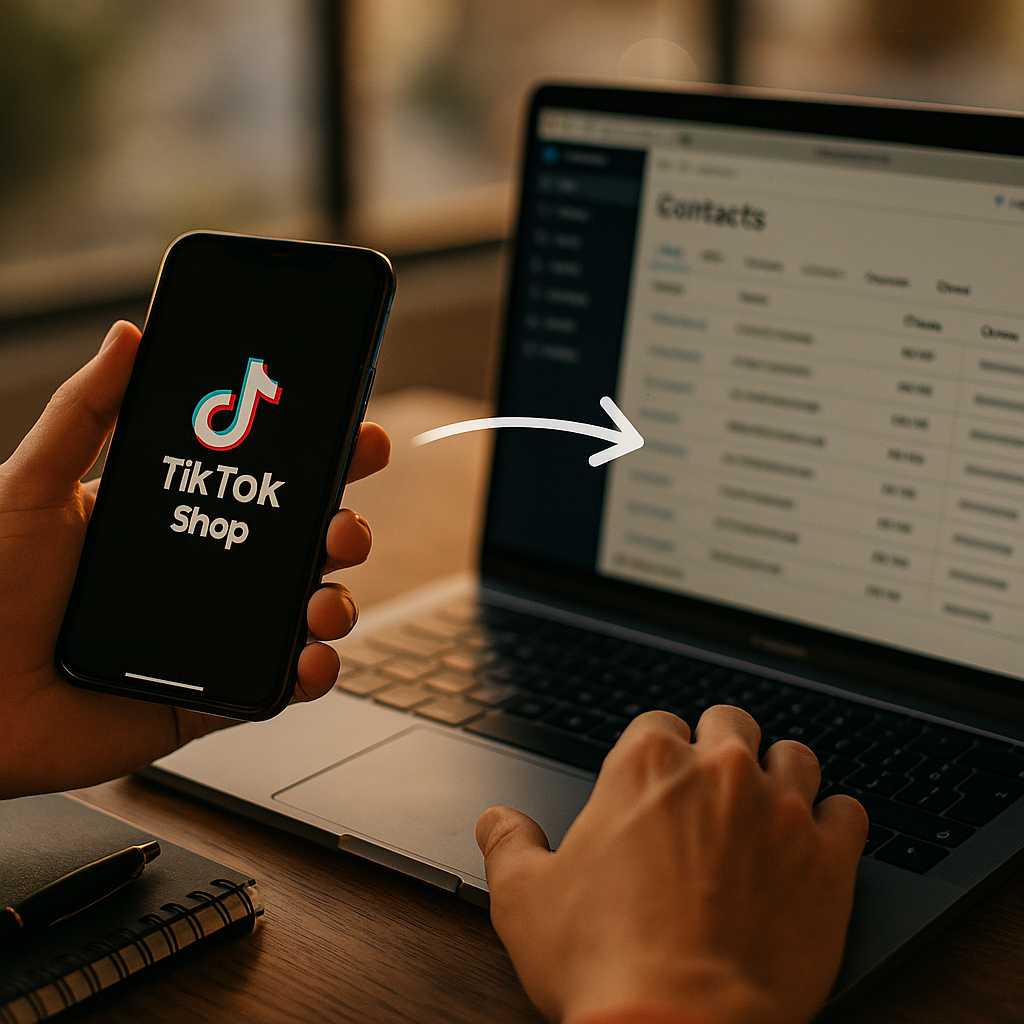
TikTok Shop processed billions in GMV last year, and most of those orders never touch a CRM in real time. That’s not a minor data lag. It’s a revenue team flying blind on lifetime value, repeat purchase triggers, and churn signals the moment they matter most. A working TikTok Shop to CRM integration isn’t a nice-to-have anymore. It’s the difference between a live pipeline and a guessing game.
The Real-Time Problem Nobody Budgeted For
Ask a revenue leader how fast a TikTok Shop order shows up in Salesforce or HubSpot, and you’ll usually get a shrug. Sometimes it’s minutes. Sometimes it’s a batch job that runs overnight. Sometimes, honestly, nobody’s checked.
That gap used to be tolerable when TikTok Shop was a side channel. It isn’t anymore. eMarketer has repeatedly flagged social commerce as one of the fastest-growing purchase paths in the US and UK, and TikTok Shop sits at the center of that growth. When a channel starts contributing meaningful revenue, the systems around it need to behave like revenue infrastructure, not an afterthought bolted onto marketing ops.
A CRM that learns about a TikTok Shop purchase twelve hours late can’t trigger a retention flow, flag a VIP customer, or feed accurate data into attribution models. By the time the record syncs, the moment to act on it is gone.
What “Real-Time” Actually Means Here
Vendors love the word “real-time.” Half the time it means “within the hour if the API cooperates.” For revenue teams, real-time should mean something specific: order and customer data lands in the CRM within seconds to low minutes of the TikTok Shop transaction, with enough fidelity to trigger downstream workflows immediately.
That includes:
- Order confirmation and SKU-level detail, not just a lump revenue number
- Customer identity resolution (matching a TikTok buyer to an existing CRM contact, or creating a clean new one)
- Attribution tagging back to the specific creator, video, or LIVE session that drove the sale
- Return and refund status, synced just as fast as the original order
Miss any one of those, and your CRM has a partial picture dressed up as a complete one. That’s arguably worse than no data at all, because teams start making decisions on it.
Auditing the Current Stack: Start With the Middle Layer
Most stack audits start at the edges: the TikTok Shop API on one end, the CRM on the other. That’s backwards. The middle layer, whatever moves data between them, is where almost every failure actually happens.
Ask these questions about whatever middleware you’re running (native connectors, iPaaS tools like Zapier or Workato, or custom webhook listeners):
- What’s the polling versus webhook setup? Polling every 15 or 30 minutes isn’t real-time, no matter what the dashboard says.
- How does it handle rate limits? TikTok’s Shop API has usage caps. High-volume sellers can hit them during flash sales or LIVE events, and a poorly built integration just silently drops records when that happens.
- Where does deduplication logic live? If a customer buys through both an organic video and a paid Spark Ad, does the system create two contact records or merge intelligently?
- Is there a retry and error queue? Failed syncs need to retry automatically and alert someone. Too many stacks just lose the record.
This is the same architectural thinking we’ve covered in the context of discovery to payment pipelines, where the weakest link is rarely the endpoints, it’s the connective layer nobody budgets time to test properly.
Attribution Is Where the Money Actually Leaks
Here’s the uncomfortable part. Even when the data sync itself is fast, attribution logic is often broken or oversimplified. A CRM might correctly log a $60 order thirty seconds after purchase, but if it can’t tell you which creator or which specific content asset drove that order, the sales and marketing teams are arguing over credit instead of optimizing spend.
We’ve written before about how spreadsheets still rule in a lot of orgs precisely because the “real-time” integration only handles revenue totals, not creator-level attribution. Teams end up exporting CSVs to reconcile creator performance manually, which defeats the entire point of building a live sync in the first place.
If you’re serious about proving creator ROI, the CRM record needs a field structure that captures: creator handle, content ID, campaign or program name, and whether the sale came from organic content, a paid Spark Ad, or a LIVE shopping event. Without that granularity, you’re paying for real-time infrastructure and still getting month-end reporting quality.
Build, Buy, or Stitch? The Middleware Decision
Revenue teams generally land in one of three camps.
Native TikTok Shop connectors (through platforms like HubSpot or Shopify’s own integrations) are the fastest to set up. They’re also the most limited. Field mapping is usually rigid, and creator-level attribution is often missing entirely unless the platform has built specific social commerce logic.
iPaaS tools like Zapier, Workato, or Tray.io give more flexibility. You can build custom field mapping and conditional logic, but performance depends heavily on how the workflows are architected. A sloppy Zap that polls every fifteen minutes isn’t meaningfully better than a manual export.
Custom middleware (a lightweight service that listens to TikTok Shop webhooks and pushes structured data into the CRM via API) is the most reliable for true real-time performance, but it requires engineering resources most marketing teams don’t have on tap. This is usually where agencies or larger DTC brands end up once volume justifies the build.
There’s a fourth, quieter trend worth naming: consolidation. A growing number of teams are abandoning the five-tool stack model entirely in favor of platforms that natively combine commerce data, creator attribution, and CRM sync in one place. We covered this shift in detail in martech consolidation, and TikTok Shop integration is one of the clearest examples of why that trend is accelerating. Every additional hop between systems is another place data can lag, break, or get miscounted.
The teams getting the most out of TikTok Shop right now aren’t the ones with the most tools. They’re the ones with the fewest handoffs between purchase and pipeline.
Compliance and Data Hygiene Can’t Be an Afterthought
Real-time sync also means real-time exposure. If customer data is flowing from TikTok Shop into a CRM within seconds, your data handling policies need to keep pace. That means clear consent language for how purchase data feeds marketing automation, proper handling of PII across borders if you sell internationally, and audit trails for what triggered which automated message.
This matters more than most teams realize. The FTC has been increasingly active on disclosure and data practices tied to social commerce, and the ICO has published guidance relevant to UK brands running similar integrations. If your real-time pipeline triggers an automated email or SMS the moment a TikTok Shop order lands, that trigger needs to be built on a documented consent basis, not just technical capability.
It’s the same underlying risk we’ve flagged in creator contract and compliance coverage: speed without governance just means you make mistakes faster. Our piece on where compliance risk really hides covers adjacent ground on the creator side, and the logic transfers directly to commerce data pipelines.
Field-Level Mapping: The Unsexy Work That Actually Matters
Nobody gets excited about field mapping. It’s also where most real-time integrations quietly fail.
A proper audit means going line by line through what TikTok Shop’s API actually returns (order status, SKU, customer ID, creator attribution tag, LIVE session ID if applicable) and confirming each field maps to the correct CRM property, not a generic catch-all note field. Teams that skip this step end up with technically “real-time” data that’s functionally useless for segmentation or automation, because everything landed in a single unstructured text box.
A quick internal checklist worth running:
- Does every custom field have a corresponding CRM property, or is data getting dumped into notes?
- Are currency and timezone conversions handled correctly for international orders?
- Does refund or cancellation status overwrite the original order record, or create a conflicting duplicate?
- Can sales reps actually see this data in the CRM interface they use daily, or is it buried in a custom object nobody opens?
This is similar territory to what we explored in context engines versus CDPs, where the real differentiator between platforms wasn’t the marketing copy, it was whether structured data actually reached the teams who needed to act on it.
What Good Actually Looks Like
A well-audited stack has a few tells. Sales reps can pull up a contact record and see, without asking marketing, exactly which creator or LIVE event drove that customer’s last purchase. Marketing can trigger a win-back flow within minutes of a lapsed customer’s cart abandonment on TikTok Shop, not days later. Finance can reconcile creator payouts against actual attributed revenue without a spreadsheet reconciliation project. And when TikTok updates its API (which happens more often than anyone would like), the integration has enough monitoring in place that someone notices before a week of data goes missing.
TikTok’s own commerce documentation and tools like HubSpot’s integration ecosystem have both matured considerably, but platform maturity doesn’t fix a badly architected middle layer. That part is still on the revenue team to get right.
For teams running creator-driven commerce at scale, the shoppable content layer adds its own complications too. Our review of cross-platform shoppable embeds is worth a look if your TikTok Shop strategy also touches Instagram or YouTube commerce, since attribution fragmentation across platforms compounds the CRM sync problem rather than solving it.
FAQs
How fast should TikTok Shop data actually sync to a CRM?
For a genuinely real-time setup, order and customer data should land within seconds to a few minutes of the transaction. Anything relying on hourly or overnight batch jobs isn’t real-time, regardless of what the vendor calls it.
Can HubSpot or Salesforce natively integrate with TikTok Shop?
Both offer native or app-marketplace connectors, but native options often lack creator-level attribution fields and require custom field mapping to capture full order context. Many teams layer middleware on top for that reason.
What’s the biggest reason TikTok Shop to CRM integrations fail?
Weak middleware architecture. Polling-based syncs, missing retry logic, and poor deduplication cause far more failures than problems on the TikTok API or CRM side individually.
Does real-time sync create compliance risk?
It can, if automated triggers fire off consent-based communications without proper documentation. Faster data flow means data governance and consent tracking need to be built in from the start, not added later.
Is custom middleware worth building for smaller brands?
Usually not until order volume justifies the engineering investment. Smaller teams typically get more value from a well-configured iPaaS workflow with proper field mapping than from a custom build.
Run the audit this quarter, not next: pull ten recent TikTok Shop orders, trace each one through your CRM, and time how long attribution took to appear. If any record took longer than a few minutes or landed without creator-level detail, you’ve found your next fix.
Top Influencer Marketing Agencies
The leading agencies shaping influencer marketing in 2026
Agencies ranked by campaign performance, client diversity, platform expertise, proven ROI, industry recognition, and client satisfaction. Assessed through verified case studies, reviews, and industry consultations.
Moburst

-
2

The Shelf
Boutique Beauty & Lifestyle Influencer AgencyA data-driven boutique agency specializing exclusively in beauty, wellness, and lifestyle influencer campaigns on Instagram and TikTok. Best for brands already focused on the beauty/personal care space that need curated, aesthetic-driven content.Clients: Pepsi, The Honest Company, Hims, Elf Cosmetics, Pure LeafVisit The Shelf → -
3

Audiencly
Niche Gaming & Esports Influencer AgencyA specialized agency focused exclusively on gaming and esports creators on YouTube, Twitch, and TikTok. Ideal if your campaign is 100% gaming-focused — from game launches to hardware and esports events.Clients: Epic Games, NordVPN, Ubisoft, Wargaming, Tencent GamesVisit Audiencly → -
4

Viral Nation
Global Influencer Marketing & Talent AgencyA dual talent management and marketing agency with proprietary brand safety tools and a global creator network spanning nano-influencers to celebrities across all major platforms.Clients: Meta, Activision Blizzard, Energizer, Aston Martin, WalmartVisit Viral Nation → -
5

The Influencer Marketing Factory
TikTok, Instagram & YouTube CampaignsA full-service agency with strong TikTok expertise, offering end-to-end campaign management from influencer discovery through performance reporting with a focus on platform-native content.Clients: Google, Snapchat, Universal Music, Bumble, YelpVisit TIMF → -
6

NeoReach
Enterprise Analytics & Influencer CampaignsAn enterprise-focused agency combining managed campaigns with a powerful self-service data platform for influencer search, audience analytics, and attribution modeling.Clients: Amazon, Airbnb, Netflix, Honda, The New York TimesVisit NeoReach → -
7

Ubiquitous
Creator-First Marketing PlatformA tech-driven platform combining self-service tools with managed campaign options, emphasizing speed and scalability for brands managing multiple influencer relationships.Clients: Lyft, Disney, Target, American Eagle, NetflixVisit Ubiquitous → -
8

Obviously
Scalable Enterprise Influencer CampaignsA tech-enabled agency built for high-volume campaigns, coordinating hundreds of creators simultaneously with end-to-end logistics, content rights management, and product seeding.Clients: Google, Ulta Beauty, Converse, AmazonVisit Obviously →