


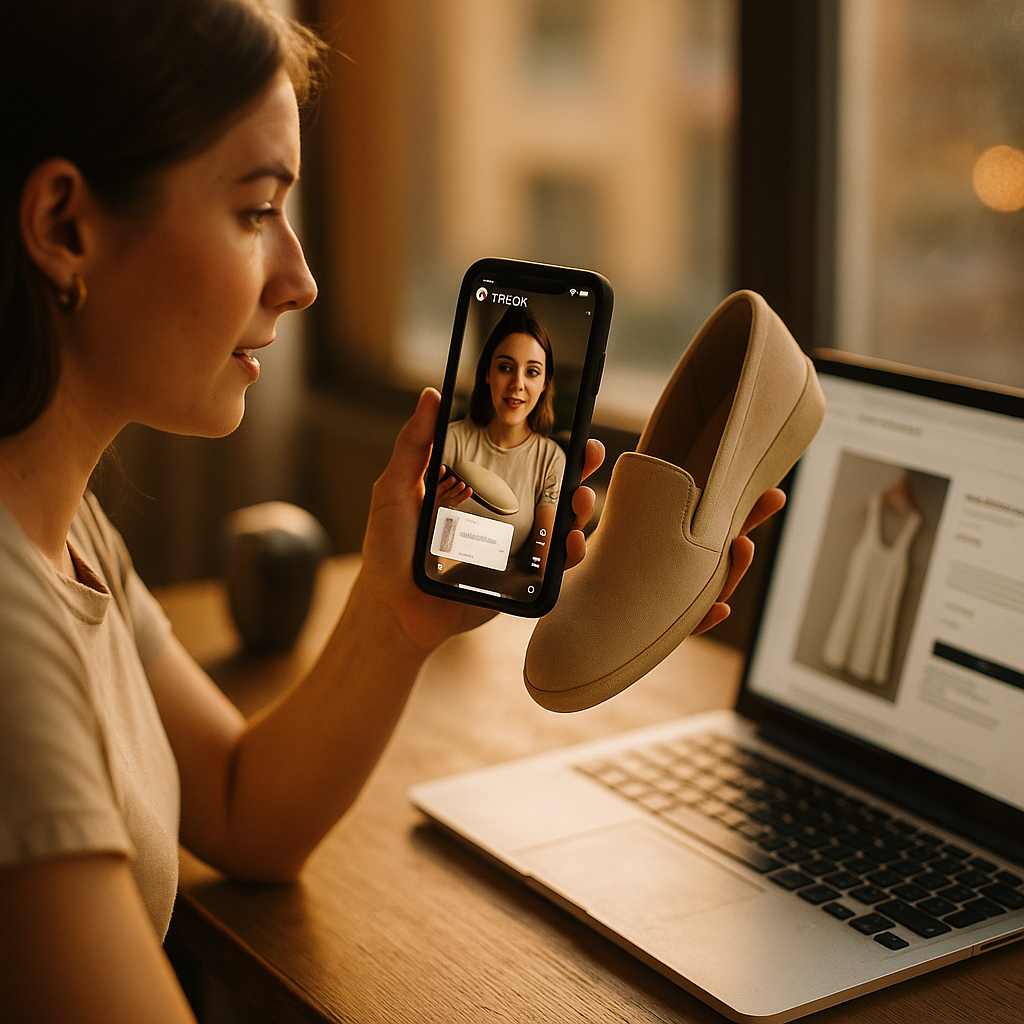
Static product pages convert at roughly 2-3% on a good day. TikTok Shop tutorial content? Sellers are reporting conversion rates north of 10% on demonstration videos that show a product actually being used. That gap isn’t a rounding error — it’s a signal that TikTok Shop tutorial-style content has quietly rewritten the rules of ecommerce merchandising, and most brands haven’t caught up yet.
If your product pages still lean on studio shots and bullet-point specs, you’re competing against creators who film in bad lighting, mess up the demo halfway through, and still outsell you. That’s not an accident. It’s a shift in what “product information” even means to a shopper scrolling at 9pm.
Why Demonstration Beats Description
Static product pages were built for a search-and-compare mindset. A shopper knows roughly what they want, types it into a search bar, and lands on a page designed to confirm the purchase decision they’d already half-made. That model still works for commodity goods — batteries, phone cases, printer paper. It falls apart for anything that requires context: how does this serum layer under makeup? Does this air fryer basket actually fit a whole chicken? Is this blazer true to size for someone with broad shoulders?
Tutorial-style content answers those questions before the shopper has to ask them. It compresses the discovery, education, and validation stages of the funnel into a single 30-to-90-second clip. A creator applies the serum on camera, films the fried chicken coming out golden, tries the blazer on in three sizes. The viewer isn’t reading a spec sheet; they’re watching a proof-of-concept.
Product pages answer “what is this?” Tutorial content answers “will this work for someone like me?” — and that second question is the one that actually closes sales.
This is the same behavioral insight driving performance in adjacent formats. Our earlier breakdown of comparison video content found nearly identical patterns: viewers trust demonstrated outcomes over claimed benefits, full stop.
The Mechanics: How TikTok’s Algorithm Rewards Demo Content
There’s a technical reason tutorial content wins beyond just “video is more engaging.” TikTok Shop’s ranking system weights completion rate, rewatch behavior, and saves heavily — and demonstration content naturally produces all three. A viewer watching a step-by-step tutorial has a reason to stay until the reveal. They rewatch the part where the product actually gets used. They save it because they intend to reference it later, maybe while shopping.
Static product imagery, even when embedded in a Shop tab, doesn’t generate that same behavioral signal. No dwell time, no rewatch, no save intent. The algorithm simply has less to work with, so it distributes less.
There’s also a discovery advantage. TikTok Shop surfaces products through the For You feed, not just search, which means a well-made tutorial can reach someone who wasn’t shopping at all. Our discovery-first playbook breakdown covers this shift in more depth — the takeaway being that demand generation and demand capture are now happening in the same swipe, on the same screen.
What “Tutorial-Style” Actually Means in Practice
Not every product video counts. The format that’s winning follows a fairly consistent structure:
- Problem framing in the first three seconds — the hook states the pain point before showing the product.
- Real-time use, not a highlight reel — viewers want to see the mess, the setup, the actual mechanics.
- An unscripted-feeling voiceover — overly polished narration reads as an ad and gets skipped.
- A visible before/after or result — the payoff has to be legible in under two seconds of screen time.
- An on-screen or spoken CTA tied to the Shop tab, not a vague “link in bio.”
Brands that try to shortcut this by repurposing polished commercial footage tend to underperform. The format has its own grammar, and audiences can tell when content was made for a billboard rather than a For You page.
What This Means for Budget Allocation
Here’s the uncomfortable part for finance teams: tutorial-style content is harder to forecast than static creative, because performance is driven by creator fit and format execution, not just media spend. A $50,000 studio shoot for product photography is a known cost with predictable output. A creator-led tutorial program is messier — you’re paying for volume, iteration, and a willingness to let content underperform before it finds its footing.
That said, the ROI math still favors demonstration content once you account for content lifespan. A static product page requires paid traffic to generate any volume at all. A strong tutorial video keeps generating organic views, saves, and Shop clicks for weeks after posting, sometimes resurfacing months later when the algorithm decides it’s relevant to a new audience segment. That’s a materially different cost curve than a page that only performs when you’re actively buying traffic to it.
A single high-performing tutorial can outproduce a paid product page for months without additional spend — the content itself becomes the acquisition channel.
Brands running affiliate-style creator programs are already restructuring commission models around this reality. Platforms like Levanta’s rate standardization work point to a market that’s pricing tutorial-format performance differently than static asset licensing, because the two formats simply don’t produce comparable return curves.
Compliance and Disclosure Don’t Disappear Because the Format Changed
Demonstration content still carries the same FTC disclosure obligations as any other endorsement. A creator showing a product “in use” without disclosing a paid partnership or free product is a compliance risk, not a growth hack. The FTC’s endorsement guidelines apply regardless of format, and TikTok Shop’s own seller policies require clear commercial disclosure on affiliate and paid content.
This matters more, not less, as tutorial content scales. When a brand runs hundreds of creator-generated demos simultaneously, manual compliance review becomes a bottleneck. Brands should be building disclosure checks into their creator onboarding workflow before the first video posts, not after a viral one draws scrutiny.
Building a Demonstration-First Content Program
Shifting from static-first to demo-first isn’t just a creative brief change. It touches sourcing, measurement, and even how you structure product catalog data.
- Audit your top SKUs for “demo-ability.” Products with a visible use case, transformation, or fit question convert best on tutorial format. Commodity SKUs may still perform fine on static pages.
- Recruit for demonstration skill, not just follower count. A creator who can explain a product clearly on camera in one take is more valuable to this format than a creator with a large but passive audience.
- Build a content velocity plan, not a single hero video. Tutorial content performance is unpredictable per-video; volume and iteration matter more than any single “perfect” asset.
- Track saves and shares as leading indicators, not just conversion rate. These are the signals TikTok’s algorithm rewards, and they predict downstream sales lift.
- Feed performance data back into paid amplification decisions. The strongest organic tutorials are also the cheapest to boost, because engagement quality is already proven.
That last point connects to a broader operational shift happening across influencer marketing: brands are increasingly using real-time dashboards to reallocate budget mid-campaign rather than waiting for a monthly report to tell them what already happened. Demonstration content rewards that speed, since a tutorial can go from flat to viral within 48 hours, and a brand that’s still reviewing last month’s numbers will miss the window to amplify it.
Industry data backs the urgency here. TikTok’s own advertising resources note that Shop-integrated content consistently outperforms external-link traffic on conversion, largely because the purchase happens without leaving the app. Combine that frictionless checkout with a format that pre-answers buyer objections, and you get a channel that’s structurally difficult for a static product page to compete with, no matter how well that page is optimized.
None of this means product pages are dead. They still matter for SEO, for retargeting, for shoppers who arrive via search with high intent already established. But as the primary conversion surface for discovery-driven commerce, the static page is losing ground fast, and TikTok Shop’s tutorial format is the clearest evidence of where that ground is going.
Frequently Asked Questions
Why does tutorial-style content convert better than static product pages on TikTok Shop?
Tutorial content answers real-world usage questions — fit, function, results — that static images and bullet points can’t demonstrate. It also generates stronger engagement signals like completion rate and saves, which TikTok’s algorithm rewards with wider organic distribution.
Do brands need professional production to make tutorial content work?
No. Overly polished footage often underperforms because it reads as an advertisement rather than authentic demonstration. Creators filming in natural settings with visible, real-time product use tend to outperform studio-produced content.
How should brands measure success for demonstration-style content?
Track saves, shares, and rewatch rate as leading indicators alongside conversion rate. These engagement metrics predict algorithmic distribution and downstream sales lift better than conversion rate alone.
Is tutorial content subject to the same disclosure rules as other sponsored posts?
Yes. FTC endorsement guidelines and TikTok Shop’s seller policies both require clear disclosure when content is paid, gifted, or affiliate-based, regardless of the video’s format or style.
Should brands abandon static product pages entirely?
No. Static pages still serve high-intent search traffic and retargeting well. The shift is about where discovery-driven, first-touch conversion happens — and that’s increasingly tutorial content, not product pages.
The brands winning on TikTok Shop right now aren’t the ones with the biggest production budgets — they’re the ones treating demonstration as the product page. Start by auditing three top SKUs for demo-ability, brief a creator to show real use rather than a highlight reel, and let saves and shares tell you which one deserves paid amplification.
Top Influencer Marketing Agencies
The leading agencies shaping influencer marketing in 2026
Agencies ranked by campaign performance, client diversity, platform expertise, proven ROI, industry recognition, and client satisfaction. Assessed through verified case studies, reviews, and industry consultations.
Moburst

-
2

The Shelf
Boutique Beauty & Lifestyle Influencer AgencyA data-driven boutique agency specializing exclusively in beauty, wellness, and lifestyle influencer campaigns on Instagram and TikTok. Best for brands already focused on the beauty/personal care space that need curated, aesthetic-driven content.Clients: Pepsi, The Honest Company, Hims, Elf Cosmetics, Pure LeafVisit The Shelf → -
3

Audiencly
Niche Gaming & Esports Influencer AgencyA specialized agency focused exclusively on gaming and esports creators on YouTube, Twitch, and TikTok. Ideal if your campaign is 100% gaming-focused — from game launches to hardware and esports events.Clients: Epic Games, NordVPN, Ubisoft, Wargaming, Tencent GamesVisit Audiencly → -
4

Viral Nation
Global Influencer Marketing & Talent AgencyA dual talent management and marketing agency with proprietary brand safety tools and a global creator network spanning nano-influencers to celebrities across all major platforms.Clients: Meta, Activision Blizzard, Energizer, Aston Martin, WalmartVisit Viral Nation → -
5

The Influencer Marketing Factory
TikTok, Instagram & YouTube CampaignsA full-service agency with strong TikTok expertise, offering end-to-end campaign management from influencer discovery through performance reporting with a focus on platform-native content.Clients: Google, Snapchat, Universal Music, Bumble, YelpVisit TIMF → -
6

NeoReach
Enterprise Analytics & Influencer CampaignsAn enterprise-focused agency combining managed campaigns with a powerful self-service data platform for influencer search, audience analytics, and attribution modeling.Clients: Amazon, Airbnb, Netflix, Honda, The New York TimesVisit NeoReach → -
7

Ubiquitous
Creator-First Marketing PlatformA tech-driven platform combining self-service tools with managed campaign options, emphasizing speed and scalability for brands managing multiple influencer relationships.Clients: Lyft, Disney, Target, American Eagle, NetflixVisit Ubiquitous → -
8

Obviously
Scalable Enterprise Influencer CampaignsA tech-enabled agency built for high-volume campaigns, coordinating hundreds of creators simultaneously with end-to-end logistics, content rights management, and product seeding.Clients: Google, Ulta Beauty, Converse, AmazonVisit Obviously →