


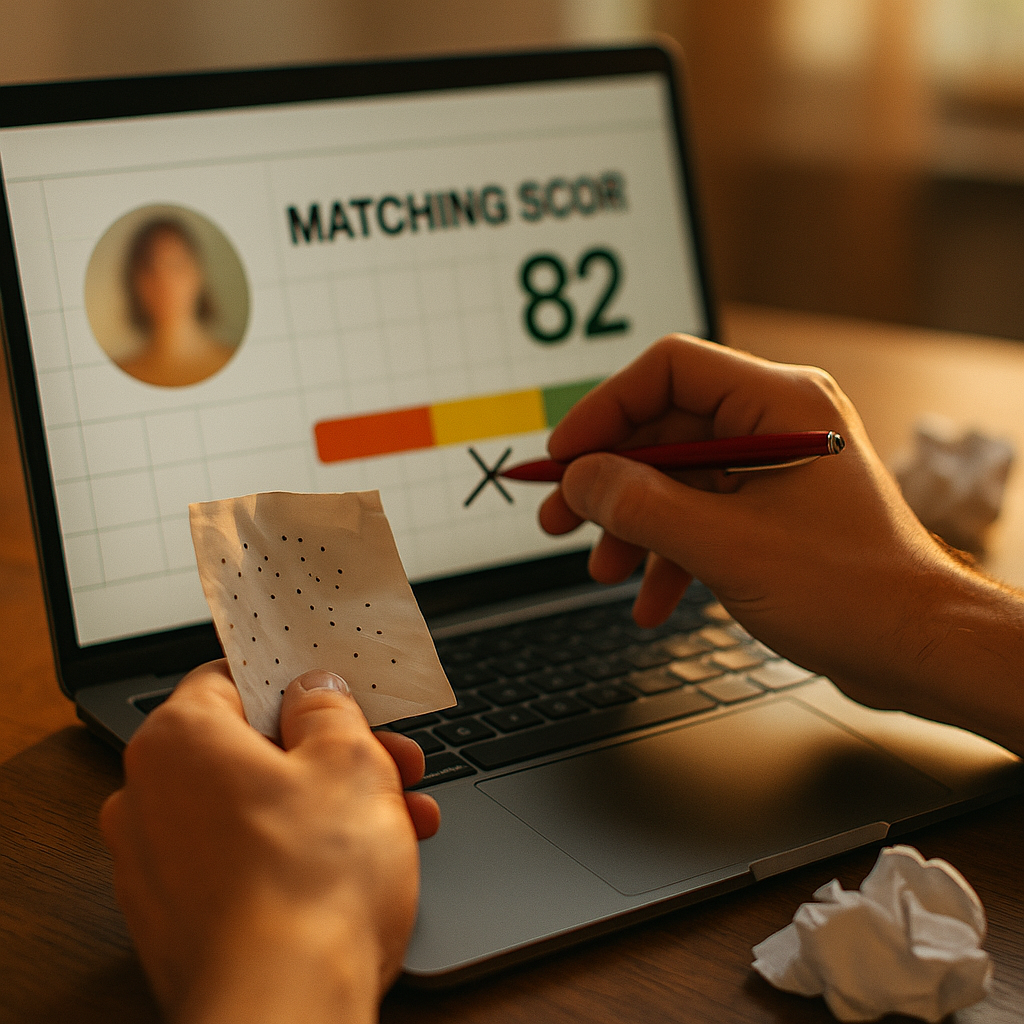
Most brands treat an 87 percent match score the way they treat a credit score: trust it, act on it, move on. But ask the platform vendor what actually produces that number, and you’ll often get a shrug dressed up in marketing language. AI creator discovery algorithms now shape the majority of influencer shortlists at mid-size and enterprise brands, yet few marketing teams can explain how a matching score is calculated or when it should be ignored.
That gap matters more than it used to. Budgets are bigger, scrutiny is sharper, and a bad match costs more than a wasted campaign. It costs a brand safety headache, a wasted retainer, and a quarter of lost momentum.
What a Matching Score Actually Measures
A matching score is a composite number, usually expressed as a percentage, that tells you how closely a creator aligns with a brand’s stated criteria. Sounds simple. It isn’t.
Underneath that single number sits a weighted model pulling from audience demographics, engagement patterns, content category, brand safety flags, past collaboration history, and increasingly, semantic analysis of what a creator actually talks about rather than just the hashtags they use. Some platforms layer in sentiment data, posting cadence, and even predicted future reach based on growth trajectory.
The problem is that every vendor weighs these inputs differently, and almost none of them publish their methodology. A 90 percent match on one platform might reflect strong audience overlap but ignore brand voice fit entirely. Another platform’s 90 percent might weight recent engagement heavily and barely touch audience authenticity. Our breakdown of semantic creator search covers how meaning-based matching differs from the old keyword-tag approach, and it’s a useful primer if your current tool still relies on static category labels.
A matching score is only as trustworthy as the data feeding it. Feed it incomplete audience data or stale engagement history, and the algorithm will confidently hand you a wrong answer dressed up as a precise one.
The Data Behind the Score (And Why It’s Often Thin)
Here’s the uncomfortable part. Most creator discovery platforms are working with incomplete data, and they rarely tell clients that upfront.
Audience demographic data, for instance, is frequently modeled rather than verified, especially on platforms like Instagram and TikTok that restrict granular audience exports. Engagement rates can be inflated by bot activity that vendors haven’t fully filtered. Brand safety scoring often relies on keyword scanning rather than contextual understanding, which means a creator discussing a sensitive topic critically can get flagged the same as one promoting it.
Research on this has started catching up with the hype. A recent industry analysis found that nearly half of AI-driven creator matches suffered from underlying data quality issues that skewed results, a finding we examined in depth in our piece on the data quality gap breaking AI matching. That’s not a rounding error. That’s a coin flip on whether your “top match” is actually a good fit.
- Audience data is often modeled, not measured, particularly for platforms with restricted API access.
- Bot and fake engagement filtering varies wildly between vendors, with some still lagging badly.
- Brand safety flags frequently miss context, nuance, and satire.
- Historical performance data can be outdated by months, especially for smaller or mid-tier creators.
If your team hasn’t run a formal check on this, it’s worth reading our guide on data quality audits for AI workflows. Most brands are surprised by what they find once they actually audit the pipeline feeding their matching tool.
Why High Scores Still Produce Bad Partnerships
You’ve seen this happen. A creator scores 94 percent match, the campaign gets greenlit, and the content lands flat. Or worse, it lands fine but the audience doesn’t convert, and nobody can explain why.
The reason is usually that matching scores optimize for similarity, not for business outcomes. A high score tells you a creator looks like a good fit on paper. It says nothing about whether their audience is in-market, whether their content style suits your funnel stage, or whether their community trusts recommendations versus scrolling past them.
This is the gap between correlation and conversion. Algorithms are excellent at pattern matching. They’re far weaker at predicting purchase intent, which is still the metric that actually matters to a CFO. According to industry benchmarking from eMarketer, brands that rely solely on platform-native matching scores without layering in performance history tend to see wider variance in campaign ROI than those that blend algorithmic scoring with manual vetting.
A matching score tells you how similar a creator looks to your brief. It does not tell you whether their audience will buy anything.
What the Algorithm Can’t See
There’s a category of fit that no scoring model handles well yet: creative chemistry. Can this creator actually make your product look good without it feeling forced? Does their tone match how your audience wants to be talked to right now, not six months ago when the training data was collected?
This is where human judgment still earns its keep. Our piece on AI agents handling volume while humans win on creative judgment makes the case plainly: algorithms are built for scale and shortlisting, not for the final creative call. Treat the matching score as a filter that narrows 10,000 creators down to 50. Treat the final decision as a human one.
Brands that skip this step tend to discover the gap the expensive way, after the campaign has already shipped.
Building a Smarter Process Around the Score
None of this means ditch the algorithm. It means stop treating the output as gospel. A few practical adjustments make a real difference:
- Ask vendors what’s actually in the model. If a platform can’t explain its weighting logic in plain language, that’s a red flag, not a trade secret.
- Cross-reference scores against brand fit documentation. Tools built around structured brand guidelines, like those covered in our piece on AI brand DNA matching, produce more defensible shortlists than generic category-based scoring.
- Keep a human vetting step before contracts go out. Automated interview tools have made this faster than it used to be. Our coverage of AI creator interview automation shows how brands are compressing vetting from days to minutes without skipping it entirely.
- Track post-campaign performance back to the original score. If 90 percent matches keep underperforming 70 percent matches, your model’s weighting is wrong, and you need to say so to the vendor.
This kind of feedback loop is rare, but it’s the single highest-leverage thing a brand can do. Platforms rarely audit their own scoring against real campaign ROI unless clients demand it. Sprout Social’s research on influencer program maturity consistently shows that brands with structured post-campaign review processes outperform those relying purely on platform dashboards.
Compliance Isn’t Optional, Even When the Algorithm Says Go
A high matching score says nothing about whether a creator discloses partnerships properly, which still matters enormously given ongoing FTC enforcement around influencer disclosure. Brands that lean entirely on algorithmic vetting and skip a manual compliance check are exposing themselves to risk that no matching score will ever flag, because disclosure history isn’t typically part of the model.
Build compliance review into the same workflow as creative vetting. It’s a five-minute check that prevents a six-figure headache.
FAQs
Frequently Asked Questions
What is a creator matching score?
A creator matching score is a percentage or numeric rating generated by an AI discovery platform that estimates how well a creator aligns with a brand’s stated criteria, typically based on audience data, content category, engagement patterns, and brand safety signals.
How accurate are AI creator discovery algorithms?
Accuracy varies significantly by platform and depends heavily on underlying data quality. Many platforms rely on modeled rather than verified audience data, and research has found data quality issues affecting a substantial share of AI-driven matches, which means scores should be treated as directional rather than definitive.
Should brands rely solely on matching scores to choose creators?
No. Matching scores are useful for narrowing a large creator pool into a manageable shortlist, but they rarely account for creative fit, purchase intent, or disclosure compliance history. A manual vetting step remains essential before any contract is signed.
Why do high matching scores sometimes lead to poor campaign performance?
High scores typically reflect similarity to the brief rather than predicted business outcomes. A creator can look like a strong fit on paper while their audience is uninterested in purchasing, which the algorithm has no reliable way to predict.
What should brands ask vendors about their matching algorithms?
Ask how audience data is sourced and verified, how engagement authenticity is filtered, what weighting is applied to each signal, and how often the model is retrained. Vendors unwilling to answer in plain language are worth questioning further.
Next step: Before your next creator shortlist goes out, pull the matching scores from your platform and cross-check the top five results against actual past campaign performance data. If the correlation is weak, that’s your signal to rebuild the vetting process around human judgment, not just algorithmic output.
Frequently Asked Questions
What is a creator matching score?
A creator matching score is a percentage or numeric rating generated by an AI discovery platform that estimates how well a creator aligns with a brand’s stated criteria, typically based on audience data, content category, engagement patterns, and brand safety signals.
How accurate are AI creator discovery algorithms?
Accuracy varies significantly by platform and depends heavily on underlying data quality. Many platforms rely on modeled rather than verified audience data, and research has found data quality issues affecting a substantial share of AI-driven matches, which means scores should be treated as directional rather than definitive.
Should brands rely solely on matching scores to choose creators?
No. Matching scores are useful for narrowing a large creator pool into a manageable shortlist, but they rarely account for creative fit, purchase intent, or disclosure compliance history. A manual vetting step remains essential before any contract is signed.
Why do high matching scores sometimes lead to poor campaign performance?
High scores typically reflect similarity to the brief rather than predicted business outcomes. A creator can look like a strong fit on paper while their audience is uninterested in purchasing, which the algorithm has no reliable way to predict.
What should brands ask vendors about their matching algorithms?
Ask how audience data is sourced and verified, how engagement authenticity is filtered, what weighting is applied to each signal, and how often the model is retrained. Vendors unwilling to answer in plain language are worth questioning further.
Top Influencer Marketing Agencies
The leading agencies shaping influencer marketing in 2026
Agencies ranked by campaign performance, client diversity, platform expertise, proven ROI, industry recognition, and client satisfaction. Assessed through verified case studies, reviews, and industry consultations.
Moburst

-
2

The Shelf
Boutique Beauty & Lifestyle Influencer AgencyA data-driven boutique agency specializing exclusively in beauty, wellness, and lifestyle influencer campaigns on Instagram and TikTok. Best for brands already focused on the beauty/personal care space that need curated, aesthetic-driven content.Clients: Pepsi, The Honest Company, Hims, Elf Cosmetics, Pure LeafVisit The Shelf → -
3

Audiencly
Niche Gaming & Esports Influencer AgencyA specialized agency focused exclusively on gaming and esports creators on YouTube, Twitch, and TikTok. Ideal if your campaign is 100% gaming-focused — from game launches to hardware and esports events.Clients: Epic Games, NordVPN, Ubisoft, Wargaming, Tencent GamesVisit Audiencly → -
4

Viral Nation
Global Influencer Marketing & Talent AgencyA dual talent management and marketing agency with proprietary brand safety tools and a global creator network spanning nano-influencers to celebrities across all major platforms.Clients: Meta, Activision Blizzard, Energizer, Aston Martin, WalmartVisit Viral Nation → -
5

The Influencer Marketing Factory
TikTok, Instagram & YouTube CampaignsA full-service agency with strong TikTok expertise, offering end-to-end campaign management from influencer discovery through performance reporting with a focus on platform-native content.Clients: Google, Snapchat, Universal Music, Bumble, YelpVisit TIMF → -
6

NeoReach
Enterprise Analytics & Influencer CampaignsAn enterprise-focused agency combining managed campaigns with a powerful self-service data platform for influencer search, audience analytics, and attribution modeling.Clients: Amazon, Airbnb, Netflix, Honda, The New York TimesVisit NeoReach → -
7

Ubiquitous
Creator-First Marketing PlatformA tech-driven platform combining self-service tools with managed campaign options, emphasizing speed and scalability for brands managing multiple influencer relationships.Clients: Lyft, Disney, Target, American Eagle, NetflixVisit Ubiquitous → -
8

Obviously
Scalable Enterprise Influencer CampaignsA tech-enabled agency built for high-volume campaigns, coordinating hundreds of creators simultaneously with end-to-end logistics, content rights management, and product seeding.Clients: Google, Ulta Beauty, Converse, AmazonVisit Obviously →