


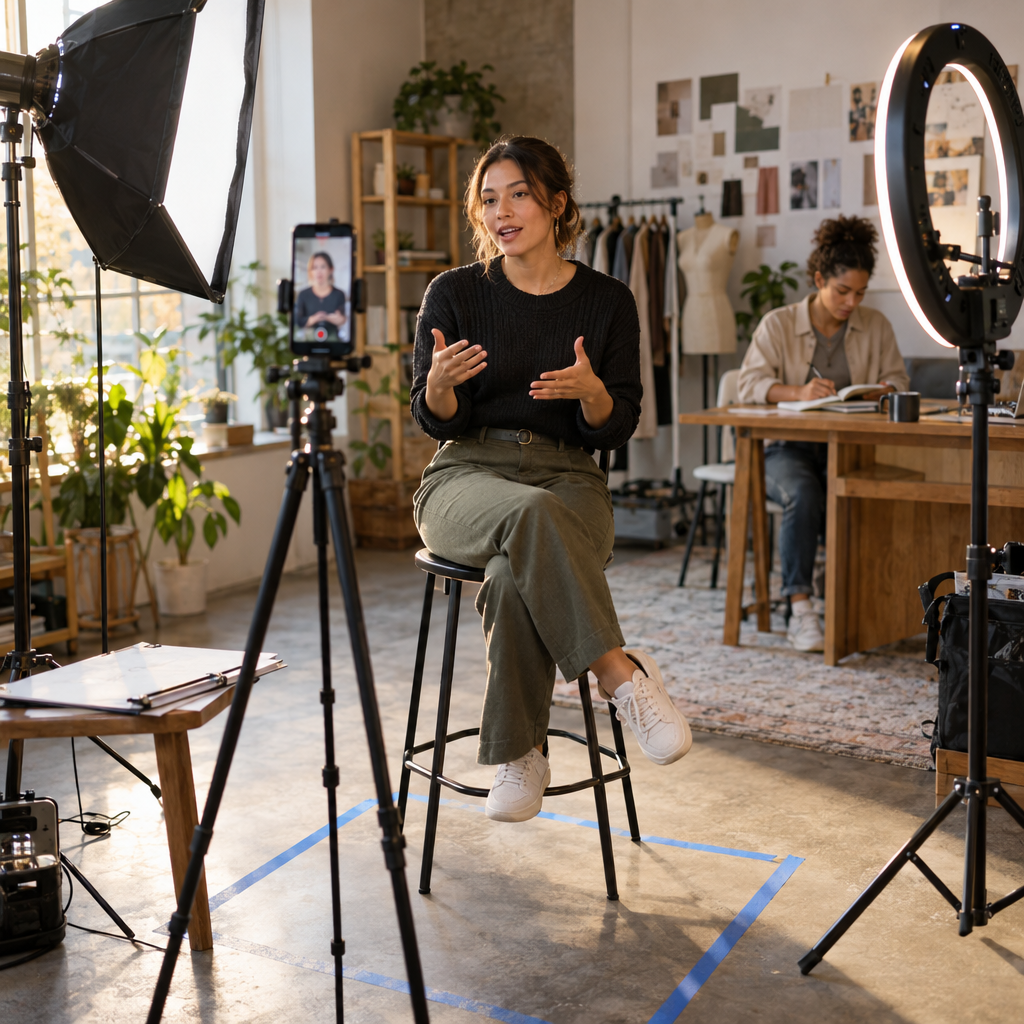
Most UGC testimonial ads fail before the creator hits record. The brief assumed a horizontal edit, a polished script, and a “we’ll crop it later” fix. Vertical-first production reverses that logic. This article gives you a UGC testimonial ads shot vertical first brief template: what to specify, what to leave loose, and what compliance needs before spend begins.
Why vertical-first is a brief problem, not a camera problem
Creators already hold their phones upright. The risk comes from the brief, which often borrows specs from a 16:9 TV or YouTube spot and asks for “a few options we can resize.”
Cropping a landscape testimonial into 9:16 throws away roughly two thirds of the frame. Faces end up cut off. Captions land in the wrong place. The “real person, real kitchen” feel disappears.
The platforms are explicit about this. TikTok’s creative guide says all ad creative on the platform is full-screen 9:16 video and that it is always a sound-on experience. Its creative best practices page adds the basics: shoot at 9:16, at least 720P, and keep key content inside the UI safe zone.
So the brief should treat those as production constraints, not post-production chores.
The production brief template, block by block
Here is the structure I use. Copy it into your brief tool of choice, whether that is Notion, Frame.io, or a shared doc.
1. Objective and placement
State the single job of the ad. Is it cold-audience proof, retargeting objection handling, or a creative test against your current control? Name the placements (TikTok In-Feed, Instagram Reels, Facebook Reels, YouTube Shorts) so the creator knows where captions and UI will collide with their face.
2. Technical specs
- Orientation: 9:16, shot upright, no landscape footage.
- Resolution: 1080p preferred, 720P as the floor per TikTok’s guidance.
- Safe zone: Keep the face, product and on-screen text away from the top and bottom edges where platform buttons and captions sit. Send the creator a safe zone overlay image to shoot against.
- Audio: Clean voice, no licensed trending tracks baked in. Add music in the platform’s library later so you control rights.
- Delivery: Raw clips plus a rough cut, separate files, no burned-in captions on the raw version.
3. The story spine (not a script)
Give the creator a four-beat spine and let them speak it in their own words:
- Hook (0-3 seconds): The problem or the surprise, said to camera.
- Before: What they tried, what annoyed them.
- Moment of proof: The product in use, shown on screen, not just described.
- Result and nudge: What changed, then a soft call to action.
Why a spine? Over-scripted testimonials sound like ads, and viewers scroll past them. The same logic drives lo-fi phone camera ads, where controlled imperfection does the persuading.
Frame it for the thumb, not the monitor
Vertical framing is its own craft. A few instructions that save reshoots:
- Hold the phone at eye level, arm’s length, or on a cheap tripod. Selfie-arm wobble reads as authentic. Chest-level angles read as sloppy.
- Fill the frame. Head and shoulders, with room above for a text hook.
- Show the product in the lower-middle third, where the eye lands, but above the zone the platform’s caption will cover.
- Use natural window light. Ask for a quick test clip before the full shoot.
- Request three alternate hooks, each recorded as a separate take. Hooks are where most of the performance variance lives.
Ask every creator for three hook takes and one clean b-roll pass. Hooks give you your testing matrix, and b-roll gives your editor cover when a claim gets cut.
If you plan to layer a buy button or link prompt later, leave space for it. The timing logic is covered in this piece on shoppable video overlays.
Claims and disclosure: the part legal will ask about
A testimonial is only useful if you can run it. That means the claims have to be true, typical, and properly disclosed.
Start with the script spine. The FTC’s consumer reviews and testimonials Q&A warns that you can imply reviews must be positive through how you solicit them. Its examples include asking people to share how much they loved something in exchange for a coupon. In a brief, that translates to one rule: ask creators for their honest experience, not for a feeling you want them to have.
Then handle the relationship. The FTC notes in the same guidance that the context of a testimonial can communicate a connection to the business, such as a video showing the person in a company uniform or office. A creator filming in your branded packaging area could signal the same thing, so brief the setting too.
On disclosure, the FTC’s endorsement guides FAQ makes clear that viewers of online video reviews may not realize the reviewer has a relationship with the brand. It also says a video of someone using a product can convey approval even without words. Your brief should therefore include:
- A required disclosure (spoken and on-screen) placed early in the video, not buried in a caption.
- A list of approved claims and a list of banned ones (health outcomes, income, “guaranteed” results).
- A note on what “typical” means for your product, so a best-case result is not presented as the norm.
- A line confirming the creator used the product and is describing a real experience.
Enforcement is also getting sharper. The FTC’s announcement of its final rule on fake reviews and testimonials says the rule allows the agency to seek civil penalties against knowing violators. That is a real change from case-by-case enforcement without penalty authority. For agencies, it makes a documented brief and approval trail a form of insurance.
A brief that records the claim list, the disclosure wording and the creator’s confirmation of actual use turns compliance from a delay into a checkbox.
Approvals, versioning and paid readiness
Does the creator post it, or do you run it as a paid ad? Decide before the shoot, because usage rights, whitelisting access and licensing length change the fee and the footage you need.
Build the approval flow into the brief:
- Test clip: 10 seconds, checked for framing, light and audio.
- Rough cut: reviewed against the claim list.
- Final: approved with disclosure visible, then versioned by hook.
For speed, pair this with a sprint model. The workflow in rapid turnaround UGC sprints shows how to move rights and disclosure checks inside a short production window. And if your testimonial needs to survive a spend ramp, read how ad-ready briefs keep native video from fatiguing.
One more option: stitching several creators into a single proof asset. That needs its own consent and credibility rules, which the guide on testimonial compilation videos covers.
How do you measure whether the brief worked?
Judge the brief by its outputs, not the creator’s charisma. Track these per version:
- Hook hold rate (how many viewers pass the first three seconds).
- Thumb-stop to click-through ratio.
- Cost per acquisition against your control creative.
- Revision rounds per asset (a proxy for brief clarity).
- Percentage of footage that cleared legal on first pass.
If revision rounds stay high, the problem is almost always the brief: vague claims, missing safe zone, or unclear rights. Fix the template, not the creator.
FAQs
What does “shot vertical first” mean for UGC ads?
It means the footage is planned, framed and filmed in 9:16 from the start, rather than shot horizontally and cropped later. Composition, text space and safe zones are all decided in the brief.
What resolution and aspect ratio should creators use?
TikTok’s creative guidance recommends 9:16 and at least 720P, with content kept inside the UI safe zone. Most teams ask for 1080p to leave room for editing.
Should a testimonial ad be fully scripted?
No. Provide a story spine and an approved claims list, then let the creator speak naturally. Over-scripting hurts authenticity, and soliciting only positive sentiment can create compliance problems under FTC guidance.
Do UGC testimonial ads need disclosure?
Yes, if the creator has any material connection to the brand, such as payment or free product. The FTC says viewers of online video may not realize that relationship exists, so disclose clearly and early in the video itself.
How many hooks should I request per creator?
Three is a practical minimum. Recording alternate openings as separate takes gives you a testing matrix without paying for a second shoot.
Can I reuse a vertical testimonial on other placements?
Usually yes across Reels, TikTok and Shorts, provided your usage rights cover paid use and each placement’s safe zone is respected. Confirm rights and licensing length in the brief.
Next step: take your last underperforming testimonial brief, add a safe zone overlay, a three-hook requirement and a written claims list, then run it through one creator test before scaling.
Top Influencer Marketing Agencies
The leading agencies shaping influencer marketing in 2026
Agencies ranked by campaign performance, client diversity, platform expertise, proven ROI, industry recognition, and client satisfaction. Assessed through verified case studies, reviews, and industry consultations.
Moburst

-
2

The Shelf
Boutique Beauty & Lifestyle Influencer AgencyA data-driven boutique agency specializing exclusively in beauty, wellness, and lifestyle influencer campaigns on Instagram and TikTok. Best for brands already focused on the beauty/personal care space that need curated, aesthetic-driven content.Clients: Pepsi, The Honest Company, Hims, Elf Cosmetics, Pure LeafVisit The Shelf → -
3

Audiencly
Niche Gaming & Esports Influencer AgencyA specialized agency focused exclusively on gaming and esports creators on YouTube, Twitch, and TikTok. Ideal if your campaign is 100% gaming-focused — from game launches to hardware and esports events.Clients: Epic Games, NordVPN, Ubisoft, Wargaming, Tencent GamesVisit Audiencly → -
4

Viral Nation
Global Influencer Marketing & Talent AgencyA dual talent management and marketing agency with proprietary brand safety tools and a global creator network spanning nano-influencers to celebrities across all major platforms.Clients: Meta, Activision Blizzard, Energizer, Aston Martin, WalmartVisit Viral Nation → -
5

The Influencer Marketing Factory
TikTok, Instagram & YouTube CampaignsA full-service agency with strong TikTok expertise, offering end-to-end campaign management from influencer discovery through performance reporting with a focus on platform-native content.Clients: Google, Snapchat, Universal Music, Bumble, YelpVisit TIMF → -
6

NeoReach
Enterprise Analytics & Influencer CampaignsAn enterprise-focused agency combining managed campaigns with a powerful self-service data platform for influencer search, audience analytics, and attribution modeling.Clients: Amazon, Airbnb, Netflix, Honda, The New York TimesVisit NeoReach → -
7

Ubiquitous
Creator-First Marketing PlatformA tech-driven platform combining self-service tools with managed campaign options, emphasizing speed and scalability for brands managing multiple influencer relationships.Clients: Lyft, Disney, Target, American Eagle, NetflixVisit Ubiquitous → -
8

Obviously
Scalable Enterprise Influencer CampaignsA tech-enabled agency built for high-volume campaigns, coordinating hundreds of creators simultaneously with end-to-end logistics, content rights management, and product seeding.Clients: Google, Ulta Beauty, Converse, AmazonVisit Obviously →