


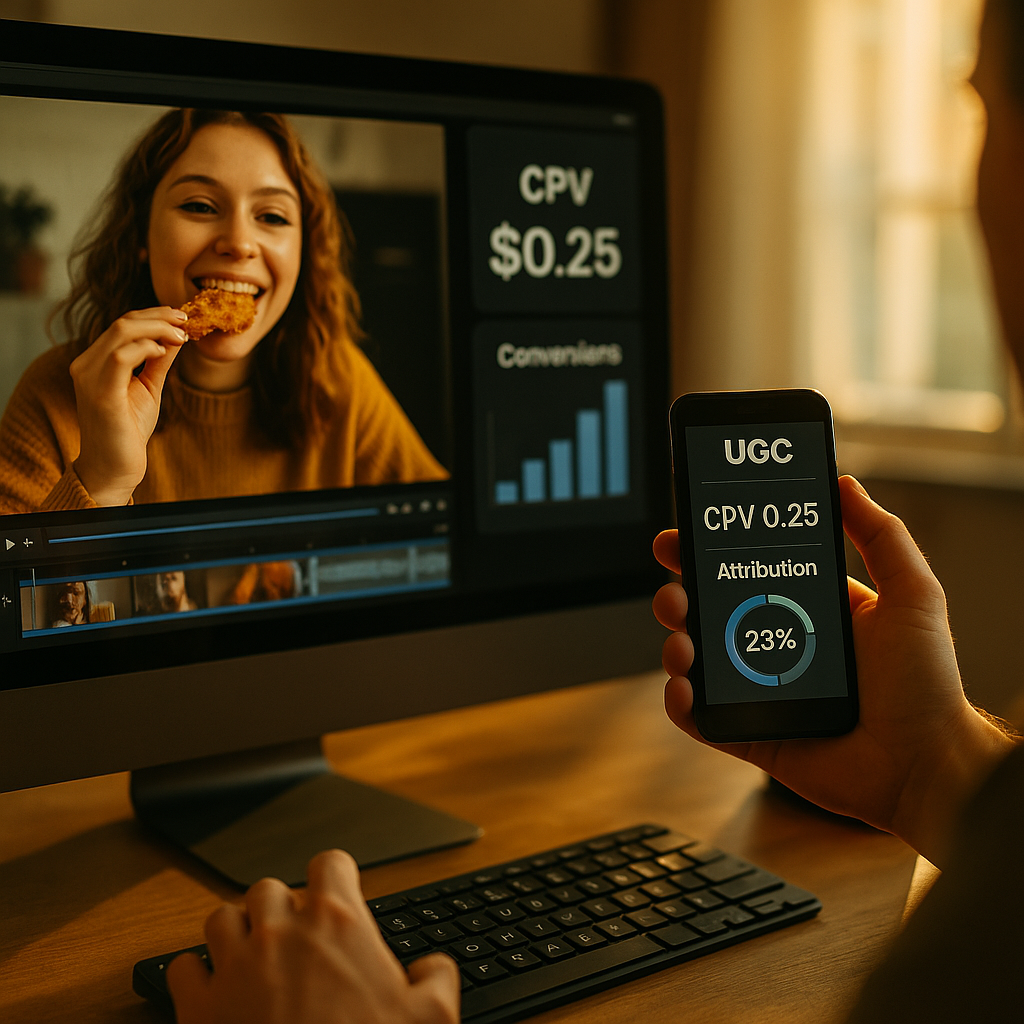
If you can’t define what a “good view” costs inside a UGD clipping network, you’re not measuring distribution — you’re guessing at it. The UGD clipping network measurement problem is real, it’s expensive, and most brand measurement frameworks weren’t built for it.
Why Standard CPV Benchmarks Break Down in Clipping Ecosystems
Traditional cost-per-view benchmarks were designed for paid media: a single creative unit, a single placement, a known audience. UGD clipping networks operate on entirely different physics. A single long-form asset gets fragmented into dozens of clips, distributed across coordinated authentic accounts (not bots, not fake profiles, genuine creators who’ve opted into a distribution arrangement), and surfaces organically across TikTok, YouTube Shorts, Instagram Reels, and X simultaneously.
The result? You’re generating views at a CPV that looks absurdly cheap on paper, often between $0.003 and $0.008 per view, while your paid social team is paying $0.02 to $0.05 for guaranteed placements. But “cheap” is meaningless without a quality denominator.
The mistake most brands make is importing paid media CPV floors directly into their clipping network reporting. A $0.005 CPV from a coordinated clip ecosystem is not the same as a $0.005 CPV from a TikTok TopView. Different audience intent, different completion rates, different downstream conversion behavior. Treating them as equivalent in a finance deck is how UGD programs get defunded after Q1.
For deeper context on how clipping infrastructure operates at scale, the operational mechanics behind scaling UGC distribution with these networks are worth understanding before you lock in any measurement framework.
Building a CPV Benchmark That Actually Reflects Distribution Quality
Start by segmenting your CPV targets by three variables: platform, clip length, and account tier within the distribution network.
Platform matters because organic view-through rates differ dramatically. YouTube Shorts, for example, auto-loops, which inflates raw view counts relative to TikTok, where a view is logged at 1 second regardless of completion. Instagram Reels sits somewhere in between. If you’re applying a single CPV target across all three, you’re comparing apples to boulders.
Clip length shapes completion probability. A 15-second clip from a product demo will almost always outperform a 58-second clip on completion rate, but the 58-second clip may drive materially higher search lift and brand recall. Your CPV benchmark needs to weight for this, either by using a completion-adjusted CPV (total spend divided by completed views rather than partial views) or by maintaining separate benchmarks for short-form and mid-form clips.
Account tier within the network defines the quality ceiling. Coordinated authentic account ecosystems typically tier their participants by follower count, engagement rate, and niche authority. A clip placed through a 50,000-follower fitness creator in your target demographic should carry a different CPV expectation than the same clip distributed through a 3,000-follower general lifestyle account. Blending these into a single average CPV metric obscures performance signal entirely.
A completion-adjusted CPV, calculated as total spend divided by views where at least 50% of the clip was watched, gives finance a number that reflects actual audience engagement rather than raw impression volume.
Attribution Windows: The Harder Problem
Attribution is where UGD clipping measurement gets genuinely difficult, and where most brand teams either over-simplify or give up entirely.
The challenge is structural. When a clip distributes organically through coordinated authentic accounts, the viewer has no reason to believe they’re seeing brand-influenced content. They engage with it as native content. That means they’re unlikely to click a link in the moment. They might search your brand name two days later, or walk into a retail location, or mention the product in a group chat. None of these touchpoints connect cleanly to the original clip view in standard attribution models.
Brands running serious UGD programs are increasingly using a layered attribution approach with three distinct windows:
- Direct window (0-48 hours): Any tracked link click, promo code redemption, or UTM-tagged conversion directly from the clip. This is your most conservative, most defensible attribution signal.
- Halo window (3-14 days): Incremental branded search volume, measured against baseline using tools like Google Ads search term reports or third-party brand lift studies. This captures the delayed intent behavior that’s actually most common with organic content.
- Awareness window (15-30 days): Share-of-voice shifts in social listening, tracked via platforms like Brandwatch or Sprinklr. Useful for CPG and lifestyle categories where purchase cycles are longer and multi-touch journeys are the norm.
The practical implication: if you’re only measuring the direct window, you’re likely attributing 20-30% of the actual downstream value. That’s a measurement gap large enough to get a high-performing program cancelled at budget review. See how other teams are structuring reporting for finance stakeholders to close this exact gap.
Reach Quality Standards for Coordinated Authentic Account Ecosystems
Reach is easy to generate. Reach quality is hard to define and harder to enforce contractually.
The core issue with coordinated authentic account ecosystems is that “authentic” is a spectrum. At one end, you have genuine micro-creators who happen to participate in a clipping network as a monetization layer on top of their existing content. At the other end, you have accounts that exist almost exclusively to distribute brand clips, with audience compositions that reflect that single-purpose origin: low engagement rates, geographically diffuse audiences, high bot-follower ratios despite the accounts themselves being real humans.
Brands need to build reach quality standards into their UGD contracts before a campaign launches. Specifically, require your network partner to certify:
- Minimum audience authenticity score (most major influencer analytics platforms, including Modash, HypeAuditor, and Phyllo, provide this at the account level)
- Geographic audience alignment with your target markets, expressed as a percentage floor (for a US-focused campaign, requiring that at least 60% of each distributing account’s audience is US-based is a reasonable starting threshold)
- Minimum engagement rate by account tier (for accounts under 10K followers, 4%+ is defensible; for accounts between 10K-100K, 2%+ is a realistic floor based on current platform norms)
- Content adjacency standards: what categories of content cannot appear within 3 posts of your distributed clip on a given account’s feed
This last point is compliance-adjacent. The FTC’s disclosure guidelines apply to any coordinated distribution arrangement where there’s material connection between the brand and the distributing account, regardless of how “authentic” the account appears. Build disclosure requirements into your reach-quality standards from day one. The UGD network contracts and measurement playbook covers the contractual language worth including.
What Good Measurement Infrastructure Actually Looks Like
At the operational level, brands running mature UGD clipping programs are building measurement stacks that combine three layers.
First, a clip-level tracking layer: every asset distributed through the network carries a unique identifier that allows you to trace which clip version, from which account tier, on which platform, generated which engagement outcomes. Tools like Sprout Social or purpose-built influencer analytics platforms handle some of this, but coordinated network partners usually need to provide supplemental reporting because not all organic clip performance is visible through standard brand listening tools.
Second, a conversion signal layer that connects to your existing attribution infrastructure. This means promo codes or vanity URLs for direct attribution, plus a clean integration with your brand lift measurement vendor (DoubleVerify, Lucid, or similar) for awareness-layer metrics.
Third, a governance layer that audits network account composition quarterly. Coordinated authentic account ecosystems are not static. Accounts grow, shift audiences, change content categories. An account that met your quality thresholds at campaign launch may not meet them 90 days later. Building quarterly audits into your SLA with the network partner protects both your measurement integrity and your brand safety posture. Structuring this into your always-on budget model is the right way to operationalize it.
The brands winning in UGD distribution right now are not the ones spending the most on clips. They’re the ones who built measurement infrastructure that lets them iterate on quality signals every 30 days instead of every quarter.
One additional consideration: as eMarketer data consistently shows, organic content-driven discovery is now the primary path to purchase for Gen Z audiences in most consumer categories. If your measurement framework can’t capture that path, you’re systematically undervaluing your most efficient distribution channel. Aligning your approach with how you measure creator performance floors gives you a consistent standard across both paid and organic signals.
Start here: define your completion-adjusted CPV target by platform, set your three attribution windows in writing before the campaign launches, and require quarterly audience quality audits in your network partner contract. Everything else in UGD measurement follows from those three decisions.
FAQs
What is a reasonable CPV benchmark for UGD clipping networks?
A reasonable completion-adjusted CPV for UGD clipping networks ranges from $0.003 to $0.012 depending on platform, clip length, and account tier. YouTube Shorts tends to produce lower raw CPVs due to auto-looping, while TikTok and Instagram Reels completion-adjusted CPVs run slightly higher. Brands should avoid applying a single flat CPV target across all platforms and account tiers, as this obscures performance signal and leads to poor optimization decisions.
How should brands set attribution windows for organic UGD distribution?
Brands should use a three-window attribution model: a direct window of 0-48 hours for tracked link clicks and promo code redemptions, a halo window of 3-14 days capturing incremental branded search volume, and an awareness window of 15-30 days tracking share-of-voice shifts via social listening. Using only the direct window typically captures 20-30% of the actual downstream value generated by organic clip distribution.
What reach-quality standards should brands require from coordinated authentic account networks?
Brands should contractually require minimum audience authenticity scores from platforms like HypeAuditor or Modash, geographic audience alignment floors (for example, 60% US-based audiences for domestic campaigns), minimum engagement rates by account tier (4%+ for under 10K followers, 2%+ for 10K-100K), and content adjacency standards that define which content categories cannot appear near distributed clips. Quarterly audits of network account composition should also be included in the SLA.
Do FTC disclosure rules apply to coordinated authentic account ecosystems?
Yes. The FTC’s disclosure guidelines apply to any distribution arrangement where there is a material connection between a brand and the account distributing content on its behalf, regardless of how organic or authentic the account appears. Brands should build disclosure requirements directly into their reach-quality standards and network partner contracts before any campaign launches.
How is completion-adjusted CPV calculated?
Completion-adjusted CPV is calculated by dividing total spend by the number of views where at least 50% of the clip was watched, rather than dividing by total raw view count. This approach gives finance teams a metric that reflects genuine audience engagement rather than inflated impression volume driven by auto-plays or 1-second view counts.
Top Influencer Marketing Agencies
The leading agencies shaping influencer marketing in 2026
Agencies ranked by campaign performance, client diversity, platform expertise, proven ROI, industry recognition, and client satisfaction. Assessed through verified case studies, reviews, and industry consultations.
Moburst

-
2

The Shelf
Boutique Beauty & Lifestyle Influencer AgencyA data-driven boutique agency specializing exclusively in beauty, wellness, and lifestyle influencer campaigns on Instagram and TikTok. Best for brands already focused on the beauty/personal care space that need curated, aesthetic-driven content.Clients: Pepsi, The Honest Company, Hims, Elf Cosmetics, Pure LeafVisit The Shelf → -
3

Audiencly
Niche Gaming & Esports Influencer AgencyA specialized agency focused exclusively on gaming and esports creators on YouTube, Twitch, and TikTok. Ideal if your campaign is 100% gaming-focused — from game launches to hardware and esports events.Clients: Epic Games, NordVPN, Ubisoft, Wargaming, Tencent GamesVisit Audiencly → -
4

Viral Nation
Global Influencer Marketing & Talent AgencyA dual talent management and marketing agency with proprietary brand safety tools and a global creator network spanning nano-influencers to celebrities across all major platforms.Clients: Meta, Activision Blizzard, Energizer, Aston Martin, WalmartVisit Viral Nation → -
5

The Influencer Marketing Factory
TikTok, Instagram & YouTube CampaignsA full-service agency with strong TikTok expertise, offering end-to-end campaign management from influencer discovery through performance reporting with a focus on platform-native content.Clients: Google, Snapchat, Universal Music, Bumble, YelpVisit TIMF → -
6

NeoReach
Enterprise Analytics & Influencer CampaignsAn enterprise-focused agency combining managed campaigns with a powerful self-service data platform for influencer search, audience analytics, and attribution modeling.Clients: Amazon, Airbnb, Netflix, Honda, The New York TimesVisit NeoReach → -
7

Ubiquitous
Creator-First Marketing PlatformA tech-driven platform combining self-service tools with managed campaign options, emphasizing speed and scalability for brands managing multiple influencer relationships.Clients: Lyft, Disney, Target, American Eagle, NetflixVisit Ubiquitous → -
8

Obviously
Scalable Enterprise Influencer CampaignsA tech-enabled agency built for high-volume campaigns, coordinating hundreds of creators simultaneously with end-to-end logistics, content rights management, and product seeding.Clients: Google, Ulta Beauty, Converse, AmazonVisit Obviously →