


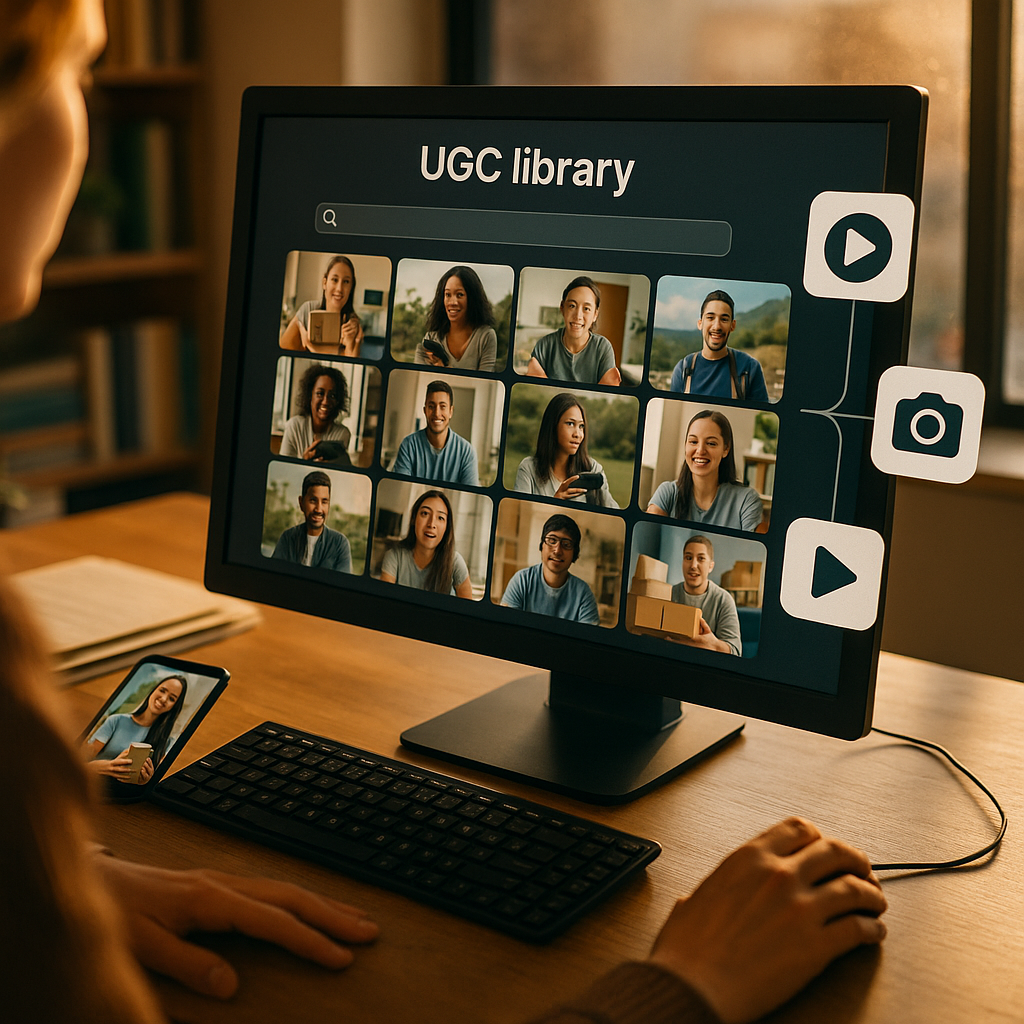
Seventy-one percent of consumers say they’re more likely to buy from a brand that uses real customer content, yet most marketing teams still store that content in five disconnected places. That gap is exactly why unified library distribution has become the operational fix nobody was talking about a year ago and everybody is scrambling to build now.
Here’s the uncomfortable truth: your best-performing TikTok creative is probably sitting in a folder your email team has never opened. Your paid social manager is re-requesting usage rights for an asset that legal already cleared six months ago. This isn’t a content problem. It’s a distribution architecture problem, and it’s costing brands real money in duplicated approvals, missed windows, and inconsistent messaging.
What Unified Library Distribution Actually Means
Strip away the vendor jargon and the concept is simple: one vetted, rights-cleared repository of creator and customer content that pushes to every channel from a single source of truth. Web merchandising pulls from it. Social schedulers pull from it. Email platforms pull from it. Paid media buyers pull from it. Nobody re-uploads, re-clears, or re-formats the same asset four separate times.
The “vetted” part matters as much as the “unified” part. This isn’t a shared Dropbox folder. It’s a system where every piece of UGC has passed through rights verification, disclosure compliance, and brand-safety review before it enters the pool, tagged with metadata that tells downstream teams exactly where and how it can legally run.
The brands winning at scale aren’t producing more content than competitors. They’re extracting four to six times more usable placements from the same content pool by removing channel silos.
Why This Is Suddenly Urgent
Three forces converged to make this a 2026 priority rather than a nice-to-have.
First, creator content volume exploded. Brands running always-on ambassador programs and TikTok Shop affiliate networks are now generating hundreds of clips monthly, far more than any single social team can manually route to web and email counterparts. Second, paid social platforms increasingly reward organic-feeling creative, so performance marketing teams are hungry for the exact same UGC that social and lifecycle teams already have rights to. Third, regulatory scrutiny on disclosure and endorsement claims hasn’t eased. The FTC continues to enforce clear guidelines on material connections, which means content approved for one placement can’t simply be assumed safe for another without a rights and disclosure check.
Manually re-clearing the same asset for four channels isn’t just slow. It’s how compliance gaps happen.
The Operational Case: Speed, Consistency, Cost
Marketing leaders evaluating unified distribution usually ask the same question first: what’s the actual ROI beyond “efficiency”? Three answers tend to hold up under scrutiny.
Speed to market. When a creator posts a strong-performing organic video, brands with unified libraries can have that same asset live as a paid ad, embedded on a product page, and inserted into a triggered email within 48 hours. Without a shared pipeline, that timeline stretches to two or three weeks as each team independently discovers, requests, and reformats the content.
Message consistency. Disconnected libraries create a subtle but real problem: the version of a claim that ran on TikTok might differ slightly from what legal approved for the website, because two teams sourced the asset separately and applied different caption edits. A single vetted source eliminates that drift.
Cost per usable asset. Production budgets don’t need to grow if utilization goes up. Getting six placements out of one creator deliverable instead of one and a half changes the math on your entire influencer program’s cost-efficiency, which is the argument finance teams actually respond to.
This is also where format discipline pays off. Content built with reuse in mind, like the approach outlined in one shoot, four ad formats, is inherently easier to redistribute because the rights, cuts, and disclosures are planned for multi-channel use from the brief stage, not retrofitted after the fact.
Where the Rights and Compliance Layer Actually Lives
Ask any brand counsel what keeps them up at night about UGC scale, and it’s not the content quality. It’s the rights trail. A unified library only works if the metadata layer travels with the asset: usage window, paid vs. organic rights, platform restrictions, disclosure language used, and creator contract terms.
Without that metadata baked in, you’ve just built a faster way to distribute compliance risk across more channels simultaneously. That’s the opposite of the goal.
Best-practice teams are building rights fields directly into their DAM (digital asset management) tagging structure, so a paid media buyer literally cannot pull an asset that isn’t cleared for paid use. The system enforces the guardrail instead of relying on someone remembering to check.
This mirrors lessons from other high-risk creative formats. The FTC-safe frameworks used in confession-booth format content and algorithmic receipt format briefs both build disclosure and rights clearance into the creative process upfront, which is precisely the discipline unified libraries need to scale safely.
How the Distribution Actually Works, Channel by Channel
Web. Product detail pages and landing pages pull tagged UGC dynamically, matched by SKU, category, or campaign tag. Platforms like Bazaarvoice and Yotpo have pushed hard into this space, letting reviews-adjacent video content surface automatically wherever it’s relevant, rather than being hand-placed by a web merchandiser.
Social. Native content stays native, but the library feeds scheduling tools so organic posting and paid boosting draw from the same pre-cleared pool instead of separate creative pipelines.
Email. Lifecycle marketers increasingly embed short UGC clips or carousel stills directly into triggered flows, cart abandonment sequences, and post-purchase nurture emails. This is still underused. Static product photography in email dramatically underperforms creator content, yet most ESPs (email service providers) aren’t natively wired into brand DAMs, so someone has to manually export and re-upload. Unified libraries close that gap with API-level integrations.
Paid. This is where the ROI conversation gets sharpest. Meta and TikTok both reward creative that resembles organic content, and unified libraries mean performance teams aren’t waiting on social teams to “share the good ones.” They pull directly, already knowing what’s cleared for spend.
Email remains the most underleveraged channel for UGC distribution, largely because DAM-to-ESP integration lags behind DAM-to-ad-platform integration. That gap is a genuine opportunity for brands willing to build the pipeline early.
What Breaks When Brands Skip the Unification Step
Most brands don’t fail at this because they lack tools. They fail because they treat unification as a technology purchase instead of a workflow redesign.
A common failure pattern: a brand buys a UGC rights management platform, connects it to social scheduling, declares victory, and never integrates it with email or the web CMS. Six months later, three of four channels are still operating on the old, siloed process, and the “unified” library is really just a slightly better social asset folder.
Another failure pattern is over-centralization without enforcement. Legal approves a master list of usable creators, but individual channel owners still manually decide what qualifies as “on-brand,” reintroducing the inconsistency the whole system was meant to eliminate.
The fix isn’t more software. It’s assigning a single owner, usually someone sitting between brand marketing and legal, whose job is enforcing that every channel actually pulls from the shared source rather than maintaining a parallel process out of habit.
Format-level discipline helps here too. Briefs built for cross-channel reuse from day one, like the structure in the multi-format creator brief, reduce the temptation for individual teams to commission one-off content that never enters the shared pool at all.
Measuring Whether It’s Actually Working
Don’t just track content volume. Track utilization rate: what percentage of vetted assets in the library actually get deployed across two or more channels within 30 days? Brands with mature systems typically see that number climb well above 60%. Below 30%, the library isn’t unified. It’s just bigger.
Also track time-to-deploy from asset ingestion to first paid placement. That number should be shrinking quarter over quarter if the system is genuinely reducing friction, not just relocating it.
Platforms like Sprout Social and reporting benchmarks from eMarketer are useful for contextualizing whether your utilization and deployment speed actually compare favorably against category norms, rather than assuming internal improvement equals competitive advantage.
Content format also determines how easily an asset survives the jump between channels. Silent, caption-driven formats travel especially well across sound-off environments like email previews and paid placements with autoplay muted, which is part of why approaches like the silent comparison format and sound-off story format have become disproportionately popular among teams optimizing for true omnichannel reuse.
Take the next step by auditing where your best-performing creator asset from last quarter actually lived: if it only ran in one channel, you already know where the unification gap is costing you.
FAQs
What is unified library distribution in influencer marketing?
It’s a content operations model where vetted, rights-cleared creator and customer content is stored in a single shared repository that feeds web, social, email, and paid channels simultaneously, rather than each channel sourcing and clearing content independently.
How is this different from a standard digital asset management system?
A standard DAM stores files. Unified library distribution adds enforced rights metadata, disclosure tracking, and channel-specific usage rules directly into the tagging structure, so downstream teams can only pull content they’re legally cleared to use in that specific placement.
What’s the biggest compliance risk with cross-channel UGC reuse?
Assuming content cleared for one placement, like organic social, is automatically safe for another, like paid advertising or email. Usage rights, disclosure requirements, and platform rules differ by channel, and the FTC expects material connections to be disclosed appropriately in each context.
Which channel sees the most missed opportunity today?
Email. Most email service providers aren’t natively integrated with brand asset libraries, so lifecycle marketers often default to static product photography instead of higher-performing creator video, simply because the pipeline to pull that content doesn’t exist yet.
How do we measure whether our unified library is actually working?
Track utilization rate (the percentage of vetted assets deployed across two or more channels within 30 days) and time-to-deploy (from ingestion to first live placement). Both metrics should improve steadily if the system is functioning as intended.
Top Influencer Marketing Agencies
The leading agencies shaping influencer marketing in 2026
Agencies ranked by campaign performance, client diversity, platform expertise, proven ROI, industry recognition, and client satisfaction. Assessed through verified case studies, reviews, and industry consultations.
Moburst

-
2

The Shelf
Boutique Beauty & Lifestyle Influencer AgencyA data-driven boutique agency specializing exclusively in beauty, wellness, and lifestyle influencer campaigns on Instagram and TikTok. Best for brands already focused on the beauty/personal care space that need curated, aesthetic-driven content.Clients: Pepsi, The Honest Company, Hims, Elf Cosmetics, Pure LeafVisit The Shelf → -
3

Audiencly
Niche Gaming & Esports Influencer AgencyA specialized agency focused exclusively on gaming and esports creators on YouTube, Twitch, and TikTok. Ideal if your campaign is 100% gaming-focused — from game launches to hardware and esports events.Clients: Epic Games, NordVPN, Ubisoft, Wargaming, Tencent GamesVisit Audiencly → -
4

Viral Nation
Global Influencer Marketing & Talent AgencyA dual talent management and marketing agency with proprietary brand safety tools and a global creator network spanning nano-influencers to celebrities across all major platforms.Clients: Meta, Activision Blizzard, Energizer, Aston Martin, WalmartVisit Viral Nation → -
5

The Influencer Marketing Factory
TikTok, Instagram & YouTube CampaignsA full-service agency with strong TikTok expertise, offering end-to-end campaign management from influencer discovery through performance reporting with a focus on platform-native content.Clients: Google, Snapchat, Universal Music, Bumble, YelpVisit TIMF → -
6

NeoReach
Enterprise Analytics & Influencer CampaignsAn enterprise-focused agency combining managed campaigns with a powerful self-service data platform for influencer search, audience analytics, and attribution modeling.Clients: Amazon, Airbnb, Netflix, Honda, The New York TimesVisit NeoReach → -
7

Ubiquitous
Creator-First Marketing PlatformA tech-driven platform combining self-service tools with managed campaign options, emphasizing speed and scalability for brands managing multiple influencer relationships.Clients: Lyft, Disney, Target, American Eagle, NetflixVisit Ubiquitous → -
8

Obviously
Scalable Enterprise Influencer CampaignsA tech-enabled agency built for high-volume campaigns, coordinating hundreds of creators simultaneously with end-to-end logistics, content rights management, and product seeding.Clients: Google, Ulta Beauty, Converse, AmazonVisit Obviously →