


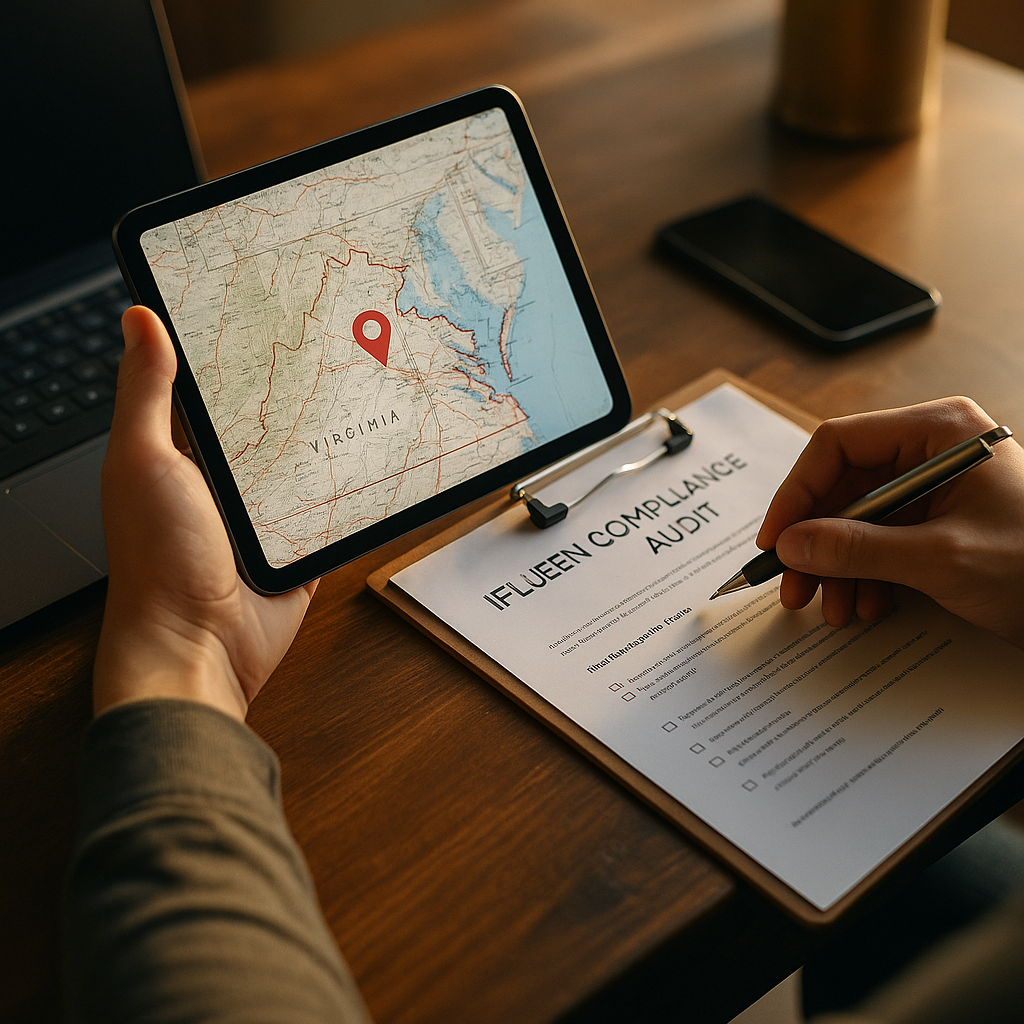
Roughly 8.5 million Virginians are now covered by one of the most specific location-data provisions in U.S. state privacy law, and most influencer marketing contracts were written before this amendment existed. The Virginia precise geolocation data amendment influencer compliance deadline is not theoretical risk, it is a live audit trigger for every brand running geo-targeted creator campaigns that touch Virginia audiences.
What the Amendment Actually Changes
Virginia’s Consumer Data Protection Act (VCDPA) already required consent for sensitive data processing. The precise geolocation amendment sharpens that requirement considerably. “Precise geolocation” is now defined as data that can identify a consumer’s location within a radius of 1,750 feet, a threshold tight enough to capture neighborhood-level targeting, store proximity triggers, and the kind of hyperlocal audience segmentation that influencer platforms routinely sell as a premium feature.
The amendment adds an explicit opt-in consent requirement before a controller or processor can collect, process, or share precise geolocation. That language matters for brands because influencer campaign infrastructure typically involves multiple processors: the creator’s platform, a third-party analytics tool, a brand safety vendor, and sometimes a separate attribution partner. Every handoff is now a potential compliance gap.
The amendment also closes a loophole that some brands quietly relied on: processing location data “incidentally” as part of broader audience analytics no longer exempts you from the consent requirement if the resulting data meets the 1,750-foot precision threshold.
If your influencer campaign uses geo-fenced audience targeting, creator proximity triggers, or platform-native location filters set below a five-mile radius, you are almost certainly processing precise geolocation data under the amended VCDPA definition, regardless of how your vendor labels it.
Where Influencer Campaigns Create Specific Exposure
Let’s be specific, because “location data compliance” is easy to wave off as an abstract legal problem until you map it to actual campaign mechanics.
Platform-native geo-targeting. TikTok, Meta, and YouTube all offer location-based audience targeting that can be set at the city or zip-code level. At zip-code level, you are routinely operating at or below the 1,750-foot threshold in dense urban areas. If your campaign targets Virginia zip codes or overlapping DMAs that include Virginia, this is direct exposure. Review your social commerce privacy compliance posture across all three platforms before assuming your existing consent flows cover location specifically.
Creator-side data collection. Some influencers use third-party link tools, swipe-up redirect platforms, or affiliate tracking software that logs audience location at the click level. If the brand receives or has access to that data, even through a shared dashboard, the brand may be acting as a joint controller under VCDPA. Your creator contracts need to address this explicitly.
Attribution and measurement vendors. Post-campaign reporting tools from companies like Traackr, CreatorIQ, or Sprinklr can surface location-segmented performance data. If those reports include Virginia audience segments broken down at granular geography, your measurement vendor is processing precise geolocation on your behalf. That makes them a processor under VCDPA, and your data processing agreement (DPA) needs to reflect the new requirements.
Store visit lift studies. Retail and QSR brands running influencer campaigns tied to store traffic attribution are particularly exposed. These studies by definition require precise location data to measure whether a viewer visited a physical location. That’s not a workaround, that’s the product. Vendors offering this service into Virginia audiences must be audited immediately.
The Contract Gap You Probably Have Right Now
Standard influencer contracts, even the more sophisticated ones used by mid-market brands, typically address data in two places: a representation that the creator will comply with platform terms of service, and a broad intellectual property clause. Neither touches data controller relationships, processor obligations, or consent requirements for geolocation. That gap was tolerable before this amendment. It is not tolerable after July 1.
Your legal team needs to add three specific provisions to creator agreements covering Virginia audience reach. First, a data processing addendum that classifies the creator’s role (processor vs. independent controller) relative to audience data they collect through their own tools. Second, an explicit prohibition on sharing precise geolocation data with the brand or third parties without documented consumer consent. Third, an audit right clause that lets the brand verify compliance without triggering a full contract renegotiation.
If you are managing a large creator roster, retrofitting every contract individually is not realistic. Build a standard addendum and require countersignature as a condition of the next campaign activation. Creators who push back are creators who need a harder conversation about your creator program governance standards.
Platform Settings: The Fastest Audit You Can Run This Week
Before you wait for legal review, there is a practical audit any media or campaign manager can run today. Go into your active campaign settings on Meta Ads Manager, TikTok Ads, and Google/YouTube. For any campaign targeting Virginia audiences, check the geographic precision of your audience definition. If you are using zip-code level, neighborhood level, or radius targeting below five miles, document it. That list becomes your priority queue for consent architecture review.
On the organic influencer side, ask your creators whether they use any third-party tools that log audience location. Many will not know offhand. That is useful information: it tells you that your creator onboarding process lacks a data disclosure step, which is itself a compliance gap to fix.
The privacy-centric marketing and data compliance framework most brands adopted after the original VCDPA did not anticipate hyperlocal creator campaigns. Now it needs to.
Consent Architecture: What “Opt-In” Actually Requires
Opt-in consent under the amended VCDPA is not a pre-checked box. It is not buried in a terms-of-service update. And it is not satisfied by a platform’s general privacy notice that consumers agreed to three years ago when they created an account.
Effective consent requires that it be: freely given (no coercion or access gates), specific (tied to the precise data use, not a catch-all), informed (the consumer knows what location data will be collected and how it will be used), and unambiguous (a clear affirmative action, not passive acceptance).
For brand teams, the practical implication is that you cannot simply rely on the platform to obtain consent on your behalf unless you have contractual documentation that the platform’s consent mechanism meets VCDPA standards for your specific use case. Review your agreements with Meta Business and TikTok for Business to confirm their consent language covers precise geolocation at the level the amendment now requires. Do not assume it does.
The FTC has been increasingly coordinating with state attorneys general on location data enforcement, and Virginia’s AG office has demonstrated a willingness to act. The risk is not purely theoretical.
Consent architecture built for general data processing will not hold up against a precise geolocation enforcement action. The amendment requires specificity, and “we relied on the platform” is not a defense when the brand is a named controller.
Building Your Compliance Audit Checklist
Here is a working framework, not a legal opinion, for structuring your internal audit before the deadline:
- Inventory all active and upcoming campaigns that include Virginia in their geographic targeting or that reach Virginia audiences through national creator campaigns.
- Identify every vendor touching location data in those campaigns: platform, analytics, attribution, brand safety, and creator-side tools.
- Pull and review your DPAs with each vendor. Flag any that do not address precise geolocation consent obligations under state law specifically.
- Audit your creator contracts for data processing language. Engage your legal team to draft a compliant addendum for any contract missing it.
- Review platform geo-targeting settings for all paid amplification tied to influencer content. Adjust or document precision levels.
- Check store visit lift and attribution study agreements for Virginia-specific consent provisions.
- Document your consent flows for any first-party data collection happening through campaign-adjacent touchpoints (landing pages, QR codes, link-in-bio tools).
For teams managing AI-generated or AI-assisted influencer content, the responsible AI governance framework for marketing should be cross-referenced here, because AI-driven audience segmentation tools often process location signals as part of their optimization logic.
The IAPP (International Association of Privacy Professionals) maintains useful state law comparison resources if your team is managing multi-state compliance simultaneously, which at this point most brand teams are.
Finally, if your campaigns run in the EU alongside U.S. markets, the geolocation standards under GDPR are stricter still. Your EU digital services compliance documentation should be updated in parallel, not sequentially.
The Virginia amendment also intersects with FTC disclosure obligations in a less obvious way: if a creator’s location is used to target a sponsored post to nearby consumers, and that targeting is not disclosed as part of the material relationship, you may have a dual compliance problem. The FTC dual disclosure rules framework is relevant reading before your next geo-targeted campaign activates.
Start with your vendor DPAs. That is the fastest way to surface the compliance gaps that carry the most institutional risk and the ones your legal team can move on immediately, before you work through the longer cycle of contract amendments with individual creators.
Frequently Asked Questions
What qualifies as “precise geolocation” under the Virginia amendment?
Under the amended VCDPA, precise geolocation is defined as data that identifies a consumer’s physical location within a radius of 1,750 feet. This threshold is specific enough to capture zip-code-level targeting, neighborhood segmentation, and store proximity triggers commonly used in influencer campaign infrastructure.
Does the Virginia amendment apply to brands headquartered outside Virginia?
Yes. The VCDPA applies to any controller or processor that targets products or services to Virginia residents, regardless of where the brand is headquartered. If your influencer campaign reaches Virginia consumers and processes their location data at the defined precision threshold, the amendment applies to you.
Are influencer platforms like TikTok and Meta responsible for obtaining consent on behalf of brands?
Not entirely. While platforms have their own consent mechanisms, brands acting as data controllers remain independently responsible for ensuring that the consent obtained meets VCDPA standards for their specific use case. Relying solely on a platform’s general privacy notice is not a sufficient compliance posture under the amendment.
Do organic influencer posts (non-paid) trigger geolocation compliance obligations?
They can. If a creator uses third-party tools (link redirectors, affiliate trackers, analytics dashboards) that log Virginia audience location data at the precision threshold, and the brand has access to or receives that data, the brand may be acting as a joint controller and must meet the amendment’s consent requirements.
What should be in a creator contract data processing addendum to address the amendment?
At minimum, the addendum should classify the creator’s role as a processor or independent controller relative to audience data, prohibit sharing precise geolocation data without documented consumer consent, and include an audit right clause allowing the brand to verify compliance without renegotiating the full agreement.
How does this amendment interact with FTC influencer disclosure rules?
If precise geolocation data is used to target a sponsored post to consumers near a specific location, and that geographic targeting is not disclosed as part of the material relationship, brands may face concurrent FTC disclosure obligations alongside VCDPA geolocation consent requirements. Both compliance tracks should be reviewed together.
Top Influencer Marketing Agencies
The leading agencies shaping influencer marketing in 2026
Agencies ranked by campaign performance, client diversity, platform expertise, proven ROI, industry recognition, and client satisfaction. Assessed through verified case studies, reviews, and industry consultations.
Moburst

-
2

The Shelf
Boutique Beauty & Lifestyle Influencer AgencyA data-driven boutique agency specializing exclusively in beauty, wellness, and lifestyle influencer campaigns on Instagram and TikTok. Best for brands already focused on the beauty/personal care space that need curated, aesthetic-driven content.Clients: Pepsi, The Honest Company, Hims, Elf Cosmetics, Pure LeafVisit The Shelf → -
3

Audiencly
Niche Gaming & Esports Influencer AgencyA specialized agency focused exclusively on gaming and esports creators on YouTube, Twitch, and TikTok. Ideal if your campaign is 100% gaming-focused — from game launches to hardware and esports events.Clients: Epic Games, NordVPN, Ubisoft, Wargaming, Tencent GamesVisit Audiencly → -
4

Viral Nation
Global Influencer Marketing & Talent AgencyA dual talent management and marketing agency with proprietary brand safety tools and a global creator network spanning nano-influencers to celebrities across all major platforms.Clients: Meta, Activision Blizzard, Energizer, Aston Martin, WalmartVisit Viral Nation → -
5

The Influencer Marketing Factory
TikTok, Instagram & YouTube CampaignsA full-service agency with strong TikTok expertise, offering end-to-end campaign management from influencer discovery through performance reporting with a focus on platform-native content.Clients: Google, Snapchat, Universal Music, Bumble, YelpVisit TIMF → -
6

NeoReach
Enterprise Analytics & Influencer CampaignsAn enterprise-focused agency combining managed campaigns with a powerful self-service data platform for influencer search, audience analytics, and attribution modeling.Clients: Amazon, Airbnb, Netflix, Honda, The New York TimesVisit NeoReach → -
7

Ubiquitous
Creator-First Marketing PlatformA tech-driven platform combining self-service tools with managed campaign options, emphasizing speed and scalability for brands managing multiple influencer relationships.Clients: Lyft, Disney, Target, American Eagle, NetflixVisit Ubiquitous → -
8

Obviously
Scalable Enterprise Influencer CampaignsA tech-enabled agency built for high-volume campaigns, coordinating hundreds of creators simultaneously with end-to-end logistics, content rights management, and product seeding.Clients: Google, Ulta Beauty, Converse, AmazonVisit Obviously →