


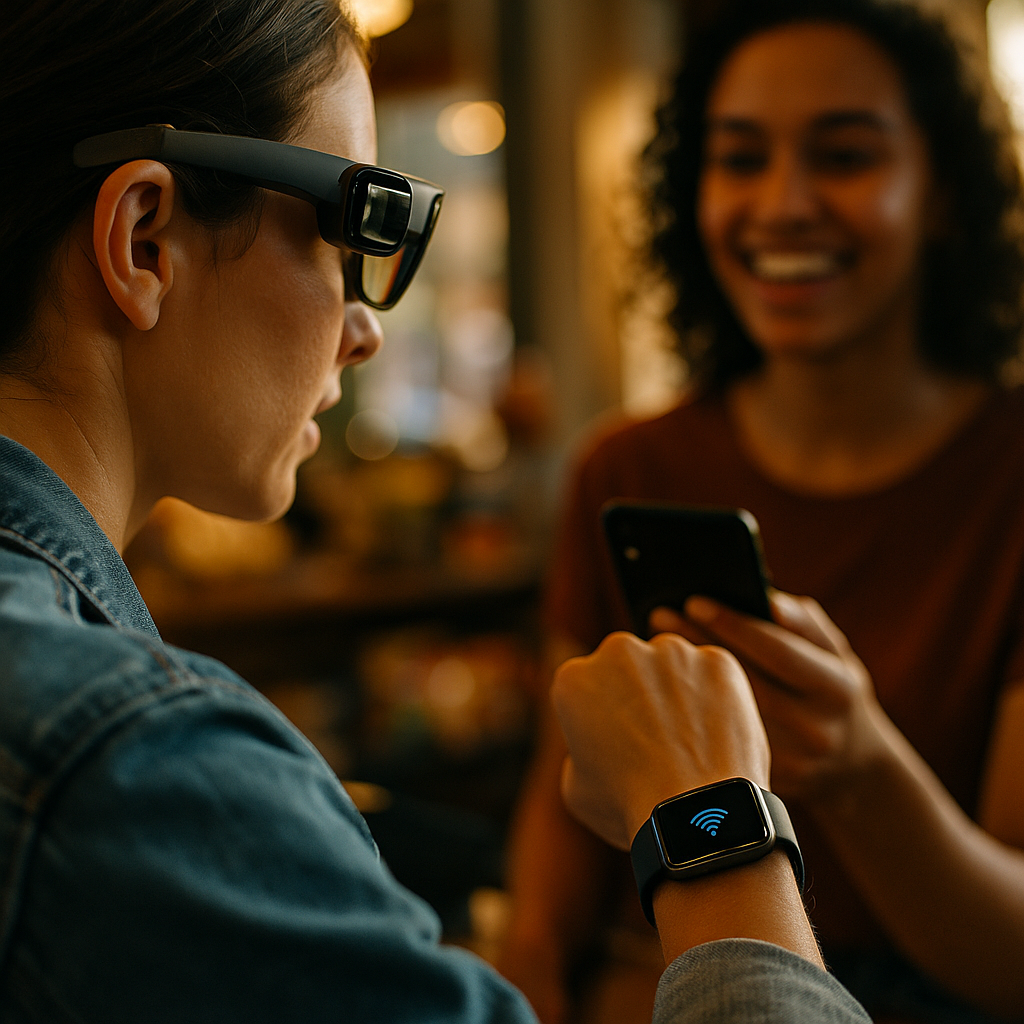
Wearable AI is moving brand touchpoints from screens to senses, reshaping how people discover, compare, and purchase in 2025. Smart glasses, rings, earbuds, and watches can listen, see, and interpret context in real time, turning everyday moments into micro-interactions with companies. This shift changes attention, trust, and loyalty patterns. The brands that adapt first will redefine habit—will yours be one of them?
Wearable AI trends for brand interactions
Wearable devices are no longer just fitness trackers. In 2025, they increasingly function as always-available assistants that filter information, anticipate needs, and reduce friction. That shift creates new interaction habits: fewer app opens, more voice-first commands, more glanceable responses, and more “invisible” brand decisions made by an assistant on the user’s behalf.
Several trends are driving this change:
- Ambient, low-friction experiences: People prefer quick, contextual answers over navigating menus. A user asks an earbud for the best allergy-friendly café nearby, and the assistant selects from brands it trusts based on location, time, and prior preferences.
- Multimodal understanding: Smart glasses and camera-enabled wearables can interpret visual cues such as product labels, signage, or menus. This enables on-the-spot brand comparisons without pulling out a phone.
- Agentic actions: More assistants can complete tasks—reordering staples, booking appointments, filing returns—after a brief confirmation. Brand interaction becomes “approve/deny” instead of “browse/select/pay.”
- Persistent identity and preferences: Wearables continuously learn user routines (sleep, commute, workouts) and can infer intent. That makes personalization feel less like marketing and more like service—when done responsibly.
For readers wondering whether this replaces mobile: not entirely. Mobile remains a deep engagement surface. Wearables, however, will increasingly own the first and most frequent touchpoint: discovery, quick decisions, reminders, and customer support triage.
Contextual personalization with wearable AI
Wearables create a new layer of personalization: contextual personalization. Instead of “who you are” alone (demographics, purchase history), the assistant incorporates “what’s happening right now” (location, motion, schedule, biometrics, and environmental signals). This changes brand interaction habits in three important ways.
1) Moments replace sessions. Traditional marketing assumes a user session—opening an app, searching, browsing. Wearables encourage micro-moments: a two-second glance on a watch, a quick voice request in earbuds, a subtle nudge in smart glasses. Brands must design for instant clarity: a single benefit, a single next step, and minimal cognitive load.
2) Intent becomes the primary targeting primitive. A wearable can infer intent signals such as “commuting,” “exercising,” or “stressed.” That creates opportunity for relevant help (e.g., hydration reminders tied to a beverage brand) but also risk if brands overreach. The habit-forming approach is to provide value first and earn repeat permission.
3) Personalization shifts from content to outcomes. People will increasingly ask for results, not options: “Get me a gift for my dad under $50 that arrives this week.” The assistant may select a brand based on reliability, return policy, ratings, and past satisfaction. If your product pages are strong but your shipping or support is weak, your brand loses in outcome-based selection.
To build trust-driven personalization, focus on:
- Preference controls: Let users set boundaries (price limits, sustainability requirements, dietary needs) and revisit them easily.
- Explainability: Provide “why this recommendation” reasons in plain language (e.g., “matches your size, arrives by Friday, best return policy”).
- Consistency across channels: The wearable suggestion should match what the user sees on mobile or in-store. Inconsistency breaks confidence fast.
Voice-first brand engagement and conversational commerce
As earbuds and watches become the most common gateway to assistants, voice-first brand engagement becomes a default interaction style. That does not mean every brand needs a “voice app.” It means brands must be legible to assistants and ready for conversational decision-making.
Wearable-driven voice interactions tend to be:
- Short: Requests are brief; responses must be even shorter.
- Interruptible: Users are walking, driving, cooking. They may pause, resume, or abandon quickly.
- Preference-sensitive: The assistant uses saved preferences, past orders, and constraints to narrow options automatically.
Common brand interactions that shift to voice in 2025 include reorder flows, service status checks, store hours, appointment booking, loyalty point balances, and product compatibility questions. The brands that win voice-first habits design for confirmation loops:
- Confirm critical choices: “Reorder the same size and flavor?” reduces mistakes and returns.
- Offer one best option plus one alternative: Too many choices frustrate voice users.
- Provide a fast handoff: When complexity increases, send a link or “continue on phone” card without losing context.
Readers often ask how to measure voice-driven commerce when the assistant mediates the journey. The practical answer is to track: assistant-attributed conversions where available, branded search lift, reorder frequency, customer service containment (issues solved without an agent), and “time to resolution.” Wearables reduce steps; your metrics should reward reduced friction, not just pageviews.
Privacy, consent, and wearable AI trust signals
Wearables can collect sensitive data—location, audio, biometrics, and potentially visual context. That makes wearable AI trust a defining competitive factor in 2025. Brand interaction habits will skew toward companies that demonstrate restraint, transparency, and security.
What trust looks like in practice:
- Consent is granular and revocable: Users should be able to allow “order updates” without allowing “always-on location tracking.”
- Data minimization by design: Collect only what you need to deliver the promised value. Store less, keep it shorter, and document retention rules.
- Clear value exchange: If you want access to wearable signals, state the user benefit plainly: “We use motion data to detect workout mode and adjust coaching prompts.”
- Security posture: Use encryption in transit and at rest, strong authentication, and regular security reviews. Communicate these protections in user-facing language, not just legal terms.
Trust signals also matter to AI assistants. As assistants choose which brands to recommend, they will likely weight signals such as verified business identity, accurate hours and inventory, transparent pricing, authentic reviews, return policies, and support responsiveness. Your brand’s reputation becomes machine-readable through structured data, platform ratings, and consistency across listings.
If you worry that privacy constraints will limit personalization, treat it as a product design challenge. Many high-value experiences can run on-device or with anonymized aggregation. When users feel safe, they opt in more often—creating a better long-term data relationship than aggressive short-term collection.
AI-driven customer experience across wearables and stores
Wearables collapse the boundary between digital and physical. People will increasingly expect an AI-driven customer experience that carries context from a wearable to a store, call center, or delivery driver without repeating themselves.
Here is how interaction habits evolve when wearables become the “remote control” for brand relationships:
- Proactive support: A shipment delay triggers a subtle watch alert with one-tap options: “keep,” “reroute,” or “cancel.” This reduces inbound calls and increases perceived reliability.
- In-store augmentation: Smart glasses can highlight items on a shopping list, show price comparisons, or surface allergy warnings. Brands that provide accurate product data and clear labeling become easier to choose.
- Hands-free loyalty: A wearable confirms membership, applies offers, and logs purchases automatically. The habit shifts from “remember to scan” to “it just works.”
- Post-purchase coaching: For products that require setup or ongoing use (appliances, skincare, fitness), wearables deliver step-by-step guidance in the moment it’s needed, lowering returns and improving satisfaction.
To make this real, brands should invest in operational fundamentals that assistants can rely on:
- Inventory accuracy: If a wearable suggests an in-stock item and it isn’t there, trust erodes fast.
- Fast, consistent support: Assistants may route users to the “best” support path. Short resolution times and strong self-serve flows become a ranking advantage.
- Unified customer profile with user control: Customers should be able to see and manage what’s remembered across channels.
This section also answers a common follow-up: will wearables reduce brand differentiation? They can, if brands rely on generic messages. Differentiation shifts to reliability, speed, privacy posture, and the quality of outcomes delivered through the assistant.
Marketing strategy for wearable AI ecosystems
In a world where assistants filter choices, traditional “reach and frequency” matters less than being the best answer in a wearable moment. A modern strategy focuses on eligibility, credibility, and compatibility with assistant-driven journeys.
Improve assistant eligibility. Ensure your brand information is accurate and machine-consumable:
- Structured product and location data: Keep pricing, availability, hours, attributes, and shipping promises consistent across platforms.
- Clear policies: Returns, warranties, cancellations, and delivery terms should be concise and easy for assistants to summarize.
- Accessibility and clarity: Wearables favor short, clear language and scannable details. Remove jargon from key pages and confirmations.
Build credibility that assistants can detect. In 2025, credibility is not only human perception; it is also signals in ecosystems:
- Verified reviews and service metrics: Encourage authentic feedback and respond to issues publicly where appropriate.
- Demonstrable expertise: Publish helpful guides, compatibility checkers, and troubleshooting steps that answer real questions. This supports EEAT by showing experience and expertise, not just claims.
- Transparent sourcing and claims: For health, sustainability, or performance claims, cite supporting evidence on your site and avoid overpromising.
Design for agentic checkout. If assistants can buy on a user’s behalf, brands need frictionless, low-error flows:
- Standardized options: Sizes, variants, bundles, and subscriptions should be clearly defined to reduce mistakes.
- Confirmation-friendly packaging: Make it easy to confirm “the right item” in one sentence: brand, model, size, color, price, delivery date.
- Post-purchase flexibility: Easy changes, pauses, and returns protect long-term habits.
Answer the question behind the question. Wearable prompts often start as quick asks—“Is this safe?” “Will it fit?” “What’s the best option?” Your content and support must resolve these quickly. Publish comparison tables, fit guides, ingredient explainers, and “who it’s for” summaries so assistants can extract accurate answers.
FAQs about wearable AI and brand interaction habits
What is wearable AI in the context of brand interactions?
Wearable AI refers to AI-powered assistants embedded in devices like smartwatches, earbuds, rings, and smart glasses that interpret context and help users complete tasks. For brands, it means customers engage through quick voice commands, glanceable prompts, and assistant-led decisions rather than long app sessions.
Will wearable AI reduce the importance of brand loyalty?
It changes loyalty rather than eliminating it. Loyalty shifts from emotional affinity alone to measurable reliability: accurate recommendations, consistent fulfillment, easy returns, and privacy-safe personalization. Brands that deliver strong outcomes get “default” status in assistant choices.
How can a brand become a recommended option in AI assistants?
Focus on data accuracy (pricing, availability, hours), clear policies, strong reviews, and consistent customer support performance. Publish helpful, expert content that answers common questions and ensure your product catalog is structured so assistants can match user constraints like budget, delivery windows, and compatibility.
What are the biggest privacy risks with wearable AI marketing?
The biggest risks include collecting sensitive signals without clear consent, retaining data longer than needed, and using always-on audio or location in ways users do not expect. The safest approach is granular opt-in, data minimization, and clear explanations of what data is used for which benefit.
Do wearables replace mobile apps for ecommerce?
Not completely. Wearables often handle discovery, reminders, quick reorders, and support updates, while phones still support deep research, complex configuration, and detailed browsing. Brands should design seamless handoffs so users can start on a wearable and finish on a phone without losing context.
What metrics should marketers track for wearable AI journeys?
Track reorder frequency, assistant-attributed conversions where available, customer support containment and resolution time, subscription retention, return rates, and brand preference lift in relevant queries. Also monitor trust indicators such as opt-in rates and privacy-related churn.
Wearables will reshape brand interaction habits in 2025 by moving decisions into real-time context, shortening journeys, and letting assistants act on behalf of customers. Brands that win will earn trust through privacy-safe personalization, operational reliability, and clear, assistant-ready information. Treat wearables as a service channel, not an ad slot, and you’ll build durable preference in the moments that matter most.