


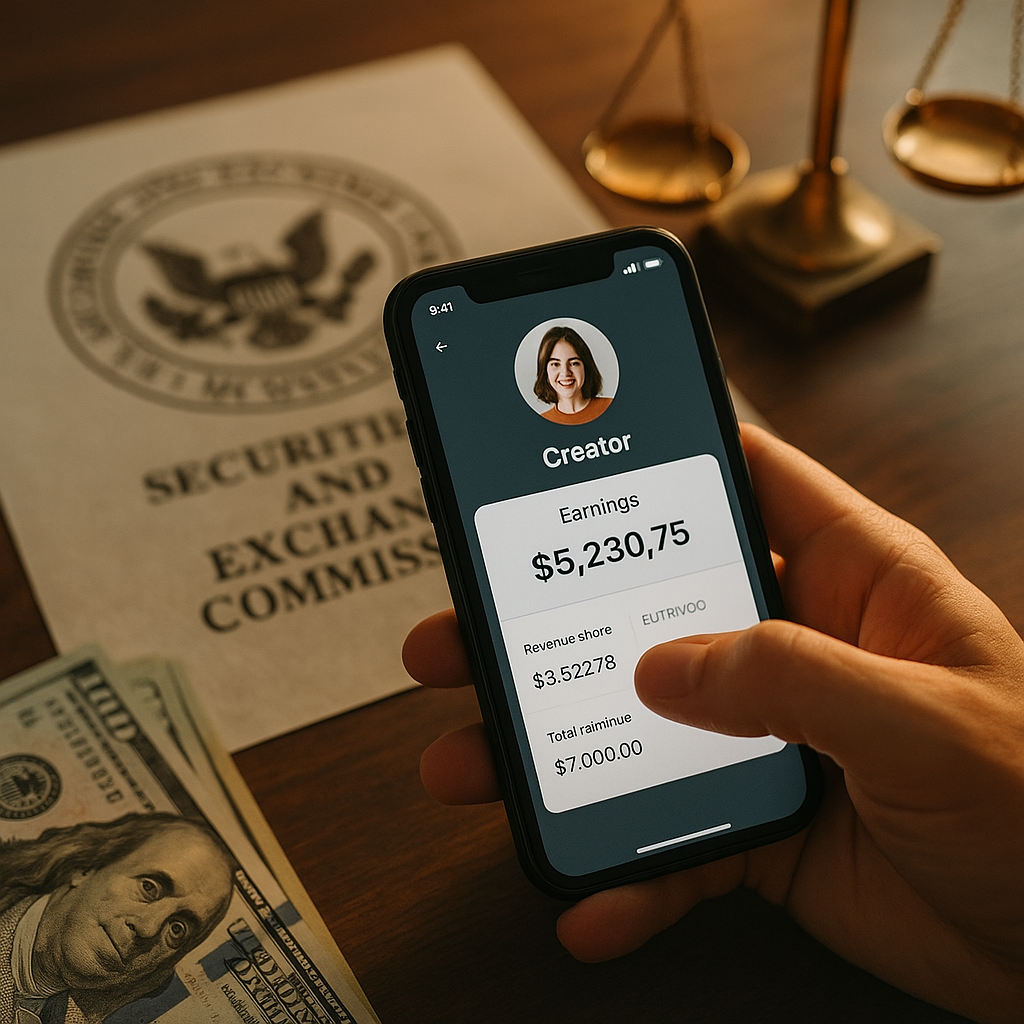
Forty-eight state securities regulators and the SEC all use some version of the same test: does the deal involve an investment of money in a common enterprise with profits expected from someone else’s effort? Structure a creator’s pay as a revenue share tied to brand performance, and you may have just answered “yes” to all three. State securities law exposure is the compliance risk nobody in influencer marketing is pricing in, and it’s about to get expensive.
Brands love revenue-share and royalty deals because they align incentives. Pay a creator a cut of sales instead of a flat fee, and suddenly they’re motivated to actually sell something. It’s elegant. It’s also, in certain structures, a security under the Howey test — and most marketing teams have never run that analysis.
Why This Is Suddenly a Real Problem
Royalty-based creator deals used to be rare. A handful of beauty founders gave early ambassadors small equity or profit points, and nobody blinked because the dollar amounts were tiny and the arrangements informal. That era is over. Creator-led product lines, co-branded SKUs, and “creator equity” partnerships are now a standard deal structure at the mid-market level, not just for celebrity-founder brands.
As these deals scale, so does scrutiny. State securities regulators — through NASAA, the umbrella group coordinating blue sky law enforcement across states — have flagged influencer-linked investment pitches as an enforcement priority, largely because of crypto and NFT promotions. But the underlying legal theory doesn’t care whether the asset is a token or a percentage of a skincare line’s net revenue. If money changes hands in exchange for a profit share dependent on the brand’s managerial efforts, the Howey framework applies regardless of the product category.
A revenue-share creator contract can look identical, legally, to an unregistered security offering — the difference often comes down to a few contract clauses most legal teams never scrutinize.
The Howey Test, Translated for Marketing Teams
Skip the law school jargon. Here’s the plain version marketing and legal ops teams actually need:
- Investment of money: Did the creator (or the brand, in some structures) put capital at risk to receive the royalty stream? Signing bonuses, buy-in fees, or creators purchasing equity to unlock revenue share all count.
- Common enterprise: Is the creator’s return tied to the collective performance of the brand’s broader business, not just their individual content output?
- Expectation of profit: Is the deal marketed or understood as a passive income opportunity rather than compensation for services rendered?
- Efforts of others: Does the creator’s payout depend mainly on the brand’s operational, marketing, and managerial decisions rather than the creator’s own promotional work?
Most standard affiliate and commission deals fail this test in the brand’s favor — the creator is being paid for their own promotional effort, full stop. The risk shows up when contracts blend royalty payments with equity options, tiered ownership stakes, or “founding creator” programs that resemble investment rounds more than service agreements. That overlap is exactly what we flagged in our due diligence framework for equity deals — the securities question doesn’t disappear just because the deal is dressed up as a partnership.
Where State Law Diverges From Federal
Here’s the part that trips up even sophisticated legal teams: federal securities exemptions don’t automatically preempt state blue sky laws. A deal structured to qualify for a Regulation D federal exemption still has to satisfy each state’s notice filing and registration requirements where the creator resides. Miss a state filing, and you’re not dealing with the SEC — you’re dealing with a state securities administrator who can issue cease-and-desist orders, impose fines, or refer the matter for criminal prosecution.
State approaches vary more than most brands assume. California’s Corporate Securities Law takes an expansive “risk capital” test that can sweep in arrangements federal law would exempt. New York’s Martin Act gives the state attorney general sweeping investigative power without needing to prove intent to defraud. Texas and Florida lean closer to the federal Howey framework but layer on their own registration and broker-dealer licensing requirements for anyone structuring or selling the arrangement. A revenue-share creator program that’s clean in Texas can be a registration violation in California, purely because of where the creator lives.
This is why a single national creator contract template is dangerous. Multi-state creator rosters need state-by-state legal review the same way cross-border payment structures need jurisdiction-specific tax review. The compliance logic is the same: payment structure triggers different regulatory regimes depending on geography, and “we’ll figure it out later” is not a defensible legal posture.
The Contract Clauses That Actually Matter
Legal teams reviewing creator revenue-share deals should be scrutinizing five specific structural elements, not just the headline compensation terms.
1. Is There an Actual Investment?
The cleanest way to avoid securities characterization: make sure the creator isn’t putting capital at risk to access the royalty. If a creator pays for equity, buys into a licensing pool, or fronts inventory costs in exchange for a revenue percentage, you’ve satisfied the “investment of money” prong. Compensation-for-services structures, where the creator contributes content, promotion, or labor rather than capital, sit on much firmer ground.
2. Whose Effort Drives the Return?
This is the prong brands can actually control through contract drafting. If the royalty is explicitly tied to the creator’s own deliverables — number of posts, campaign duration, personal sales attribution via unique codes — the payout depends on the creator’s effort, not the brand’s managerial skill. That’s a service contract, not a security. But if the contract describes the royalty as a share of “company revenue” or “brand performance” broadly, divorced from the creator’s individual output, you’ve drifted toward the “efforts of others” test that defines a security.
Tie the payout language explicitly to the creator’s own deliverables. Vague references to “brand performance” or “company growth” are the single biggest red flag in royalty contract drafting.
3. Is It Marketed as an Investment Opportunity?
Regulators look hard at how a deal is pitched, not just how it’s papered. If a brand’s outreach deck to prospective creator partners uses language like “passive income,” “equity upside,” or “get in early,” that marketing framing becomes evidence in a securities analysis — regardless of what the final contract says. Sales and partnerships teams need the same disclosure discipline here that equity-paid creator programs require on the FTC side. Consistency between pitch materials and contract language isn’t optional.
4. Registration Exemption Stacking
If a revenue-share arrangement does trip the securities definition, the brand needs a valid exemption at both the federal and state level. Regulation D private placement exemptions (Rule 506(b) or 506(c)) are the most common federal fallback, but they come with restrictions on general solicitation and investor accreditation that are awkward to reconcile with influencer marketing’s inherently public nature — you can’t run an open creator recruitment campaign and simultaneously claim you didn’t generally solicit. Brands considering equity-adjacent creator deals should model this exemption question before launch, not after a state regulator sends a letter.
5. Termination and Clawback Mechanics
Securities characterization risk also shows up in how contracts handle termination. If a creator’s royalty continues indefinitely after they stop producing content — a pure passive residual — that strengthens the “common enterprise” and “efforts of others” arguments against the brand. Contracts that sunset royalty payments on a defined schedule tied to active participation are more defensible. This connects to broader questions about how creator obligations survive contract termination, similar to the tension we covered in how equity breaks standard non-compete structures.
What Happens If You Get It Wrong
Unregistered securities violations carry real teeth. State administrators can order rescission, forcing the brand to unwind the entire arrangement and refund any capital the creator invested, plus interest. Some states allow creators (as “investors” under this framing) to sue directly for damages. And because securities violations often trigger mandatory disclosure in subsequent fundraising, a brand caught in an unregistered offering dispute can find the issue resurfacing during their next institutional raise or acquisition due diligence process.
There’s also a reputational dimension marketing leaders underestimate. A securities enforcement action against a consumer brand for its creator program is a very different news cycle than a routine FTC disclosure fine. It signals the company doesn’t understand its own compensation structures — a credibility problem investors and retail partners notice.
Building the Internal Review Process
Practically, this means influencer marketing teams can’t greenlight royalty or revenue-share deals without a securities-specific legal review layered on top of standard FTC and contract review. A workable process looks like this:
- Flag any creator deal involving equity, royalties, or revenue share for securities review before it reaches term sheet stage.
- Map creator residency against state blue sky requirements — treat multi-state rosters like multi-jurisdiction compliance projects.
- Audit recruitment and pitch materials for investment-style language, not just final contracts.
- Build clear, effort-based payout language tied to the creator’s specific deliverables.
- Document the exemption analysis and keep it alongside the contract file, the same way you’d retain data agreement compliance records for audit purposes.
None of this is exotic. It’s the same operational discipline brands already apply to FTC endorsement compliance and data privacy — just pointed at a regulatory regime marketing teams haven’t historically had to think about. According to eMarketer, creator economy spend continues to climb into the tens of billions annually, and a growing share of that spend involves equity or performance-linked structures rather than flat fees. The regulatory surface area is expanding right alongside it.
Marketing leaders don’t need to become securities lawyers. But they do need to know when a deal structure requires one. For more on how regulators are already testing creator compensation structures in adjacent areas, see the FTC’s guidance on endorsements, which increasingly intersects with these compensation questions.
The Takeaway
Route every royalty, revenue-share, or equity-adjacent creator deal through securities counsel before signature, not after a state regulator asks questions. The cost of that review is a rounding error next to the cost of an unwind order.
FAQs
Does every creator revenue-share deal count as a security?
No. If the payout is tied directly to the creator’s own promotional effort and no capital investment is involved, most revenue-share arrangements function as standard service compensation, not securities. Risk increases when the deal involves equity, buy-in fees, or payouts tied to broad company performance rather than the creator’s specific output.
How is state securities law different from SEC oversight here?
Federal exemptions like Regulation D don’t automatically satisfy state blue sky law requirements. Each state has its own registration, notice filing, and in some cases broker-dealer licensing rules that apply independently based on where the creator resides.
What’s the fastest way to reduce exposure in existing contracts?
Rewrite royalty language to tie payouts explicitly to the creator’s individual deliverables (posts, campaigns, attributed sales) rather than vague references to overall brand or company performance, and confirm creators aren’t investing capital to access the arrangement.
Can pitch decks and recruitment materials create securities risk even if the contract is clean?
Yes. Regulators consider how a deal was marketed, not just the final contract terms. Language suggesting passive income or investment upside in outreach materials can support a securities characterization even when the signed agreement avoids that framing.
Should brands avoid royalty and equity-based creator deals altogether?
Not necessarily. These structures can align incentives effectively. The requirement is running a securities-specific legal review before launch, mapping creator residency against state requirements, and documenting exemption analysis alongside the contract file.
FAQs
Does every creator revenue-share deal count as a security?
No. If the payout is tied directly to the creator’s own promotional effort and no capital investment is involved, most revenue-share arrangements function as standard service compensation, not securities. Risk increases when the deal involves equity, buy-in fees, or payouts tied to broad company performance rather than the creator’s specific output.
How is state securities law different from SEC oversight here?
Federal exemptions like Regulation D don’t automatically satisfy state blue sky law requirements. Each state has its own registration, notice filing, and in some cases broker-dealer licensing rules that apply independently based on where the creator resides.
What’s the fastest way to reduce exposure in existing contracts?
Rewrite royalty language to tie payouts explicitly to the creator’s individual deliverables (posts, campaigns, attributed sales) rather than vague references to overall brand or company performance, and confirm creators aren’t investing capital to access the arrangement.
Can pitch decks and recruitment materials create securities risk even if the contract is clean?
Yes. Regulators consider how a deal was marketed, not just the final contract terms. Language suggesting passive income or investment upside in outreach materials can support a securities characterization even when the signed agreement avoids that framing.
Should brands avoid royalty and equity-based creator deals altogether?
Not necessarily. These structures can align incentives effectively. The requirement is running a securities-specific legal review before launch, mapping creator residency against state requirements, and documenting exemption analysis alongside the contract file.
Top Influencer Marketing Agencies
The leading agencies shaping influencer marketing in 2026
Agencies ranked by campaign performance, client diversity, platform expertise, proven ROI, industry recognition, and client satisfaction. Assessed through verified case studies, reviews, and industry consultations.
Moburst

-
2

The Shelf
Boutique Beauty & Lifestyle Influencer AgencyA data-driven boutique agency specializing exclusively in beauty, wellness, and lifestyle influencer campaigns on Instagram and TikTok. Best for brands already focused on the beauty/personal care space that need curated, aesthetic-driven content.Clients: Pepsi, The Honest Company, Hims, Elf Cosmetics, Pure LeafVisit The Shelf → -
3

Audiencly
Niche Gaming & Esports Influencer AgencyA specialized agency focused exclusively on gaming and esports creators on YouTube, Twitch, and TikTok. Ideal if your campaign is 100% gaming-focused — from game launches to hardware and esports events.Clients: Epic Games, NordVPN, Ubisoft, Wargaming, Tencent GamesVisit Audiencly → -
4

Viral Nation
Global Influencer Marketing & Talent AgencyA dual talent management and marketing agency with proprietary brand safety tools and a global creator network spanning nano-influencers to celebrities across all major platforms.Clients: Meta, Activision Blizzard, Energizer, Aston Martin, WalmartVisit Viral Nation → -
5

The Influencer Marketing Factory
TikTok, Instagram & YouTube CampaignsA full-service agency with strong TikTok expertise, offering end-to-end campaign management from influencer discovery through performance reporting with a focus on platform-native content.Clients: Google, Snapchat, Universal Music, Bumble, YelpVisit TIMF → -
6

NeoReach
Enterprise Analytics & Influencer CampaignsAn enterprise-focused agency combining managed campaigns with a powerful self-service data platform for influencer search, audience analytics, and attribution modeling.Clients: Amazon, Airbnb, Netflix, Honda, The New York TimesVisit NeoReach → -
7

Ubiquitous
Creator-First Marketing PlatformA tech-driven platform combining self-service tools with managed campaign options, emphasizing speed and scalability for brands managing multiple influencer relationships.Clients: Lyft, Disney, Target, American Eagle, NetflixVisit Ubiquitous → -
8

Obviously
Scalable Enterprise Influencer CampaignsA tech-enabled agency built for high-volume campaigns, coordinating hundreds of creators simultaneously with end-to-end logistics, content rights management, and product seeding.Clients: Google, Ulta Beauty, Converse, AmazonVisit Obviously →