


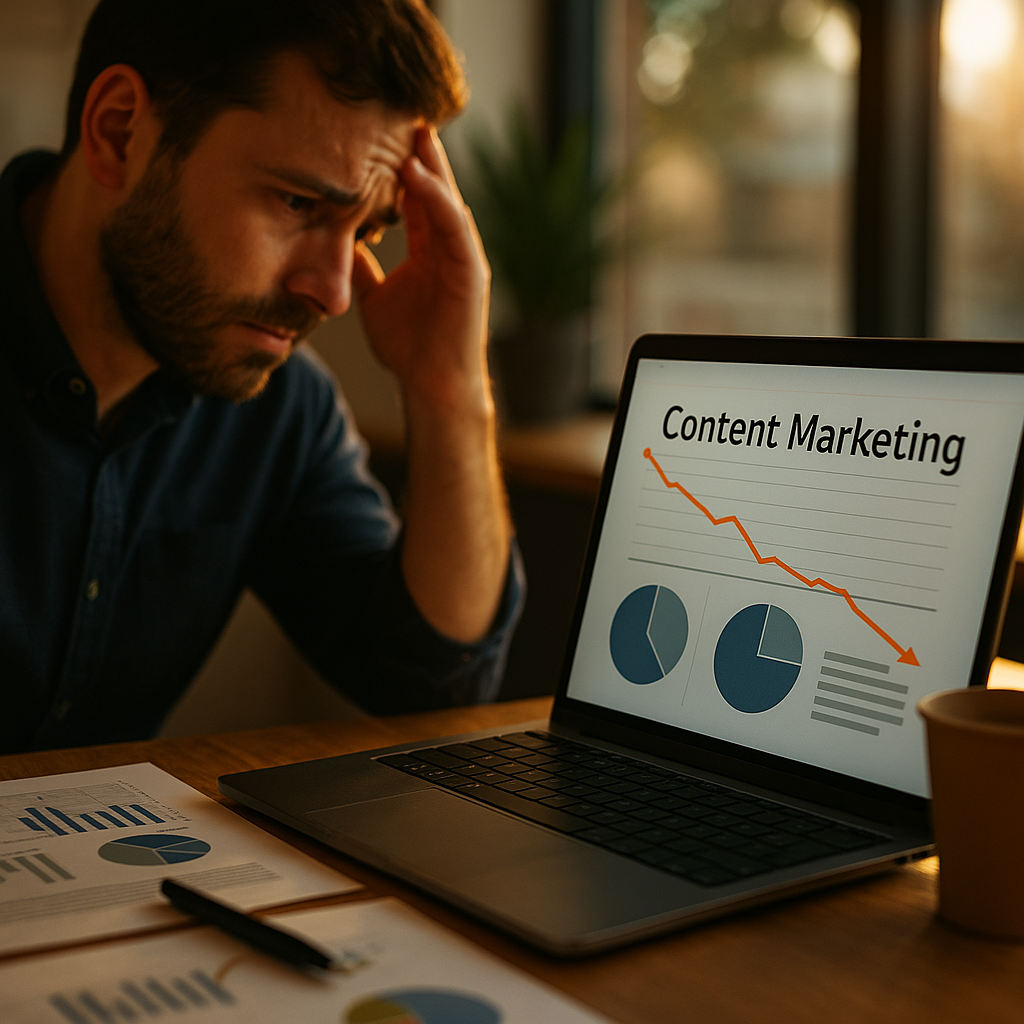
When a content marketing program fails to generate any leads, marketing leaders are left asking tough questions and analyzing every step of their strategy. Understanding why content fails is crucial for businesses that depend on inbound traffic. In this post-mortem, we dissect what went wrong and outline actionable insights to chart a better path forward.
Content Marketing Strategy Missteps and Missed Buyer Personas
One of the most critical aspects of content marketing is aligning your strategy with your ideal buyer personas. Many failed content marketing programs, especially in 2025’s fast-evolving landscape, can be traced back to fundamental flaws in strategy:
- Superficial audience research: Without recent, in-depth research, marketers create content based on assumptions, missing the real motivations and pain points of target buyers.
- Unclear value proposition: If your content doesn’t quickly and clearly communicate the unique value you offer, leads will look elsewhere.
- Mismatched content formats: Are you using text-heavy blogs when your audience prefers interactive webinars or visual explainers? Not matching the right format to your persona is a classic error.
In failed programs, these issues often manifest together. The result is content that may attract traffic, but not the right kind of traffic—leaving leads and conversion rates stagnant.
SEO Mistakes and Lack of Search Intent Alignment
Organic search remains a primary channel for content lead generation in 2025. But many businesses falter by misunderstanding how SEO and search intent intersect:
- Poor keyword targeting: Targeting broad, highly competitive keywords might boost vanity metrics like impressions but fails to engage ready-to-convert visitors.
- Ignoring user intent: When content doesn’t answer the specific queries and needs driving the search, visitors bounce quickly.
- Neglecting proper on-page SEO: Failing to structure content with clear headings, meta descriptions, or schema reduces the chance of ranking and decreases click-through rates.
High-quality, lead-generating content aligns with user intent, incorporates keyword research, and utilizes technical SEO exhaustively. Including structured data and optimization for voice and mobile search, which both surged in 2025, matters more than ever.
Weak Calls-to-Action and Conversion Architecture
No matter how good your content is, if the calls-to-action (CTAs) aren’t strong or visible, leads will not be captured. Post-mortems of failed programs often reveal issues such as:
- Buried or unclear CTAs: Users don’t see the next step or don’t grasp the benefit of taking it.
- Lack of contextually-relevant offers: Opt-ins, downloads, or demos must closely match the content and the funnel stage.
- Missing or broken lead capture forms: Even minor technical issues can kill conversions.
Effective lead generation requires clear, concise CTAs that anticipate and remove user friction. Optimizing landing pages, using persuasive language, split-testing CTA designs, and providing tangible value in exchange for contact information are non-negotiables in 2025’s competitive market.
Content Quality, Trustworthiness, and EEAT Signals
With Google’s most recent EEAT (Experience, Expertise, Authoritativeness, Trustworthiness) updates, content quality now directly impacts lead generation. Programs that fail to produce leads often cut corners on:
- Original insights: Regurgitated or generic advice harms credibility and deliver little unique value.
- Demonstrated expertise: Content lacking author bios, up-to-date references, industry-recognized contributions, or data-supported arguments appear untrustworthy.
- Poor credibility signals: Absence of testimonials, client logos, or clear privacy policies deter users from submitting their details.
EEAT-compliant content always cites data, includes expert opinions, and builds trust with transparent author and brand information. Without these signals, visitors hesitate to convert.
Distribution, Promotion, and the Amplification Gap
It’s a misconception that quality content will automatically attract leads if it “goes live.” Often, the real breakdown is distribution—when valuable content doesn’t reach its intended audience. In failed programs, common distribution issues include:
- Lack of promotion: Without coordinated social, email, and paid promotion, even great content dies unseen.
- No partnerships or syndication: Strategic collaboration with industry influencers and platforms multiplies reach but is frequently overlooked.
- Underutilized employee advocacy: Employees can be powerful content amplifiers, but formal programs are rare.
In 2025, distribution needs a plan as sophisticated as content creation itself. Mixing organic and paid strategies, leveraging partnerships, and consistently tracking engagement ensures content connects with prospects and generates leads.
Tracking, Analytics, and Iteration in Lead Generation Analysis
Every failed content marketing program is a missed opportunity to learn. The most successful marketing teams treat analytics as a core pillar of their strategy, consistently reviewing performance and adapting. Post-mortems reveal common analytical failures:
- No baseline or goal setting: If you don’t define what a “lead” means or set clear KPIs, measuring failure is impossible.
- Ignoring attribution models: Understanding how visitors convert across a multi-channel funnel is crucial, but many teams still rely on last-click attribution.
- Failure to pivot: Data without decisive action is meaningless. Nimble teams continuously A/B test, reallocate budget, and experiment, while failing programs rarely iterate.
Combining analytics with agile processes ensures content marketing remains responsive, efficient, and lead-focused—turning insights from failure into the foundation for future success.
FAQs About Content Marketing Programs Failing to Generate Leads
-
What are early warning signs that my content isn’t generating leads?
Poor engagement rates, high bounce rates, lack of form submissions, and low CTA click-through rates often indicate that your content isn’t resonating. Consistent declines in organic and referral leads should prompt a program review.
-
How important is EEAT for lead generation in 2025?
EEAT—Experience, Expertise, Authoritativeness, and Trustworthiness—is critical. Google and users now demand content that is credible, supported by data, and authored by recognized experts. These factors directly influence conversions and lead quality.
-
How can I better align content with my target audience’s needs?
Conduct detailed persona research, survey current clients, analyze analytics for content preferences, and involve sales teams in topic ideation. Continually update personas as market conditions shift.
-
Can paid promotion fix a failing content program?
Paid promotion can amplify reach, but cannot compensate for poor-quality or misaligned content. Audit and address content gaps first, then use targeted ads strategically for best results.
-
What role does analytics play in preventing content marketing failure?
Robust analytics enable early intervention. They help identify content bottlenecks, conversion drop-offs, and fast-moving trends—allowing you to refine tactics ahead of costly failures.
A content marketing program that failed to generate leads offers invaluable lessons for future growth. Review buyer alignment, SEO, EEAT, CTAs, promotion, and analytics rigorously. Treat every failure as a blueprint for improvement—because in 2025’s fiercely competitive landscape, only adaptive, data-driven programs deliver real, consistent results.
Top Influencer Marketing Agencies
The leading agencies shaping influencer marketing in 2026
Agencies ranked by campaign performance, client diversity, platform expertise, proven ROI, industry recognition, and client satisfaction. Assessed through verified case studies, reviews, and industry consultations.
Moburst

-
2

The Shelf
Boutique Beauty & Lifestyle Influencer AgencyA data-driven boutique agency specializing exclusively in beauty, wellness, and lifestyle influencer campaigns on Instagram and TikTok. Best for brands already focused on the beauty/personal care space that need curated, aesthetic-driven content.Clients: Pepsi, The Honest Company, Hims, Elf Cosmetics, Pure LeafVisit The Shelf → -
3

Audiencly
Niche Gaming & Esports Influencer AgencyA specialized agency focused exclusively on gaming and esports creators on YouTube, Twitch, and TikTok. Ideal if your campaign is 100% gaming-focused — from game launches to hardware and esports events.Clients: Epic Games, NordVPN, Ubisoft, Wargaming, Tencent GamesVisit Audiencly → -
4

Viral Nation
Global Influencer Marketing & Talent AgencyA dual talent management and marketing agency with proprietary brand safety tools and a global creator network spanning nano-influencers to celebrities across all major platforms.Clients: Meta, Activision Blizzard, Energizer, Aston Martin, WalmartVisit Viral Nation → -
5

The Influencer Marketing Factory
TikTok, Instagram & YouTube CampaignsA full-service agency with strong TikTok expertise, offering end-to-end campaign management from influencer discovery through performance reporting with a focus on platform-native content.Clients: Google, Snapchat, Universal Music, Bumble, YelpVisit TIMF → -
6

NeoReach
Enterprise Analytics & Influencer CampaignsAn enterprise-focused agency combining managed campaigns with a powerful self-service data platform for influencer search, audience analytics, and attribution modeling.Clients: Amazon, Airbnb, Netflix, Honda, The New York TimesVisit NeoReach → -
7

Ubiquitous
Creator-First Marketing PlatformA tech-driven platform combining self-service tools with managed campaign options, emphasizing speed and scalability for brands managing multiple influencer relationships.Clients: Lyft, Disney, Target, American Eagle, NetflixVisit Ubiquitous → -
8

Obviously
Scalable Enterprise Influencer CampaignsA tech-enabled agency built for high-volume campaigns, coordinating hundreds of creators simultaneously with end-to-end logistics, content rights management, and product seeding.Clients: Google, Ulta Beauty, Converse, AmazonVisit Obviously →