


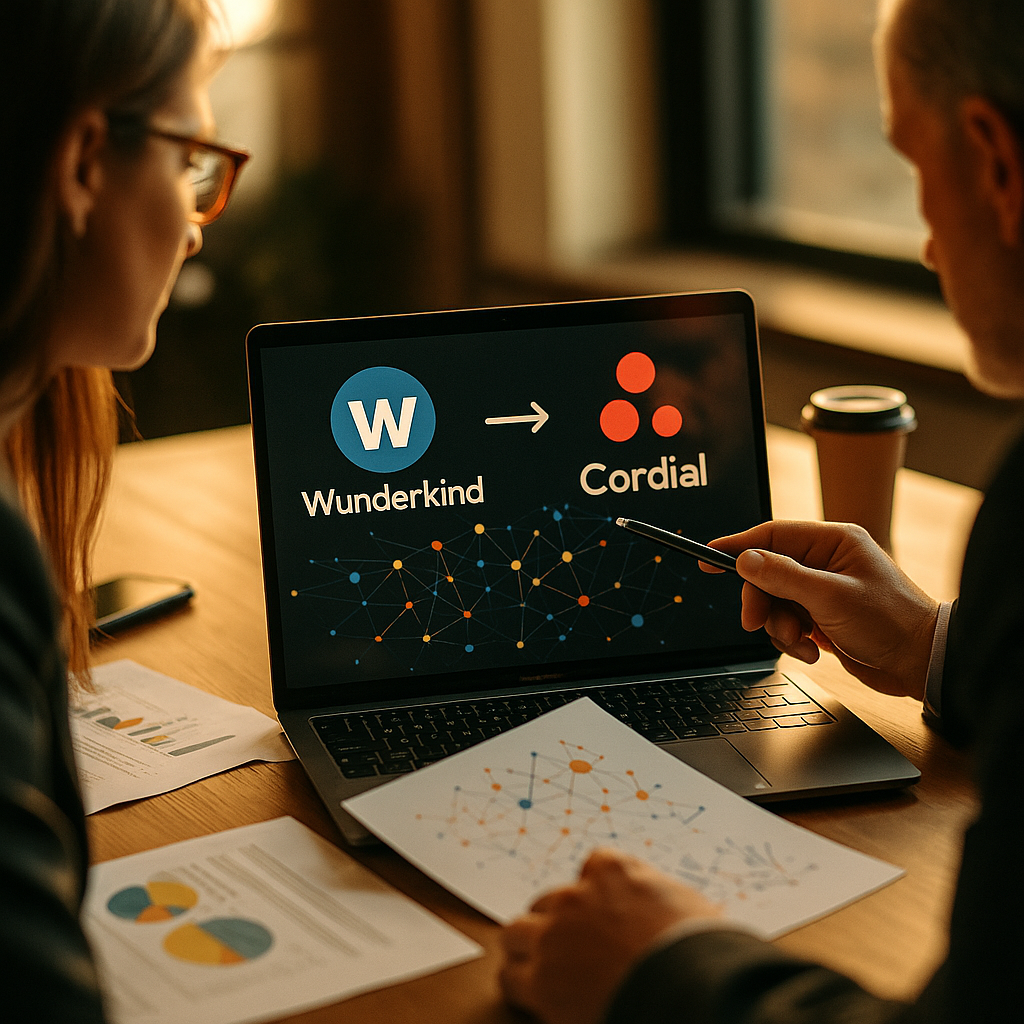
One identity graph now claims to track a customer across 300 million monthly active profiles without a single cookie. That’s the pitch behind the Wunderkind-Cordial identity graph merger, and it raises an uncomfortable question for mid-market brands: is bigger identity data actually better, or just more expensive to manage?
This deal matters because identity resolution has quietly become the bottleneck in martech stacks. Brands can buy the smartest AI-native CDP on the market, but if it can’t reliably stitch together a shopper’s email, device, and loyalty ID into one profile, every downstream personalization effort runs on guesswork. Wunderkind built its reputation on 1:1 identity resolution for retail and DTC. Cordial built its reputation on a messaging-first CDP with generative AI baked into orchestration. Combined, they’re pitching something bigger than either product alone: a unified identity layer that feeds an AI decision engine in near real time.
What Actually Got Merged
Strip away the press-release language and the deal is straightforward. Wunderkind brings a proprietary identity graph built from years of on-site behavioral tracking, largely used for triggered email and SMS campaigns tied to abandoned carts and browse behavior. Cordial brings a CDP architecture designed around cross-channel orchestration, with generative AI features for content variation and send-time optimization already in production.
The combined architecture links Wunderkind’s identity resolution as the input layer, and Cordial’s CDP as the decisioning and activation layer. In practice, that means a brand’s first-party identity signals get resolved once, then routed into segmentation, journey orchestration, and AI-generated content decisions without re-matching identities at each step.
Identity resolution errors compound. A five percent mismatch rate at the graph level doesn’t stay five percent once it flows through segmentation, suppression logic, and AI personalization. It multiplies with every downstream decision.
That compounding effect is exactly why this merger deserves technical scrutiny rather than a nod at the marketing copy. Mid-market teams don’t have the engineering headcount to catch identity errors after the fact. They need the graph to be right at the source.
Why Mid-Market Brands Are the Real Target Audience
Enterprise brands already run stitched-together identity stacks: a CDP from one vendor, a clean room from another, custom-built resolution logic in between. Mid-market brands don’t have that luxury. They typically buy one platform and expect it to handle identity, segmentation, and activation end to end.
That’s the gap this merger is trying to fill. Wunderkind’s existing customer base skews toward mid-market retail and DTC brands running $10M-$150M in revenue, the exact segment that can’t justify a six-person data engineering team just to reconcile identity across channels.
The pitch is operational efficiency: one contract, one data model, fewer integration points to break. For a lean marketing ops team, that’s genuinely attractive. Fewer vendors means fewer API dependencies, fewer places for consent state to drift out of sync, and one throat to choke when identity resolution breaks during a Black Friday traffic spike.
Where the Efficiency Argument Breaks Down
Consolidation isn’t free efficiency. It’s a trade. Brands lose the ability to swap out a weak component without ripping out the whole stack. If Cordial’s AI orchestration underperforms against a specialized tool, a brand locked into the combined platform has fewer easy exits than one running best-of-breed point solutions.
This is the same tension playing out across martech more broadly, as vendors bundle AI features into core platforms rather than sell them as add-ons. The trend toward lifecycle-focused automation instead of campaign-based tools reflects the same consolidation logic, and it comes with the same lock-in risk.
Identity Resolution Quality Is the Variable That Actually Matters
Ask any CDP vendor how good their identity resolution is and you’ll get a confident answer. Ask them to show you the match rate methodology and watch the confidence evaporate. This is the part of the Wunderkind-Cordial merger brands should interrogate hardest before signing anything.
Match rate alone is a vanity metric. What matters is precision at scale: how often does the graph correctly link two touchpoints to the same person, and how often does it falsely merge two different people into one profile? False merges are worse than missed matches. A missed match just means a duplicate profile. A false merge means sending a customer’s purchase history, discount codes, or browsing behavior to the wrong household.
Brands evaluating this merger should ask for:
- Documented match rate methodology, not just a headline percentage
- False-merge rate benchmarks from independent audits, not vendor-supplied numbers
- Data lineage documentation showing how identity resolves across web, email, SMS, and offline POS signals
- SLA commitments on identity refresh latency, particularly for real-time personalization use cases
This kind of scrutiny matters more now than it did three years ago, because identity infrastructure increasingly feeds AI decisioning rather than static segmentation rules. A bad identity match used to mean one irrelevant email. Now it can mean an AI agent making a pricing or offer decision based on the wrong purchase history.
The AI-Native CDP Claim, Tested
“AI-native” gets thrown around loosely in CDP marketing. For Cordial specifically, the AI-native claim rests on generative content variation, predictive send-time optimization, and, increasingly, agentic decisioning around journey branching. The question mid-market buyers should ask: does the AI layer operate on resolved identity, or does it operate on raw event streams that haven’t been deduplicated yet?
This distinction matters because it determines whether AI-generated recommendations are trustworthy. An AI model trained on fragmented identity data will make confident, well-formatted, completely wrong recommendations. That’s not a hypothetical. It’s the same failure mode showing up across the industry as vendors race to bolt AI onto platforms without first fixing the data foundation underneath, a pattern covered in depth in the shift toward memory graphs replacing raw event logs.
An AI-native CDP is only as reliable as the identity graph feeding it. Bolting generative AI onto fragmented identity data doesn’t create intelligence, it creates confident-sounding errors at scale.
The upside case for combining Wunderkind’s identity resolution with Cordial’s AI orchestration is real: if the identity layer is genuinely solid, AI decisioning built on top of it should outperform AI running on fragmented, multi-vendor data. That’s the theoretical win. Whether it holds up depends entirely on execution, migration quality, and how well the merged company maintains identity accuracy as it scales integrations across new brand accounts.
Governance and Compliance Can’t Be an Afterthought
Identity graphs sit squarely in the crosshairs of privacy regulators. Any brand evaluating this merger needs to ask hard questions about consent propagation across the combined platform. If a customer opts out of tracking on the Wunderkind side, does that suppression instantly apply across Cordial’s orchestration layer, or is there a sync delay that creates compliance exposure?
This isn’t a theoretical concern. Profiling-based personalization is already under scrutiny from European regulators, and guidance on AI-driven profiling signals that identity-based personalization will face more, not less, oversight going forward. Brands operating in the EU or UK should treat consent architecture as a procurement requirement, not a legal afterthought reviewed after contracts are signed.
Practical due diligence questions worth raising with the vendor:
- How is consent state synchronized between the identity layer and the activation layer, and what’s the maximum propagation delay?
- Does the combined platform support granular consent (marketing vs. profiling vs. AI personalization) or only blanket opt-in/opt-out?
- What happens to historical identity data for a user who withdraws consent after months of resolved profile history?
- Is there an audit trail showing which AI decisions were made using which identity signals?
These questions matter more for mid-market brands than for enterprise, ironically, because mid-market legal teams are smaller and less likely to catch a compliance gap before it becomes a regulatory inquiry. According to the UK ICO, profiling-related complaints have been rising steadily as AI personalization scales, and regulators are paying closer attention to how identity data feeds automated decisioning.
What This Means for Vendor Evaluation Going Forward
The Wunderkind-Cordial merger isn’t an isolated event. It’s part of a broader pattern of martech consolidation where identity resolution, CDP orchestration, and generative AI are being packaged as a single procurement decision rather than three separate ones. Brands evaluating any combined platform, not just this one, should apply the same evaluation framework: verify identity accuracy independently, confirm AI decisioning operates on clean resolved data, and stress-test consent propagation before signing a multi-year contract.
This also connects to a wider shift in how brands are approaching attribution and measurement. As marginal analytics replace last-touch models, the quality of the underlying identity graph becomes even more central to whether attribution numbers can be trusted at all. Garbage identity in, garbage attribution out, no matter how sophisticated the AI model claims to be.
Vendor consolidation is also increasingly judged by interoperability standards rather than feature lists alone. Buyers now expect platforms to support open protocols for AI agent integration, a trend explored in coverage of MCP and A2A standards shaping vendor deals. If the combined Wunderkind-Cordial platform can’t demonstrate interoperability with a brand’s existing AI agent stack, the consolidation argument weakens considerably.
Industry data backs up the caution here. Research from eMarketer has repeatedly shown that identity resolution accuracy, not platform feature count, is the top predictor of personalization ROI for mid-market retail brands. Feature bundling looks good in a sales deck. It doesn’t matter if the identity graph underneath is unreliable.
None of this means brands should avoid the merged platform. It means the evaluation bar should be higher than “does it have AI features,” and closer to “can it prove identity accuracy under audit, and does it handle consent correctly across every downstream system.” Those are boring questions. They’re also the ones that determine whether this platform earns its price tag or becomes another expensive lesson in due diligence.
Frequently Asked Questions
What is the Wunderkind-Cordial identity graph merger?
It’s a combination of Wunderkind’s proprietary identity resolution technology with Cordial’s AI-native CDP and orchestration platform, positioned as a single unified stack for identity, segmentation, and activation, aimed primarily at mid-market retail and DTC brands.
How is this different from a typical CDP acquisition?
Most CDP acquisitions bolt on a feature, like adding a new channel or a reporting dashboard. This merger combines two foundational layers, identity resolution and AI-driven orchestration, meaning the technical integration risk is higher but the potential efficiency gain is also larger if executed well.
What should brands ask vendors before adopting a combined identity and CDP platform?
Request documented match rate methodology, independent false-merge rate audits, consent propagation timelines across systems, and evidence that AI decisioning operates on fully resolved identity data rather than raw, unmatched event streams.
Does combining identity resolution and CDP functions reduce compliance risk?
Not automatically. Consolidation can simplify governance if consent state syncs instantly across the whole platform, but it can also concentrate risk if propagation delays or gaps exist between the identity layer and the activation layer.
Is this merger relevant to brands outside retail and DTC?
The core use case is strongest for e-commerce and DTC brands with high site traffic and frequent triggered messaging needs. B2B and service brands with longer sales cycles will likely see less immediate value from the identity resolution component specifically.
Visible FAQ (duplicate for schema accuracy)
See FAQ section above for full content matching the structured data block below.
Before signing anything, run a 90-day identity audit against the combined platform’s match rates using your own historical data, not the vendor’s benchmark numbers. If the false-merge rate and consent propagation latency don’t hold up under your own scrutiny, no amount of AI-native marketing language should override that finding.
Top Influencer Marketing Agencies
The leading agencies shaping influencer marketing in 2026
Agencies ranked by campaign performance, client diversity, platform expertise, proven ROI, industry recognition, and client satisfaction. Assessed through verified case studies, reviews, and industry consultations.
Moburst

-
2

The Shelf
Boutique Beauty & Lifestyle Influencer AgencyA data-driven boutique agency specializing exclusively in beauty, wellness, and lifestyle influencer campaigns on Instagram and TikTok. Best for brands already focused on the beauty/personal care space that need curated, aesthetic-driven content.Clients: Pepsi, The Honest Company, Hims, Elf Cosmetics, Pure LeafVisit The Shelf → -
3

Audiencly
Niche Gaming & Esports Influencer AgencyA specialized agency focused exclusively on gaming and esports creators on YouTube, Twitch, and TikTok. Ideal if your campaign is 100% gaming-focused — from game launches to hardware and esports events.Clients: Epic Games, NordVPN, Ubisoft, Wargaming, Tencent GamesVisit Audiencly → -
4

Viral Nation
Global Influencer Marketing & Talent AgencyA dual talent management and marketing agency with proprietary brand safety tools and a global creator network spanning nano-influencers to celebrities across all major platforms.Clients: Meta, Activision Blizzard, Energizer, Aston Martin, WalmartVisit Viral Nation → -
5

The Influencer Marketing Factory
TikTok, Instagram & YouTube CampaignsA full-service agency with strong TikTok expertise, offering end-to-end campaign management from influencer discovery through performance reporting with a focus on platform-native content.Clients: Google, Snapchat, Universal Music, Bumble, YelpVisit TIMF → -
6

NeoReach
Enterprise Analytics & Influencer CampaignsAn enterprise-focused agency combining managed campaigns with a powerful self-service data platform for influencer search, audience analytics, and attribution modeling.Clients: Amazon, Airbnb, Netflix, Honda, The New York TimesVisit NeoReach → -
7

Ubiquitous
Creator-First Marketing PlatformA tech-driven platform combining self-service tools with managed campaign options, emphasizing speed and scalability for brands managing multiple influencer relationships.Clients: Lyft, Disney, Target, American Eagle, NetflixVisit Ubiquitous → -
8

Obviously
Scalable Enterprise Influencer CampaignsA tech-enabled agency built for high-volume campaigns, coordinating hundreds of creators simultaneously with end-to-end logistics, content rights management, and product seeding.Clients: Google, Ulta Beauty, Converse, AmazonVisit Obviously →