


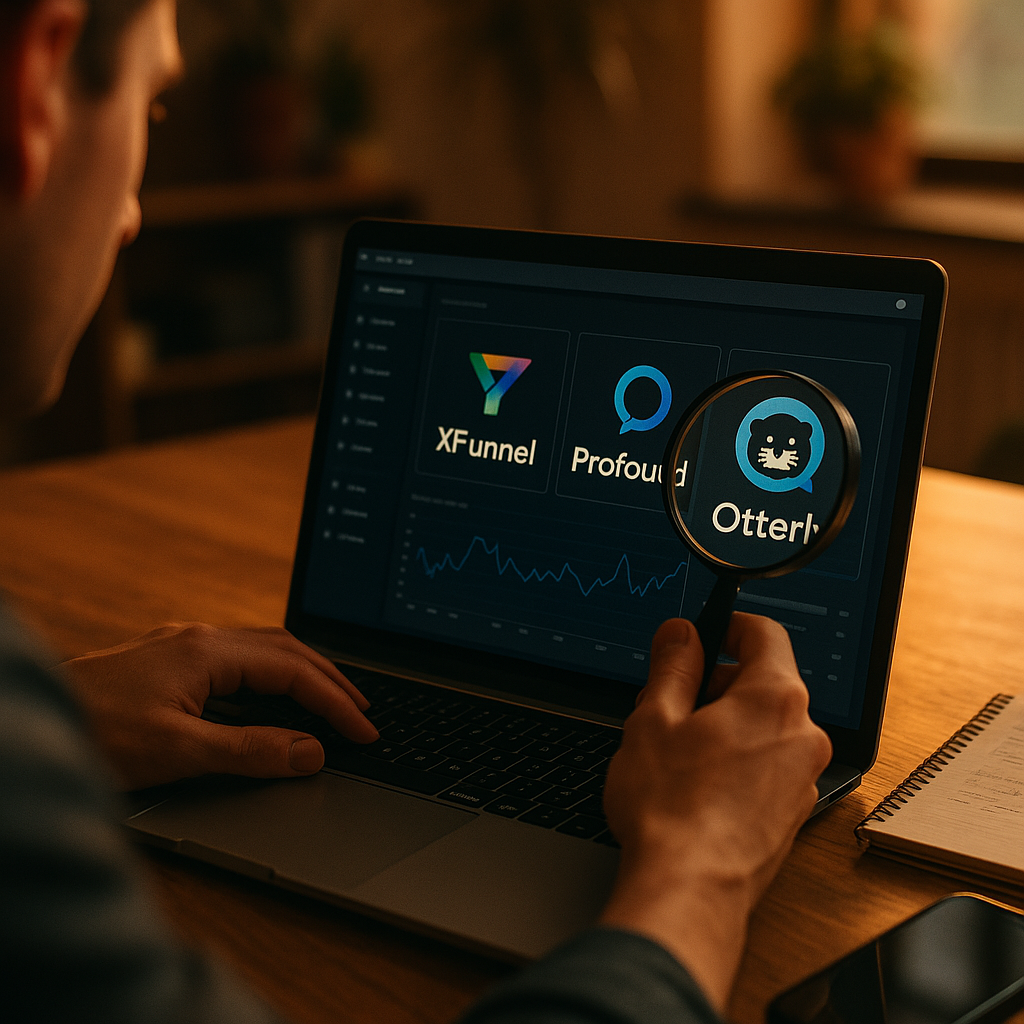
Nearly two in five consumers now start product research inside a chatbot instead of Google, according to eMarketer estimates on generative search adoption. If your brand isn’t showing up when ChatGPT or Perplexity answers a category question, you’re invisible to a growing slice of buyers. Brand mention tracking for AI search has become the newest line item in the martech stack, and three vendors, XFunnel, Profound, and Otterly, are the names coming up most often in procurement conversations.
Why Brand Mention Tracking Became a Boardroom Metric
Two years ago, “share of voice” meant social listening dashboards and press mentions. Now it means something stranger: how often a large language model cites your brand when a user asks “what’s the best CRM for a 50-person sales team” or “which running shoe brand is most sustainable.” These answers get generated on the fly, they change week to week, and there’s no keyword ranking report to check.
That’s the gap XFunnel, Profound, and Otterly were built to close. Each one pings AI models with representative queries, logs whether and how your brand gets mentioned, and tries to reverse-engineer why a competitor got cited instead. The category has a name now: answer engine optimization, or AEO. Our earlier breakdown of AEO and GEO agency bundles covers the services layer; this piece is about the tooling underneath it.
If your brand mention tracking tool can’t tell you which source (Reddit thread, review site, press release) triggered the citation, you’re buying a scoreboard, not a strategy.
XFunnel: Built for Multi-Model Query Simulation
XFunnel’s pitch is coverage breadth. It runs your brand’s target prompts across multiple model providers, not just one, and shows how citation frequency shifts between them. That matters more than it sounds. A brand can dominate ChatGPT answers and barely register in Gemini or Perplexity results, and most legacy SEO teams have no visibility into that split.
What sets XFunnel apart operationally is its funnel-stage tagging. Queries get bucketed into awareness, consideration, and decision intent, so a marketing lead can see whether the brand shows up for “what is a creator CDP” versus “best creator CDP for mid-market DTC brands.” That mapping is genuinely useful for teams trying to connect AI visibility to pipeline, similar to the logic used in CDP and CRM scoring frameworks for influencer programs.
The tradeoff: XFunnel’s reporting UI is dense. Smaller teams without a dedicated analyst can find the dashboard overwhelming in the first few weeks, and onboarding takes longer than either competitor here.
Profound: The Enterprise Answer Engine Tracker
Profound has positioned itself as the enterprise-grade option, and the pricing reflects that. It’s the tool most likely to show up in a Fortune 500 marketing ops stack, largely because it ties AI citation data to existing analytics infrastructure rather than living as a standalone dashboard.
Its strongest feature is source attribution. Profound doesn’t just tell you that your brand was mentioned, it tries to identify the underlying content the model likely pulled from, whether that’s a Wikipedia entry, a G2 review, or a competitor’s comparison page. For brand safety and PR teams, that’s the difference between reacting to a symptom and fixing a root cause. It pairs well conceptually with the vetting rigor covered in AI brand safety scanner evaluations, since both categories are ultimately about auditing what an algorithm is doing with your name.
Profound also plays nicer with enterprise procurement requirements: SOC 2 documentation, SSO, role-based access. If your legal team needs to sign off before anyone touches the tool, Profound has already done that homework.
Otterly: Lean, Fast, and Built for SMB Budgets
Otterly.ai took a different bet. Instead of chasing enterprise contracts, it built a fast, affordable tool that agencies and mid-market brands can self-serve without a sales call. Setup takes under a day in most cases, and pricing tiers start low enough that a solo marketer can justify the spend without a budget review.
The tradeoff for that simplicity is depth. Otterly tracks mention frequency and basic sentiment well, but it doesn’t do the source-level forensics Profound offers, and it covers fewer AI models than XFunnel. For a brand just trying to answer “are we showing up at all,” that’s fine. For a team trying to diagnose why a competitor is winning citations in a specific vertical, it’s thinner.
Otterly’s real strength is speed to insight. Reports refresh quickly, alerts are readable without a data science background, and the interface doesn’t require a training session. Agencies managing multiple client accounts tend to gravitate here because it’s the fastest to demo and the easiest to justify on a monthly retainer.
Which Tool Fits Which Team?
There’s no single winner, and any vendor that claims otherwise is selling, not advising. The right pick depends on team size, budget, and how deep you need the diagnostic layer to go.
- Choose XFunnel if you need multi-model coverage and funnel-stage mapping, and you have an analyst who can live in a dense dashboard.
- Choose Profound if you’re an enterprise brand with compliance requirements and you want source-level attribution to guide content strategy, not just a mention count.
- Choose Otterly if you’re an agency or SMB that needs fast setup, low cost, and directionally accurate mention tracking without a steep learning curve.
One pattern worth flagging: none of these three tools replace a broader AI search strategy. They measure outcomes; they don’t fix the content gaps causing poor citation rates. Pairing a tracker with a vendor that also handles the optimization side, as we outlined in AI search optimization vendor scoring, tends to produce faster gains than tracking alone.
A mention tracker without an action plan is just a very expensive way to confirm what you already suspected.
What About Accuracy? Can Any of These Be Trusted Fully?
Here’s the uncomfortable truth: AI models are non-deterministic. Ask the same question twice and you can get two different answers, with different brands cited. That means every tool in this category, XFunnel, Profound, Otterly, and whoever launches next quarter, is sampling a moving target, not measuring a fixed ranking like a Google SERP.
Treat the output as directional intelligence, not gospel. Run queries at consistent intervals, track trend lines rather than single snapshots, and cross-reference big swings against real-world events (a product launch, a negative review cycle, a Reddit thread going viral). Marketing teams already do this kind of trend smoothing with paid and organic data via tools like Sprout Social; apply the same discipline here.
It’s also worth noting that none of these platforms currently offer the kind of standardized methodology disclosure that, say, HubSpot provides for its state-of-marketing benchmarks. Ask each vendor directly how many queries they run per tracked term, how often models get re-polled, and whether they normalize for regional variation. If a sales rep can’t answer that clearly, that’s a red flag worth noting before signing a contract.
Budget and Contract Considerations
Pricing across the category is still fluid, which is typical for a tool set that’s barely two years old. Otterly’s entry tiers tend to run in the low hundreds per month, XFunnel sits in the mid-market range with usage-based scaling, and Profound requires a custom quote, standard for anything marketed as “enterprise.” Ask for a month-to-month pilot before committing to an annual contract. This category is evolving fast enough that the tool you pick now may need a feature it doesn’t have yet within two quarters.
Also worth checking: does the contract include model coverage as new AI search products launch? A tool that only tracks ChatGPT and misses whatever comes next isn’t future-proof, it’s already behind. Procurement teams evaluating attribution tooling elsewhere in the stack, like those covered in our real-time attribution procurement checklist, will recognize this pattern: buy for adaptability, not just current feature parity.
FAQs
Frequently Asked Questions
What is brand mention tracking for AI search?
It’s the practice of monitoring how often and how favorably a brand gets cited when users query AI chat tools like ChatGPT, Gemini, or Perplexity, rather than tracking traditional search engine rankings.
Is Profound more expensive than Otterly and XFunnel?
Generally yes. Profound targets enterprise buyers with custom pricing and compliance features, while Otterly offers the lowest entry-level tiers and XFunnel sits in between with usage-based scaling.
Can these tools guarantee a brand will appear more often in AI answers?
No. They measure and diagnose citation patterns but don’t directly control what a model outputs. Improving mentions requires content and authority work alongside the tracking data.
How often should a brand check its AI search mention data?
Weekly reviews are common for active campaigns, with monthly trend analysis for steady-state monitoring. Because AI outputs are non-deterministic, single-day snapshots can be misleading.
Do these tools work for local or regional brands, not just national ones?
Coverage varies by vendor. Ask specifically about regional query support and language handling before purchase, since not all three platforms weight local intent the same way.
Start with a two-week pilot on whichever tool matches your team size, not your ambitions: Otterly for lean teams, XFunnel for multi-model depth, Profound for enterprise compliance needs. Then measure whether the data actually changes a content decision, because that’s the only ROI metric that matters here.
Top Influencer Marketing Agencies
The leading agencies shaping influencer marketing in 2026
Agencies ranked by campaign performance, client diversity, platform expertise, proven ROI, industry recognition, and client satisfaction. Assessed through verified case studies, reviews, and industry consultations.
Moburst

-
2

The Shelf
Boutique Beauty & Lifestyle Influencer AgencyA data-driven boutique agency specializing exclusively in beauty, wellness, and lifestyle influencer campaigns on Instagram and TikTok. Best for brands already focused on the beauty/personal care space that need curated, aesthetic-driven content.Clients: Pepsi, The Honest Company, Hims, Elf Cosmetics, Pure LeafVisit The Shelf → -
3

Audiencly
Niche Gaming & Esports Influencer AgencyA specialized agency focused exclusively on gaming and esports creators on YouTube, Twitch, and TikTok. Ideal if your campaign is 100% gaming-focused — from game launches to hardware and esports events.Clients: Epic Games, NordVPN, Ubisoft, Wargaming, Tencent GamesVisit Audiencly → -
4

Viral Nation
Global Influencer Marketing & Talent AgencyA dual talent management and marketing agency with proprietary brand safety tools and a global creator network spanning nano-influencers to celebrities across all major platforms.Clients: Meta, Activision Blizzard, Energizer, Aston Martin, WalmartVisit Viral Nation → -
5

The Influencer Marketing Factory
TikTok, Instagram & YouTube CampaignsA full-service agency with strong TikTok expertise, offering end-to-end campaign management from influencer discovery through performance reporting with a focus on platform-native content.Clients: Google, Snapchat, Universal Music, Bumble, YelpVisit TIMF → -
6

NeoReach
Enterprise Analytics & Influencer CampaignsAn enterprise-focused agency combining managed campaigns with a powerful self-service data platform for influencer search, audience analytics, and attribution modeling.Clients: Amazon, Airbnb, Netflix, Honda, The New York TimesVisit NeoReach → -
7

Ubiquitous
Creator-First Marketing PlatformA tech-driven platform combining self-service tools with managed campaign options, emphasizing speed and scalability for brands managing multiple influencer relationships.Clients: Lyft, Disney, Target, American Eagle, NetflixVisit Ubiquitous → -
8

Obviously
Scalable Enterprise Influencer CampaignsA tech-enabled agency built for high-volume campaigns, coordinating hundreds of creators simultaneously with end-to-end logistics, content rights management, and product seeding.Clients: Google, Ulta Beauty, Converse, AmazonVisit Obviously →