


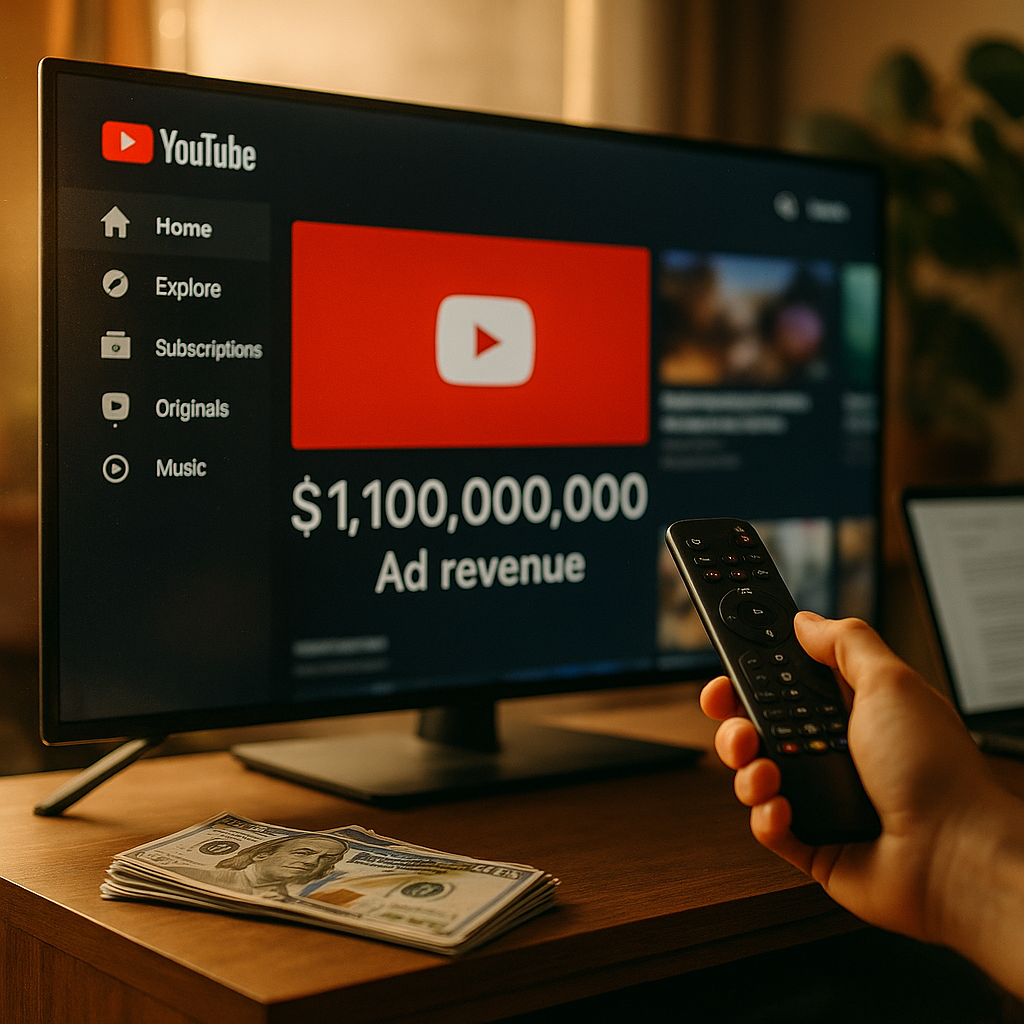
Living rooms are quietly becoming the biggest screen in influencer marketing, and most brand strategists haven’t updated their media plans to match. YouTube’s connected TV (CTV) footprint has grown into a $1.1 billion-plus quarterly ad revenue engine, according to Alphabet’s own earnings disclosures, and it’s reshaping how brands think about reach, brand safety, and creator content distribution. If your CTV strategy still treats YouTube as “the app on the phone,” you’re leaving money and measurement clarity on the table.
The Number That Should Reset Your Media Plan
YouTube has repeatedly told investors that it’s the top streaming service on U.S. TV screens by watch time, per Nielsen’s Gauge data. That’s not a vanity stat. It means a meaningful share of the platform’s ad inventory, including creator-adjacent placements, now runs on the biggest screen in the house rather than the smallest.
The $1.1 billion figure represents quarterly CTV-specific ad revenue growth Alphabet has flagged in recent calls, and it’s compounding. Brands that built influencer budgets around mobile-first vertical video are now competing for inventory against traditional TV upfronts, streaming platforms, and a growing crop of connected-device advertisers. Pretending this is a niche channel is no longer defensible.
YouTube’s living room audience isn’t a subset of its mobile audience anymore. It’s a distinct viewing behavior with its own creative expectations, attention patterns, and buying mechanics.
Why “Living Room” Changes the Creative Math
Vertical, nine-second hook content built for scroll-stopping on a phone often falls flat on a 65-inch screen viewed from a couch. Viewers in living room mode behave more like traditional TV audiences: longer attention spans, less tolerance for jump cuts, more willingness to sit through a mid-roll if the content earns it.
This matters enormously for creator partnerships. A brand deal that works as a TikTok-style skit might read as chaotic or low-production on a CTV screen. Smart brands are now briefing creators for dual-format delivery: a punchy mobile cut and a longer, cleaner living room version. This isn’t a huge lift creatively, but it does require production budgets and creator briefs to catch up.
- Longer intros are viable again. CTV viewers don’t punish a three-second setup the way mobile scrollers do.
- Sound design matters more. Living rooms often have real speakers, not tinny phone audio.
- Call-to-action strategy shifts. There’s no thumb to swipe up, so QR codes and second-screen prompts become essential.
Brand Safety on the Big Screen Isn’t the Same Fight
Brand safety conversations in influencer marketing have mostly focused on comment sections, algorithmic virality, and creator controversy. CTV adds a new wrinkle: contextual adjacency on the largest, most family-visible screen in the home. A misplaced ad next to inappropriate content lands differently when it’s playing on a living room TV during family time versus scrolling past on someone’s phone in a coffee shop.
This is one reason the FTC and international regulators keep tightening disclosure expectations for sponsored content, and CTV’s larger, more public viewing context raises the stakes for compliance. Brands running creator content through YouTube’s CTV inventory need contractual language and creative review processes that account for this shift, not just a copy-paste of mobile-first brand safety guidelines.
Teams navigating this shift should look at how algorithm-driven liability exposure is already forcing legal reviews earlier in the campaign pipeline. CTV just adds another layer of scrutiny to an already complicated risk picture.
Measurement: The Real Reason Brands Are Nervous
Here’s the uncomfortable truth: CTV measurement is still catching up to mobile-grade attribution. Brands accustomed to click-through data, pixel tracking, and last-touch attribution on social platforms suddenly have to reckon with a channel where the “click” often doesn’t exist in the traditional sense.
YouTube has leaned into this by pushing advertisers toward incrementality testing, brand lift studies, and its own measurement partnerships, but plenty of marketing leaders remain skeptical of walled-garden reporting. This mirrors a broader trend already playing out in influencer budgets, where a growing share of marketers now track ROI as their sole KPI, refusing to accept vanity metrics as a substitute for revenue proof.
If your team is going to shift creator dollars toward CTV inventory, insist on the same rigor you’d apply to any performance channel. That means:
- Requiring third-party measurement validation, not just platform-reported numbers.
- Running matched-market or holdout tests before scaling spend.
- Tracking downstream conversion, not just completed views.
For context on how measurement maturity is reshaping budget allocation more broadly, eMarketer’s forecasts on CTV ad spend growth are worth reviewing alongside your own attribution stack.
Creator Content Is Becoming TV Content, Whether Brands Are Ready or Not
YouTube has spent years blurring the line between “creator video” and “television,” and the living room data confirms the strategy is working. Long-form creator programming, podcasts with video components, and branded series are increasingly consumed the way sitcoms and prestige dramas used to be: scheduled, binge-watched, and discussed the next day.
This shift rewards brands that treat creator partnerships as ongoing content programs rather than one-off integrations. It’s the same logic driving the industry’s move toward retention-focused creator partnerships instead of campaign-by-campaign spot buys. A creator who shows up consistently in someone’s living room feed builds trust that a single sponsored segment never will.
It also changes who gets picked for partnerships. Production quality now genuinely matters for CTV placements, which favors mid-tier and established creators with the gear and editing chops to hold up on a big screen. That said, don’t assume bigger production budgets mean better ROI. Recent data shows niche creators still beat celebrity reach on qualified leads, and that dynamic doesn’t disappear just because the screen got bigger.
What This Means for Budget Allocation
Brands are going to face an internal argument this year: does CTV spend come out of the traditional TV budget, the digital video budget, or the influencer line item? There’s no universally right answer, but the wrong answer is treating it as free money that doesn’t cannibalize existing plans.
Some organizations are already restructuring around this reality. The move toward owning creator data in house gives brands more flexibility to shift spend across channels without losing visibility into performance, which matters enormously when a channel like CTV is still building out third-party measurement standards.
Agencies and in-house teams alike should also watch how AI martech growth is reshuffling creator budgets. A lot of the tooling being built for CTV optimization, creative testing, and audience targeting is coming out of the same AI infrastructure wave reshaping influencer measurement generally. Treating CTV strategy and influencer strategy as separate budget conversations is increasingly a mistake.
A Practical Starting Point
You don’t need to overhaul your entire media plan this quarter. Start smaller and smarter.
- Audit which existing creator content is already being served into YouTube’s CTV inventory, and check whether it was optimized for that context.
- Pilot a dual-format creative brief with two or three creator partners already delivering strong mobile performance.
- Set a measurement baseline now, before scaling spend, so you have a clean comparison point.
- Loop legal and brand safety teams into CTV-specific review, since the exposure profile differs from mobile placements.
The brands that treat this as an operational shift, not a creative afterthought, will be the ones with defensible ROI numbers when the next budget cycle comes around.
Frequently Asked Questions
FAQs
What does “living room economy” mean for YouTube advertising?
It refers to the growing share of YouTube viewing and ad revenue coming from connected TV screens rather than mobile or desktop devices, which changes creative format, measurement, and brand safety expectations.
Is YouTube’s CTV inventory the same as its mobile inventory?
No. While targeting and reporting share the same backend systems, CTV placements reach viewers in a different context (longer sessions, shared household viewing, no swipe-up capability), which affects creative performance and calls to action.
How should brands adjust creator briefs for CTV?
Brands should request dual-format delivery: a mobile-optimized vertical cut and a longer, cleaner horizontal version suited to living room viewing, with stronger sound design and second-screen calls to action like QR codes.
Does CTV measurement work the same as social media attribution?
Not exactly. CTV lacks the direct click-through mechanics of mobile and social platforms, so brands typically need incrementality testing, brand lift studies, or matched-market tests to validate performance.
Should influencer budgets shift toward CTV spend?
Only with clear measurement in place. Brands should pilot small, validate results against a baseline, and avoid treating CTV as incremental “free” reach without checking for cannibalization of existing channels.
Next step: pull your last two quarters of YouTube performance data, split it by device type, and see how much of your “digital video” spend is actually landing on living room screens. That single audit will tell you more about your real CTV exposure than any industry forecast.
Top Influencer Marketing Agencies
The leading agencies shaping influencer marketing in 2026
Agencies ranked by campaign performance, client diversity, platform expertise, proven ROI, industry recognition, and client satisfaction. Assessed through verified case studies, reviews, and industry consultations.
Moburst

-
2

The Shelf
Boutique Beauty & Lifestyle Influencer AgencyA data-driven boutique agency specializing exclusively in beauty, wellness, and lifestyle influencer campaigns on Instagram and TikTok. Best for brands already focused on the beauty/personal care space that need curated, aesthetic-driven content.Clients: Pepsi, The Honest Company, Hims, Elf Cosmetics, Pure LeafVisit The Shelf → -
3

Audiencly
Niche Gaming & Esports Influencer AgencyA specialized agency focused exclusively on gaming and esports creators on YouTube, Twitch, and TikTok. Ideal if your campaign is 100% gaming-focused — from game launches to hardware and esports events.Clients: Epic Games, NordVPN, Ubisoft, Wargaming, Tencent GamesVisit Audiencly → -
4

Viral Nation
Global Influencer Marketing & Talent AgencyA dual talent management and marketing agency with proprietary brand safety tools and a global creator network spanning nano-influencers to celebrities across all major platforms.Clients: Meta, Activision Blizzard, Energizer, Aston Martin, WalmartVisit Viral Nation → -
5

The Influencer Marketing Factory
TikTok, Instagram & YouTube CampaignsA full-service agency with strong TikTok expertise, offering end-to-end campaign management from influencer discovery through performance reporting with a focus on platform-native content.Clients: Google, Snapchat, Universal Music, Bumble, YelpVisit TIMF → -
6

NeoReach
Enterprise Analytics & Influencer CampaignsAn enterprise-focused agency combining managed campaigns with a powerful self-service data platform for influencer search, audience analytics, and attribution modeling.Clients: Amazon, Airbnb, Netflix, Honda, The New York TimesVisit NeoReach → -
7

Ubiquitous
Creator-First Marketing PlatformA tech-driven platform combining self-service tools with managed campaign options, emphasizing speed and scalability for brands managing multiple influencer relationships.Clients: Lyft, Disney, Target, American Eagle, NetflixVisit Ubiquitous → -
8

Obviously
Scalable Enterprise Influencer CampaignsA tech-enabled agency built for high-volume campaigns, coordinating hundreds of creators simultaneously with end-to-end logistics, content rights management, and product seeding.Clients: Google, Ulta Beauty, Converse, AmazonVisit Obviously →