


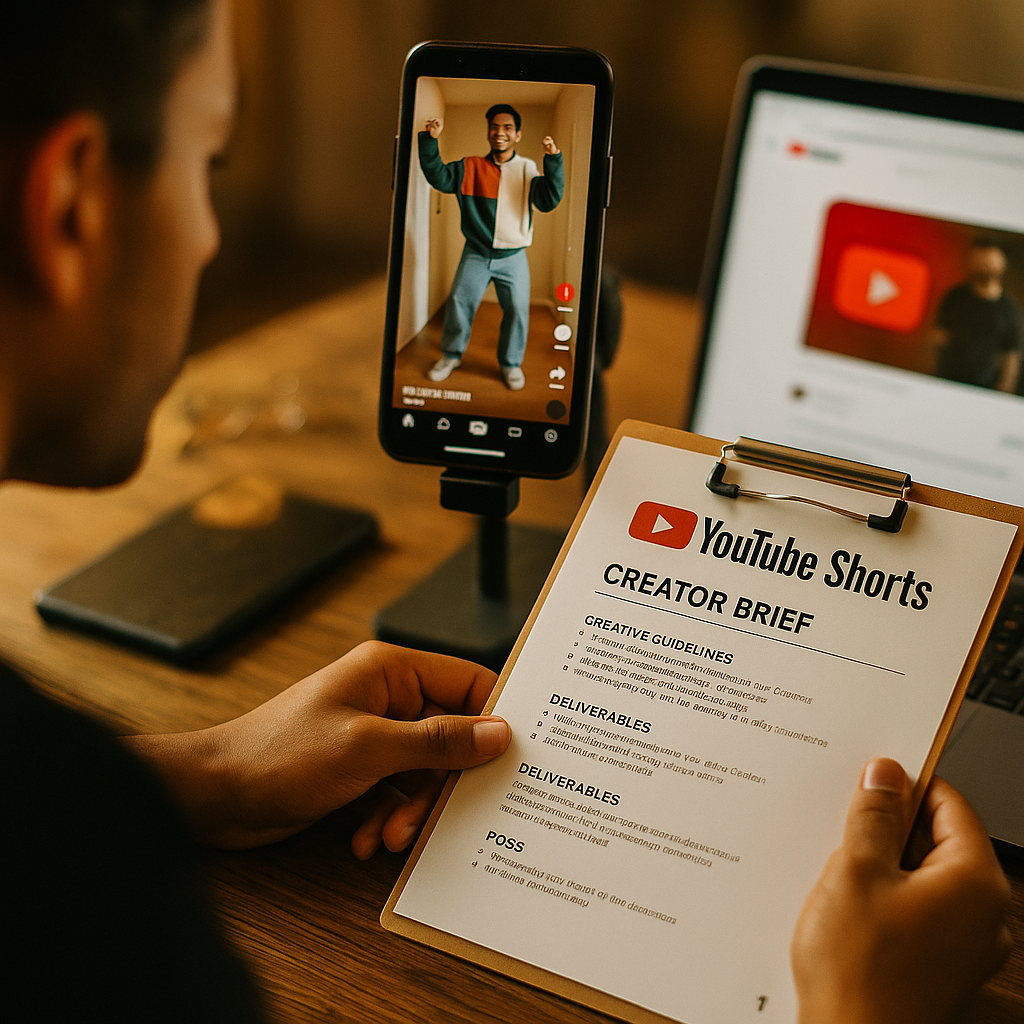
The Brief You’re Sending Creators Is Already Obsolete
Brands running YouTube Shorts campaigns are leaving serious reach on the table — not because their creators are underperforming, but because their briefs were written for a platform that no longer exists. YouTube’s recommendation engine now weighs paid-partnership signals as active ranking inputs inside the Shorts feed, which fundamentally changes what a compliant, ROI-positive creator brief needs to contain.
What’s Actually Changed in the Shorts Feed
YouTube’s AI recommendation system — built on a two-tower neural network architecture that scores candidate videos against viewer interest graphs — has quietly evolved its treatment of monetized content. Historically, paid-partnership labels acted as neutral disclosures. Today, they’re behavioral classifiers. The system uses the declared commercial relationship as a contextual signal to route content toward higher-intent viewer clusters.
That’s a structural shift, not a tweak. When a Short carries a paid-partnership disclosure, YouTube’s algorithm doesn’t penalize it the way Meta’s early branded content filters did. Instead, it cross-references the declared brand category with topic-interest clusters, adjusting distribution accordingly. A fitness brand’s paid Short gets surfaced to viewers whose watch history skews toward supplement reviews, gym tutorials, and transformation content — even if the creator’s organic audience is primarily gaming-focused.
Paid-partnership labels on YouTube Shorts are no longer just compliance checkboxes. They’re distribution levers — and most brand briefs aren’t written to pull them.
For brand teams, this creates a genuine operational opportunity. But only if your brief gives creators the structural inputs the algorithm is actually scoring.
Why Most Creator Briefs Fail the Algorithm
Pull any standard influencer brief from a mid-market brand’s template library and you’ll find the same artifacts: brand voice guidelines, approved hashtags, a disclosure reminder, a list of do’s and don’ts. What you almost never find are algorithm-specific content architecture requirements.
The Shorts feed ranks content on several signals: hook retention (how many viewers watch past the 3-second mark), replay rate, engagement velocity in the first 90 minutes post-publish, and now — increasingly — the semantic alignment between the paid-partnership category and the viewer’s declared interest graph. A brief that tells a creator to “make it feel authentic” without specifying watch-time architecture, pacing cues, or category-signal keywords is essentially asking someone to bake a cake without giving them a recipe.
Compare this to how sophisticated teams are approaching platform-specific creator briefs across channels. The delta in campaign performance between algorithm-aware briefs and generic ones is consistently measurable — and the gap is widening as recommendation engines get more granular.
The New Brief Architecture for Paid-First Shorts
Rewriting your brief for YouTube’s current AI stack requires thinking in layers: the hook layer, the signal layer, and the conversion layer.
The hook layer is non-negotiable. YouTube’s own internal data shows that Shorts with strong retention past the 3-second threshold are 2.3x more likely to be recommended in subsequent feed sessions. Your brief needs to specify the hook format — a pattern interrupt, a direct question addressed to camera, or a visual reveal — not just say “grab attention.” Give creators 2-3 approved hook frameworks, not open-ended latitude.
The signal layer is where most brands have zero visibility. This is the set of verbal, visual, and categorical cues that tell YouTube’s classifier what the content is about. Your paid-partnership category declaration sets the macro context. What the creator says in the first 10 seconds sets the micro context. If your brief asks a tech creator to promote a meal kit without including any language anchoring the content to “cooking,” “meal prep,” or “healthy eating,” the algorithm has weak category signals to work with — and distribution suffers.
The conversion layer is where sponsored Shorts diverge from organic ones. Organic Shorts optimize for follows and profile clicks. Sponsored Shorts need to drive a declared action. Your brief should specify CTA placement (seconds 45-55 in a 60-second Short tend to outperform end-card CTAs), verbal phrasing, and whether the link-in-bio or a YouTube Shopping tag is the primary conversion mechanism.
For brands already running paid amplification on top of organic creator posts, the mechanics here connect directly to how YouTube’s paid-first algorithm affects overall campaign ROI. Organic seeding and paid promotion need to be brief-coordinated, not treated as separate workstreams.
Organic Discovery Doesn’t Die — It Gets Restructured
One reasonable concern from brand strategists: does leaning into paid-partnership signals cannibalize organic reach? The data says no — with conditions.
YouTube’s feed doesn’t suppress paid content from organic distribution pools. A Short that performs well organically and carries a paid-partnership label continues to circulate in both paid and organic recommendation stacks. The issue arises when brands over-optimize for the paid stack (heavy product messaging, low entertainment value) at the expense of the signals that drive organic velocity (high retention, high replay, saves).
The brief’s job is to hold both objectives simultaneously. That means creators need explicit permission — written into the brief — to prioritize watch-time architecture over brand messaging density. A 60-second Short with 15 seconds of genuine entertainment value before the brand mention will consistently outperform a 60-second advertorial. This isn’t a hunch; it’s the same pattern documented across paid-first sponsorship strategies on every major short-form platform.
Compliance, Disclosure, and the FTC Layer
Paid-partnership signals as ranking factors creates a subtle compliance wrinkle. Brands that previously encouraged “soft” disclosure practices — burying labels, delaying on-screen text — now have an algorithmic incentive to do the opposite. Declaring the paid relationship clearly and early isn’t just FTC-compliant; it’s algorithmically advantageous.
Build this into your brief explicitly. Require creators to enable YouTube’s paid promotion toggle before publishing. Specify that verbal acknowledgment of the brand relationship (not a legal disclaimer, just a natural “I’ve been working with [Brand] on this”) in the first 20 seconds strengthens the algorithm’s category routing. Compliance and performance are aligned here — which is a rare gift in influencer marketing.
Budget Allocation Implications
If YouTube’s algorithm is treating paid-partnership signals as ranking inputs, the CPM math on Shorts campaigns shifts. You’re not just buying views — you’re buying algorithmic positioning within a high-intent interest cluster. That changes how you should think about spend allocation across creator tiers.
Macro creators (1M+ subscribers) deliver paid-partnership category authority — the algorithm treats their declared brand relationships as high-confidence signals. Micro creators (50K-250K) deliver more precise interest-cluster alignment because their audience graphs are narrower and more consistent. For brands running Shorts at scale, a portfolio approach — 2-3 macro creators for category authority plus 8-10 micro creators for interest-cluster precision — tends to generate stronger aggregate reach than concentrating spend on a single large creator.
This mirrors frameworks already validated on other platforms. The TikTok vs. Instagram budget allocation logic applies here: the platform’s distribution mechanics should dictate creator tier weighting, not vanity metrics like follower count.
On YouTube Shorts, a micro-creator with a 65% watch-through rate on a paid Short will consistently outperform a macro-creator at 28% — because the algorithm scores retention signals above subscriber authority.
For teams also running paid social across Meta and TikTok, the brief-architecture principles here connect directly to how Meta’s AI systems score sponsored Reels — similar signal layering, different weighting. Understanding the cross-platform pattern accelerates brief iteration significantly.
YouTube’s own creator support documentation on paid promotions has been updated to reflect these disclosure mechanics — worth reviewing before your next campaign build. For broader benchmarking, eMarketer’s short-form video data shows YouTube Shorts ad spend growing faster than TikTok among brand advertisers in the U.S. market, making algorithmic fluency here an urgent competitive advantage. Cross-reference with Sprout Social’s engagement benchmarks to calibrate your retention rate targets by vertical.
The next step is concrete: Audit your three most recent YouTube Shorts briefs against these three layers — hook architecture, category signal language, and CTA placement specificity. If any brief lacks explicit requirements on all three, it’s underperforming the algorithm by design. Fix the brief before you scale the budget.
FAQs
Does YouTube’s algorithm penalize Shorts with paid-partnership labels?
No. YouTube’s recommendation engine does not suppress Shorts for carrying paid-partnership disclosures. In fact, the declared commercial relationship is used as a contextual category signal that can improve distribution to high-intent interest clusters — provided the content itself meets retention and engagement quality thresholds.
What specific elements should a YouTube Shorts creator brief include to optimize for algorithmic amplification?
An algorithm-optimized brief should specify: approved hook frameworks targeting 3-second retention, category-signal language for the first 10 seconds of dialogue, the paid-promotion toggle requirement before publishing, CTA placement timing (typically seconds 45-55 in a 60-second Short), and whether YouTube Shopping tags or link-in-bio are the primary conversion mechanism.
How does enabling YouTube’s paid promotion toggle affect organic reach?
Enabling the paid promotion toggle does not remove a Short from organic distribution pools. Content that performs well on retention and engagement metrics continues to circulate in organic recommendation stacks. The toggle adds a paid-distribution layer without replacing organic reach — which is why brief-level watch-time architecture remains important even for sponsored content.
Is a macro or micro creator a better choice for YouTube Shorts paid campaigns?
Both serve distinct functions. Macro creators (1M+ subscribers) provide category authority signals that the algorithm weights as high-confidence brand associations. Micro creators (50K-250K) deliver tighter interest-cluster alignment due to more homogeneous audience graphs. The highest-performing Shorts campaigns typically use a portfolio approach: 2-3 macro creators for category authority and 8-10 micro creators for precision targeting.
Does verbal disclosure of a brand relationship in the Short itself help algorithmic performance?
Yes. Natural verbal acknowledgment of the brand relationship in the first 20 seconds — not a legal disclaimer, just an organic mention — strengthens the algorithm’s category-routing confidence. This aligns disclosure compliance with performance optimization, making early verbal mentions both an FTC best practice and an algorithmic advantage.
Top Influencer Marketing Agencies
The leading agencies shaping influencer marketing in 2026
Agencies ranked by campaign performance, client diversity, platform expertise, proven ROI, industry recognition, and client satisfaction. Assessed through verified case studies, reviews, and industry consultations.
Moburst

-
2

The Shelf
Boutique Beauty & Lifestyle Influencer AgencyA data-driven boutique agency specializing exclusively in beauty, wellness, and lifestyle influencer campaigns on Instagram and TikTok. Best for brands already focused on the beauty/personal care space that need curated, aesthetic-driven content.Clients: Pepsi, The Honest Company, Hims, Elf Cosmetics, Pure LeafVisit The Shelf → -
3

Audiencly
Niche Gaming & Esports Influencer AgencyA specialized agency focused exclusively on gaming and esports creators on YouTube, Twitch, and TikTok. Ideal if your campaign is 100% gaming-focused — from game launches to hardware and esports events.Clients: Epic Games, NordVPN, Ubisoft, Wargaming, Tencent GamesVisit Audiencly → -
4

Viral Nation
Global Influencer Marketing & Talent AgencyA dual talent management and marketing agency with proprietary brand safety tools and a global creator network spanning nano-influencers to celebrities across all major platforms.Clients: Meta, Activision Blizzard, Energizer, Aston Martin, WalmartVisit Viral Nation → -
5

The Influencer Marketing Factory
TikTok, Instagram & YouTube CampaignsA full-service agency with strong TikTok expertise, offering end-to-end campaign management from influencer discovery through performance reporting with a focus on platform-native content.Clients: Google, Snapchat, Universal Music, Bumble, YelpVisit TIMF → -
6

NeoReach
Enterprise Analytics & Influencer CampaignsAn enterprise-focused agency combining managed campaigns with a powerful self-service data platform for influencer search, audience analytics, and attribution modeling.Clients: Amazon, Airbnb, Netflix, Honda, The New York TimesVisit NeoReach → -
7

Ubiquitous
Creator-First Marketing PlatformA tech-driven platform combining self-service tools with managed campaign options, emphasizing speed and scalability for brands managing multiple influencer relationships.Clients: Lyft, Disney, Target, American Eagle, NetflixVisit Ubiquitous → -
8

Obviously
Scalable Enterprise Influencer CampaignsA tech-enabled agency built for high-volume campaigns, coordinating hundreds of creators simultaneously with end-to-end logistics, content rights management, and product seeding.Clients: Google, Ulta Beauty, Converse, AmazonVisit Obviously →