


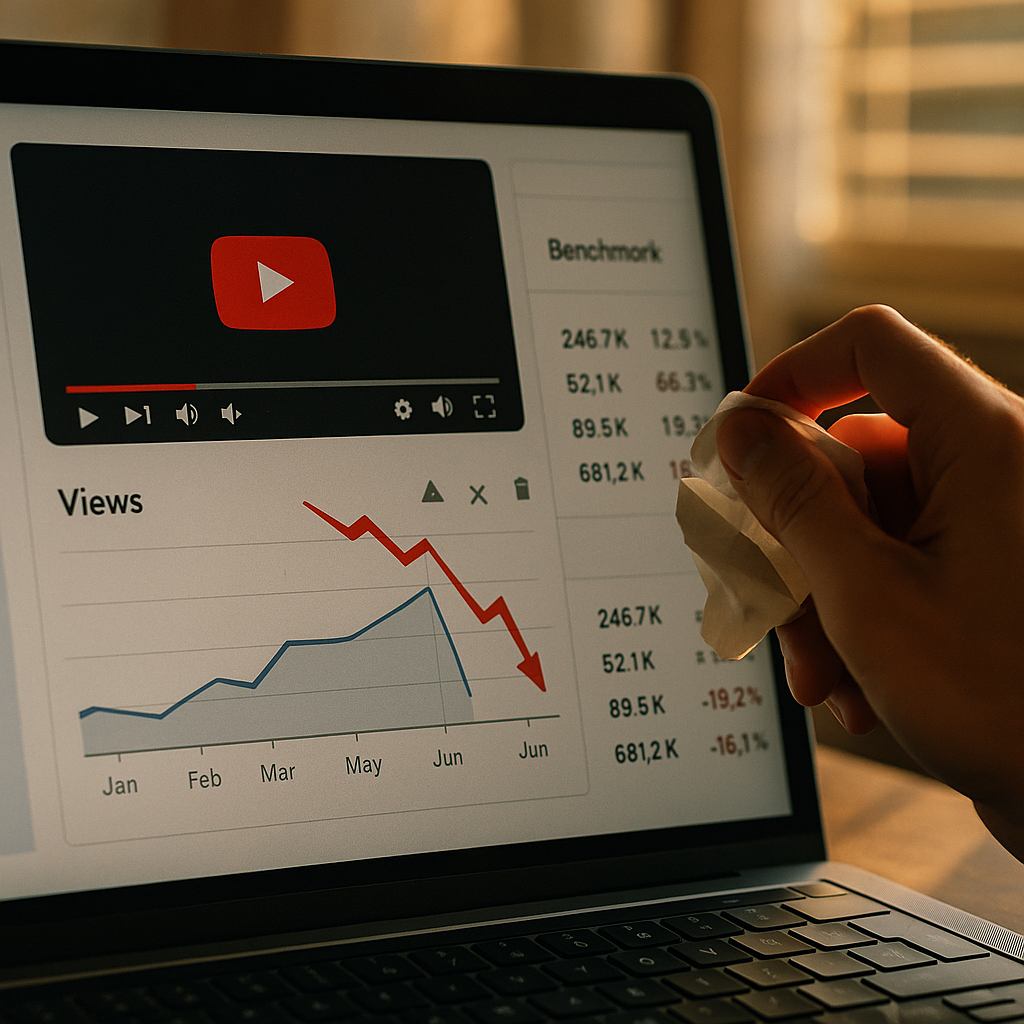
One number now describes a six-second Short, a ninety-minute podcast rebroadcast, and a livestream replay. That’s the bet YouTube is making with its view-count methodology overhaul, and it’s the biggest change to the platform’s measurement stack in years. If your reporting decks still treat Shorts views and long-form views as apples-to-apples, they haven’t been accurate for a while — and now YouTube is finally trying to fix that itself.
Why YouTube Is Rebuilding Its Counting Logic Now
For most of its history, YouTube counted a “view” using rules that made sense for one format: long-form video watched start to finish, or close to it. Then Shorts happened. Then Live happened at scale. Then podcasts moved onto the platform in huge numbers, per eMarketer’s creator economy tracking. Each format had its own quirks in how a “view” got logged, and none of them talked to each other cleanly in reporting dashboards.
That fragmentation was tolerable when brands ran single-format campaigns. It stopped being tolerable once cross-format creator deals became the norm — a creator posting a Short, a long-form deep dive, and a livestream teaser for the same campaign, each format generating a view count that meant something structurally different. Try explaining that blended number to a CFO.
YouTube’s overhaul isn’t cosmetic — it’s an admission that view counts stopped being comparable across formats years before anyone fixed the reporting layer.
What Actually Changed
YouTube’s update standardizes the qualifying threshold and counting window across Shorts, standard uploads, and Live content, aligning them under a more consistent engagement-time model rather than format-specific triggers. In plain terms: a view is being redefined to mean roughly the same thing regardless of where it happened. The platform has also pushed for clearer labeling in YouTube Studio’s analytics documentation, separating raw view counts from “engaged views” that factor in watch duration and replay behavior.
This matters more than it sounds. Under the old system, a Short could register a view after roughly a couple of seconds of play, while a long-form video required a longer threshold. That discrepancy inflated Shorts performance relative to long-form in any blended report, making short-form look disproportionately efficient on a pure view basis even when watch time and conversion told a different story.
- Unified minimum watch-time thresholds across Shorts, long-form, and Live replays.
- Clearer separation between “views” and “engaged views” in Studio analytics.
- More consistent counting of looped or repeat Shorts plays, reducing artificial inflation.
- Better alignment between live view counts and post-stream VOD counts.
None of this is flashy. It’s plumbing. But plumbing is exactly what’s been missing from cross-format influencer reporting, and this echoes a pattern we’ve already seen play out elsewhere — see how the TikTok view count methodology change similarly forced brands to rebuild their benchmarks overnight.
The Brand-Side Problem This Solves (and the One It Creates)
For agencies running multi-format YouTube programs, the old inconsistency made benchmarking a guessing game. A brand comparing two creators — one Shorts-heavy, one long-form-heavy — was never doing a fair comparison. The Shorts creator’s views were structurally easier to accumulate. That skewed everything downstream: CPM calculations, creator rate negotiations, even internal performance scorecards.
The overhaul narrows that gap. Reporting should now reflect actual attention more honestly, which is good news if you’ve been arguing internally that “views” alone were never a reliable proxy for impact.
But here’s the catch: historical benchmarks just broke. Every YoY comparison, every “average views per creator tier” spreadsheet, every media plan built on trailing twelve-month view data is now measuring against a moving target. Brands need a clean line in their reporting — pre-overhaul and post-overhaul — the same way marketers had to draw a line after Meta’s video view redefinitions years ago.
This is also a reminder of why conversion rate matters more than raw reach as a north-star metric. Platforms will keep adjusting how they count attention. Conversion, revenue, and retention don’t move when a platform tweaks its counting logic.
What This Means for Cross-Format Creator Deals
If you’re structuring creator contracts around guaranteed view thresholds — and plenty of enterprise brands do — those thresholds need revisiting. A guarantee written under the old Shorts counting rules might now be harder or easier to hit, depending on which direction the threshold moved for that format. Renegotiate before your Q1 campaigns lock in, not after.
This is the same operational discipline enterprise marketers have had to apply to tiered influencer models, where different creator tiers get different KPI structures. Cross-format view standardization should push brands toward similar tiering by content type, not a single blended view target across formats that still behave differently in terms of intent and completion.
How This Compares to What TikTok and Meta Have Done
YouTube isn’t moving first here. TikTok already recalibrated its own view-count logic, and that shift forced brands to rebuild trailing benchmarks from scratch — a pain point covered in depth when we broke down the TikTok view-count methodology change. Meta went through something similar years ago when it separated “video views” from “3-second views” and then again when it introduced watch-time-weighted metrics for Reels.
The pattern across all three platforms is consistent: as short-form and long-form content converge on the same feeds and the same creator rosters, platforms are under pressure to make cross-format comparison legitimate. It’s not altruism. It’s commercial necessity. Advertisers were starting to distrust blended metrics, and distrust is bad for platform ad revenue.
Sprout Social’s platform benchmarking research has flagged this exact issue repeatedly: marketers increasingly rank “metric consistency across formats” as a top frustration in multi-platform reporting, above even attribution accuracy. YouTube’s move is a direct response to that frustration, whether or not the company frames it that way publicly.
Operational Steps for Brands and Agencies
Don’t just read the changelog and move on. Treat this like any platform-level measurement shift that touches contracts, dashboards, and forecasting.
- Audit historical reporting. Flag every dashboard, deck, or dataset that blends pre- and post-overhaul view counts without a footnote. Someone in a QBR will eventually ask why the numbers don’t line up.
- Rebuild creator benchmarks by format. Stop comparing a Shorts creator’s view count directly to a long-form creator’s. Build separate benchmark tiers per format, then layer in engagement rate and watch time as the real comparison points.
- Revisit contract language. Any deal with view-count guarantees needs a definitions clause specifying which counting methodology applies and when it was measured.
- Push for engaged-view reporting. Ask your creator management platform or agency partner to surface “engaged views” alongside raw views in every recap. Raw views are now a floor metric, not a performance metric.
- Loop in attribution and analytics teams early. If your multi-touch attribution model ingests YouTube view data as an input signal, the model needs recalibrating too. Garbage-in from a shifted metric definition produces quietly wrong attribution weights.
This is also a moment to reassess who owns metric governance internally. As influencer manager roles increasingly require CAC and LTV fluency, platform-level metric changes like this one are exactly the kind of thing that separates teams reacting to headlines from teams with a standing process for absorbing platform changes into forecasting models.
Is This Actually About Transparency, or About Ad Revenue?
Probably both, and that’s fine. YouTube’s advertiser base has grown more sophisticated. Programmatic buyers, agency trading desks, and in-house media teams all want consistent, auditable metrics they can plug into cross-platform media mix models. A platform that can’t offer that starts losing budget to platforms that can.
Statista’s advertising data consistently shows video ad spend concentrating among a handful of platforms precisely because measurement clarity de-risks the buy. YouTube standardizing its view methodology is, in part, a competitive move to keep that spend flowing rather than watching it migrate toward platforms with cleaner reporting.
None of that makes the change less useful for brands. Self-interest and genuine transparency aren’t mutually exclusive here — YouTube benefits from advertisers trusting the numbers, and advertisers benefit from numbers they can actually trust. Rare alignment in adtech.
The Takeaway
Rebuild your YouTube benchmarks by format this quarter, not next. Flag every historical report that blends pre- and post-overhaul view data, and push your creator contracts to define “view” explicitly rather than assuming everyone means the same thing.
FAQs
What is YouTube’s view-count methodology overhaul?
It’s a platform-wide update that standardizes how views are counted and qualified across Shorts, long-form video, and Live content, aiming for consistent watch-time thresholds instead of format-specific rules.
Why did YouTube change how it counts views?
Growing demand for cross-format creator campaigns exposed inconsistencies between how Shorts, long-form, and Live views were counted, making blended reporting unreliable for advertisers and agencies.
How does this affect existing creator contracts?
Any contract with view-count guarantees written under the old counting rules should be reviewed, since thresholds for qualifying views have shifted by format.
Should brands still use raw view counts as a KPI?
Raw views should now be treated as a baseline metric, not a performance metric. Engaged views, watch time, and conversion rate offer a more reliable read on actual campaign impact.
How does this compare to TikTok’s view-count changes?
TikTok made a similar recalibration to its view-counting logic, which also forced brands to rebuild historical benchmarks. Both moves reflect platforms responding to advertiser demand for measurement consistency.
Does this change affect attribution models?
Yes. Any multi-touch attribution model that ingests YouTube view data as an input needs recalibration to account for the new counting methodology, or attribution weights will skew inaccurately.
Top Influencer Marketing Agencies
The leading agencies shaping influencer marketing in 2026
Agencies ranked by campaign performance, client diversity, platform expertise, proven ROI, industry recognition, and client satisfaction. Assessed through verified case studies, reviews, and industry consultations.
Moburst

-
2

The Shelf
Boutique Beauty & Lifestyle Influencer AgencyA data-driven boutique agency specializing exclusively in beauty, wellness, and lifestyle influencer campaigns on Instagram and TikTok. Best for brands already focused on the beauty/personal care space that need curated, aesthetic-driven content.Clients: Pepsi, The Honest Company, Hims, Elf Cosmetics, Pure LeafVisit The Shelf → -
3

Audiencly
Niche Gaming & Esports Influencer AgencyA specialized agency focused exclusively on gaming and esports creators on YouTube, Twitch, and TikTok. Ideal if your campaign is 100% gaming-focused — from game launches to hardware and esports events.Clients: Epic Games, NordVPN, Ubisoft, Wargaming, Tencent GamesVisit Audiencly → -
4

Viral Nation
Global Influencer Marketing & Talent AgencyA dual talent management and marketing agency with proprietary brand safety tools and a global creator network spanning nano-influencers to celebrities across all major platforms.Clients: Meta, Activision Blizzard, Energizer, Aston Martin, WalmartVisit Viral Nation → -
5

The Influencer Marketing Factory
TikTok, Instagram & YouTube CampaignsA full-service agency with strong TikTok expertise, offering end-to-end campaign management from influencer discovery through performance reporting with a focus on platform-native content.Clients: Google, Snapchat, Universal Music, Bumble, YelpVisit TIMF → -
6

NeoReach
Enterprise Analytics & Influencer CampaignsAn enterprise-focused agency combining managed campaigns with a powerful self-service data platform for influencer search, audience analytics, and attribution modeling.Clients: Amazon, Airbnb, Netflix, Honda, The New York TimesVisit NeoReach → -
7

Ubiquitous
Creator-First Marketing PlatformA tech-driven platform combining self-service tools with managed campaign options, emphasizing speed and scalability for brands managing multiple influencer relationships.Clients: Lyft, Disney, Target, American Eagle, NetflixVisit Ubiquitous → -
8

Obviously
Scalable Enterprise Influencer CampaignsA tech-enabled agency built for high-volume campaigns, coordinating hundreds of creators simultaneously with end-to-end logistics, content rights management, and product seeding.Clients: Google, Ulta Beauty, Converse, AmazonVisit Obviously →