


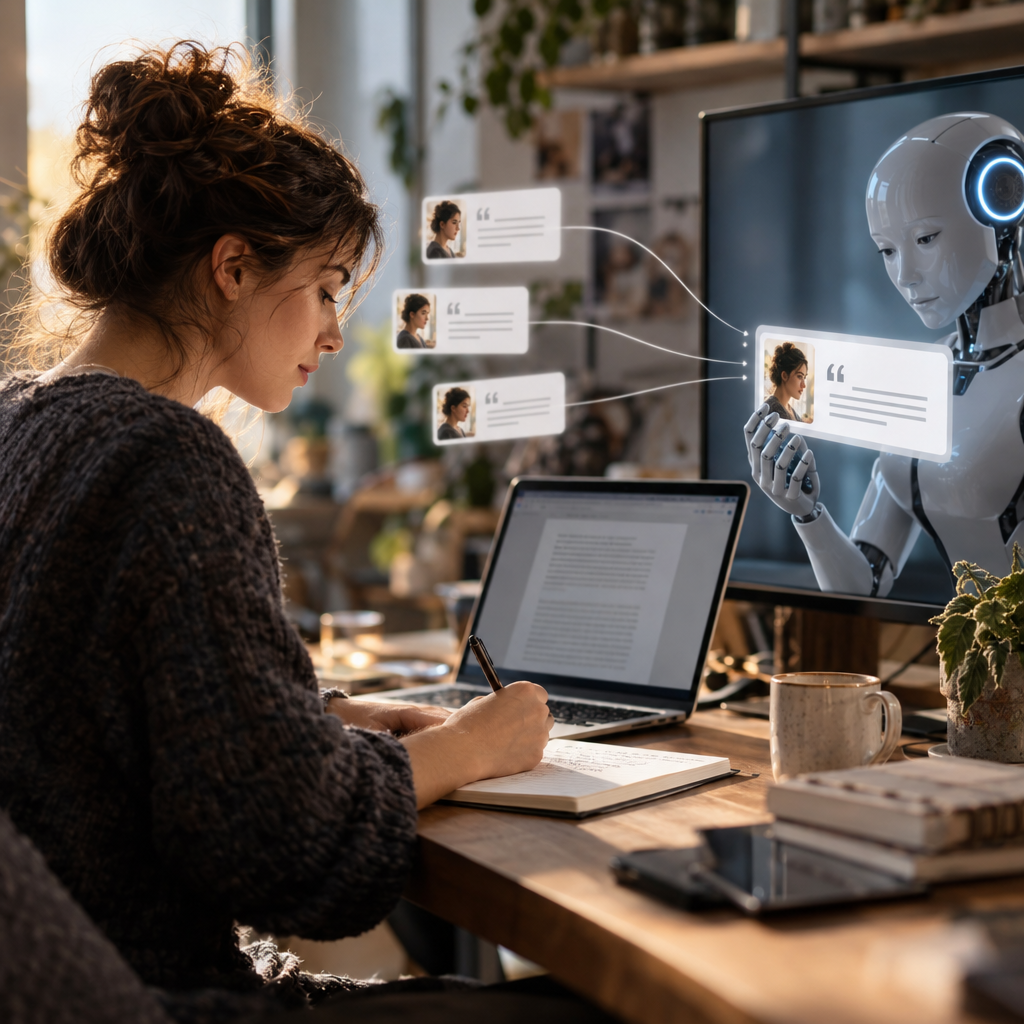
Most searches now end before anyone visits a site, and that changes what a creator video is for. For brands, scripting for AI chat answers is now a distribution decision, not a niche SEO tactic. If your creator’s video gets quoted but nobody clicks, did the campaign work? It can, if you brief for it.
The click is shrinking. The citation is not.
According to Pew, visitors who saw an AI summary clicked a result link in 8% of visits, versus 15% for visitors who did not see one. In the same Pew data, clicks on links inside the summary itself happened in just 1% of visits.
Pew also found that Wikipedia, YouTube and Reddit were the most frequently cited sources, and together they made up 15% of sources listed in AI summaries. Two of those three are creator-heavy environments. That is your opening.
The strategic shift is simple. Your KPI stack has to include being the named source inside the answer, not only the visit that follows. Brand recall, branded search lift, and assisted conversions carry more weight when the click is scarce.
In a zero-click environment, the unit of value is the quotable claim. A creator script that cannot be lifted into one clean sentence is invisible to an AI answer.
What does an “answerable” script actually look like?
AI systems assemble responses from passages they can extract and trust. Rambling hooks and inside jokes are great for retention and terrible for extraction. The fix is not to flatten the creator. It is to add a layer.
Build every script with three components:
- The question, spoken aloud. Have the creator say the query the way a buyer would type it. “Does retinol work for sensitive skin?” beats “So, retinol, let’s talk.”
- The 20-second answer. A direct, self-contained response delivered early. No pronouns pointing backward (“it,” “that one”). Name the product, the category, and the condition.
- The proof beat. One specific detail only the creator could provide: how long they tested, what changed, what failed.
That last item matters most. Google’s own guidance on generative AI features separates commodity content (common knowledge anyone could write) from non-commodity content with unique expert or experienced takes. In its guide to optimizing for generative AI features, Google recommends creating non-commodity content that is helpful, reliable and people-first. Creators are naturally positioned for this. Most brand copy is not.
Format the spoken word like a page
Video is not text, but it gets transcribed, captioned, and described. Treat those layers as your on-page SEO.
Start with the first caption line. It should restate the question and the answer in plain language. Then check titles and descriptions: the title carries the query, the description carries the answer in two sentences, and the pinned comment carries the product name and specs. Chapters help too, because each chapter title becomes a candidate answer to a distinct question.
Google’s guide also advises organizing content with clear paragraphs, sections and headings, and supporting text with high-quality images and video. The same logic applies to a long-form YouTube script. Segment it. Label it. Make each segment survive on its own.
Does this clash with native platform craft? Less than you would think. Our piece on adapting video natively covers how to keep one shoot flexible. Add an “answer pass” to that edit plan: one extra cut where the spoken answer leads.
Claims, comparisons and compliance
Here is the risk side. Extractable claims travel without context. A creator’s playful “this crushes the competition” can surface in an AI answer as a flat, comparative statement with your brand name attached. Legal teams should care about that.
Write claims so they hold up when stripped of tone. Substantiate them in the script itself, state the test conditions, and keep disclosure in spoken and written form. For frameworks, see our guides on claims that pass legal review and disclosure brands cannot skip. Disclosure language should sit inside the same passage as the claim, because that passage may be all that gets quoted.
Myth-busting formats are especially extractable, since they pair a false belief with a correction. They are also where overreach lives. Our breakdown of myth busting reels shows how to keep the correction sourced.
Trust signals AI systems can read
Google states that trust is the most important element of E-E-A-T, and that the other elements contribute to it. Its helpful content guidance is clear that E-E-A-T is not a single ranking factor, but a mix of signals. So what can a creator brief add?
- Experience: first-hand use, stated with specifics (duration, setting, comparison).
- Expertise: credentials stated once, plainly, ideally in the description and on a linked bio page.
- Authoritativeness: a brand-owned page that hosts the creator’s claim, sources, and a consistent author name.
- Trust: disclosure, accurate pricing, and honest limits (“not ideal if you have X”).
Pairing a credentialed voice with creator reach is a proven structure. See expert reaction content for how to set that up.
Do not mass-produce answers
The temptation is obvious: brief 200 creators with 200 query variants. Resist it. Google says that creating separate content for every possible query variation primarily to manipulate rankings or AI responses violates its scaled content abuse spam policy, and that it is ineffective long term. The same guide asks that AI-assisted content meet Search Essentials and spam policy standards.
Choose 10 to 15 questions your buyers genuinely ask. Pull them from sales calls, support tickets, and review text. Assign each to the creator best placed to answer it from experience.
Measure what zero click leaves behind
You will not see a click for many of these views. Track the following instead:
- Branded search volume and direct traffic in the weeks after a publish.
- Manual spot checks: ask ChatGPT, Gemini and Google the target question monthly and log whether your brand or creator is named.
- Transcript-level reviews: does the answer sentence appear verbatim in captions and descriptions?
- Assisted conversions from creator-tagged landing pages.
Log results in a simple sheet. Patterns emerge fast. Questions with a crisp answer and a proof beat get cited more often than broad explainers.
FAQs
What does scripting for AI chat answers mean?
It means writing creator content so that a clear, self-contained answer to a specific buyer question can be extracted, transcribed and quoted by AI chat tools and search summaries. The script states the question, answers it early, and supplies first-hand proof.
Do AI summaries really cut clicks?
The Pew study found that users clicked a traditional result link in 8% of visits with an AI summary, compared with 15% on pages without one. That is the main reason brands should measure citations and brand lift alongside traffic.
Does Google have separate rules for optimizing for AI features?
Google’s guidance says pages must be indexed and eligible to appear in Search with a snippet to show in generative AI features. It also says that existing SEO best practices remain worthwhile, so there is no separate trick to learn.
Should every creator video be written this way?
No. Entertainment and storytelling formats still drive reach and affinity. Use answer-first scripting for educational, comparison, and how-to content where buyers ask direct questions.
How do we protect the brand from out-of-context quotes?
Keep substantiation, test conditions and disclosure inside the same passage as the claim. Run the script through legal review as if the single answer sentence were the whole ad.
Can AI tools write these scripts?
They can help with structure and question research. Google’s guidance says AI-assisted content must still meet Search Essentials and spam policies, and the unique proof beat has to come from the creator’s real experience.
Next step: pull your ten most common buyer questions this week, assign each to a creator with first-hand experience, and add a spoken question, a 20-second answer, and a proof beat to every brief.
Top Influencer Marketing Agencies
The leading agencies shaping influencer marketing in 2026
Agencies ranked by campaign performance, client diversity, platform expertise, proven ROI, industry recognition, and client satisfaction. Assessed through verified case studies, reviews, and industry consultations.
Moburst

-
2

The Shelf
Boutique Beauty & Lifestyle Influencer AgencyA data-driven boutique agency specializing exclusively in beauty, wellness, and lifestyle influencer campaigns on Instagram and TikTok. Best for brands already focused on the beauty/personal care space that need curated, aesthetic-driven content.Clients: Pepsi, The Honest Company, Hims, Elf Cosmetics, Pure LeafVisit The Shelf → -
3

Audiencly
Niche Gaming & Esports Influencer AgencyA specialized agency focused exclusively on gaming and esports creators on YouTube, Twitch, and TikTok. Ideal if your campaign is 100% gaming-focused — from game launches to hardware and esports events.Clients: Epic Games, NordVPN, Ubisoft, Wargaming, Tencent GamesVisit Audiencly → -
4

Viral Nation
Global Influencer Marketing & Talent AgencyA dual talent management and marketing agency with proprietary brand safety tools and a global creator network spanning nano-influencers to celebrities across all major platforms.Clients: Meta, Activision Blizzard, Energizer, Aston Martin, WalmartVisit Viral Nation → -
5

The Influencer Marketing Factory
TikTok, Instagram & YouTube CampaignsA full-service agency with strong TikTok expertise, offering end-to-end campaign management from influencer discovery through performance reporting with a focus on platform-native content.Clients: Google, Snapchat, Universal Music, Bumble, YelpVisit TIMF → -
6

NeoReach
Enterprise Analytics & Influencer CampaignsAn enterprise-focused agency combining managed campaigns with a powerful self-service data platform for influencer search, audience analytics, and attribution modeling.Clients: Amazon, Airbnb, Netflix, Honda, The New York TimesVisit NeoReach → -
7

Ubiquitous
Creator-First Marketing PlatformA tech-driven platform combining self-service tools with managed campaign options, emphasizing speed and scalability for brands managing multiple influencer relationships.Clients: Lyft, Disney, Target, American Eagle, NetflixVisit Ubiquitous → -
8

Obviously
Scalable Enterprise Influencer CampaignsA tech-enabled agency built for high-volume campaigns, coordinating hundreds of creators simultaneously with end-to-end logistics, content rights management, and product seeding.Clients: Google, Ulta Beauty, Converse, AmazonVisit Obviously →