


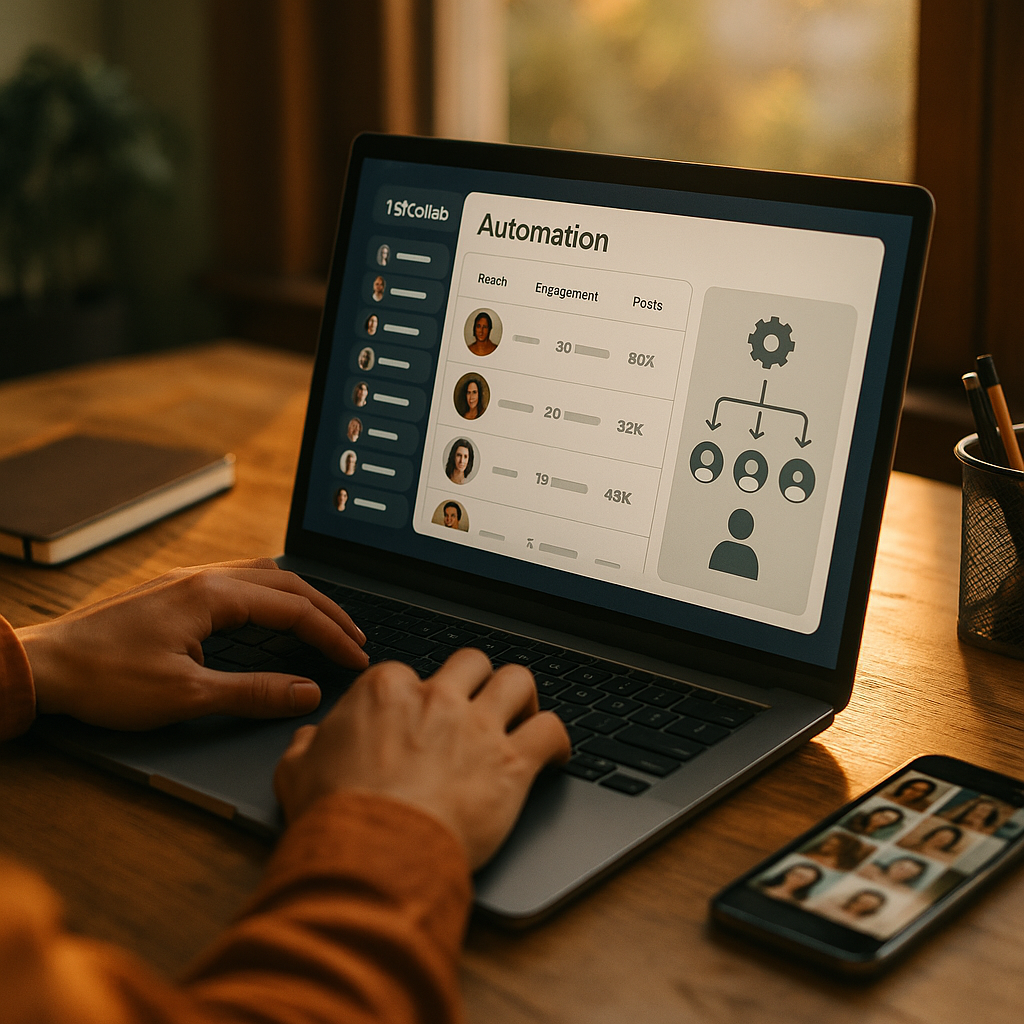
Would you trust an algorithm to negotiate creator rates, source talent, and manage campaign logistics with zero human involvement? A growing crop of YC-backed startups is betting you will. 1stCollab, the automated influencer platform that raised eyebrows (and funding) for replacing agency workflows with AI agents, is the clearest signal yet that influencer marketing is entering its software-eats-services phase.
The Pitch: Agencies, But Make It Software
1stCollab’s core pitch is blunt: influencer marketing agencies are slow, expensive, and inconsistent. Its platform automates creator discovery, outreach, negotiation, and reporting using AI models trained on historical campaign data. Brands upload a brief, the system identifies matching creators, drafts outreach, negotiates within set parameters, and surfaces performance data post-campaign. No account manager chasing a spreadsheet. No three-week onboarding call.
That’s the promise, anyway. And it’s landing at a moment when brands are already questioning what they pay agency retainers for. According to eMarketer, influencer marketing spend in the U.S. is projected to keep climbing past $10 billion annually, even as marketers report growing frustration with measurement gaps and agency markups. When budgets rise but confidence in ROI doesn’t, automation vendors get a receptive audience.
The real story isn’t that AI can send DMs to creators. It’s that AI can now handle the negotiation logic that used to require a human relationship manager — and that changes the unit economics of every agency retainer on the table.
Why YC Keeps Betting on Creator Automation
1stCollab isn’t an isolated bet. Y Combinator’s recent batches have included multiple startups targeting the influencer workflow stack: automated payment and contracting tools, AI-driven creator matching engines, and platforms that generate campaign briefs directly from a product URL. This isn’t coincidence — it’s pattern recognition from investors who’ve watched B2B SaaS get “agentified” and are now applying the same thesis to marketing services.
The logic is straightforward. Influencer marketing has historically resisted software because it’s relationship-heavy: rates get negotiated over DMs, deliverables get renegotiated mid-campaign, and creative approval is subjective. That messiness made it hard to automate — until large language models got good enough to handle unstructured negotiation and judgment calls at scale. Now the messiness looks less like a moat and more like a training set.
Compare this to what happened with programmatic ad buying a decade ago. Media buyers who once negotiated placements by phone got replaced by bidding algorithms. Influencer marketing is following a similar arc, just five to seven years behind. The difference is that creator relationships carry more brand risk than a banner ad ever did — which is exactly why the compliance and quality-control questions matter more here than they did in programmatic’s early days.
What’s Actually Getting Automated (And What Isn’t, Yet)
It’s worth separating hype from capability. Fully automated influencer platforms today are strongest at:
- Creator discovery and shortlisting — matching audience demographics, engagement patterns, and brand-safety signals faster than manual research.
- Outreach and initial negotiation — templated but personalized messaging that handles rate discussions within pre-set bands.
- Reporting rollups — pulling performance data into standardized dashboards without a human building slides.
They’re weaker — still — at creative judgment. An algorithm can flag that a creator’s audience skews 68% female, 25-34, but it can’t reliably tell you whether that creator’s tone fits a luxury skincare brand versus a budget one. Nuance like that still benefits from human review, at least for now. Brands running high-stakes campaigns (think pharma, finance, anything with legal exposure) are keeping humans in the approval loop even when sourcing and outreach are automated.
This is where the parallel to other MarTech automation waves gets useful. The same pattern showed up in AI content brief generation: fast output, but brands quickly learned to audit for accuracy before shipping anything client-facing. Automated influencer platforms deserve the same scrutiny.
The Agency Displacement Question
Let’s address the elephant in the room. If 1stCollab and its peers deliver on speed and cost, does that mean boutique influencer agencies are done?
Not exactly — but their value proposition has to shift. Agencies that primarily did sourcing and negotiation are the most exposed. Agencies that do strategic positioning, creative direction, crisis management, and long-term creator relationship-building have a harder skill set to automate. The winners in the next 24 months will likely be agencies that adopt these AI tools themselves, using them to cut execution time and reallocating staff toward strategy and brand safety oversight.
This mirrors what’s happening across the broader MarTech stack. Agentforce vs Adobe CX Coworker comparisons show the same tension: AI agents handling operational tasks while human teams focus on judgment calls the software can’t yet make. Influencer marketing is just the latest function to face that split.
Where the Risk Actually Lives
Automated negotiation sounds efficient until you consider what happens when an AI agent commits a brand to a deliverable that legal never reviewed, or negotiates a usage-rights clause that conflicts with a master services agreement. Contract terms are where automated platforms need the most scrutiny, not the least.
Brands adopting these tools should be asking vendors specific questions: Does the platform’s negotiation logic account for FTC disclosure requirements? Can it flag when a creator’s past sponsored content has drawn regulatory attention? Does it integrate with existing contract review workflows, or does it operate as a walled-off black box? The FTC’s endorsement guidelines haven’t gotten friendlier to ambiguity, and an AI agent moving fast on outreach can just as easily move fast on a compliance miss.
This is precisely the gap that AI co-pilot tools for contract redlining are trying to close — pairing automated sourcing with automated legal review so nothing slips through unchecked. Brands evaluating 1stCollab-style platforms should treat contract redlining integration as a baseline requirement, not a nice-to-have.
Fraud and authenticity checks are the other pressure point. Automated discovery is only as good as the data feeding it. If a platform’s matching engine can’t reliably distinguish real engagement from bot-inflated metrics, speed just means brands make bad decisions faster. Tools built specifically for AI fraud detection in influencer vetting are becoming a necessary companion layer, not a competing category.
The Measurement Problem Doesn’t Disappear
Here’s what automated platforms don’t solve on their own: attribution. Sourcing a creator faster and negotiating a rate via AI doesn’t tell you whether that creator actually drove incremental revenue. That’s a separate, harder problem — one that’s been the subject of ongoing debate across attribution vendors like Rockerbox, Northbeam, and Triple Whale, each taking different approaches to creator attribution modeling.
Brands layering an automated sourcing platform on top of a fragmented measurement stack are solving the wrong bottleneck. If you can’t tie creator activity to pipeline or revenue with confidence, faster sourcing just means faster spending without faster clarity. This is why server-side identity resolution matters as much as any AI negotiation feature — it’s the plumbing that makes the automation’s output actually measurable.
According to HubSpot’s marketing benchmark research, attribution confidence remains one of the top-cited gaps among marketers investing in influencer and creator channels. Automation vendors rarely lead with this limitation. Buyers should ask about it directly.
How to Evaluate These Platforms Without Getting Burned
If you’re a brand or agency leader considering a fully automated influencer platform, run it through the same rigor you’d apply to any MarTech acquisition. That means asking where it sits in your five-layer martech stack and whether it duplicates capability you already own.
A few practical filters worth applying before signing a contract:
- Audit for redundancy first. Many brands already pay for creator discovery through existing platforms. Adding another tool without cutting one is how stacks bloat — the same trap covered in stack rationalization frameworks.
- Demand transparency on negotiation logic. Ask what data trains the rate-negotiation model and whether it’s benchmarked against your category, not just aggregate creator marketplace averages.
- Check integration depth, not just API existence. A platform that “integrates” with your CRM but requires manual CSV exports isn’t integrated — it’s connected by duct tape, the same failure mode flagged in coverage of hidden automation risk.
- Pilot with a capped budget and a hard stop. Treat the first campaign as a controlled test, not a rollout. Compare output against a manually sourced control group.
Sprout Social’s ongoing research into social and influencer marketing trends consistently shows brands under pressure to prove ROI faster with leaner teams — which is exactly the pressure automated platforms are designed to relieve. Just make sure relief doesn’t come at the cost of oversight.
What This Means for the Next Wave of MarTech
1stCollab is a symptom, not the whole disease. The broader trend is AI agents absorbing operational marketing tasks across the stack — briefing, contracting, negotiation, reporting — while human teams get pushed toward strategy, creative judgment, and risk management. That’s not a bad trade if brands manage the transition deliberately. It’s a costly one if they adopt automation for its own sake and skip the audit step.
Expect consolidation here within the next 18 months. Point solutions for sourcing, negotiation, and contract review will get acquired or bundled by larger platforms wanting an end-to-end automated pipeline. Brands that pick a fragmented set of automation vendors now may find themselves re-platforming sooner than they’d like.
Next step: before piloting any automated influencer platform, run a 90-day controlled comparison against your current sourcing process, and require the vendor to disclose exactly how negotiation and compliance checks work under the hood.
FAQs
What is 1stCollab and how does it differ from a traditional influencer agency?
1stCollab is a YC-backed platform that automates creator discovery, outreach, negotiation, and reporting using AI, replacing the manual workflows typically handled by influencer marketing agencies.
Are fully automated influencer platforms actually reliable for brand-safe campaigns?
They’re improving quickly for sourcing and negotiation but still require human oversight for creative judgment, nuanced brand fit, and compliance review, especially in regulated industries.
Will AI-driven platforms replace influencer marketing agencies entirely?
Unlikely in the near term. Agencies focused purely on sourcing and negotiation face the most disruption, while those offering strategy, crisis management, and creative direction retain a defensible position.
What should brands check before adopting an automated influencer platform?
Brands should verify integration depth with existing MarTech, transparency in negotiation logic, fraud detection capability, and compliance with FTC disclosure requirements before committing budget.
Does automation solve the influencer attribution problem?
No. Automated sourcing and negotiation don’t address measurement gaps. Brands still need robust attribution infrastructure to connect creator activity to actual revenue outcomes.
Top Influencer Marketing Agencies
The leading agencies shaping influencer marketing in 2026
Agencies ranked by campaign performance, client diversity, platform expertise, proven ROI, industry recognition, and client satisfaction. Assessed through verified case studies, reviews, and industry consultations.
Moburst

-
2

The Shelf
Boutique Beauty & Lifestyle Influencer AgencyA data-driven boutique agency specializing exclusively in beauty, wellness, and lifestyle influencer campaigns on Instagram and TikTok. Best for brands already focused on the beauty/personal care space that need curated, aesthetic-driven content.Clients: Pepsi, The Honest Company, Hims, Elf Cosmetics, Pure LeafVisit The Shelf → -
3

Audiencly
Niche Gaming & Esports Influencer AgencyA specialized agency focused exclusively on gaming and esports creators on YouTube, Twitch, and TikTok. Ideal if your campaign is 100% gaming-focused — from game launches to hardware and esports events.Clients: Epic Games, NordVPN, Ubisoft, Wargaming, Tencent GamesVisit Audiencly → -
4

Viral Nation
Global Influencer Marketing & Talent AgencyA dual talent management and marketing agency with proprietary brand safety tools and a global creator network spanning nano-influencers to celebrities across all major platforms.Clients: Meta, Activision Blizzard, Energizer, Aston Martin, WalmartVisit Viral Nation → -
5

The Influencer Marketing Factory
TikTok, Instagram & YouTube CampaignsA full-service agency with strong TikTok expertise, offering end-to-end campaign management from influencer discovery through performance reporting with a focus on platform-native content.Clients: Google, Snapchat, Universal Music, Bumble, YelpVisit TIMF → -
6

NeoReach
Enterprise Analytics & Influencer CampaignsAn enterprise-focused agency combining managed campaigns with a powerful self-service data platform for influencer search, audience analytics, and attribution modeling.Clients: Amazon, Airbnb, Netflix, Honda, The New York TimesVisit NeoReach → -
7

Ubiquitous
Creator-First Marketing PlatformA tech-driven platform combining self-service tools with managed campaign options, emphasizing speed and scalability for brands managing multiple influencer relationships.Clients: Lyft, Disney, Target, American Eagle, NetflixVisit Ubiquitous → -
8

Obviously
Scalable Enterprise Influencer CampaignsA tech-enabled agency built for high-volume campaigns, coordinating hundreds of creators simultaneously with end-to-end logistics, content rights management, and product seeding.Clients: Google, Ulta Beauty, Converse, AmazonVisit Obviously →