


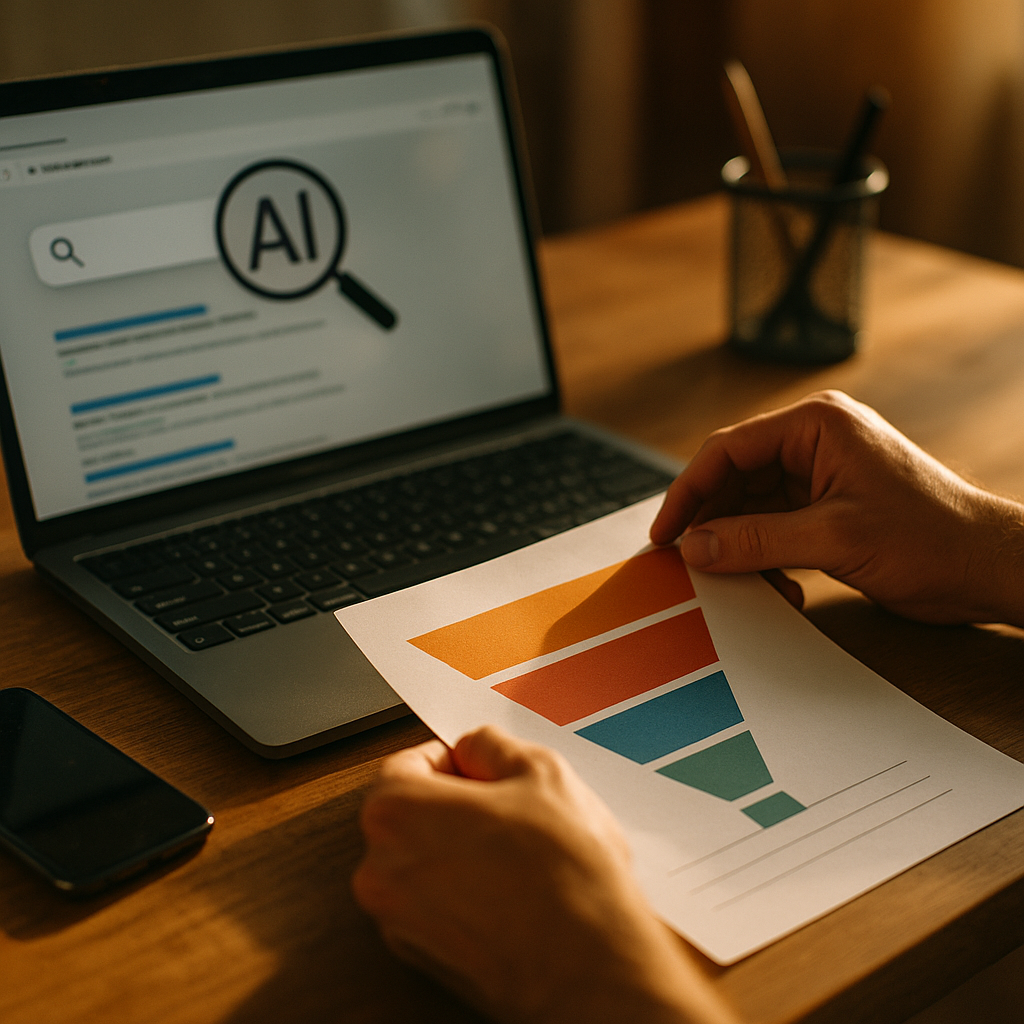
AI search traffic is up 392 percent year over year, and most brand discovery strategies still assume Google’s ten blue links are the finish line. They are not. ChatGPT, Perplexity, and Gemini are rewriting how consumers find products, and the creator discovery funnel built for 2019 SEO is leaking value at every stage.
That stat alone should reset budget conversations this quarter. If your creator content was built purely for keyword rankings, you are optimizing for a traffic source that is shrinking relative to AI-mediated answers.
What’s Actually Driving the 392 Percent Jump
The number comes from aggregated web analytics tracking referral traffic from AI assistants and answer engines, a category that barely existed three years ago. Perplexity now handles hundreds of millions of queries monthly. ChatGPT’s search mode has become a default habit for younger consumers researching purchases. Google’s AI Overviews answer a growing share of queries before a user ever clicks through to a website.
What makes this different from the typical “new channel, same playbook” story is that AI search doesn’t reward the same signals as traditional SEO. Backlinks and keyword density matter less. What matters is whether your brand, product, or creator content gets cited as a source inside an AI-generated answer. That’s a fundamentally different optimization target, and it’s one AI search summaries are already rerouting significant retail media spend toward.
If an AI assistant never cites your brand or your creator’s review, you don’t just lose a click. You lose the entire consideration moment, because the consumer never sees an alternative.
The Old Discovery Funnel Is Broken, Not Just Slower
For a decade, the creator discovery funnel looked roughly like this: awareness through social feeds, consideration through search and review content, conversion through retail or direct-to-consumer checkout. Brands built entire measurement stacks around that sequence. Agencies priced retainers around it.
That funnel assumed a human was clicking through a chain of links. AI search collapses the chain. A consumer asks ChatGPT “what’s the best collagen supplement for joint pain” and gets a synthesized answer pulling from Reddit threads, creator reviews, and product pages, often without the user ever visiting a single site directly. The research happens inside the AI interface, not across your owned channels.
This isn’t a hypothetical risk. It echoes what we’ve already seen with low quality AI content flooding search and eroding trust in generic brand copy. The same dynamic now applies to creator content: thin, templated reviews get ignored by AI summarization models in favor of sources with demonstrated expertise and specificity.
Why Creator Content Still Wins (If You Rebuild It Right)
Here’s the part that should reassure, not panic, marketing leaders. AI models are trained to favor content with clear experience signals, specific detail, and consistent sourcing across multiple platforms. That’s exactly what good creator content provides when it’s not just a scripted ad read.
A creator who says “I used this for six weeks and my joint pain specifically improved after week three” gives an AI model something concrete to cite. A generic brand description does not. This is a structural advantage for brands running authentic creator programs over those relying purely on owned content or paid search copy.
The catch: volume and consistency matter more than ever. One creator post won’t move the needle in an AI training or retrieval corpus. Twenty creators saying similar things with varied, specific language across TikTok, YouTube, Reddit, and review sites starts to build the kind of corroborating signal these models weight heavily.
Rebuilding the Funnel: Five Operational Shifts
Brand and agency teams need to treat this as a structural shift, not a tactical patch. A few changes worth prioritizing immediately:
- Shift from keyword briefs to answer briefs. Give creators the actual questions consumers ask AI assistants, not just target keywords. Specificity in the creator’s response matters more than SEO phrasing ever did.
- Diversify platform footprint. AI models pull heavily from Reddit, YouTube transcripts, and long-form reviews. A creator strategy concentrated entirely on Instagram Reels leaves visibility gaps in the sources AI tools actually cite.
- Prioritize UGC and review depth over polish. Highly produced brand content reads as promotional to retrieval models. Rawer, detailed creator commentary reads as credible.
- Track citation share, not just impressions. New measurement tools are emerging to track how often a brand is cited inside AI answers. This deserves its own line item in reporting, separate from traditional share of voice.
- Audit existing creator content for AI retrievability. Old posts with vague claims and no specific product detail are functionally invisible to these systems, regardless of how well they performed on launch.
This connects directly to a broader theme we’ve covered: systems thinking beats prompting when it comes to extracting real ROI from AI tools. The same logic applies here. One clever prompt or one viral creator post won’t fix a structurally outdated discovery funnel. The fix is operational: content architecture, platform diversity, and measurement redesign working together.
Attribution Gets Harder Before It Gets Easier
If a consumer discovers your product through an AI-summarized answer that cited a creator’s TikTok, then buys three days later through a direct Google search, how do you attribute that sale? Most attribution models can’t answer that yet. This is the same blind spot flagged in our coverage of why last click attribution fails creator driven buying journeys, now compounded by an entirely new discovery layer sitting between the creator post and the purchase.
Marketing leaders should expect reported ROI to look murkier for a few quarters, not because campaigns are underperforming, but because the measurement infrastructure hasn’t caught up to how consumers now actually search. CMOs already struggling with this problem shouldn’t wait for perfect attribution before acting. That mindset is part of why 61 percent of CMOs can’t measure ROI even as spend keeps climbing.
What This Means for Budget and Agency Selection
Expect agencies and platforms to start pitching “AI search optimization” or “answer engine optimization” (AEO) as a new line item. Some of that is legitimate capability building. Some of it is repackaged SEO with a new acronym slapped on.
The acquisition activity backs this up: AEO and GEO demand is already fueling an agency acquisition race, with holding companies buying up boutique shops that claim expertise in this space. Vet these claims carefully. Ask for evidence of actual citation tracking, not just vague promises about “future proofing” your content.
If an agency can’t show you how it measures whether your brand gets cited inside AI-generated answers, it likely isn’t doing the work yet either.
Budget-wise, this doesn’t necessarily mean spending more. It means reallocating creative and measurement budget toward content types that perform in retrieval contexts: long-form reviews, Reddit-style community content, and creator FAQs that directly answer the questions consumers are typing into AI tools. For teams already tracking creator CAC benchmarks by platform, factor in that AI-referred traffic may convert differently than social-referred traffic, and your CAC math should reflect that distinction as data becomes available.
Industry data from eMarketer and Statista suggests AI-assisted search behavior is accelerating fastest among consumers under 35, the exact demographic most brands are chasing through creator partnerships. That overlap is either an opportunity or a risk, depending entirely on whether your content is built to be found inside these new interfaces.
A Quick Gut Check for Your Team
Before the next planning cycle, pull up ChatGPT or Perplexity and ask the actual questions your target customer would ask about your category. Does your brand show up? Does a creator you’ve worked with get cited? If the answer is no across multiple queries, that’s not a marketing failure exactly, it’s a visibility gap that traditional SEO reporting won’t show you because it’s measuring the wrong funnel.
Tools from HubSpot and social listening platforms like Sprout Social are starting to build AI citation tracking into their reporting suites. Worth testing now, before it becomes table stakes.
Next step: run that gut-check query audit this week across your top three product categories, then brief your creator partners on the specific gaps you find instead of waiting for a formal AEO strategy to materialize.
Frequently Asked Questions
What does the 392 percent increase in AI search traffic actually measure?
It refers to the growth in website referral traffic originating from AI assistants and answer engines like ChatGPT, Perplexity, and Google’s AI Overviews, compared to the prior year. It reflects a behavioral shift in how consumers research products before buying.
How is the creator discovery funnel different from the traditional SEO funnel?
Traditional SEO rewards keyword matching and backlink authority to rank in search results. AI search rewards content that gets cited inside a synthesized answer, which favors specific, experience-based creator content over generic, keyword-optimized copy.
Should brands pause traditional SEO investment to focus on AI search optimization?
No. Traditional search still drives significant traffic and conversions. The smarter move is reallocating a portion of content and creator budget toward formats that also perform well in AI retrieval, without abandoning existing SEO infrastructure.
Can brands track whether they’re being cited inside AI-generated answers?
Emerging tools from martech vendors are beginning to offer AI citation tracking, though the category is still maturing. Manually auditing AI assistant responses for your top product queries remains a reliable interim method.
Does creator content actually perform better in AI search results than brand-owned content?
Generally yes, when the creator content includes specific, detailed, first-person claims. AI models tend to weight content with clear experience signals and cross-platform corroboration over promotional brand copy.
Frequently Asked Questions
Top Influencer Marketing Agencies
The leading agencies shaping influencer marketing in 2026
Agencies ranked by campaign performance, client diversity, platform expertise, proven ROI, industry recognition, and client satisfaction. Assessed through verified case studies, reviews, and industry consultations.
Moburst

-
2

The Shelf
Boutique Beauty & Lifestyle Influencer AgencyA data-driven boutique agency specializing exclusively in beauty, wellness, and lifestyle influencer campaigns on Instagram and TikTok. Best for brands already focused on the beauty/personal care space that need curated, aesthetic-driven content.Clients: Pepsi, The Honest Company, Hims, Elf Cosmetics, Pure LeafVisit The Shelf → -
3

Audiencly
Niche Gaming & Esports Influencer AgencyA specialized agency focused exclusively on gaming and esports creators on YouTube, Twitch, and TikTok. Ideal if your campaign is 100% gaming-focused — from game launches to hardware and esports events.Clients: Epic Games, NordVPN, Ubisoft, Wargaming, Tencent GamesVisit Audiencly → -
4

Viral Nation
Global Influencer Marketing & Talent AgencyA dual talent management and marketing agency with proprietary brand safety tools and a global creator network spanning nano-influencers to celebrities across all major platforms.Clients: Meta, Activision Blizzard, Energizer, Aston Martin, WalmartVisit Viral Nation → -
5

The Influencer Marketing Factory
TikTok, Instagram & YouTube CampaignsA full-service agency with strong TikTok expertise, offering end-to-end campaign management from influencer discovery through performance reporting with a focus on platform-native content.Clients: Google, Snapchat, Universal Music, Bumble, YelpVisit TIMF → -
6

NeoReach
Enterprise Analytics & Influencer CampaignsAn enterprise-focused agency combining managed campaigns with a powerful self-service data platform for influencer search, audience analytics, and attribution modeling.Clients: Amazon, Airbnb, Netflix, Honda, The New York TimesVisit NeoReach → -
7

Ubiquitous
Creator-First Marketing PlatformA tech-driven platform combining self-service tools with managed campaign options, emphasizing speed and scalability for brands managing multiple influencer relationships.Clients: Lyft, Disney, Target, American Eagle, NetflixVisit Ubiquitous → -
8

Obviously
Scalable Enterprise Influencer CampaignsA tech-enabled agency built for high-volume campaigns, coordinating hundreds of creators simultaneously with end-to-end logistics, content rights management, and product seeding.Clients: Google, Ulta Beauty, Converse, AmazonVisit Obviously →