


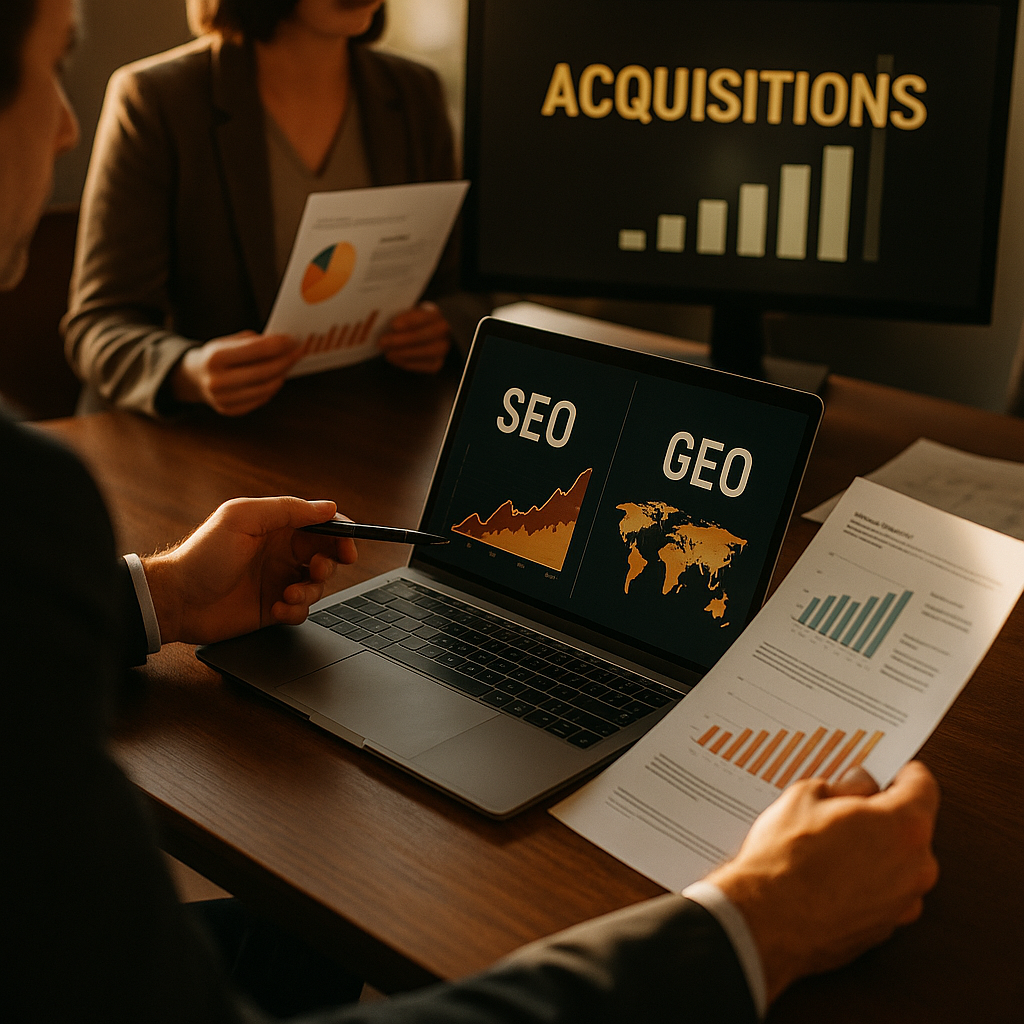
Nearly six in ten consumers now get product recommendations straight from an AI chatbot before they ever hit a search results page. That shift alone explains why AEO and GEO consulting demand has become the hottest line item on agency pitch decks this year. Holding companies are buying their way into answer engine expertise because building it from scratch takes too long and costs too much.
Why Every Agency Suddenly Wants an AI Visibility Practice
Answer Engine Optimization (AEO) and Generative Engine Optimization (GEO) were niche terms eighteen months ago. Now they’re board-level priorities. Brands watched organic traffic dip as ChatGPT, Perplexity, and Google’s AI Overviews started answering questions directly, skipping the click entirely. The 60 percent AI search summaries trend already rerouting retail media spend made the problem impossible to ignore.
Clients don’t just want to rank anymore. They want to be the cited source inside an AI-generated answer, the brand name an assistant actually mentions when a shopper asks “what’s the best running shoe for flat feet.” That’s a fundamentally different discipline than traditional SEO, and most agencies don’t have it in-house.
Agencies that can’t explain how a brand gets cited inside an AI answer are losing retainers to boutiques that can, regardless of how strong their creative work is.
The M&A Wave: Buying Capability Instead of Building It
Agency consolidation isn’t new, but the motive has shifted. Historically, networks acquired shops for geographic reach or vertical specialization. Now the deals are about capability arbitrage: a legacy SEO or content agency gets folded into a larger holding company specifically because it has a team fluent in structured data, large language model indexing, and prompt-level content testing.
This mirrors the consolidation pattern already playing out across creator platforms. The HyperM Korea merger and the HyperM Roots N Wings deal both signal the same underlying logic: platforms and agencies alike are buying AI-native capability rather than waiting years to train it internally. Procurement teams should take note. Every one of these acquisitions changes the vendor risk profile, the data handling practices, and sometimes the account team overnight.
Why does this matter for a CMO reading a vendor renewal contract? Because the agency you signed with last year may not be the agency delivering your program next quarter. Capability acquisitions often come with staff turnover, new subcontractor relationships, and shifting data governance. If your current retainer touches AEO or GEO work, ask directly who is doing the work and where your brand data lives.
What Clients Are Actually Asking For
- Audits of brand mentions and citation frequency across ChatGPT, Perplexity, Gemini, and Copilot.
- Structured data and schema markup overhauls built specifically for answer engine crawlers.
- Content rewritten for extractability, meaning clear, quotable, fact-dense passages rather than keyword-stuffed copy.
- Competitive share-of-voice tracking inside AI answers, not just search engine results pages.
- Integration between GEO strategy and influencer content, since creator-generated reviews increasingly feed LLM training and retrieval sources.
That last point is the one most brands underestimate. Large language models pull heavily from forums, review sites, and creator content when generating answers about products. A brand’s influencer strategy is no longer just a social play. It’s an input into how AI systems describe that brand to millions of users who never visit the brand’s website at all.
Measurement Is Still the Weak Link
Here’s the uncomfortable truth: nobody has fully solved AEO and GEO attribution yet. Traditional analytics platforms weren’t built to track whether a chatbot mentioned your brand, let alone whether that mention drove a purchase. This is the same measurement gap that’s already plaguing influencer programs, where 61 percent of CMOs admit they can’t measure ROI even as spend keeps climbing.
Agencies selling AEO and GEO services need to be honest about this limitation rather than papering over it with vanity metrics. A citation count means little if it doesn’t correlate to pipeline, revenue, or at minimum branded search lift. Smart brands are pushing vendors toward the same kind of rigor already demanded in creator marketing, where CAC payback period has become the gatekeeper metric and last-click attribution has been exposed as inadequate for nonlinear buying journeys.
If an agency can’t show you a dashboard linking AI citation frequency to actual conversion data, you’re paying for a visibility project, not a growth strategy.
Industry data backs up the urgency even without perfect attribution models. Research from eMarketer and Statista both point to accelerating adoption of AI-powered search and shopping assistants, and the IAB’s own findings that AI now drives five of six marketer priorities confirm this isn’t a passing trend. Marketers are allocating budget toward AI visibility whether or not the measurement stack has caught up.
What This Means for Brand Budgets
Budget line items are shifting fast, and finance teams are noticing. Traditional SEO retainers are being renegotiated to include AEO and GEO deliverables, often without a proportional budget increase, which squeezes agency margins and explains part of the consolidation pressure. Agencies are responding the way they always do when margins tighten: they’re defending fee structures rather than discounting, a pattern already documented when agencies reject AI discounts and frame their fees as risk control instead of a commodity line item.
That framing is smart, and brands should recognize why. An agency managing your AEO and GEO presence is effectively managing brand reputation inside systems you don’t control and can’t fully audit. Getting miscited, misrepresented, or omitted entirely by an AI assistant carries real risk, similar to the compliance exposure already forcing shifts in regulated categories like the one described in Doceree’s AI field force tools. Paying for expertise that reduces that risk is not the same as paying for a content calendar.
Questions to Ask Before Signing an AEO or GEO Retainer
- Which specific AI platforms will be monitored, and how frequently?
- What does the agency consider a “win,” and is it tied to any downstream business metric?
- Who owns the underlying content and structured data after the contract ends?
- Has the agency recently merged with or acquired another firm, and if so, who’s actually staffing the account?
- How does the agency handle brand safety if an AI assistant generates an inaccurate or unfavorable summary?
Asking these questions upfront will separate agencies with genuine capability from those bolting “GEO” onto an existing SEO deck to chase budget. The consolidation wave guarantees more of the latter before it guarantees more of the former.
The Creator Connection Nobody’s Pricing In Yet
One underappreciated angle: creator content is becoming a primary training and retrieval input for generative answer engines. A product review from a mid-tier creator on YouTube or a detailed comparison thread can show up, paraphrased, inside an AI-generated shopping answer. This is pushing smart agencies to merge their influencer and GEO practices rather than running them as separate silos.
Brands already grappling with inflated creator costs, as outlined in creator CAC benchmarks by platform, now have another reason to be deliberate about which creators they fund: those creators’ content may end up shaping how AI assistants describe the brand for months or years after the campaign ends. That’s a long tail of influence traditional campaign reporting never accounted for.
It also means reusable, well-structured creator content has compounding value. Brands building reusable creative libraries are better positioned to feed both search engines and answer engines consistently, rather than producing one-off assets that disappear after a campaign window closes.
Where This Goes Next
Expect the acquisition pace to continue as long as AI assistants keep eating into click-through traffic. Boutique AEO and GEO shops with proven playbooks are attractive, finite targets, and holding companies know the window to acquire cheaply is closing. Brands evaluating agency partners should treat AI visibility capability the same way they’d treat any other specialized skill set: verify it, price it on outcomes where possible, and stay alert to how mergers might change who’s actually doing the work on their account.
Frequently Asked Questions
What is the difference between AEO and GEO?
AEO (Answer Engine Optimization) focuses on getting content featured as a direct answer in search features and voice assistants. GEO (Generative Engine Optimization) focuses specifically on getting brands cited or recommended within AI-generated responses from tools like ChatGPT, Perplexity, and Gemini. The two overlap heavily and are increasingly sold as a single service.
Why are agencies merging to offer AEO and GEO services?
Building AEO and GEO expertise internally requires specialized skills in structured data, LLM behavior, and content extractability that most traditional SEO or creative agencies lack. Acquiring a smaller firm with that expertise is faster than hiring and training a team from scratch, especially while client demand is accelerating.
How do brands measure ROI from AEO and GEO work?
Measurement is still immature industry-wide. Most agencies track citation frequency and share of voice across AI platforms, but linking those metrics to revenue or conversions remains difficult. Brands should push for dashboards that connect AI visibility to branded search lift or pipeline data wherever possible.
Does influencer marketing content affect AEO and GEO performance?
Yes. Generative AI tools often pull from reviews, creator content, and forum discussions when forming answers about products or brands. This means influencer content strategy increasingly overlaps with AI visibility strategy, and brands should coordinate the two rather than treating them as separate budgets.
Should brands worry about agency mergers affecting their current contracts?
Brands should at minimum confirm who is staffing their account after a merger, how client data is handled under the new ownership, and whether service quality or pricing structures are changing. Agency consolidation can bring new capability, but it can also mean staff turnover and shifting priorities.
Next step: before renewing any SEO or content retainer, ask your agency to show you a live example of your brand (or a competitor’s) being cited inside an AI-generated answer, and whether their recent M&A activity changes who’s actually doing that work.
Top Influencer Marketing Agencies
The leading agencies shaping influencer marketing in 2026
Agencies ranked by campaign performance, client diversity, platform expertise, proven ROI, industry recognition, and client satisfaction. Assessed through verified case studies, reviews, and industry consultations.
Moburst

-
2

The Shelf
Boutique Beauty & Lifestyle Influencer AgencyA data-driven boutique agency specializing exclusively in beauty, wellness, and lifestyle influencer campaigns on Instagram and TikTok. Best for brands already focused on the beauty/personal care space that need curated, aesthetic-driven content.Clients: Pepsi, The Honest Company, Hims, Elf Cosmetics, Pure LeafVisit The Shelf → -
3

Audiencly
Niche Gaming & Esports Influencer AgencyA specialized agency focused exclusively on gaming and esports creators on YouTube, Twitch, and TikTok. Ideal if your campaign is 100% gaming-focused — from game launches to hardware and esports events.Clients: Epic Games, NordVPN, Ubisoft, Wargaming, Tencent GamesVisit Audiencly → -
4

Viral Nation
Global Influencer Marketing & Talent AgencyA dual talent management and marketing agency with proprietary brand safety tools and a global creator network spanning nano-influencers to celebrities across all major platforms.Clients: Meta, Activision Blizzard, Energizer, Aston Martin, WalmartVisit Viral Nation → -
5

The Influencer Marketing Factory
TikTok, Instagram & YouTube CampaignsA full-service agency with strong TikTok expertise, offering end-to-end campaign management from influencer discovery through performance reporting with a focus on platform-native content.Clients: Google, Snapchat, Universal Music, Bumble, YelpVisit TIMF → -
6

NeoReach
Enterprise Analytics & Influencer CampaignsAn enterprise-focused agency combining managed campaigns with a powerful self-service data platform for influencer search, audience analytics, and attribution modeling.Clients: Amazon, Airbnb, Netflix, Honda, The New York TimesVisit NeoReach → -
7

Ubiquitous
Creator-First Marketing PlatformA tech-driven platform combining self-service tools with managed campaign options, emphasizing speed and scalability for brands managing multiple influencer relationships.Clients: Lyft, Disney, Target, American Eagle, NetflixVisit Ubiquitous → -
8

Obviously
Scalable Enterprise Influencer CampaignsA tech-enabled agency built for high-volume campaigns, coordinating hundreds of creators simultaneously with end-to-end logistics, content rights management, and product seeding.Clients: Google, Ulta Beauty, Converse, AmazonVisit Obviously →