


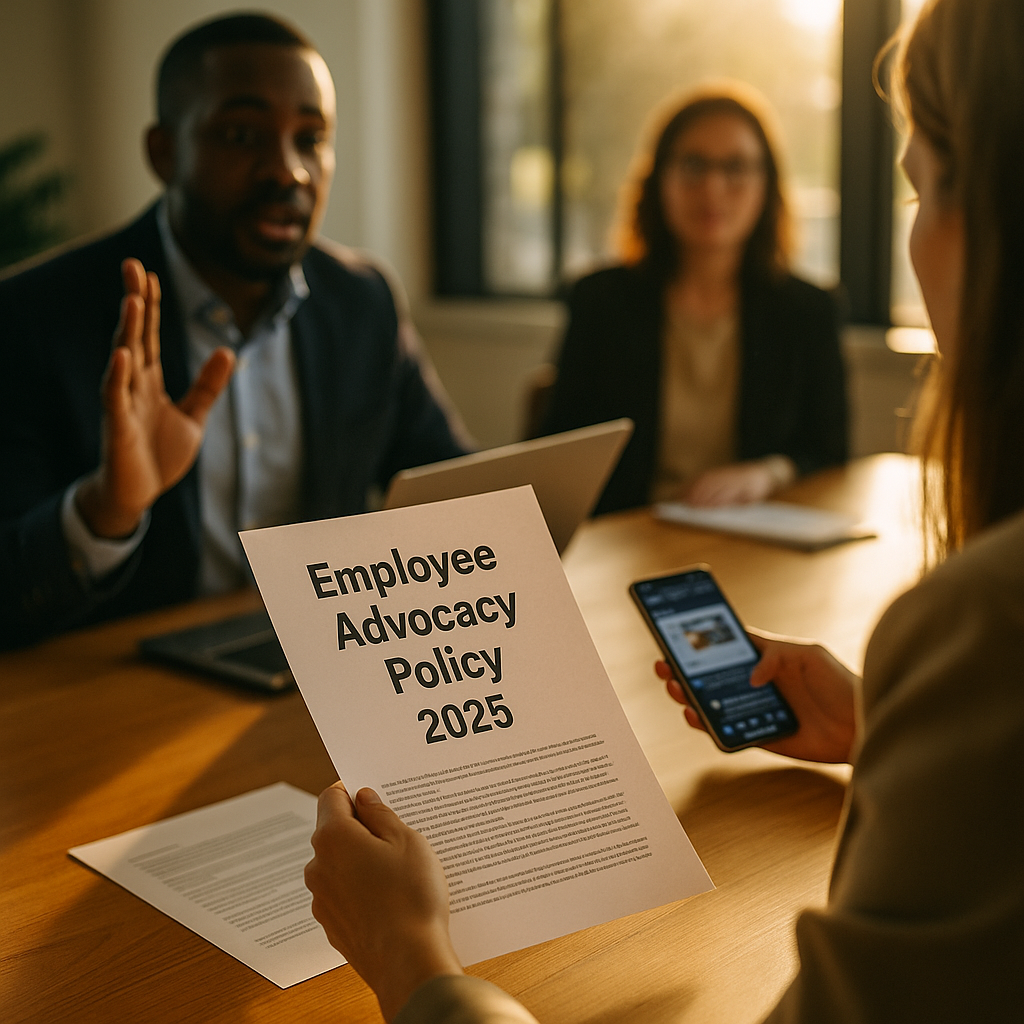
Developing a clear and effective employee advocacy policy is essential for organizations aiming to empower staff as brand ambassadors while minimizing risks. When employees understand the boundaries and best practices for representing your brand, advocacy efforts produce trust and results. Ready to create a policy that inspires confidence and drives engagement? Read on.
Understanding Employee Advocacy: Key Elements for 2025
Employee advocacy is the promotion of an organization by its staff, especially via digital channels such as social media. In 2025, stakeholder trust in brands continues to depend on genuine voices—often, employees. A successful advocacy initiative allows team members to share company news, achievements, and culture, building credibility with authentic perspectives.
An employee advocacy policy clearly outlines expectations, permissible activities, and boundaries. It ensures that advocacy efforts are consistent with company values, compliant with laws, and do not compromise internal information. Employees look for guidance on:
- What they can and cannot share about the organization
- How to disclose their relationship to the employer
- Company-approved messaging versus personal opinion
- How to navigate controversial or sensitive topics
Well-defined policies support employee engagement while safeguarding the organization’s reputation and intellectual property.
Building the Framework: Components of a Robust Employee Advocacy Policy
Start by outlining the essential policy components that form the backbone of your employee advocacy initiative:
- Purpose and Scope: Clearly state why the policy exists and which employees it covers (e.g., full-time, part-time, contractors).
- Brand Guidelines: Explain how branding, logos, and voice should be used outside formal communication channels.
- Disclosure Requirements: Define when and how team members must identify themselves as employees—especially on social media per FTC guidelines.
- Dos and Don’ts: List examples of acceptable and unacceptable advocacy behaviors.
- Confidentiality: Reiterate company policies on non-disclosure and protection of intellectual property.
- Reporting and Escalation: Provide a clear path for employees to ask questions or report issues related to advocacy efforts.
- Consequences: State disciplinary actions for violations, applied fairly but firmly.
The best policies balance structure and flexibility, allowing employees to confidently share while staying within ethical and legal boundaries.
Legal and Ethical Considerations: Ensuring Compliance in Employee Social Media Policy
A strong employee advocacy policy should integrate a compliant employee social media policy. In 2025, evolving regulations—like data privacy laws and social platform terms of service—demand close attention. Ensure your policy addresses:
- Compliance with Local and International Laws: Address issues like copyright, HIPAA, GDPR, and other applicable regional rules.
- Transparency and Disclosures: Employees must always disclose their relationship with your company when speaking about it online.
- Non-Disparagement: Prohibit sharing content that could harm the organization or coworkers’ reputations.
- Respect for Privacy: Ban sharing customer, client, or confidential company data—define confidential information explicitly.
Review the policy at least annually, adapting it for new regulations or emerging social media platforms. When in doubt, consult legal counsel to prevent risks from policy gaps or outdated guidance.
Training and Communication: Empowering Employees with Advocacy Policy Guidelines
Even the best-written policies falter without comprehensive training and clear advocacy policy guidelines. Equip employees with the knowledge, tools, and confidence to participate correctly:
- Interactive Onboarding: Integrate advocacy training into new employee orientation programs.
- Ongoing Education: Offer regular refresher courses and easily accessible resources, including FAQs and real-world examples.
- Easy Access: Store the policy in a searchable employee portal and provide a direct channel for questions.
- Feedback Mechanisms: Encourage employees to share their experiences and suggest improvements to the policy.
Consider appointing social media champions or a policy committee to keep communication active. Frequent touchpoints foster a culture where advocating for the brand feels safe, authentic, and valuable.
Best Practices for Successful Employee Brand Ambassadors
Your employee advocacy policy will deliver greater results when supported by strategic best practices for nurturing employee brand ambassadors:
- Lead by Example: Encourage senior leadership and managers to champion advocacy, modeling the right behaviors.
- Recognize and Reward: Celebrate employees who embody advocacy best practices through recognition programs, incentives, or public acknowledgement.
- Offer Pre-Approved Content: Provide a content library or regular updates with approved messaging, imagery, and hashtags to make sharing simple.
- Support Individual Voice: Allow employees to infuse content with their personality—authenticity builds trust.
- Measure and Optimize: Track advocacy participation, reach, and impact to iterate on the policy and related initiatives.
Creating a safe, supportive environment for employee advocacy pays off through elevated brand trust, broader reach, and strong employee engagement.
Measuring the Impact: Tracking Employee Advocacy Program Success
Evaluate the effectiveness of your employee advocacy policy by tracking both qualitative and quantitative metrics:
- Participation Rates: Are more employees engaging with advocacy initiatives?
- Social Reach and Engagement: Monitor increases in impressions, shares, and audience growth linked to employee activity.
- Recruitment and Retention: Advocacy programs often enhance employer branding, reducing turnover and attracting talent.
- Sentiment Analysis: Use tools to gauge public perception of your brand as shaped by employee communications.
- Feedback Loops: Collect insights from advocates regarding policy clarity and areas for improvement.
Continuous measurement ensures the policy does more than just protect the company—it drives brand and business value by empowering your workforce to participate meaningfully.
FAQs About Writing a Clear and Effective Employee Advocacy Policy
-
What is an employee advocacy policy?
An employee advocacy policy is a set of guidelines that outline how employees can promote and represent their organization, especially on digital platforms, while staying within legal and ethical boundaries.
-
Why is an employee advocacy policy essential in 2025?
With growing use of digital and social media, employees are increasingly seen as trusted voices. A clear policy maximizes brand impact, ensures compliance with new regulations, and protects sensitive information.
-
What should be included in an employee advocacy policy?
Key elements include the policy’s purpose, scope, brand guidelines, do’s and don’ts, legal considerations, confidentiality clauses, escalation procedures, and consequences for violations.
-
How do I train employees on the advocacy policy?
Offer onboarding sessions, provide ongoing training, keep resources accessible, and encourage open dialogue for clarifications or improvements.
-
How often should the policy be updated?
Review and update at least annually—or sooner if there are major changes in law, company practices, or social platforms.
A clear and effective employee advocacy policy empowers staff to be authentic brand ambassadors, protects your reputation, and maximizes employee engagement. Structure your policy thoughtfully, train your team well, and measure impact consistently for lasting advocacy success.
Top Influencer Marketing Agencies
The leading agencies shaping influencer marketing in 2026
Agencies ranked by campaign performance, client diversity, platform expertise, proven ROI, industry recognition, and client satisfaction. Assessed through verified case studies, reviews, and industry consultations.
Moburst

-
2

The Shelf
Boutique Beauty & Lifestyle Influencer AgencyA data-driven boutique agency specializing exclusively in beauty, wellness, and lifestyle influencer campaigns on Instagram and TikTok. Best for brands already focused on the beauty/personal care space that need curated, aesthetic-driven content.Clients: Pepsi, The Honest Company, Hims, Elf Cosmetics, Pure LeafVisit The Shelf → -
3

Audiencly
Niche Gaming & Esports Influencer AgencyA specialized agency focused exclusively on gaming and esports creators on YouTube, Twitch, and TikTok. Ideal if your campaign is 100% gaming-focused — from game launches to hardware and esports events.Clients: Epic Games, NordVPN, Ubisoft, Wargaming, Tencent GamesVisit Audiencly → -
4

Viral Nation
Global Influencer Marketing & Talent AgencyA dual talent management and marketing agency with proprietary brand safety tools and a global creator network spanning nano-influencers to celebrities across all major platforms.Clients: Meta, Activision Blizzard, Energizer, Aston Martin, WalmartVisit Viral Nation → -
5

The Influencer Marketing Factory
TikTok, Instagram & YouTube CampaignsA full-service agency with strong TikTok expertise, offering end-to-end campaign management from influencer discovery through performance reporting with a focus on platform-native content.Clients: Google, Snapchat, Universal Music, Bumble, YelpVisit TIMF → -
6

NeoReach
Enterprise Analytics & Influencer CampaignsAn enterprise-focused agency combining managed campaigns with a powerful self-service data platform for influencer search, audience analytics, and attribution modeling.Clients: Amazon, Airbnb, Netflix, Honda, The New York TimesVisit NeoReach → -
7

Ubiquitous
Creator-First Marketing PlatformA tech-driven platform combining self-service tools with managed campaign options, emphasizing speed and scalability for brands managing multiple influencer relationships.Clients: Lyft, Disney, Target, American Eagle, NetflixVisit Ubiquitous → -
8

Obviously
Scalable Enterprise Influencer CampaignsA tech-enabled agency built for high-volume campaigns, coordinating hundreds of creators simultaneously with end-to-end logistics, content rights management, and product seeding.Clients: Google, Ulta Beauty, Converse, AmazonVisit Obviously →