


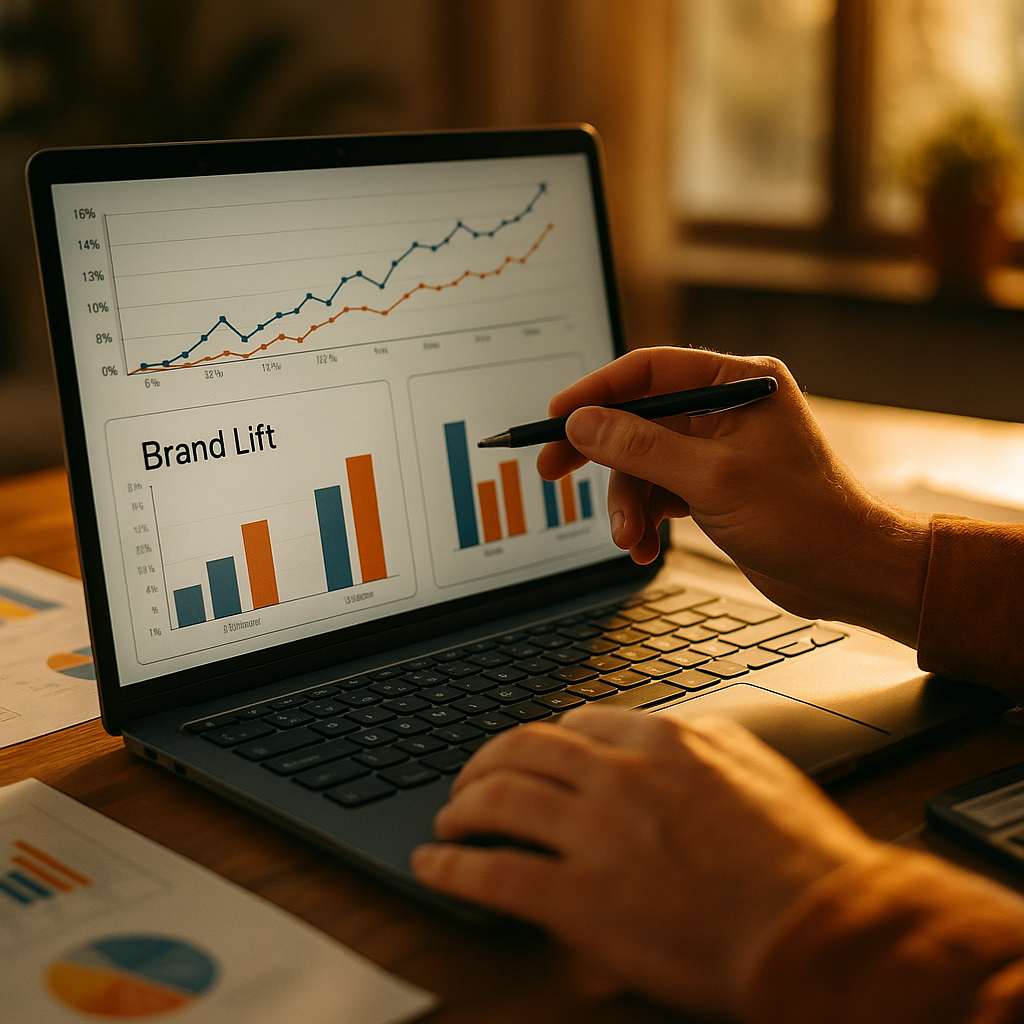
Measuring brand lift studies for upper funnel campaigns allows marketers to understand the real impact of their awareness efforts. With budgets under scrutiny, tracking brand perceptions accurately has become essential for driving marketing ROI. Let’s explore how you can extract actionable insights from brand lift studies and ensure your upper funnel campaigns deliver lasting value.
Understanding Brand Lift in Upper Funnel Campaigns
Brand lift represents the incremental improvement in brand metrics—such as awareness, consideration, or favorability—generated by your marketing efforts. For upper funnel campaigns, which focus primarily on reaching new audiences and building recognition, these metrics serve as leading indicators for future conversions.
Unlike direct-response campaigns, upper funnel initiatives rarely drive immediate sales. Instead, their value lies in influencing customer perceptions, strengthening brand associations, and planting seeds for downstream action. By measuring brand lift, marketers obtain concrete evidence of whether their campaigns are moving the needle where it matters most: in the minds of potential customers.
Key elements commonly tracked in brand lift studies include:
- Brand awareness: Are more consumers aware of your brand?
- Ad recall: Do people remember seeing your campaign?
- Brand favorability: Has sentiment toward your brand improved?
- Purchase intent: Are people more likely to choose your brand?
These metrics guide optimization and help justify further investment in top-of-funnel activity.
Designing Effective Brand Lift Studies: Best Practices
Implementing a robust brand lift study begins with a clear hypothesis and precise experimental design. The process typically involves splitting your audience into two random groups: one exposed to your campaign (test group) and one not (control group). By comparing changes in responses between these groups, you can isolate the effect of your campaign from external influences.
Here are best practices for high-integrity brand lift studies in 2025:
- Randomization: Ensure test and control groups are demographically identical. This eliminates bias.
- Sample Size: Aim for statistically significant numbers. Insufficient sample sizes can render results unreliable.
- Survey Consistency: Use the same survey instruments for both groups to avoid skewed data.
- Timing: Measure responses promptly after exposure to capture true lift, but avoid measurement too soon, which can inflate recall.
- Question Clarity: Use straightforward, unbiased language in your survey questions to gather accurate insights.
Leading platforms—including Meta, Google, and TikTok—offer built-in tools for executing brand lift studies at scale, all built around rigorous scientific standards.
Choosing the Right Metrics for Campaign Measurement
Upper funnel measurement success depends on aligning the right metrics with your specific campaign goals. While brand awareness is a frequent focus, it’s rarely the only KPI worth tracking. Consider complementing it with:
- Ad Recall: Determines if your creative leaves a memorable impression.
- Brand Association: Measures if your message resonates with desired attributes (such as innovation, trustworthiness, or quality).
- Share of Voice: Assesses your brand’s competitive position in conversations and impressions within your category.
- Consideration and Preference: Indicates movement in the buyer journey, even before intent to purchase.
Industry research from late 2024 found that brands measuring campaign impact across at least three distinct upper-funnel KPIs were 40% more likely to report increased marketing ROI. Diversifying your metrics allows you to spot nuanced strengths and weaknesses, informing more targeted optimization.
Interpreting Results: Moving from Insight to Action
Analyzing the results of your brand lift study requires a nuanced approach. A positive lift in awareness or favorability is valuable, but you should dig deeper:
- Evaluate Benchmark Performance: Compare your lift against category or historical benchmarks. A 3% lift in a saturated category may be more impressive than 8% in an emerging one.
- Segment Analysis: Break out your results by demographics, geography, and other audience characteristics. Identify pockets of high or low performance for focused improvement.
- Creative and Placement Insights: Cross-tabulate lift by messaging, creative, platform, or ad format to see what’s resonating.
- ROI Modeling: Combine lift data with downstream indicators—such as organic search volume or direct site traffic—to start building a connection between awareness and business outcomes.
Strategic action is key. For instance, if a campaign underperforms on recall, refining your creative for stronger hooks could be the next logical step. Insight-driven iteration drives continuous improvement, enhancing the likelihood of real-world impact.
Leveraging Technology and AI for Advanced Brand Lift Insights
Recent advances in marketing analytics have transformed how brands measure upper funnel effectiveness. AI-powered platforms now synthesize brand lift survey results with digital behavior signals for a multidimensional view of impact. For example, sentiment analysis tools can read open-ended survey responses to detect subtle shifts in brand perception, while machine learning models link survey data with online engagement and even offline sales trajectories.
In 2025, marketers can leverage:
- Automated survey optimization to minimize bias and boost response quality.
- Real-time reporting dashboards that visualize lift alongside other media KPIs.
- Predictive analytics to forecast the long-term payoff from brand building investments.
By integrating AI, brand teams move from backward-looking reports to forward-looking strategy, investing more confidently in upper funnel activity that drives lasting brand equity.
Integrating Brand Lift Measurement into Your Marketing Workflow
To ensure lasting value, organizations must make brand lift measurement a core part of the campaign lifecycle. Here’s how to embed it seamlessly into your process:
- Align stakeholders early on desired outcomes and reporting cadence.
- Standardize metrics to allow for cross-campaign benchmarking.
- Automate data collection where possible, freeing up time for strategic analysis.
- Share insights broadly across creative, media, and brand teams to encourage a culture of learning.
- Establish feedback loops that lead directly into creative and targeting adjustments for future campaigns.
By treating brand lift as a shared, actionable metric—not just a research afterthought—organizations ensure upper funnel spend is viewed as a growth driver, not a vague cost center.
Conclusion
Measuring brand lift studies for upper funnel campaigns reveals the true power of brand-building investments. By adopting rigorous design, choosing relevant metrics, harnessing technology, and acting on insights, marketers can connect awareness efforts to real-world outcomes. Make brand lift central to your workflow, and you’ll champion marketing that earns both attention and measurable results.
FAQs: Measuring Brand Lift Studies for Upper Funnel Campaigns
-
What is a brand lift study?
A brand lift study measures the incremental effect a marketing campaign has on brand perceptions, such as awareness, recall, or consideration, by comparing exposed and non-exposed groups.
-
Why are brand lift studies important for upper funnel campaigns?
They help marketers quantify and validate the true impact of awareness-focused campaigns, proving value before sales or conversions occur, and guiding future strategy.
-
How long should a brand lift study run?
Most effective studies run between two to six weeks, providing enough time for exposure and measurement without introducing confounding factors.
-
What is the difference between brand lift and sales lift?
Brand lift measures perception changes; sales lift tracks actual business outcomes. Both are important, but brand lift specifically evaluates upper funnel marketing effectiveness.
-
Can small brands conduct brand lift studies?
Yes. Even with modest budgets, small brands can leverage built-in tools from digital platforms to measure and optimize their upper funnel impact.
Top Influencer Marketing Agencies
The leading agencies shaping influencer marketing in 2026
Agencies ranked by campaign performance, client diversity, platform expertise, proven ROI, industry recognition, and client satisfaction. Assessed through verified case studies, reviews, and industry consultations.
Moburst

-
2

The Shelf
Boutique Beauty & Lifestyle Influencer AgencyA data-driven boutique agency specializing exclusively in beauty, wellness, and lifestyle influencer campaigns on Instagram and TikTok. Best for brands already focused on the beauty/personal care space that need curated, aesthetic-driven content.Clients: Pepsi, The Honest Company, Hims, Elf Cosmetics, Pure LeafVisit The Shelf → -
3

Audiencly
Niche Gaming & Esports Influencer AgencyA specialized agency focused exclusively on gaming and esports creators on YouTube, Twitch, and TikTok. Ideal if your campaign is 100% gaming-focused — from game launches to hardware and esports events.Clients: Epic Games, NordVPN, Ubisoft, Wargaming, Tencent GamesVisit Audiencly → -
4

Viral Nation
Global Influencer Marketing & Talent AgencyA dual talent management and marketing agency with proprietary brand safety tools and a global creator network spanning nano-influencers to celebrities across all major platforms.Clients: Meta, Activision Blizzard, Energizer, Aston Martin, WalmartVisit Viral Nation → -
5

The Influencer Marketing Factory
TikTok, Instagram & YouTube CampaignsA full-service agency with strong TikTok expertise, offering end-to-end campaign management from influencer discovery through performance reporting with a focus on platform-native content.Clients: Google, Snapchat, Universal Music, Bumble, YelpVisit TIMF → -
6

NeoReach
Enterprise Analytics & Influencer CampaignsAn enterprise-focused agency combining managed campaigns with a powerful self-service data platform for influencer search, audience analytics, and attribution modeling.Clients: Amazon, Airbnb, Netflix, Honda, The New York TimesVisit NeoReach → -
7

Ubiquitous
Creator-First Marketing PlatformA tech-driven platform combining self-service tools with managed campaign options, emphasizing speed and scalability for brands managing multiple influencer relationships.Clients: Lyft, Disney, Target, American Eagle, NetflixVisit Ubiquitous → -
8

Obviously
Scalable Enterprise Influencer CampaignsA tech-enabled agency built for high-volume campaigns, coordinating hundreds of creators simultaneously with end-to-end logistics, content rights management, and product seeding.Clients: Google, Ulta Beauty, Converse, AmazonVisit Obviously →