


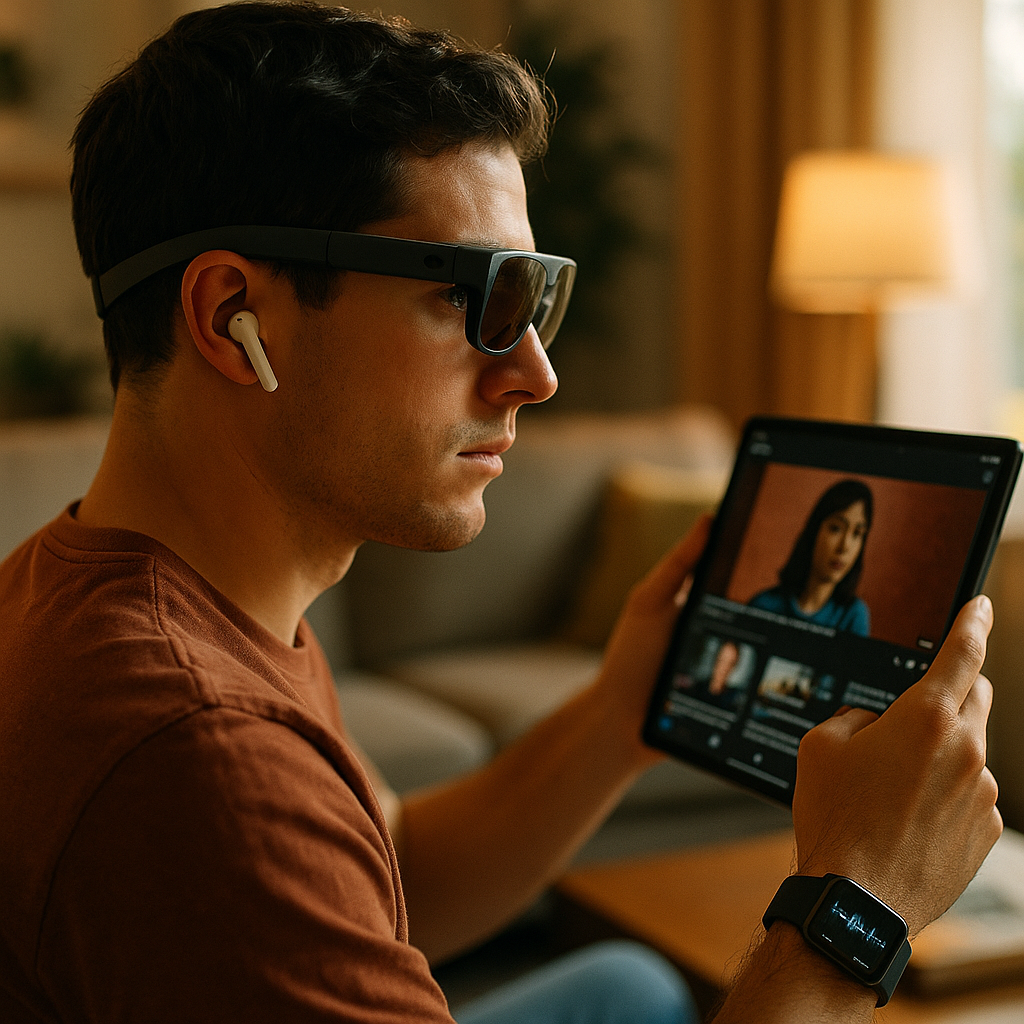
In 2025, wearable AI devices are shifting how people discover, watch, read, and listen—often without pulling out a phone. This article explains the Impact Of Wearable AI Devices On Future Content Consumption Habits, from always-on assistants to screenless media and hyper-personal recommendations. You’ll learn what changes first, what creators must adapt, and what to watch for next—because the next “feed” may be your ear.
Wearable AI content consumption: from screens to ambient experiences
Wearable AI content consumption is moving content closer to the body and further from the traditional screen. Smart glasses, AI earbuds, rings, and camera-based pendants can observe context (location, calendar, movement, surrounding audio) and deliver information when it is most useful. The practical result is a shift from “open an app and browse” to “receive content as an assistive layer.”
In 2025, the most visible habit change is frequency and format. People check phones less for quick answers and micro-updates because wearables can provide immediate summaries, translations, reminders, and navigation cues. Instead of consuming a full article, a user might hear a 25-second brief, ask follow-up questions, then save the long-form version for later. This is not just convenience; it’s a reordering of attention toward short, context-triggered moments.
This shift also creates new “content surfaces.” A headline becomes a spoken alert; a product review becomes a one-sentence verdict plus a “why” when asked; a tutorial becomes step-by-step prompts delivered at the moment a user’s hands are busy. Expect content strategies to split into two tracks: ambient (small, timely, interruptible) and deep (long-form for intentional sessions).
Screenless content delivery: audio-first, glanceable, and conversational
Screenless content delivery changes what “consumption” means. AI earbuds can summarize news, read messages, and answer questions with a conversational interface. Smart glasses can add glanceable overlays—captions, directions, translated text—without requiring a phone. Camera-enabled wearables can “see” an object and provide instructions, comparisons, or safety notes.
As these devices become more common, expect three dominant formats:
- Audio briefs: short spoken updates with the option to expand into deeper explanations via voice prompts.
- Glanceable cards: minimal overlays such as key stats, definitions, or next steps that vanish when no longer needed.
- Conversational content: Q&A experiences where users interrogate information rather than passively scroll.
For publishers and creators, this reduces the value of “page view” mechanics and increases the value of answer quality, structured clarity, and follow-up readiness. If a listener asks, “What’s the source?” or “What should I do next?” the experience must provide credible references and actionable steps. That means writing that anticipates the second question, not just the first.
For consumers, screenless delivery changes when content is consumed. People listen while walking, commuting, cooking, or exercising. That pushes content toward tighter structure: short segments, clear signposting, and summaries that do not depend on visuals. When visuals matter, glasses-based overlays or “send to phone” handoffs become the bridge between ambient and intentional viewing.
Personalized media recommendations: contextual, predictive, and privacy-sensitive
Personalized media recommendations on wearable AI devices become more contextual than traditional social or streaming feeds. Instead of relying mainly on clicks and watch time, wearables can infer intent from signals like movement (running vs. sitting), time available (calendar), environment (noise level), and the user’s current task. In practice, the recommendation engine becomes less about “what’s trending” and more about “what fits right now.”
This can improve relevance, but it also raises immediate follow-up concerns: How does it avoid manipulation? How does it respect privacy? How does it prevent filter bubbles? In 2025, the best implementations increasingly emphasize:
- On-device processing for sensitive signals, reducing the need to transmit raw audio or video.
- User controls for turning off specific data inputs (for example, location-based personalization).
- Explainable recommendations such as “Suggested because you follow this topic” or “Because you have 8 minutes free.”
Creators should expect recommendation prompts to be phrased as needs, not categories: “Want a two-minute explainer?” “Need the key points from today’s market update?” This favors content that is modular and well-labeled. When content can be broken into definable units (summary, key takeaways, steps, cautions, sources), the assistant can assemble a personalized experience without distorting meaning.
One more implication: personalization will increasingly optimize for outcomes rather than engagement alone. If a wearable helps a user learn a concept, complete a workout safely, or choose the right product, those successful outcomes become a stronger retention driver than endless scrolling.
AI earbuds and smart glasses: new behaviors for news, entertainment, and learning
AI earbuds and smart glasses are likely to shape the largest behavior shifts because they sit on the two most active channels for everyday life: hearing and sight. Together, they enable “always-available” content without “always-visible” screens.
News becomes more episodic and interactive. Instead of browsing multiple outlets, users may ask for a balanced brief, then request primary sources, local angles, or a counterargument. That puts pressure on publishers to provide transparent sourcing and to separate facts from analysis clearly. It also pushes more people to consume news in micro-sessions throughout the day.
Entertainment becomes more context-aware. Earbuds can adapt audio to the environment (noise, motion) and provide interactive storytelling or companion commentary. Glasses can offer second-screen overlays—cast info, trivia, translations—without forcing a phone unlock. As a result, entertainment becomes “layered”: the core experience plus optional enhancements on demand.
Learning becomes more situated. Wearables can coach language practice during errands, guide a repair while looking at the object, or provide just-in-time definitions during a lecture. This reduces friction: learners can act immediately rather than saving questions for later. The habit change is significant—learning moves from scheduled sessions to frequent, small upgrades throughout the day.
If you create educational content, expect users to ask for: a 30-second overview, a deeper explanation, a quiz question, and a real-world example. Designing content for these “learning loops” improves usefulness and makes it easier for AI assistants to deliver accurate, safe guidance.
Trust, authenticity, and deepfakes: what “credible content” means on wearables
When content arrives through a voice assistant or a tiny overlay, users cannot easily scan a webpage, check an about page, or compare multiple tabs. That makes trust the main currency of wearable delivery. It also makes authenticity harder, because synthetic media and voice cloning can mimic credible sources.
In 2025, credible content on wearables depends on practical signals:
- Attribution: clear naming of the publisher, author, and primary source within the experience, not hidden behind links.
- Verifiability: the ability to request “show sources” or “send references to my phone” for review.
- Editorial clarity: explicit separation of fact, opinion, and sponsored content—especially in spoken summaries.
- Expert alignment: medical, financial, and legal topics should include credentialed review and cautious language.
For brands and publishers, applying EEAT best practices becomes operational, not cosmetic. That means publishing author bios with relevant expertise, maintaining transparent editorial policies, correcting errors publicly, and avoiding overconfident claims. It also means designing content so it remains accurate when summarized. If a summary can accidentally drop a key condition or safety caveat, restructure the original to keep the caveat near the headline and key takeaway.
For consumers, the best habit is simple: treat high-stakes guidance as “assistive,” not final. Use wearables for fast orientation, then confirm critical decisions with primary sources or professionals. Wearables can shorten the path to understanding, but they should not replace due diligence.
Content strategy for creators and brands: optimize for voice, intent, and outcomes
To thrive as wearable-driven consumption grows, creators and brands need to optimize for voice, intent, and outcomes rather than only for clicks. Wearables reward content that is easy to summarize, easy to verify, and easy to act on.
Practical steps that hold up well in 2025:
- Write for spoken delivery: short sentences, clear definitions, and fewer ambiguous references like “this” or “that.”
- Add structured takeaways: include a concise summary, key points, and actionable steps so assistants can extract the right layer.
- Build follow-up paths: anticipate voice questions (“How do you know?” “What should I do?” “What are the risks?”) and answer them clearly.
- Prioritize primary sources: link or cite original research, standards, or official guidance; make citations easy to surface in audio.
- Design for handoff: let users move from wearable to phone or desktop for charts, long reading, or purchasing with minimal friction.
Brands should also rethink measurement. If a wearable answers a question without a click, the value may still be real: brand recall, trust, downstream conversion, or subscription retention. Track performance with a broader view: assisted conversions, branded queries, repeat requests for your content, and user satisfaction signals where available.
Finally, respect attention. Wearables can interrupt at any moment, so the best experiences are permission-based, minimal by default, and expandable on demand. The creators who win will be the ones who deliver utility quickly and credibility consistently.
FAQs
What are wearable AI devices, and how do they deliver content?
Wearable AI devices include AI earbuds, smart glasses, rings, watches, and camera-based pendants that use on-device or cloud AI to summarize, recommend, translate, and answer questions. They deliver content through audio, haptic cues, and glanceable overlays, often triggered by context like location, time, or the user’s activity.
Will wearables replace smartphones for content consumption?
For quick answers, navigation, and short updates, wearables can reduce phone dependence. For long-form reading, complex shopping, detailed video, and heavy creation workflows, phones and larger screens remain important. The likely pattern is a split: wearables for ambient moments, phones for deep sessions.
How will wearable AI change social media and the “feed”?
The feed becomes more conversational and intent-based. Users may ask for “the most important updates from people I follow” or “a balanced view of this topic,” then drill down. This reduces passive scrolling and increases curated summaries, voice interactions, and context-aware alerts.
What content formats perform best on AI earbuds and smart glasses?
Short audio briefs, structured explainers, step-by-step guides, and Q&A-style content perform well. Content that includes clear summaries, labeled sections, and credible sourcing is easier for assistants to present accurately and for users to trust.
How can users protect privacy when using wearable AI?
Use device settings to limit microphone and camera access, disable location-based personalization when unnecessary, and review data retention options. Prefer devices and apps that support on-device processing for sensitive features and that provide clear controls for deleting history and managing personalization.
How do creators build trust when content is summarized by AI?
Creators should make key facts and caveats summary-safe, cite primary sources, identify authors and expertise clearly, and publish transparent correction policies. They should also anticipate follow-up questions and provide easy ways for users to view references on a larger screen.
Wearables are turning content into an on-demand layer that follows people through daily life, reshaping discovery, formats, and trust expectations. The biggest change is not a new app—it’s a new habit: consuming information in short, contextual moments and expanding only when needed. In 2025, the clear takeaway is to design and choose content that is credible, concise, and easy to verify—because the next interaction is a question, not a click.
Top Influencer Marketing Agencies
The leading agencies shaping influencer marketing in 2026
Agencies ranked by campaign performance, client diversity, platform expertise, proven ROI, industry recognition, and client satisfaction. Assessed through verified case studies, reviews, and industry consultations.
Moburst

-
2

The Shelf
Boutique Beauty & Lifestyle Influencer AgencyA data-driven boutique agency specializing exclusively in beauty, wellness, and lifestyle influencer campaigns on Instagram and TikTok. Best for brands already focused on the beauty/personal care space that need curated, aesthetic-driven content.Clients: Pepsi, The Honest Company, Hims, Elf Cosmetics, Pure LeafVisit The Shelf → -
3

Audiencly
Niche Gaming & Esports Influencer AgencyA specialized agency focused exclusively on gaming and esports creators on YouTube, Twitch, and TikTok. Ideal if your campaign is 100% gaming-focused — from game launches to hardware and esports events.Clients: Epic Games, NordVPN, Ubisoft, Wargaming, Tencent GamesVisit Audiencly → -
4

Viral Nation
Global Influencer Marketing & Talent AgencyA dual talent management and marketing agency with proprietary brand safety tools and a global creator network spanning nano-influencers to celebrities across all major platforms.Clients: Meta, Activision Blizzard, Energizer, Aston Martin, WalmartVisit Viral Nation → -
5

The Influencer Marketing Factory
TikTok, Instagram & YouTube CampaignsA full-service agency with strong TikTok expertise, offering end-to-end campaign management from influencer discovery through performance reporting with a focus on platform-native content.Clients: Google, Snapchat, Universal Music, Bumble, YelpVisit TIMF → -
6

NeoReach
Enterprise Analytics & Influencer CampaignsAn enterprise-focused agency combining managed campaigns with a powerful self-service data platform for influencer search, audience analytics, and attribution modeling.Clients: Amazon, Airbnb, Netflix, Honda, The New York TimesVisit NeoReach → -
7

Ubiquitous
Creator-First Marketing PlatformA tech-driven platform combining self-service tools with managed campaign options, emphasizing speed and scalability for brands managing multiple influencer relationships.Clients: Lyft, Disney, Target, American Eagle, NetflixVisit Ubiquitous → -
8

Obviously
Scalable Enterprise Influencer CampaignsA tech-enabled agency built for high-volume campaigns, coordinating hundreds of creators simultaneously with end-to-end logistics, content rights management, and product seeding.Clients: Google, Ulta Beauty, Converse, AmazonVisit Obviously →