


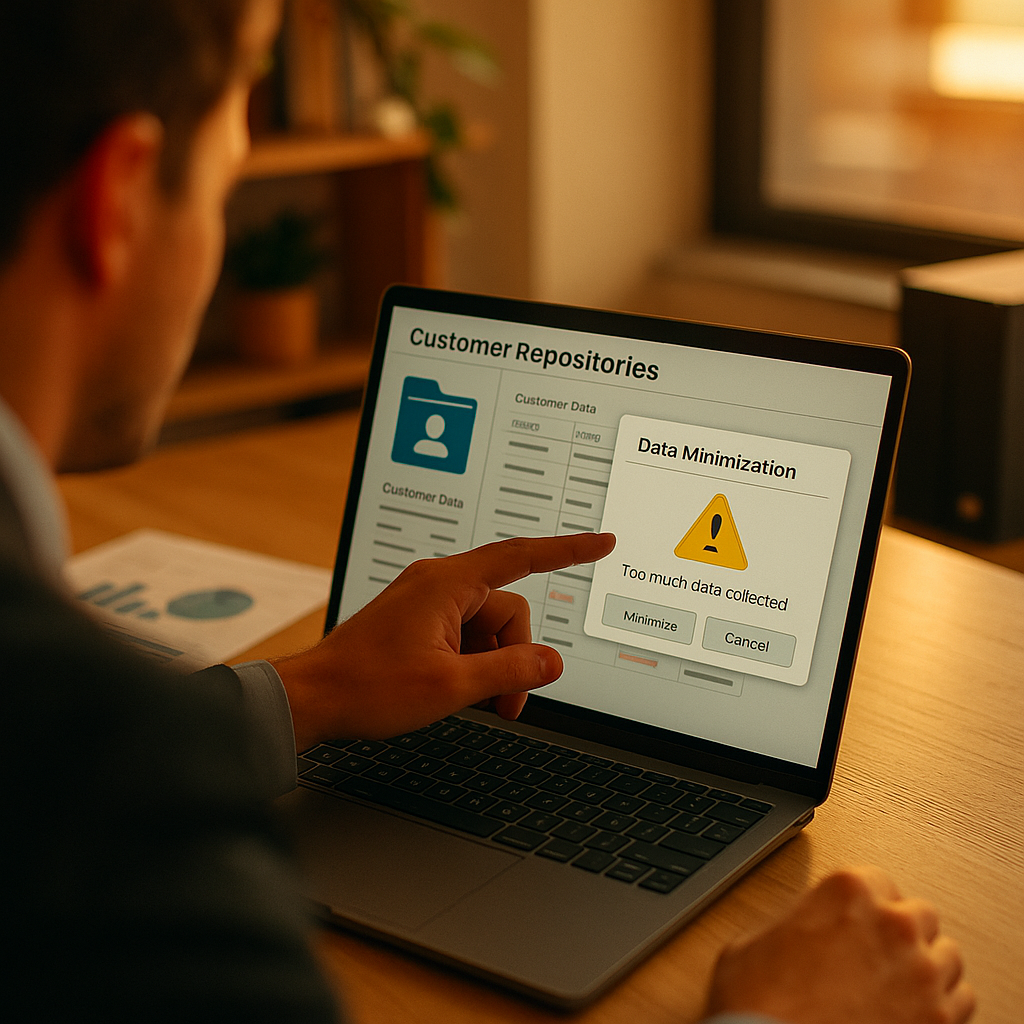
Customer data fuels personalization, fraud prevention, and support, yet regulators increasingly expect restraint. This guide to Navigating Data Minimization Laws in 2026 Customer Repositories explains how to collect less, keep it for less time, and still deliver business value. You will learn practical governance patterns, architecture choices, and documentation tactics that reduce risk and build trust—before your next audit arrives.
Data minimization compliance: what “necessary” means in 2025
Data minimization is no longer a vague privacy principle; it is an operational standard that affects product design, analytics, security, and vendor management. In practice, “minimize” means you collect, use, and retain only what is adequate, relevant, and limited for a specific, documented purpose. The key word is specific. If a team cannot explain why a field exists and how it is used, it is a liability.
Most data minimization regimes share three expectations:
- Purpose limitation: define why data is collected and do not reuse it for unrelated goals without a lawful basis and user transparency.
- Data reduction: choose the least invasive data elements that still accomplish the task (for example, age range instead of full birthdate where feasible).
- Storage limitation: keep data only as long as required for the purpose, legal obligations, or defensible security needs.
Follow-up question teams ask: “Do we need to minimize if we already encrypt?” Yes. Encryption reduces breach impact, but minimization reduces what can be breached, what can be misused internally, and what must be governed across the lifecycle. Regulators and auditors typically view minimization and security controls as complementary, not interchangeable.
Another common question: “What about legitimate interest or business need?” That can support processing, but you still must justify necessity, document tradeoffs, and implement safeguards. A strong minimization program makes these assessments easier to defend.
Customer repository governance: mapping, ownership, and lawful bases
Customer repositories often sprawl: CRM records, support tickets, web analytics, marketing automation, payment systems, data warehouses, and feature flag logs. Minimization starts with a data inventory that is granular enough to drive action, not just compliance theater. Aim to map data at the field level for high-risk categories (identity, contact, authentication, payment, precise location, behavioral profiles) and at the table/object level for lower-risk sets.
Establish clear ownership:
- Data product owner: accountable for why the dataset exists and for approving new fields.
- System owner: accountable for technical controls, access, backups, and deletion mechanisms.
- Privacy lead: accountable for policy alignment, lawful basis review, and training.
- Security lead: accountable for threat modeling and risk acceptance when data is hard to minimize.
Then connect each dataset to a lawful basis and purpose. If you operate across jurisdictions, avoid writing purposes that are too broad. “Improve our services” is rarely precise enough to justify collecting sensitive attributes. Instead, use purpose statements such as: “Detect account takeover by evaluating failed login patterns for up to 30 days.” Precision enables deletion schedules, narrower access, and better user disclosures.
Answer the likely follow-up: “How do we handle multiple purposes for the same data?” Use purpose tagging and rule-based access. For example, an email address may be necessary for login and support, but marketing use may require separate consent or opt-out handling. Treat marketing as a distinct purpose with its own retention and suppression rules.
Retention schedules and deletion workflows: the backbone of minimization
Data minimization fails most often at retention. Repositories accumulate “just in case” data, and deletion is delayed because it is operationally hard. Build minimization into your lifecycle with retention schedules that are enforceable in systems, not only written in policy documents.
Implement these building blocks:
- Field-level retention: keep certain fields (like full IP address) for days or weeks, while keeping other account data longer for customer service or legal obligations.
- Event vs. profile separation: store high-volume behavioral events in time-partitioned stores with automatic expiration, while keeping the customer profile lean.
- Deletion orchestration: automate deletions across primary databases, analytics stores, search indexes, ticketing tools, and backups where feasible.
- Exception handling: define narrow retention exceptions (for example, chargeback disputes, fraud investigations, statutory accounting) and log who approved them and why.
To make schedules actionable, align them to a small set of retention tiers such as “7 days,” “30 days,” “90 days,” “1 year,” and “legal hold.” Too many unique timeframes cause teams to ignore the policy. Where you need nuance, keep it in the rationale, not in dozens of custom durations.
Follow-up question: “Do we need to delete from backups?” Many regimes acknowledge backups are challenging, but you still need a defensible approach. Common patterns include short backup retention, encrypted backups with strict access, and “tombstone” records that prevent restored systems from reactivating deleted accounts. Document the technical constraints and your compensating controls.
Also address internal data copies. Analysts often export datasets into personal workspaces. Use controlled analytics environments, time-bound access, and automated export expiration to prevent shadow repositories that defeat minimization.
Privacy-by-design architecture: pseudonymization, purpose tagging, and access control
Architecture choices determine whether minimization is sustainable. In customer repositories, aim for designs that reduce identity exposure by default and make over-collection difficult.
Practical design patterns include:
- Pseudonymization: replace direct identifiers (email, phone) with stable tokens for analytics and testing. Keep the mapping in a separate, tightly controlled service.
- Data tiering: store sensitive fields in a “vault” with stricter access controls, while the main customer table contains only what most systems need.
- Purpose tagging and policy enforcement: tag fields and events with purpose metadata and enforce access via policy (for example, marketing tools cannot query authentication logs).
- Just-in-time collection: collect certain attributes only at the moment they are required (for example, address at checkout rather than at account creation).
- Default redaction: redact or hash values in logs (tokens, IDs, partial addresses) so operational telemetry does not become a parallel customer database.
Answer the follow-up: “Will minimization hurt personalization and analytics?” It can, but only if you minimize blindly. The goal is to preserve outcomes while reducing exposure. Many teams regain capability by using aggregated metrics, on-device processing, or short-lived event data. If you cannot justify a field for a clear decision or model feature, remove it. If you can justify it, keep it with tight retention and access controls.
Another common concern is product velocity. Create a field intake process that is fast but disciplined: a short form that requires purpose, lawful basis, retention tier, access group, and whether a less invasive alternative exists. Make “no” a normal outcome when the field cannot be defended.
Cross-border transfer risk and vendor minimization in customer repositories
Customer repositories rarely live entirely in-house. CRMs, support platforms, email providers, analytics SDKs, and fraud tools all receive customer data. Minimization must extend to vendors, especially when transfers occur across borders or when vendors act as independent controllers for certain processing.
Apply a vendor minimization checklist:
- Share the minimum dataset: send only the fields required for the vendor’s function; avoid sending full profiles “for convenience.”
- Disable optional collection: many SaaS tools ingest extra attributes by default; configure schemas and SDKs to limit payloads.
- Contract for deletion and purpose limits: require deletion timelines, subprocessors disclosure, and clear restrictions on secondary use.
- Regional processing options: choose data residency controls where they materially reduce risk and simplify compliance obligations.
- Ongoing verification: confirm via audits, security attestations, and configuration reviews that the vendor setup still matches your minimization policy.
Follow-up question: “What if the vendor says they need more data for ‘performance’?” Ask for evidence and alternatives. Often the vendor can operate on hashed identifiers, partial values, or scoped datasets. If they cannot, document the necessity analysis and consider additional safeguards: shorter retention at the vendor, stricter access, or a different provider.
Also treat internal cross-border access as part of transfer risk. Remote support teams and global engineering can access customer repositories; use least-privilege roles, session logging, and region-based access restrictions for sensitive datasets.
Audit-ready documentation and metrics: proving minimization works
Minimization is easiest to defend when you can show continuous control, not one-time cleanups. Create documentation that connects policy to implementation and produces measurable evidence.
Maintain an audit-ready package:
- Record of processing: purposes, categories of data, retention tiers, and systems of record for each repository.
- Data flow diagrams: where data enters, where it is copied, and where it is deleted.
- Decision logs: why new fields were approved or rejected, including less invasive alternatives considered.
- Access reviews: recurring attestations that only necessary roles retain access.
- Deletion evidence: job logs, reports, and sampling results that demonstrate data is actually expiring.
Track simple, business-friendly metrics to keep momentum:
- Field count trend: number of customer profile fields over time; a flat or declining trend indicates discipline.
- Retention compliance rate: percentage of datasets with automated expiration aligned to policy.
- DSAR completion quality: ability to locate and delete/export data across repositories within internal targets.
- Access minimization: number of privileged users and frequency of elevated access sessions.
Answer the follow-up: “What should we do first if our repository is already bloated?” Run a minimization sprint focused on the highest-risk data: authentication artifacts, government IDs, precise location, and free-text fields in tickets. Free-text fields are notorious because they capture sensitive data unintentionally. Add UI warnings, automated detectors, and redaction workflows to reduce future intake.
FAQs
-
What is the fastest way to start a data minimization program for customer repositories?
Start with a field-level inventory of the main customer profile, authentication logs, and support tickets. Assign an owner to each dataset, define a purpose and retention tier, and implement automated expiration for the highest-volume event stores first. Then add a lightweight approval process for any new fields.
-
How do we decide whether a data field is “necessary”?
Require the requester to state the exact decision the field enables, what happens if it is absent, and whether a less invasive alternative exists. If the field supports only speculative future use, do not collect it. If it supports a real control like fraud detection, keep it with short retention and restricted access.
-
Does pseudonymization satisfy data minimization requirements?
Pseudonymization helps by reducing exposure of direct identifiers, but it does not remove obligations. You still need a clear purpose, retention limits, and access controls. Treat pseudonymized data as potentially re-identifiable and govern it accordingly.
-
How should we handle data in logs and observability tools?
Adopt default redaction and structured logging. Block secrets and identifiers from being logged, shorten log retention, and restrict access to log search. For debugging, use synthetic identifiers or temporary debug modes with time limits and approvals.
-
What about legal holds and regulatory recordkeeping that require longer retention?
Create a documented exception process with narrow criteria, limited access, and periodic review. Keep only the records required for the obligation, and separate “legal hold” storage from general product analytics so exceptions do not become the default.
-
How can we minimize data shared with vendors without breaking integrations?
Map each vendor’s required inputs, turn off optional fields and auto-capture features, and send tokens or hashed identifiers where possible. Validate configurations after updates, and ensure contracts restrict secondary use and define deletion timelines.
Data minimization works when it is engineered into customer repositories, not bolted on during audits. Define precise purposes, assign accountable owners, enforce retention with automation, and design architectures that limit identity exposure by default. Treat vendors and cross-border access as part of the same footprint. The takeaway: document necessity, delete relentlessly, and measure outcomes to keep minimization durable.
Top Influencer Marketing Agencies
The leading agencies shaping influencer marketing in 2026
Agencies ranked by campaign performance, client diversity, platform expertise, proven ROI, industry recognition, and client satisfaction. Assessed through verified case studies, reviews, and industry consultations.
Moburst

-
2

The Shelf
Boutique Beauty & Lifestyle Influencer AgencyA data-driven boutique agency specializing exclusively in beauty, wellness, and lifestyle influencer campaigns on Instagram and TikTok. Best for brands already focused on the beauty/personal care space that need curated, aesthetic-driven content.Clients: Pepsi, The Honest Company, Hims, Elf Cosmetics, Pure LeafVisit The Shelf → -
3

Audiencly
Niche Gaming & Esports Influencer AgencyA specialized agency focused exclusively on gaming and esports creators on YouTube, Twitch, and TikTok. Ideal if your campaign is 100% gaming-focused — from game launches to hardware and esports events.Clients: Epic Games, NordVPN, Ubisoft, Wargaming, Tencent GamesVisit Audiencly → -
4

Viral Nation
Global Influencer Marketing & Talent AgencyA dual talent management and marketing agency with proprietary brand safety tools and a global creator network spanning nano-influencers to celebrities across all major platforms.Clients: Meta, Activision Blizzard, Energizer, Aston Martin, WalmartVisit Viral Nation → -
5

The Influencer Marketing Factory
TikTok, Instagram & YouTube CampaignsA full-service agency with strong TikTok expertise, offering end-to-end campaign management from influencer discovery through performance reporting with a focus on platform-native content.Clients: Google, Snapchat, Universal Music, Bumble, YelpVisit TIMF → -
6

NeoReach
Enterprise Analytics & Influencer CampaignsAn enterprise-focused agency combining managed campaigns with a powerful self-service data platform for influencer search, audience analytics, and attribution modeling.Clients: Amazon, Airbnb, Netflix, Honda, The New York TimesVisit NeoReach → -
7

Ubiquitous
Creator-First Marketing PlatformA tech-driven platform combining self-service tools with managed campaign options, emphasizing speed and scalability for brands managing multiple influencer relationships.Clients: Lyft, Disney, Target, American Eagle, NetflixVisit Ubiquitous → -
8

Obviously
Scalable Enterprise Influencer CampaignsA tech-enabled agency built for high-volume campaigns, coordinating hundreds of creators simultaneously with end-to-end logistics, content rights management, and product seeding.Clients: Google, Ulta Beauty, Converse, AmazonVisit Obviously →