


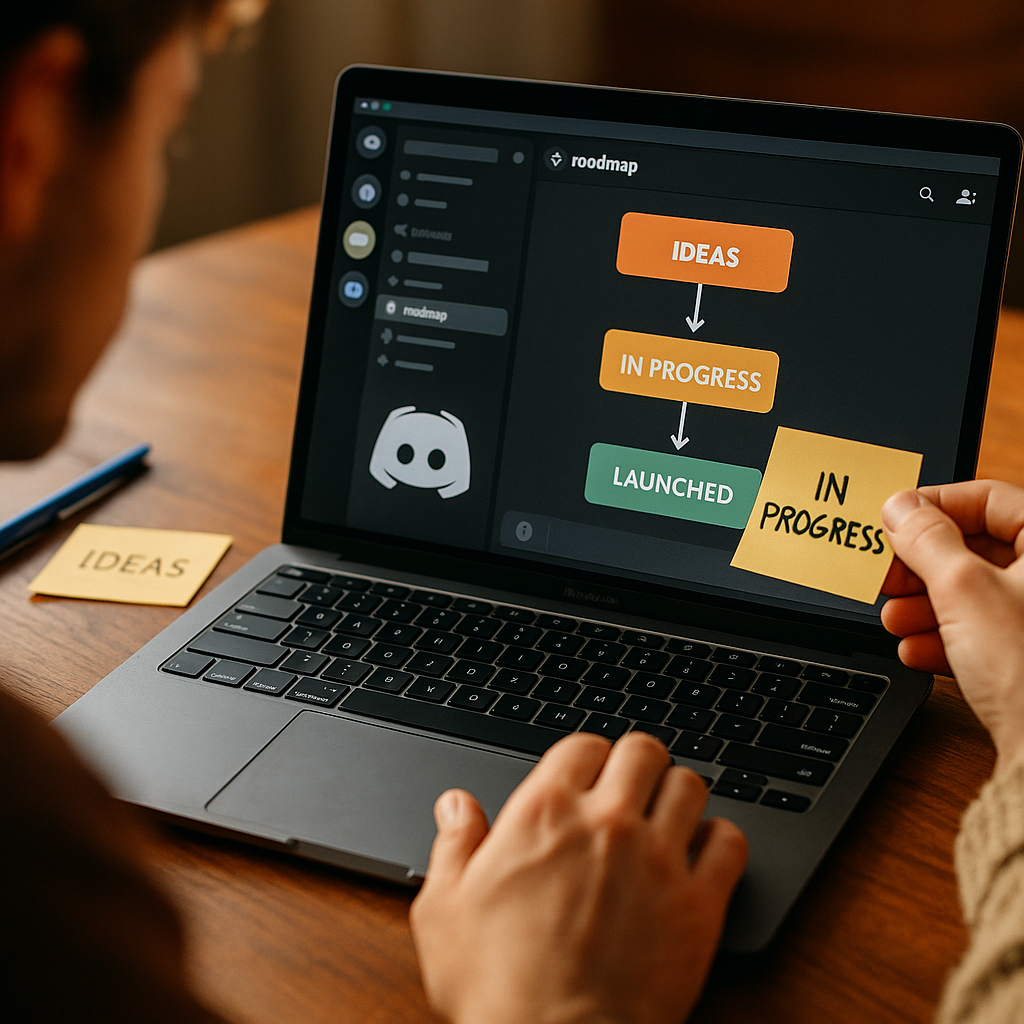
In 2025, teams ship faster when customers help steer what ships next. A community driven product roadmap on Discord turns daily conversations into prioritized features, clearer trade-offs, and better adoption. But it only works with structure: governance, data hygiene, and transparent decisions that build trust. This playbook shows the exact system to capture signals, validate demand, and deliver outcomes—ready to implement today. Want fewer debates and better bets?
Discord product feedback: design channels that capture signal, not noise
Discord can become a real-time research hub or an endless scroll of opinions. The difference is intentional information architecture. Start by mapping your feedback flow from “idea appears” to “decision communicated.” Then build channels that mirror that flow, with clear instructions and consistent moderation.
Recommended channel layout (simple, scalable):
- #start-here: Community rules, how to suggest ideas, what happens after you post, and how decisions are made.
- #announcements: Read-only releases, roadmap updates, and links to changelogs. Pin a “How we prioritize” post.
- #support: Keep support separate from roadmap. Route product gaps into feedback via a lightweight process.
- #feature-requests: The main intake. Require a template in each post (problem, who it affects, desired outcome).
- #bugs: Separate from features. Include environment fields (platform, version, steps, expected vs actual).
- #research: Opt-in interviews, surveys, prototype tests. Post findings summaries to build credibility.
- #roadmap: A curated feed of what’s being explored, in discovery, in delivery, and shipped.
Make every request actionable. Use a short template that forces clarity:
- Job to be done: “When I…, I want to…, so I can…”
- Current workaround: What users do today (and the cost).
- Impact: Time saved, revenue risk, compliance need, churn driver, or adoption blocker.
- Who is affected: Segment, plan tier, role, device, region.
Answer follow-up questions in the channel itself by training moderators and product advocates to ask: “What’s the smallest success criteria?” and “What would you stop doing if this existed?” Those two prompts often reveal whether the request is a feature, a UX issue, a missing integration, or a documentation gap.
Signal hygiene tip: Avoid letting reactions become your only ranking mechanism. Emojis skew toward the loudest time zones and the most social users. Treat reactions as a lead indicator, then validate with structured evidence in later steps.
Community roadmap governance: set rules that build trust and prevent chaos
Community input improves roadmaps when the team commits to a repeatable decision system. Governance is not bureaucracy; it is a public contract. Define who can decide, what criteria matter, and how often you review. Then publish the rules in #start-here and link them in every roadmap update.
Roles to define (even in a small team):
- Roadmap owner (Product): Owns prioritization, trade-offs, and communication.
- Community ops/moderators: Enforce templates, merge duplicates, and keep discussions constructive.
- Engineering liaison: Provides feasibility and effort ranges early, flags hidden dependencies.
- Support/Success liaison: Brings churn risk, escalation themes, and customer context.
- Data/analytics partner (optional): Validates with usage patterns and cohort insights.
Set review cadences that match reality:
- Weekly triage: Deduplicate, tag, and request clarifications.
- Monthly prioritization: Rank top candidates against your criteria and capacity.
- Quarterly roadmap refresh: Reconfirm strategy, outcomes, and big bets. Communicate shifts transparently.
Publish your prioritization criteria in plain language. A practical set looks like this:
- User impact: How many users and how intense is the pain?
- Business impact: Revenue expansion, retention, conversion, or strategic differentiation.
- Confidence: Evidence quality (research, data, multiple segments).
- Effort and risk: Build time, maintenance, security, and performance implications.
- Opportunity cost: What you delay if you ship this now.
Prevent “promise drift.” Use three public statuses for requests:
- Considering: You understand the problem and are collecting evidence.
- Planned: You intend to ship, but the scope may still change.
- Shipped: Delivered, with notes on what changed and what’s next.
Reserve “In progress” for items that are actively being built. This small discipline avoids accidental commitments and reduces backlash when priorities shift.
Discord feature prioritization: turn requests into a ranked, evidence-backed backlog
The goal is not to “take votes.” The goal is to convert raw community input into comparable units: problems, outcomes, and measurable impact. You can do this without heavy tooling, but you must standardize the metadata.
Step 1: Normalize and tag. For each request, capture:
- Theme: Onboarding, collaboration, reporting, integrations, performance, billing, admin.
- Segment: Persona/role and plan tier.
- Type: Feature, UX improvement, bug, documentation, policy/compliance.
- Severity: Blocker, major friction, minor improvement.
Step 2: Deduplicate without erasing context. When you merge similar posts, keep links to originals so contributors feel heard and you preserve edge cases. Post a short moderator note: “Merged into [link] to keep discussion in one place.”
Step 3: Add evidence quickly. For your top candidates, attach at least two of these evidence types:
- Usage data: Drop-off points, feature adoption, time-to-value, error rates.
- Support volume: Ticket tags and escalation frequency.
- Customer interviews: Short quotes focused on outcomes, not opinions.
- Deal impact: Sales notes on wins/losses tied to the capability.
- Competitive pressure: Only when it maps to customer outcomes.
Step 4: Rank with a lightweight model. A simple, explainable approach works best for community-facing roadmaps. Use a score like:
- Impact (1–5) × Confidence (1–5) ÷ Effort (1–5)
Then apply guardrails: security, compliance, and reliability items can override scoring. When they do, say so explicitly in #roadmap. The community respects trade-offs when you name them.
Answer the follow-up question: “Why not build everything?” Explain capacity in outcomes. For example: “We can deliver two medium initiatives per month without compromising reliability. Choosing A means B moves to next cycle.” Clear constraints reduce repetitive arguments.
Product roadmap transparency: communicate decisions, trade-offs, and progress
Transparency is the multiplier that makes community roadmaps work. It does not mean sharing every internal detail; it means sharing the logic, the current status, and what you need from users next.
Use a public roadmap format built for Discord reading. Post a monthly update with three sections:
- Now: What’s actively shipping and why it matters.
- Next: What’s planned after current work, with outcome-focused descriptions.
- Later: What you’re exploring, including what evidence you still need.
Write roadmap items as outcomes, not features. Instead of “Add export button,” use: “Reduce reporting time by enabling self-serve exports for admins.” This helps users understand intent and makes scope changes less surprising.
Close the loop every time you ship. In #announcements and #roadmap, include:
- What shipped: Key capabilities.
- Who it’s for: Segments and any rollout limits.
- How to use it: Short steps or a link to docs.
- What’s next: Known gaps or planned follow-ups.
- Credit: Tag contributors (with consent) whose feedback shaped the solution.
Handle “not now” with respect and clarity. When declining or delaying, explain the constraint category (effort, risk, misalignment, or insufficient evidence) and provide an alternative (workaround, integration option, documentation, or a research invite). This reduces churn and keeps the relationship intact.
EEAT in action: Summarize research findings publicly. A short “What we learned” post after interviews builds authority and demonstrates responsible decision-making. Keep personal data out of Discord and anonymize quotes.
Discord community engagement: run repeatable rituals that generate high-quality insights
High-quality roadmaps come from sustained participation, not sporadic idea drops. Rituals create predictability, and predictability improves the quality of feedback. Aim for engagement structures that scale as your community grows.
Rituals that work in most product communities:
- Weekly “Top threads” recap: Moderators highlight 5–10 requests with the most learning, not just the most reactions.
- Monthly roadmap AMA: A one-hour Q&A in a dedicated channel. Collect questions in advance to reduce repetition.
- Quarterly discovery sprint: Run polls to pick themes, then recruit 10–20 users for interviews or prototype tests.
- Beta cohorts: Create a role for opt-in testers, with clear expectations and a feedback form.
- Office hours: Product and engineering rotate through to answer “how does this work?” and “what’s coming?”
Ask better questions to avoid biased input. Replace “Do you want X?” with:
- “What problem are you solving when you ask for X?”
- “How often does this happen?”
- “What does success look like in 30 days?”
Prevent power-user capture. Power users are valuable, but they can dominate. Balance by:
- Segmented feedback drives: Invite newer users, different roles, and different company sizes.
- Silent input options: Use forms for users who avoid public posting.
- Weighted evidence: Consider revenue, churn risk, and breadth of impact alongside community volume.
Keep Discord safe and compliant. Publish moderation rules, enforce respectful disagreement, and define what cannot be shared (personal data, credentials, sensitive company details). If you run betas, clarify data handling and how to report security issues.
Roadmap analytics and outcomes: measure what changed, not just what shipped
Shipping features is activity; improving outcomes is progress. Tie your Discord-driven roadmap to measurable results so your team can defend priorities and iterate intelligently. This also strengthens trust: users see that feedback leads to improvements, not just announcements.
Define metrics at three levels:
- Input metrics: Number of validated requests, duplicate rate (lower is better), time-to-triage.
- Process metrics: Time from “Considering” to decision, time-to-ship for top initiatives, % of roadmap items with evidence attached.
- Outcome metrics: Activation rate, retention, feature adoption, task completion time, error rate, NPS/CSAT changes for relevant cohorts.
Create a “feedback-to-outcome” thread for major initiatives. For each shipped item, post:
- The original problem statement
- What you built and why
- Early results (adoption, reduced tickets, performance improvements)
- What you’re changing next
Answer the follow-up: “How do we avoid vanity metrics?” Focus on behavior and business value: fewer support escalations, faster onboarding, more successful workflows, higher retention in cohorts that requested the change. Avoid measuring only message volume or emoji counts.
When data conflicts with community sentiment, explain it. Sometimes a loud request reflects a niche edge case. Share what you observed (anonymized), then offer a path: a smaller fix, an integration, or a targeted beta. The community can handle nuance when you provide evidence and options.
FAQs: Community driven product roadmaps on Discord
How do we start if our Discord is currently chaotic?
Freeze new feature threads for 48 hours, create #feature-requests with a template, and move existing threads into a single “archive” channel. Then reopen intake with clear rules, weekly triage, and a public status system (Considering/Planned/Shipped).
Should we use reactions as votes for prioritization?
Use reactions as a discovery signal, not a final decision tool. Validate top items with structured evidence: user interviews, usage data, support volume, and segment impact. Publish your criteria so the community understands how “popular” translates into “priority.”
How do we handle enterprise customers who want private roadmap influence?
Separate confidentiality from fairness. Collect sensitive needs in private channels or customer calls, then translate them into anonymized problem statements that can be discussed publicly when possible. Apply the same prioritization criteria and explain when contractual obligations affect sequencing.
What tooling do we need beyond Discord?
You can start with Discord plus a shared tracker (a lightweight database, spreadsheet, or product tool). The key is consistent metadata and links back to source threads. As volume grows, add automation for tagging, deduplication, and status syncing.
How often should we update the roadmap in Discord?
Post a short update monthly and a deeper refresh quarterly. Also post “ship notes” immediately when features launch. Consistency matters more than frequency; missing updates erodes trust faster than sharing fewer, higher-quality updates.
How do we keep the roadmap transparent without overcommitting?
Use status language carefully: “Considering” and “Exploring” invite collaboration without implying a promise. Reserve “Planned” for items with capacity allocated. Describe initiatives as outcomes and include scope caveats, especially during discovery.
Community-driven roadmaps succeed when Discord conversations flow into a disciplined system: structured intake, clear governance, evidence-based prioritization, and transparent communication. In 2025, the winning teams treat community input as product research, not a popularity contest. Build repeatable rituals, measure outcomes, and close the loop after every ship. The takeaway: make your decision process public, then execute consistently to earn durable trust.
Top Influencer Marketing Agencies
The leading agencies shaping influencer marketing in 2026
Agencies ranked by campaign performance, client diversity, platform expertise, proven ROI, industry recognition, and client satisfaction. Assessed through verified case studies, reviews, and industry consultations.
Moburst

-
2

The Shelf
Boutique Beauty & Lifestyle Influencer AgencyA data-driven boutique agency specializing exclusively in beauty, wellness, and lifestyle influencer campaigns on Instagram and TikTok. Best for brands already focused on the beauty/personal care space that need curated, aesthetic-driven content.Clients: Pepsi, The Honest Company, Hims, Elf Cosmetics, Pure LeafVisit The Shelf → -
3

Audiencly
Niche Gaming & Esports Influencer AgencyA specialized agency focused exclusively on gaming and esports creators on YouTube, Twitch, and TikTok. Ideal if your campaign is 100% gaming-focused — from game launches to hardware and esports events.Clients: Epic Games, NordVPN, Ubisoft, Wargaming, Tencent GamesVisit Audiencly → -
4

Viral Nation
Global Influencer Marketing & Talent AgencyA dual talent management and marketing agency with proprietary brand safety tools and a global creator network spanning nano-influencers to celebrities across all major platforms.Clients: Meta, Activision Blizzard, Energizer, Aston Martin, WalmartVisit Viral Nation → -
5

The Influencer Marketing Factory
TikTok, Instagram & YouTube CampaignsA full-service agency with strong TikTok expertise, offering end-to-end campaign management from influencer discovery through performance reporting with a focus on platform-native content.Clients: Google, Snapchat, Universal Music, Bumble, YelpVisit TIMF → -
6

NeoReach
Enterprise Analytics & Influencer CampaignsAn enterprise-focused agency combining managed campaigns with a powerful self-service data platform for influencer search, audience analytics, and attribution modeling.Clients: Amazon, Airbnb, Netflix, Honda, The New York TimesVisit NeoReach → -
7

Ubiquitous
Creator-First Marketing PlatformA tech-driven platform combining self-service tools with managed campaign options, emphasizing speed and scalability for brands managing multiple influencer relationships.Clients: Lyft, Disney, Target, American Eagle, NetflixVisit Ubiquitous → -
8

Obviously
Scalable Enterprise Influencer CampaignsA tech-enabled agency built for high-volume campaigns, coordinating hundreds of creators simultaneously with end-to-end logistics, content rights management, and product seeding.Clients: Google, Ulta Beauty, Converse, AmazonVisit Obviously →