


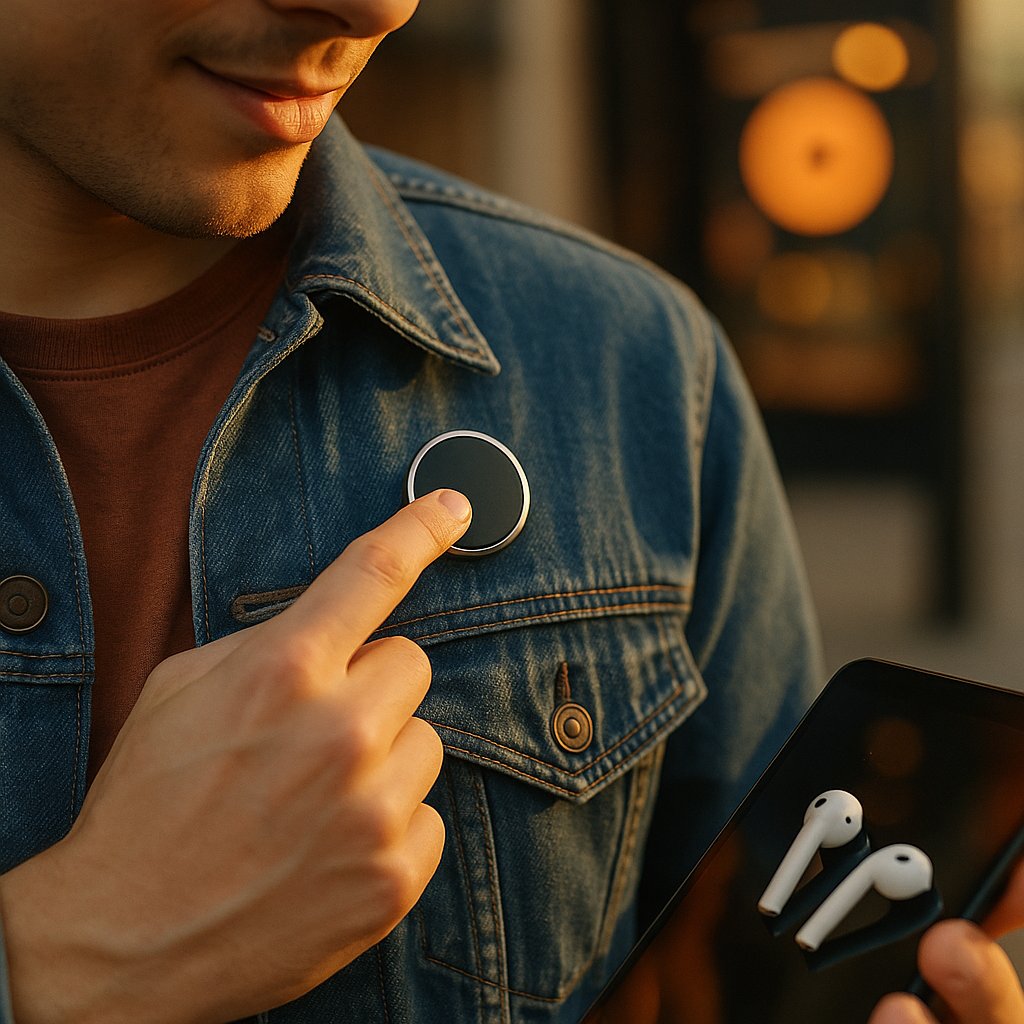
In 2025, audio-first marketing is moving from podcasts and smart speakers to a new frontier: wearable smart pins. These clip-on devices deliver voice interactions, context-aware prompts, and hands-free experiences that feel personal and immediate. This playbook shows how to plan, build, and measure campaigns that respect attention, protect privacy, and grow revenue—starting with what listeners actually need. Ready to earn a spot in the ear?
Wearable smart pins marketing: what they are and why audio wins
Wearable smart pins are compact, always-available devices—typically clipped to clothing—that combine microphones, speakers (or paired earbuds), sensors, and AI-driven assistants. They create a “spoken interface” layer that sits between a brand and a customer’s daily life. Unlike phones, pins reduce friction: the user can ask, listen, and act without pulling out a screen.
Why audio-first fits this form factor
- Hands-free moments: commuting, cooking, warehouse work, field service, fitness, caregiving, and retail are high-intent contexts where screens are inconvenient.
- Lower interaction cost: spoken requests often beat taps when the goal is quick information, reminders, reorder, or guidance.
- Context sensitivity: pins can react to time, location, motion, and calendars to make prompts timely rather than noisy.
- Trust dynamics: a voice experience can feel like a concierge—if it is accurate, transparent, and non-intrusive.
What “audio-first marketing” means here: you design for listening and speaking as primary actions, and treat any companion app or screen as optional support. That means shorter copy, clearer intent recognition, fewer steps, and consent-driven personalization. It also means you plan for interruptions: audio experiences must recover gracefully when the user gets distracted.
Where brands are most likely to win early: utilities (banking alerts, insurance claims triage), consumer packaged goods (reorder flows), travel (itinerary changes), healthcare admin (appointment prep), and B2B operations (training, checklists, inventory prompts). If your value can be delivered in 10–45 seconds, you’re a strong candidate.
Audio-first brand strategy: choose jobs-to-be-done, not gimmicks
Before recording a single word, map the “job” your customer hires you to do in moments where a smart pin makes sense. Audio-first marketing succeeds when it eliminates steps, reduces uncertainty, or speeds up decisions.
Start with three questions
- What urgent question does the user ask? Example: “Where is my delivery?” “What’s my deductible?” “What’s next on my route?”
- What decision are they trying to make quickly? Example: “Which plan should I choose?” “Can I reorder my usual?”
- What task do they need guided? Example: “Walk me through setup.” “Help me troubleshoot.”
Then pick an experience type based on value and risk:
- Utility alerts: opt-in notifications with clear action (“Say ‘delay delivery’ or ‘leave at door’”).
- Voice concierge: a conversational flow that handles common requests end-to-end, escalating to a human when needed.
- Audio micro-content: short daily briefings, tips, or product education designed for repeat listening.
- Guided commerce: reorder, appointment booking, upgrades, or bundled recommendations with transparent pricing.
Design your “voice value proposition” in one sentence: “In under 30 seconds, we help you do X without opening an app.” If you can’t make it that simple, split the experience into smaller modules.
Answer the follow-up now: “Will this annoy users?” Not if you build around user-initiated requests and explicit opt-ins for proactive prompts. In audio, attention is the currency; your strategy must earn it every time.
Voice UX design for smart pins: scripts, flows, and error recovery
Smart pin audio experiences must sound natural, but they must also behave predictably. Great voice UX reduces cognitive load, handles ambiguity, and protects the user from accidental actions.
Script for outcomes, not dialogue. Instead of writing long conversations, define:
- Intents: what the user wants (“track order,” “change address,” “reorder”).
- Entities: details needed (order number, date, product, location).
- Confirmations: required for sensitive actions (payments, address changes, cancellations).
- Fallbacks: what happens when speech recognition fails or the request is unclear.
Use an audio-first structure that fits wearable attention spans:
- 1) Acknowledge + set expectation: “Got it. I can give you a quick update.”
- 2) Deliver the answer early: “Your package arrives tomorrow by 3 PM.”
- 3) Offer next best actions: “Say ‘change delivery’ or ‘text me the link’.”
- 4) Exit cleanly: “Anything else?” then stop talking.
Keep prompts short and choice-limited. In audio, more than two or three options increases drop-off. If you need a menu, chunk it: “I can help with billing or claims. Which one?”
Design for noisy, real-world conditions. Pins are used on streets, in stores, and at work. Build:
- Progressive disclosure: start with a short answer, then offer more detail.
- Repair phrases: “I didn’t catch that. Do you mean A or B?”
- Multimodal handoff: “I can send a summary to your phone” for complex info.
Brand voice matters, but clarity matters more. Define a style guide: tone, speed, vocabulary, pronunciation rules, and compliance phrasing. Then test it with actual customer queries, including slang and “messy” speech.
Contextual audio ads and content: create moments that feel helpful
Audio-first marketing on smart pins should feel like assistance, not interruption. The best-performing campaigns will align with user context and provide immediate utility.
Three campaign models that fit wearable pins
- 1) Opt-in brand briefings: a daily or weekly audio update (2–4 minutes) with personalized segments. Works for finance, retail, travel, sports, and local services.
- 2) Task-triggered offers: a discount or add-on offered only after the user completes a related action. Example: after booking a flight, offer lounge access or insurance with a single spoken “yes/no.”
- 3) In-the-moment guidance: “How-to” audio sequences activated by user request (“Walk me through returning an item”). This builds trust and reduces support costs while opening room for upsell if appropriate.
Creative rules for contextual audio
- Lead with the value: “Want the fastest route to your next stop?” beats “Introducing our new…”
- Use concrete time savings: “I can do that in 20 seconds” sets the expectation.
- Offer a safe next step: “Send details to my phone” is lower risk than “Buy now.”
- Make consent audible: “Would you like me to remind you?” is clear and respectful.
Personalization without creepiness. Audio feels intimate; over-personalization can backfire. Use:
- Declared preferences: topics, frequency, and channels chosen by the user.
- Session context: what the user is doing now (with permission), not long-term surveillance.
- Transparent reasoning: “Because you asked about returns…” explains relevance.
Answer the follow-up: “Can we repurpose podcast ads?” You can adapt the message, but you must rewrite the structure. Smart pin audio needs faster payoff, fewer brand flourishes, and clear voice commands. Treat it as interactive utility, not passive listening.
Privacy, consent, and trust signals: the non-negotiables in 2025
Wearable smart pins sit close to the body and can capture sensitive data. If your marketing plan does not prioritize privacy and safety, you will lose user trust and may create regulatory and reputational risk.
Build trust into the experience
- Explicit opt-in: get permission for notifications, personalization, and data usage separately.
- Just-in-time explanations: explain why data is needed at the moment you ask for it.
- Easy controls: “Pause marketing messages,” “delete recent history,” and “export my data” should be discoverable and simple.
- Visible and audible indicators: ensure users understand when the mic is active and what is being processed.
Minimize data by design. Only collect what you need to deliver the user’s requested outcome. Prefer on-device processing when possible and set short retention windows for voice recordings and transcripts unless the user chooses otherwise.
Protect sensitive actions. For payments, address changes, and account access:
- Use step-up authentication: voice biometrics, device unlock, passcode, or phone confirmation.
- Confirm critical details aloud: “Charge $29.99 to Visa ending 1234?”
- Offer a non-audio path: “I sent a secure link to confirm.”
EEAT in practice: publish clear policies, document how the experience works, and show accountability (support contacts, escalation paths, and incident response). In audio, credibility comes from consistency: accurate answers, safe defaults, and honest limits (“I can’t access that yet, but I can connect you to support”).
Measurement and optimization: KPIs for audio-first marketing performance
Traditional digital metrics don’t map cleanly onto spoken experiences. You need KPIs that reflect completion, comprehension, and customer value—while respecting privacy.
Core funnel metrics for smart pin audio
- Activation rate: percent of eligible users who opt in and successfully complete first use.
- Intent success rate: percent of sessions where the system correctly fulfills the user’s goal without human help.
- Time-to-value: seconds to deliver the primary answer or outcome.
- Fallback rate: frequency of “I didn’t understand” moments; track by intent and environment.
- Handoff rate: percent routed to app, SMS, email, or agent; monitor satisfaction after handoff.
- Retention: repeat usage across weeks tied to specific use cases.
Commercial metrics that matter
- Incremental conversion: measure lift versus a control group that does not receive the audio experience.
- Assisted revenue: purchases influenced by audio that complete on another channel.
- Support deflection: reduction in calls/chats for intents the pin handles reliably.
- Customer effort score: quick post-interaction rating via voice (“Was this easy? yes/no”).
How to run experiments without breaking trust. Use privacy-preserving A/B tests that avoid storing raw voice when not needed. Test one variable at a time: opening line, number of choices, confirmation wording, or proactive prompt frequency. Keep a “do no harm” threshold: if fallback or complaint rates rise, roll back quickly.
Answer the follow-up: “What’s a good benchmark?” Benchmarks vary by intent complexity and environment noise. Instead of chasing generic numbers, set targets from baseline recordings: improve time-to-value, reduce fallbacks, and raise completion for your top three intents first. That is where ROI compounds.
FAQs: audio first marketing on wearable smart pins
What is the primary advantage of audio-first marketing on smart pins?
It reaches customers in hands-free, high-intent moments and reduces friction by letting them speak and act without opening a phone, which improves completion for quick tasks like status checks, scheduling, and reorders.
Do smart pin campaigns require a companion app?
Not always, but a companion app (or SMS/email handoff) helps for complex steps, secure confirmations, preferences, and summaries. The audio experience should still deliver value even if the user never opens the app.
How long should an audio message be on a wearable pin?
Aim to deliver the primary answer within 5–10 seconds, and finish most interactions in 10–45 seconds. Longer content can work only when it is explicitly requested (briefings, guided help).
How do we prevent the experience from feeling intrusive?
Use explicit opt-ins, limit proactive prompts, provide “pause” controls, and rely on user-initiated sessions. When you do prompt, explain relevance (“Because you asked about delivery yesterday…”).
What content works best for audio-first marketing?
Utility-first content: order updates, appointment prep, quick recommendations, guided troubleshooting, and personalized briefings. Purely promotional audio tends to underperform unless tied to a task the user already wants to complete.
How do we measure ROI if purchases happen elsewhere?
Track assisted conversions with privacy-safe attribution: control groups, tagged handoff links, and intent-level outcomes (booking completed, reorder placed, issue resolved). Combine this with customer effort and deflection metrics.
Wearable smart pins turn marketing into a conversation that lives inside real-life moments. Win by designing audio-first experiences around clear jobs-to-be-done, fast time-to-value, and respectful consent. Build tight voice flows, offer safe handoffs for complex actions, and measure success by completed outcomes—not impressions. When utility leads and trust stays visible, smart pin audio becomes a durable growth channel.
Top Influencer Marketing Agencies
The leading agencies shaping influencer marketing in 2026
Agencies ranked by campaign performance, client diversity, platform expertise, proven ROI, industry recognition, and client satisfaction. Assessed through verified case studies, reviews, and industry consultations.
Moburst

-
2

The Shelf
Boutique Beauty & Lifestyle Influencer AgencyA data-driven boutique agency specializing exclusively in beauty, wellness, and lifestyle influencer campaigns on Instagram and TikTok. Best for brands already focused on the beauty/personal care space that need curated, aesthetic-driven content.Clients: Pepsi, The Honest Company, Hims, Elf Cosmetics, Pure LeafVisit The Shelf → -
3

Audiencly
Niche Gaming & Esports Influencer AgencyA specialized agency focused exclusively on gaming and esports creators on YouTube, Twitch, and TikTok. Ideal if your campaign is 100% gaming-focused — from game launches to hardware and esports events.Clients: Epic Games, NordVPN, Ubisoft, Wargaming, Tencent GamesVisit Audiencly → -
4

Viral Nation
Global Influencer Marketing & Talent AgencyA dual talent management and marketing agency with proprietary brand safety tools and a global creator network spanning nano-influencers to celebrities across all major platforms.Clients: Meta, Activision Blizzard, Energizer, Aston Martin, WalmartVisit Viral Nation → -
5

The Influencer Marketing Factory
TikTok, Instagram & YouTube CampaignsA full-service agency with strong TikTok expertise, offering end-to-end campaign management from influencer discovery through performance reporting with a focus on platform-native content.Clients: Google, Snapchat, Universal Music, Bumble, YelpVisit TIMF → -
6

NeoReach
Enterprise Analytics & Influencer CampaignsAn enterprise-focused agency combining managed campaigns with a powerful self-service data platform for influencer search, audience analytics, and attribution modeling.Clients: Amazon, Airbnb, Netflix, Honda, The New York TimesVisit NeoReach → -
7

Ubiquitous
Creator-First Marketing PlatformA tech-driven platform combining self-service tools with managed campaign options, emphasizing speed and scalability for brands managing multiple influencer relationships.Clients: Lyft, Disney, Target, American Eagle, NetflixVisit Ubiquitous → -
8

Obviously
Scalable Enterprise Influencer CampaignsA tech-enabled agency built for high-volume campaigns, coordinating hundreds of creators simultaneously with end-to-end logistics, content rights management, and product seeding.Clients: Google, Ulta Beauty, Converse, AmazonVisit Obviously →