


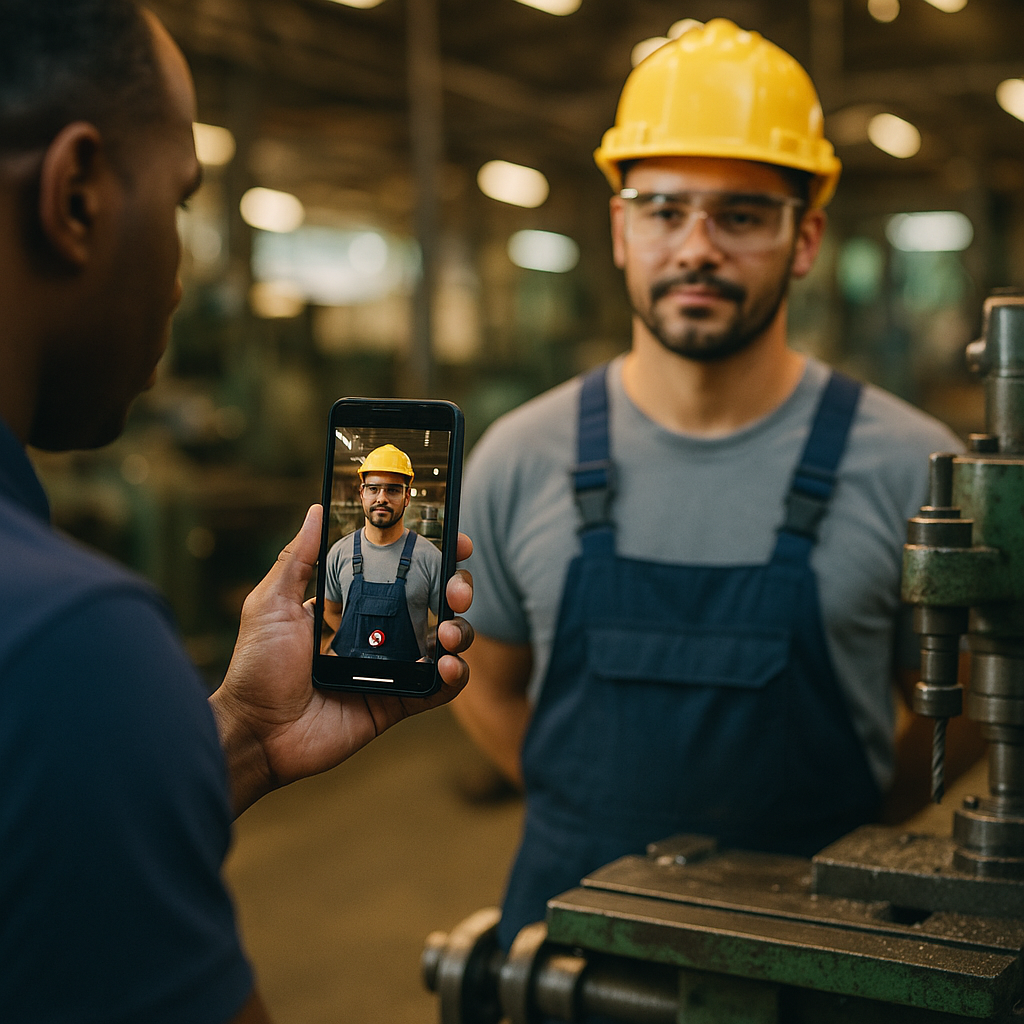
In 2025, specialized hiring is less about posting and waiting and more about proving what work feels like. This case study shows how a mid-sized manufacturer used TikTok recruiting to attract CNC machinists, maintenance techs, and quality engineers—without diluting standards or wasting recruiter time. The results came from process, not luck, and the playbook is repeatable—if you know what to change first.
Employer branding on TikTok: the company, the roles, and the recruiting problem
Riverton Precision Components (RPC) is a U.S.-based manufacturing firm with ~550 employees across two plants. RPC produces tight-tolerance parts for industrial automation and energy customers. The work is stable and well-paid, but the hiring market for skilled trades and technical roles remained tight in 2025.
Roles in scope: CNC machinists (mills and lathes), maintenance technicians (electrical + mechanical), quality engineers (metrology, GD&T), and production supervisors with lean experience.
The challenge: RPC’s traditional channels—job boards, staffing agencies, and referrals—delivered volume but not fit. Recruiters reported three recurring issues:
- Low relevance: Many applicants lacked required certifications or hands-on shop experience.
- Slow response cycles: Candidates who were qualified often accepted competing offers before interviews were scheduled.
- Perception gap: Candidates assumed the plant was “dirty, dangerous, and outdated,” despite recent investments in automation, safety, and training.
RPC’s leadership wanted faster time-to-fill and higher-quality applicants while protecting candidate experience. They also wanted to reduce agency spend without lowering pay or “watering down” requirements.
Specialized recruiting strategy: why TikTok, and how the plan stayed job-relevant
RPC did not choose TikTok to chase trends. The team chose it because their target candidates already used short-form video to learn: tooling tips, machine setups, troubleshooting, metrology basics, and career paths. The platform also allowed RPC to show proof of work—machines, processes, safety systems, team routines—in a format that candidates actually watch.
Primary objective: Increase qualified applicants for hard-to-fill roles while reducing unqualified volume.
Secondary objectives: Improve offer acceptance, compress interview scheduling time, and create a repeatable content engine owned by recruiting and operations together.
To keep the strategy “specialized” (not generic employer branding), RPC set three rules:
- Every video must map to a job requirement. If a CNC role requires first-article inspection, the content must show how RPC performs it.
- Every video must answer a candidate question. Examples: shift schedule, training path, toolroom support, overtime expectations, safety practices, pay progression, and what “good” looks like in the first 90 days.
- No hype without evidence. Claims such as “modern shop” required visual proof: enclosed CNC cells, documented 5S areas, calibration logs, or safety boards—without exposing proprietary data.
RPC also built a compliance checklist with HR and EHS: no controlled drawings, no customer part numbers, no confidential screens, and no filming in restricted areas. That guardrail let the team publish confidently and consistently.
TikTok content marketing for hiring: the content system that attracted qualified talent
RPC ran a 10-week sprint using a content calendar with four recurring series. Each series was designed to pull in candidates who recognized the work and self-selected into applying.
Series 1: “One Setup, One Tip” (CNC focus)
- 30–45 second clips showing a real setup step: indicating a vise, verifying offsets, using probing cycles, or checking a bore with an air gauge.
- On-screen text listed the exact skill: “Fanuc offsets,” “first-article verification,” “basic GD&T callouts.”
- Caption included a simple CTA: “If you can run this without supervision, apply for CNC Set-Up Machinist.”
Series 2: “Maintenance Minute” (troubleshooting focus)
- Examples: diagnosing a VFD fault, lockout/tagout steps, reading a schematic, replacing a proximity sensor, or PM routines.
- Each video included a safety checkpoint and a note on shift rotation.
Series 3: “Quality in Real Life” (metrology focus)
- Demonstrations of CMM programming basics, calibration routines, gauge R&R concepts, and how nonconformances are handled.
- RPC avoided jargon dumps by using “what this means for your day” explanations.
Series 4: “Day 1 to Day 90” (onboarding focus)
- Short interviews with a lead machinist, a maintenance trainer, and a quality manager explaining expectations and support.
- Clear statements on training time, who signs off competencies, and what triggers pay progression.
RPC kept production lightweight: a phone, a lapel mic, and a tripod. Videos were filmed in 20-minute blocks during pre-approved windows. Supervisors approved shots on the spot to avoid delays.
Crucial detail: RPC used plain language and showed real people doing real work. Candidates could see whether they fit the environment before applying, which reduced unqualified volume later.
Candidate experience on TikTok: the application flow, screening, and trust signals
Viral reach means little if candidates hit friction. RPC redesigned the funnel so a motivated viewer could move from interest to scheduled conversation quickly—without sacrificing screening quality.
Step 1: Link-in-bio built for skilled roles
- Three buttons only: “CNC,” “Maintenance,” “Quality/Engineering.”
- Each landing page displayed pay range, shift options, overtime rules, and a realistic preview of the work.
- A “What you’ll be asked” section listed screening topics (e.g., blueprint reading, offsets, PM experience), reducing anxiety and ghosting.
Step 2: Two-stage screening that respected time
- Stage A (5 minutes): A short form confirming must-haves (work authorization, shift availability, core skills). No personality tests.
- Stage B (10–12 minutes): A recruiter call using a structured script tied to the skills shown in videos.
Step 3: Skill-aligned proof, not busywork
- For CNC: a brief print-reading exercise using a generic part drawing and tolerance interpretation.
- For maintenance: a scenario question aligned to safety and troubleshooting sequence.
- For quality: a metrology workflow question (how they’d validate a measurement method).
Trust signals that improved conversion:
- Recruiters answered TikTok comments with specifics: shifts, training, and who to contact.
- Managers appeared on camera and explained what “good performance” looks like—reducing fear of bait-and-switch.
- RPC posted a clear statement on safety, PTO, and pay progression so candidates did not have to guess.
By treating the TikTok audience like serious candidates—not “views”—RPC strengthened credibility. That credibility mattered most for experienced tradespeople who can spot vague promises instantly.
Manufacturing hiring metrics: results, what worked, and what didn’t
RPC tracked outcomes like a production process: inputs, yield, and cycle time. The recruiting team reported results over the 10-week sprint and the following 6 weeks of hiring activity.
Top outcomes observed:
- Higher applicant relevance: A larger share of applicants met baseline requirements (shift fit + minimum hands-on experience), reducing recruiter screening time.
- Faster scheduling: Candidates moved from application to recruiter call more quickly because the funnel was simplified and expectations were explicit.
- Improved interview quality: Hiring managers said candidates arrived informed about processes, tooling, and shop standards—because they had already “seen the job.”
- Better offer acceptance: Candidates understood the environment and supervision style before receiving an offer, which reduced surprises.
RPC also learned what did not work:
- Over-produced videos underperformed. Polished montages attracted views but fewer qualified applicants. Practical skill clips performed better.
- Generic culture posts drew the wrong audience. Broad “we’re hiring” messages increased unqualified volume and comment moderation workload.
- Inconsistent posting reduced momentum. When production got busy and content paused, inbound messages dropped quickly. Consistency mattered more than peak creativity.
How RPC protected quality while scaling: They created a “content-to-competency map” tying each video to a skill in the job description and to an interview question. That let recruiters and managers validate that content attracted the right people—and prevented drift into entertainment-only posts.
Recruiting compliance and safety: governance, privacy, and operational buy-in
Manufacturing has real constraints: safety, IP, and regulatory requirements. RPC treated governance as a success factor, not an obstacle.
Governance model:
- Co-ownership: Talent Acquisition owned the calendar and responses; Operations owned accuracy; EHS owned safety checks.
- Pre-approved zones: Filming allowed only in marked areas with no customer identifiers and no sensitive screens visible.
- Consent-first policy: Any employee on camera signed a simple consent form and could opt out anytime.
- Comment moderation standards: The team published rules for respectful comments and handled pay/benefit questions transparently.
Operational buy-in came from one thing: RPC showed supervisors that better-fit candidates reduced rework in training. When supervisors saw fewer “false starts” and less time wasted on mismatched hires, they protected filming time on the schedule.
EEAT in practice: RPC increased trust by featuring credible voices (lead machinists, maintenance trainers, quality managers), using real demonstrations, and aligning claims with visible evidence. The content did not pretend every day is perfect; it explained how RPC handles problems—downtime, scrap, urgent orders—so candidates could judge fit realistically.
FAQs about TikTok recruiting for manufacturing
Is TikTok actually effective for recruiting skilled trades?
Yes, when the content shows job-relevant skills and working conditions. Skilled candidates use short-form video to learn and compare shops. Practical, specific clips tend to convert better than generic “we’re hiring” posts.
How do you avoid attracting unqualified applicants?
State must-have requirements on-screen, show the actual work, and use a short knockout form for shift availability and core skills. A content-to-competency map also keeps posts targeted.
What should a manufacturing firm post first?
Start with a “day-in-the-life” that includes the machines, safety practices, and what success looks like in the first 30–90 days. Then post a series tied to one role: setup steps for CNC, troubleshooting routines for maintenance, or metrology workflows for quality.
How often should we post to see results?
Consistency matters more than volume. Many firms see traction with 3–5 posts per week for a focused 8–12 week sprint, supported by prompt comment replies and a fast scheduling process.
How do we handle safety, confidentiality, and customer privacy?
Create pre-approved filming zones, ban customer identifiers and sensitive screens, and run an EHS review checklist. Keep shots tight on tools and processes, not proprietary part details.
Should recruiters or shop-floor employees be on camera?
Both, with clear roles. Recruiters explain the process, pay ranges, and scheduling. Skilled employees demonstrate work and standards. This combination improves credibility and reduces misalignment.
Do we need paid ads on TikTok?
Not at the start. Many firms begin organically to learn what content drives qualified conversations. Paid promotion becomes useful once you have proven posts and want to target by location and interests.
RPC’s case shows that TikTok can work for specialized recruiting when it functions as a realistic job preview, not a branding stunt. In 2025, the winning approach is simple: show the work, state requirements, and make the next step fast. Treat content like part of the hiring process, and you attract fewer spectators and more qualified candidates.
Top Influencer Marketing Agencies
The leading agencies shaping influencer marketing in 2026
Agencies ranked by campaign performance, client diversity, platform expertise, proven ROI, industry recognition, and client satisfaction. Assessed through verified case studies, reviews, and industry consultations.
Moburst

-
2

The Shelf
Boutique Beauty & Lifestyle Influencer AgencyA data-driven boutique agency specializing exclusively in beauty, wellness, and lifestyle influencer campaigns on Instagram and TikTok. Best for brands already focused on the beauty/personal care space that need curated, aesthetic-driven content.Clients: Pepsi, The Honest Company, Hims, Elf Cosmetics, Pure LeafVisit The Shelf → -
3

Audiencly
Niche Gaming & Esports Influencer AgencyA specialized agency focused exclusively on gaming and esports creators on YouTube, Twitch, and TikTok. Ideal if your campaign is 100% gaming-focused — from game launches to hardware and esports events.Clients: Epic Games, NordVPN, Ubisoft, Wargaming, Tencent GamesVisit Audiencly → -
4

Viral Nation
Global Influencer Marketing & Talent AgencyA dual talent management and marketing agency with proprietary brand safety tools and a global creator network spanning nano-influencers to celebrities across all major platforms.Clients: Meta, Activision Blizzard, Energizer, Aston Martin, WalmartVisit Viral Nation → -
5

The Influencer Marketing Factory
TikTok, Instagram & YouTube CampaignsA full-service agency with strong TikTok expertise, offering end-to-end campaign management from influencer discovery through performance reporting with a focus on platform-native content.Clients: Google, Snapchat, Universal Music, Bumble, YelpVisit TIMF → -
6

NeoReach
Enterprise Analytics & Influencer CampaignsAn enterprise-focused agency combining managed campaigns with a powerful self-service data platform for influencer search, audience analytics, and attribution modeling.Clients: Amazon, Airbnb, Netflix, Honda, The New York TimesVisit NeoReach → -
7

Ubiquitous
Creator-First Marketing PlatformA tech-driven platform combining self-service tools with managed campaign options, emphasizing speed and scalability for brands managing multiple influencer relationships.Clients: Lyft, Disney, Target, American Eagle, NetflixVisit Ubiquitous → -
8

Obviously
Scalable Enterprise Influencer CampaignsA tech-enabled agency built for high-volume campaigns, coordinating hundreds of creators simultaneously with end-to-end logistics, content rights management, and product seeding.Clients: Google, Ulta Beauty, Converse, AmazonVisit Obviously →