


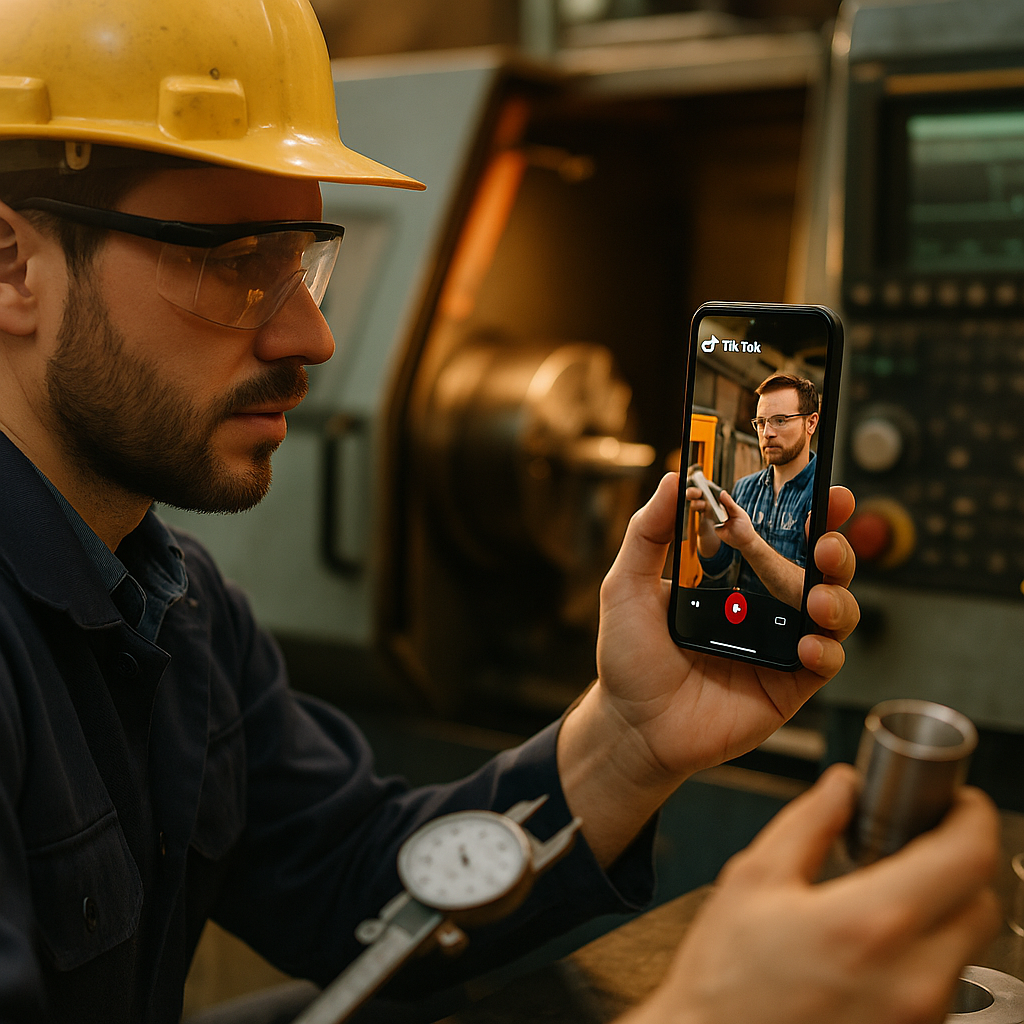
In 2025, more industrial employers are realizing that short-form video can reach skilled talent faster than job boards. This case study shows how one mid-sized manufacturer used TikTok recruiting to fill hard-to-staff roles in CNC, maintenance, and quality. You’ll see the strategy, content, compliance steps, and measurable outcomes—and why it worked when other channels stalled.
TikTok recruiting strategy: why this manufacturer chose the platform
Riverton Components (name changed for confidentiality) is a 700-employee precision manufacturing firm supplying aerospace and medical device customers. It had a persistent problem: specialized roles stayed open for too long, especially CNC machinists (3–5 axis), industrial maintenance technicians, metrology/quality inspectors, and shift supervisors with lean experience. Traditional recruiting tactics produced volume, not fit.
By early 2025, the company’s HR and operations leaders aligned on three realities:
- Skilled candidates were already employed and unlikely to be actively searching on job boards.
- Referrals worked, but internal networks were saturated and uneven across shifts.
- The company’s work wasn’t visible to local and regional talent; “manufacturing” was a vague label that didn’t convey modern equipment, safety standards, or career pathways.
The team also reviewed recent market signals. TikTok’s own newsroom materials cite that its community includes large adult audiences and that users often discover brands and opportunities through the For You feed. Riverton didn’t treat TikTok as a replacement for applicant tracking or screening; it treated it as top-of-funnel awareness for niche roles. That decision shaped everything: content, measurement, and compliance.
The core hypothesis was simple: if candidates can see the machines, the team, the schedule reality, and the learning curve, qualified people will self-select in. The goal wasn’t virality. It was steady, local reach and higher-intent applicants.
Skilled trades hiring goals: roles, personas, and success metrics
Riverton started with a recruiting intake process that looked more like product marketing than HR. For each hard-to-fill role, the team defined a candidate persona and what that person needs to believe before applying.
Priority roles (first 90 days):
- CNC machinist (setup + prove-out): 2nd shift
- Industrial maintenance technician: rotating weekends
- Quality inspector (CMM + GD&T): days
- Manufacturing engineer (process improvement): days
Candidate “friction points” uncovered in interviews with recent hires and declined offers:
- Unclear pay progression and certification support
- Concern about outdated equipment and poor safety culture
- Shift schedule uncertainty and mandatory overtime rumors
- “Will I be stuck doing the same operation forever?”
What success looked like (tracked weekly in the ATS and a lightweight dashboard):
- Qualified applicant rate (meets minimum requirements) up 25%
- Time-to-first-interview under 7 days for priority roles
- Offer acceptance rate up 10%
- 90-day retention stable or improving (guardrail metric)
They also set channel-specific metrics that prevented “views-only” reporting: link clicks, completed application starts, and hires attributed to TikTok-assisted journeys (first-touch or assisted-touch). This mattered because skilled trades candidates often apply after multiple touches: a video, a comment exchange, a coworker referral, and then a job page visit.
Employer branding on TikTok: content pillars that attracted qualified candidates
Riverton built an employer brand content system designed to answer practical questions candidates ask but rarely get answered in job descriptions. The team produced content in-house with a plant-approved filming plan and a small kit (phone, lav mic, LED light). No agency. Consistency beat polish.
Content pillars (each mapped to a hiring objection):
- “Day in the life” on real shifts (reduces schedule anxiety): start-of-shift huddles, tool crib flow, break timing, shift handoff.
- Skill proof and pride (signals technical seriousness): cutting parameters, fixture logic, gauging routines, CMM workflows, deburring standards.
- Career pathways (reduces “dead-end job” fear): machinist-to-programmer progression, maintenance apprenticeships, quality tech ladders.
- Pay transparency context (without violating policy): ranges for roles, differentials for shift, and how raises work.
- Culture and leadership access (builds trust): short Q&As with supervisors, safety manager, and a senior machinist.
They avoided gimmicks. Instead, they used clear captions, straightforward explanations, and an operator-first perspective. A machinist would narrate why a certain setup matters, what tolerances are typical, and what the company expects on day one versus month three. That specificity filtered out unqualified applicants while pulling in the right ones.
Example video concepts that consistently produced high-intent comments and clicks:
- “What we mean by ‘setup experience’ (and what we train)”
- “3 mistakes that scrap parts on this machine—and how we prevent them”
- “CMM inspection: how we read a GD&T callout in real life”
- “Maintenance walk: top 5 sensors we keep in stock and why”
- “Overtime: what’s scheduled, what’s voluntary, what’s rare”
Riverton also answered follow-up questions inside the content rather than pushing everything to a recruiter DM. When candidates asked, “Do you hire without aerospace experience?” they created a video explaining transferable skills, the onboarding plan, and how they qualify operators for critical parts.
To strengthen EEAT, they featured credible voices: a certified quality lead explaining measurement practices, the safety manager explaining PPE and lockout/tagout expectations, and a maintenance lead describing troubleshooting standards. Each video was grounded in what the company actually does—no inflated claims, no vague “family” language.
Recruiting funnel optimization: from views to interviews and hires
Riverton treated TikTok as an acquisition channel and built a clean path from discovery to application. The process minimized friction for mobile users while keeping screening standards high.
Step 1: Clear calls to action
Every video ended with one action: “Search ‘Riverton CNC’ on our careers page” or “Tap the link for the shift schedule and pay range.” They avoided multiple CTAs that confuse candidates.
Step 2: A mobile-first landing page
Instead of sending candidates to a generic careers homepage, Riverton created a landing page per role family (CNC, Maintenance, Quality). Each page included:
- Pay range and shift differential details
- Schedule examples (including weekends/rotation specifics)
- Minimum requirements vs trainable skills
- A 90-day onboarding outline
- Benefits summary in plain language
This reduced drop-off and improved applicant quality because candidates self-screened before applying.
Step 3: Fast response SLAs
Riverton set a service-level agreement: qualified applicants received a response within 48 business hours. For in-demand trades, speed signals competence. Recruiters used structured phone screens with role-specific questions agreed upon by operations.
Step 4: Comment and DM handling
They created a simple playbook:
- Answer common questions publicly when appropriate (pay range, schedule, training).
- Move sensitive discussions to a secure channel (“Apply here; we’ll follow up through email/phone”).
- Never discuss protected characteristics or make promises about individual outcomes.
Step 5: Attribution that leadership trusts
They used three methods to connect TikTok activity to hiring outcomes:
- Unique links/UTM parameters for each role landing page
- “How did you hear about us?” with “TikTok” as an option
- Recruiter notes for assisted-touch journeys (e.g., “Candidate referenced CNC setup video”)
Within eight weeks, the recruiting team noticed a qualitative shift: candidates arrived with better questions. They asked about tooling systems, preventive maintenance cadence, gauge calibration, and overtime policy—signals of trade fluency. Interviews became more efficient because the basics were already covered by the content.
Compliance and risk management: safety, privacy, and labor considerations
Manufacturing content can introduce safety, confidentiality, and labor risks if handled casually. Riverton prevented issues by involving HR, EHS, legal counsel, and operations from the start. This cross-functional design strengthened trust internally and made the program sustainable.
Plant filming rules were documented and enforced:
- No filming customer drawings, traveler documents, or proprietary part geometry
- No filming screens showing programs, internal dashboards, or personal data
- PPE must be worn correctly on camera; unsafe behavior meant the clip was discarded
- Approved filming zones and times to avoid disruptions and hazards
Employee participation followed consent and clarity:
- Written opt-in for employees featured on camera
- Clear statement that participation is voluntary and not tied to performance reviews
- Guidelines on what employees can and cannot say (no wage comparisons to named employers, no discriminatory statements, no promises of guaranteed hours)
Hiring fairness remained consistent with EEAT-aligned “trust and transparency”:
- Content did not imply preference for any protected group
- Requirements were accurate and matched job postings
- Recruiters used structured interviews and documented evaluations
This section matters because readers often ask: “Can we even film in a plant?” The answer is yes—if you treat TikTok like any other communication channel with safety and confidentiality controls. Riverton’s approach proved you can show meaningful work without exposing sensitive details.
Results and lessons learned: manufacturing recruitment ROI in 2025
Riverton ran an initial 12-week pilot and then expanded. The outcomes were strong enough to earn ongoing budget for a small internal content effort and limited paid amplification for hard-to-fill openings.
Key outcomes from the pilot (rounded, internal reporting):
- Qualified applicant rate increased by 34% for CNC and Quality roles
- Time-to-first-interview dropped from 12 days to 6 days for priority roles
- Offer acceptance rate improved by 14% for roles featured in content
- Hires attributed to TikTok-assisted journeys: 11 in 12 weeks, including 4 CNC setup machinists
Riverton also saw a benefit that doesn’t show up immediately in dashboards: better alignment between operations and HR. Because leaders had to explain roles on camera in plain language, job requirements became sharper and more realistic. That reduced late-stage surprises that can derail offers.
What worked best (repeatable lessons):
- Specific beats generic: “How we inspect this tolerance” outperformed “We’re hiring machinists.”
- Show the schedule honestly: clarity reduced churn and improved acceptance.
- Use real experts: credible voices built trust quickly with experienced tradespeople.
- Reply with content: turning FAQs into videos kept momentum and reduced recruiter workload.
What didn’t work (and what they changed):
- Overproduced videos took too long; they moved to a lighter, weekly cadence.
- Pure culture clips underperformed; they paired culture with a skill or process every time.
- Long application forms killed conversion; they shortened the first step to essentials and followed up for details.
If you’re wondering whether paid ads were necessary: the pilot was mostly organic. After proof of concept, Riverton used small paid boosts for role landing pages in a defined commuting radius. The paid component worked best when the creative looked like the organic posts—operator-led, practical, and direct.
FAQs about TikTok for specialized recruiting in manufacturing
-
Does TikTok work for experienced machinists and maintenance technicians?
Yes, when content respects the craft. Experienced candidates respond to specific setups, troubleshooting logic, inspection practices, and clear pay-and-schedule information. Riverton’s strongest applicants referenced technical details from videos during interviews.
-
How often should a manufacturer post recruiting content?
A consistent cadence beats bursts. Riverton started with 3 posts per week and maintained momentum by rotating content pillars. If resources are tight, 2 posts per week plus active comment responses can still perform well.
-
What should we avoid filming in a plant?
Avoid customer identifiers, drawings, part numbers tied to clients, screens with programs or personal data, and any unsafe behavior. Create approved zones, require PPE on camera, and have EHS review guidelines before filming.
-
Do we need a separate TikTok account for recruiting?
Not always. Many manufacturers succeed with one brand account that mixes product, process, and hiring content. If your marketing channel has strict brand constraints, a dedicated careers account can move faster while still following governance rules.
-
How do we measure TikTok recruiting ROI?
Track qualified applicants, interview speed, offer acceptance, and retention guardrails. Use role-specific landing pages with unique links, add “TikTok” to source-of-hire options, and capture assisted-touch notes when candidates reference videos.
-
Will TikTok increase unqualified applicants?
It can if your content is vague. Riverton reduced noise by stating minimum requirements clearly, showing real work, and explaining what is trainable. The more specific your content, the more it filters for fit.
Riverton’s experience shows that TikTok can do more than generate awareness; it can bring specialized manufacturing candidates into a measurable, well-governed hiring funnel. The company won attention by showing real work, earned trust through credible voices, and protected safety and privacy with clear rules. The takeaway: build practical content, shorten the path to apply, and measure outcomes that hiring managers respect.
Top Influencer Marketing Agencies
The leading agencies shaping influencer marketing in 2026
Agencies ranked by campaign performance, client diversity, platform expertise, proven ROI, industry recognition, and client satisfaction. Assessed through verified case studies, reviews, and industry consultations.
Moburst

-
2

The Shelf
Boutique Beauty & Lifestyle Influencer AgencyA data-driven boutique agency specializing exclusively in beauty, wellness, and lifestyle influencer campaigns on Instagram and TikTok. Best for brands already focused on the beauty/personal care space that need curated, aesthetic-driven content.Clients: Pepsi, The Honest Company, Hims, Elf Cosmetics, Pure LeafVisit The Shelf → -
3

Audiencly
Niche Gaming & Esports Influencer AgencyA specialized agency focused exclusively on gaming and esports creators on YouTube, Twitch, and TikTok. Ideal if your campaign is 100% gaming-focused — from game launches to hardware and esports events.Clients: Epic Games, NordVPN, Ubisoft, Wargaming, Tencent GamesVisit Audiencly → -
4

Viral Nation
Global Influencer Marketing & Talent AgencyA dual talent management and marketing agency with proprietary brand safety tools and a global creator network spanning nano-influencers to celebrities across all major platforms.Clients: Meta, Activision Blizzard, Energizer, Aston Martin, WalmartVisit Viral Nation → -
5

The Influencer Marketing Factory
TikTok, Instagram & YouTube CampaignsA full-service agency with strong TikTok expertise, offering end-to-end campaign management from influencer discovery through performance reporting with a focus on platform-native content.Clients: Google, Snapchat, Universal Music, Bumble, YelpVisit TIMF → -
6

NeoReach
Enterprise Analytics & Influencer CampaignsAn enterprise-focused agency combining managed campaigns with a powerful self-service data platform for influencer search, audience analytics, and attribution modeling.Clients: Amazon, Airbnb, Netflix, Honda, The New York TimesVisit NeoReach → -
7

Ubiquitous
Creator-First Marketing PlatformA tech-driven platform combining self-service tools with managed campaign options, emphasizing speed and scalability for brands managing multiple influencer relationships.Clients: Lyft, Disney, Target, American Eagle, NetflixVisit Ubiquitous → -
8

Obviously
Scalable Enterprise Influencer CampaignsA tech-enabled agency built for high-volume campaigns, coordinating hundreds of creators simultaneously with end-to-end logistics, content rights management, and product seeding.Clients: Google, Ulta Beauty, Converse, AmazonVisit Obviously →