


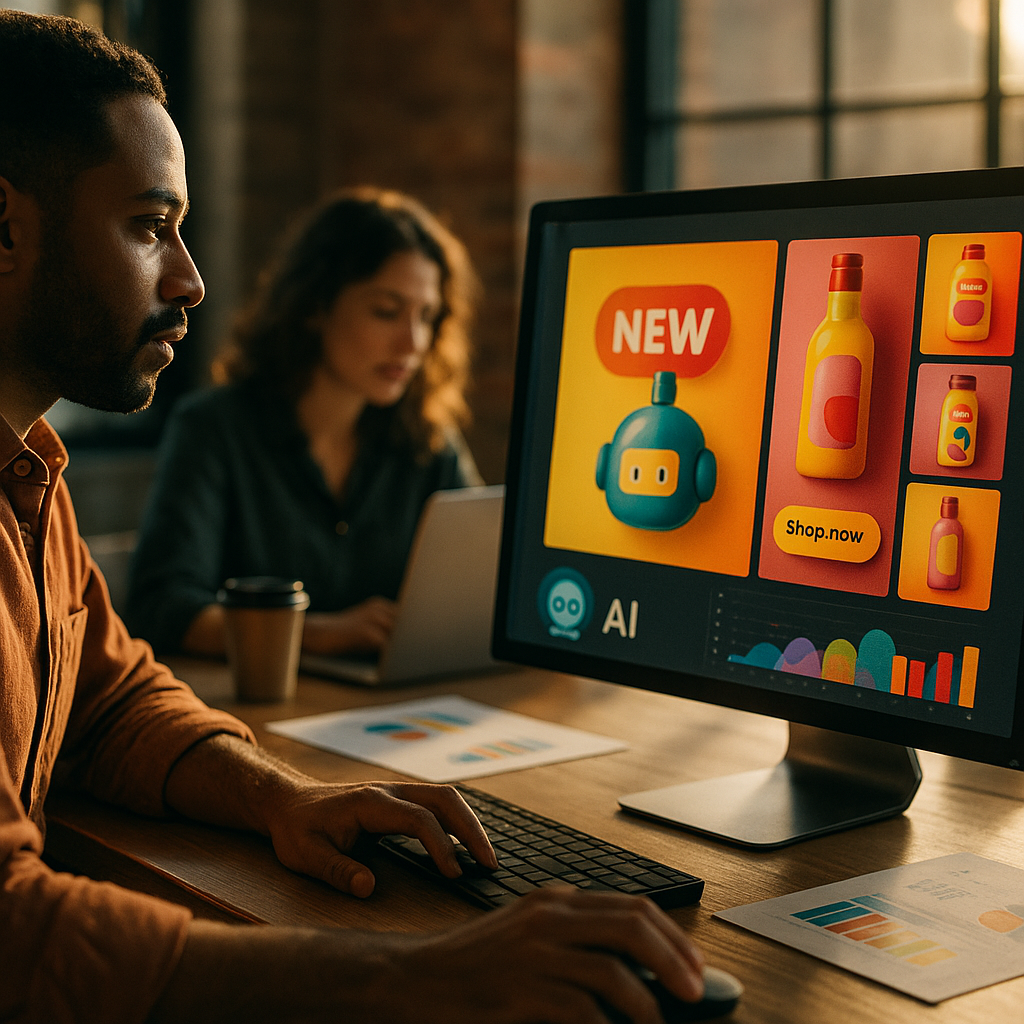
AI for ad creative evolution is changing how teams produce, test, and refresh ads at speed without sacrificing brand standards. Instead of one “final” concept, marketers can generate controlled variations, learn from performance signals, and iterate continuously. When models help design and refine creative, every impression becomes feedback, every test becomes faster, and every update becomes smarter—so what does a modern workflow actually look like?
AI-generated ad variations
Creative fatigue and fragmented audiences make “one hero ad” a risky bet in 2025. AI-generated ad variations solve a practical problem: you need many tailored versions of a message across placements, formats, and audience segments, and you need them quickly. The goal is not to replace strategy or taste; it is to expand the range of viable options while keeping constraints tight.
High-performing variation systems start with a strong creative brief and a clear definition of what may change. In practice, teams define “fixed” elements (brand promise, product truth, compliance language, visual identity rules) and “flex” elements (headline angle, CTA phrasing, background scene, framing, hook length, voice). This is where AI becomes most useful: it can explore the flex space systematically, producing options that would be too time-consuming to craft manually.
To keep outputs helpful and on-brand, treat variation as a structured experiment, not a free-form generation sprint:
- Establish a message map: 3–6 audience pain points, 3–6 benefits, proof points, and objections.
- Create modular creative components: hooks, claims, proof snippets, CTAs, and visual motifs.
- Define guardrails: prohibited claims, required disclosures, tone boundaries, and visual do-not’s.
- Generate in batches tied to hypotheses: each batch tests a specific premise (e.g., “speed” vs “quality” benefit).
This approach also answers a common follow-up question: “How do we avoid generic AI ads?” You avoid them by feeding the model real differentiation (unique proof, product specifics, customer language) and by forcing variation to stay within a measurable hypothesis.
Generative AI for marketing creative
Generative AI for marketing creative works best when you split the problem into three layers: strategy, execution, and evaluation. Humans own strategy: positioning, audience selection, and the brand’s truth. AI accelerates execution: drafting copy, proposing visual compositions, and adapting assets to formats. Evaluation blends both: the model can summarize results and propose next tests, but humans decide what aligns with long-term brand equity.
For strong EEAT, align every generated claim with verifiable product reality. If your ad says “cuts reporting time by 40%,” your team should have a substantiated source and know where it lives (case study, internal benchmark, or third-party research). If that proof is missing, either remove the claim or rewrite it as a non-quantified benefit that remains accurate.
A practical workflow many teams adopt:
- Input: creative brief, audience insights, approved brand voice guidance, compliance requirements, and a small set of “gold standard” ads.
- Generate: 20–100 variations per concept across copy lengths and hooks, plus format adaptations (feed, stories, short video).
- Filter: automated checks for prohibited terms, required disclosures, reading level, and brand lexicon alignment.
- Review: human creative and legal review on a small set of finalists, not the entire batch.
- Launch: test with controlled budgets and clear success metrics.
- Learn: capture why winners won (message, framing, visual, CTA) and feed that learning into the next round.
Another follow-up question is “Will this harm brand consistency?” It can if you let the model improvise identity elements. You avoid that by using templates, locked brand components, and limited degrees of freedom. Your brand system becomes the creative playground’s boundaries.
Creative automation workflow
A creative automation workflow turns iteration into an operating system. The key is to connect production to measurement so variations are not random. In 2025, the most resilient workflows are privacy-aware and do not rely on granular user-level tracking. They focus on creative-level insights, aggregated performance signals, and on-platform experimentation features.
Build your workflow around repeatable “variation cycles”:
- Cycle 1: Angle discovery. Test distinct value propositions (price, speed, outcomes, trust, ease of use).
- Cycle 2: Hook optimization. Within the best angle, test hook styles (question, problem-first, proof-first, contrarian).
- Cycle 3: Proof amplification. Add credibility assets: reviews, certifications, demos, comparisons, guarantees.
- Cycle 4: Format localization. Adapt winners to placements, aspect ratios, and audience segments.
- Cycle 5: Fatigue management. Rotate refreshed variants that preserve the winning structure.
To keep the loop tight, standardize naming and metadata. Tag each creative with variables you can analyze later: angle, hook type, CTA, length, product focus, visual motif, and any promotional element. With consistent tagging, you can answer: “Which hook types work best for this segment?” and “Which visuals reduce CPA without hurting conversion rate?”
Operationally, teams see the biggest gains when they centralize:
- A single source of truth for approved claims and proof.
- A reusable asset library (logos, product UI, b-roll, screenshots, brand backgrounds).
- Clear approval paths based on risk (low-risk copy tweaks vs high-risk claim changes).
This workflow supports EEAT because it makes quality and compliance repeatable, not dependent on memory or ad hoc reviews.
Data-driven creative testing
Data-driven creative testing is where iteration becomes intelligent. A model can generate many variations, but only testing can tell you what customers respond to in real conditions. The trap is measuring the wrong thing. Click-through rate alone can reward curiosity while hurting downstream conversions. Strong testing uses a balanced scorecard aligned to your funnel.
Choose metrics based on objective:
- Prospecting: thumb-stop rate, video watch time, landing-page view rate, qualified click rate, incremental lift where available.
- Consideration: add-to-cart rate, lead form completion rate, cost per qualified lead, on-site engagement.
- Conversion: conversion rate, cost per acquisition, contribution margin, refund/chargeback rate for certain offers.
To make tests trustworthy, control variables. If you change headline, visual, and offer simultaneously, you do not learn what caused the improvement. Instead, design tests with a single primary variable, and keep everything else stable. If you must test multiple variables, use structured multivariate approaches and accept that interpretation will be less direct.
Models can help after results come in by summarizing patterns across winners and losers. However, insist on transparency: require the model to cite the exact creatives, metrics, and sample sizes it used to form a conclusion. If a model cannot point to the data, treat the insight as a hypothesis, not a fact.
Common follow-up questions:
- How many variations should we test? Start with enough to cover distinct angles (often 6–12), then iterate on winners with smaller batches (3–8) to avoid spreading budget too thin.
- How long should a test run? Long enough to reduce noise: reach stable delivery and sufficient conversions or leads. The right duration depends on volume, but the principle is consistency over speed.
- How do we handle creative fatigue? Track frequency and performance decay; refresh by swapping hooks, opening frames, and proof modules while keeping the winning structure intact.
Brand safety and compliance in AI ads
Brand safety and compliance in AI ads are non-negotiable. Iterative variation increases surface area for mistakes: unsupported claims, prohibited targeting implications, misleading before/after visuals, or tone drift. A reliable system combines policy, process, and technical controls.
Implement a “risk-tier” framework:
- Low risk: cosmetic edits, formatting changes, shortening copy, swapping CTAs within approved list.
- Medium risk: new benefit emphasis, new hooks, new testimonials (must be verified).
- High risk: quantified claims, comparative claims, health/finance outcomes, new offers with terms.
For each tier, define required approvals. High-risk changes should route to legal or compliance, while low-risk changes can be approved by a trained brand reviewer using a checklist. This keeps speed without sacrificing rigor.
Technical guardrails also matter:
- Claim library: only allow generated copy to pull from a vetted list of claims and proof points.
- Disclosure injection: automatically add required terms where applicable (e.g., subscription details, eligibility).
- Style constraints: enforce tone, banned phrases, reading level, and formatting rules.
- Asset controls: lock logos, colors, and type styles; restrict background imagery categories if needed.
EEAT improves when your ad system is auditable. Maintain version history: prompts, source assets, reviewers, approvals, and performance outcomes. If a platform flags an ad or a customer disputes a claim, you can trace exactly how the creative was produced and why it was approved.
Human-AI collaboration for ad design
Human-AI collaboration for ad design is the difference between “more content” and “better creative.” The most effective teams treat AI as a creative partner that proposes options and accelerates production, while humans provide taste, ethics, and strategic direction.
Define roles clearly:
- Strategist: sets positioning, audience hypotheses, and success metrics.
- Creative lead: defines the brand’s creative system, approves angles, and safeguards originality.
- Performance marketer: designs experiments, controls budgets, and interprets results.
- Compliance reviewer: validates claims, disclosures, and regulated language.
- AI operator: manages prompts, templates, asset pipelines, and model settings.
To let models design iterative variations responsibly, give them structured inputs: audience segment, intent stage, angle, proof point, tone, format, and constraints. Then require structured outputs: headline, primary text, CTA options, visual direction notes, and a rationale tied to the brief. This makes it easier to review, test, and learn.
Address a final follow-up question: “How do we keep creativity from becoming formulaic?” Rotate inputs that are grounded in real customer evidence—support tickets, sales calls, reviews, and on-site search queries—so the model’s raw material stays fresh. Pair that with periodic “concept resets” where humans develop a new campaign platform, then use AI to scale variations within it.
FAQs
Can AI create ad creatives that outperform human-made ads?
AI can outperform in speed and breadth of iteration, which often leads to better-performing variants over time. The best results usually come from human-led strategy combined with AI-generated variations and disciplined testing.
What inputs do I need to generate high-quality ad variations?
You need a clear brief, audience definition, a message map, approved claims and proof, brand voice rules, format specs, and a set of example “gold standard” ads. Without these, outputs tend to be generic or risky.
How do I prevent compliance issues when using generative models?
Use a vetted claim library, enforce required disclosures, implement banned-phrase filters, tier approvals by risk, and keep an audit trail of prompts, versions, and reviewers. Never allow the model to invent performance or outcome claims.
How many variations should I launch per concept?
Launch enough to test distinct angles (often 6–12). After you identify a winner, iterate with smaller batches (3–8) focused on one variable at a time, such as hook or proof.
Will AI-generated ads hurt brand consistency?
Not if you lock brand elements (logos, fonts, colors), restrict tone and vocabulary, and generate within templates. Consistency improves when variation is constrained to approved flex elements.
What’s the fastest way to reduce creative fatigue?
Refresh openings, hooks, and proof modules while keeping the winning structure. AI helps by producing rotation-ready variants that preserve what works and change what audiences are tiring of.
AI-driven iteration works when you treat creative like a system: clear strategy, constrained variation, careful testing, and strict governance. In 2025, the advantage goes to teams that let models generate many controlled options, then use performance signals to refine the best ideas without drifting off-brand or off-truth. Build guardrails, keep proof verified, and iterate relentlessly—your next winner is usually a variation away.
Top Influencer Marketing Agencies
The leading agencies shaping influencer marketing in 2026
Agencies ranked by campaign performance, client diversity, platform expertise, proven ROI, industry recognition, and client satisfaction. Assessed through verified case studies, reviews, and industry consultations.
Moburst

-
2

The Shelf
Boutique Beauty & Lifestyle Influencer AgencyA data-driven boutique agency specializing exclusively in beauty, wellness, and lifestyle influencer campaigns on Instagram and TikTok. Best for brands already focused on the beauty/personal care space that need curated, aesthetic-driven content.Clients: Pepsi, The Honest Company, Hims, Elf Cosmetics, Pure LeafVisit The Shelf → -
3

Audiencly
Niche Gaming & Esports Influencer AgencyA specialized agency focused exclusively on gaming and esports creators on YouTube, Twitch, and TikTok. Ideal if your campaign is 100% gaming-focused — from game launches to hardware and esports events.Clients: Epic Games, NordVPN, Ubisoft, Wargaming, Tencent GamesVisit Audiencly → -
4

Viral Nation
Global Influencer Marketing & Talent AgencyA dual talent management and marketing agency with proprietary brand safety tools and a global creator network spanning nano-influencers to celebrities across all major platforms.Clients: Meta, Activision Blizzard, Energizer, Aston Martin, WalmartVisit Viral Nation → -
5

The Influencer Marketing Factory
TikTok, Instagram & YouTube CampaignsA full-service agency with strong TikTok expertise, offering end-to-end campaign management from influencer discovery through performance reporting with a focus on platform-native content.Clients: Google, Snapchat, Universal Music, Bumble, YelpVisit TIMF → -
6

NeoReach
Enterprise Analytics & Influencer CampaignsAn enterprise-focused agency combining managed campaigns with a powerful self-service data platform for influencer search, audience analytics, and attribution modeling.Clients: Amazon, Airbnb, Netflix, Honda, The New York TimesVisit NeoReach → -
7

Ubiquitous
Creator-First Marketing PlatformA tech-driven platform combining self-service tools with managed campaign options, emphasizing speed and scalability for brands managing multiple influencer relationships.Clients: Lyft, Disney, Target, American Eagle, NetflixVisit Ubiquitous → -
8

Obviously
Scalable Enterprise Influencer CampaignsA tech-enabled agency built for high-volume campaigns, coordinating hundreds of creators simultaneously with end-to-end logistics, content rights management, and product seeding.Clients: Google, Ulta Beauty, Converse, AmazonVisit Obviously →