


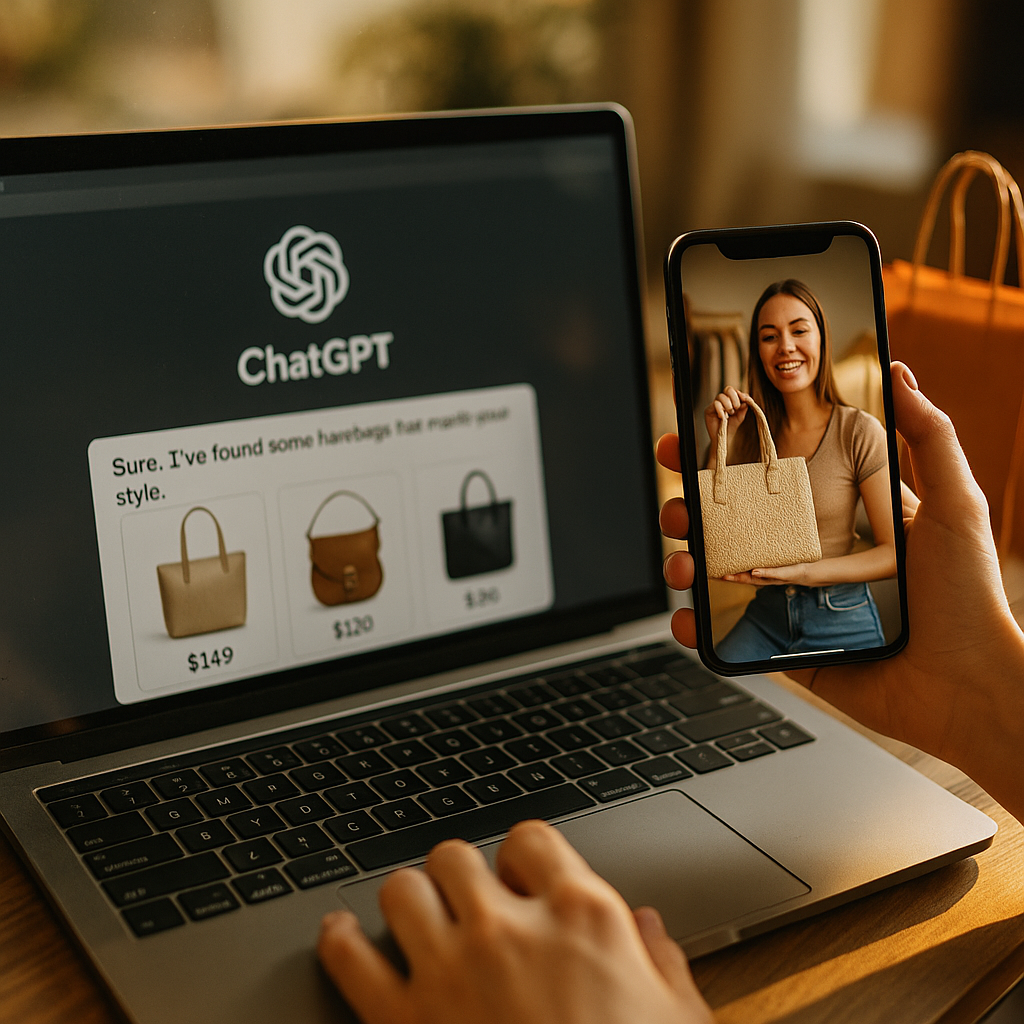
When the Shopping Agent Bypasses Your Creator Funnel
Here’s a number that should keep every influencer marketer awake: 28% of ChatGPT Plus subscribers have already used a shopping agent to complete a purchase without ever visiting a brand’s website, according to Statista’s consumer AI adoption tracker. That means the carefully constructed journey — creator sparks interest, link-in-bio drives traffic, landing page converts — is being short-circuited by an autonomous layer of AI. ChatGPT shopping agents are no longer a thought experiment. Little Caesars, Starbucks, and Burger King have active AI-powered commerce deployments, and they’re fundamentally changing where influencer-driven discovery ends and autonomous purchase begins.
What ChatGPT Shopping Agents Actually Do (and Don’t Do)
Let’s kill the ambiguity. A ChatGPT shopping agent is a conversational AI layer that can browse product catalogs, compare prices, apply stored preferences, and execute transactions — often inside a single chat thread. OpenAI’s operator framework, which matured rapidly in late 2025, now supports persistent memory, payment credentials, and real-time inventory lookups across integrated merchant APIs.
What it doesn’t do (yet) is replicate the emotional resonance of a creator recommendation. It doesn’t scroll TikTok. It doesn’t watch a 90-second unboxing. But it does intercept the moment between “I want that” and “I’ll buy that” with ruthless efficiency.
For QSR brands, the implications are immediate. Starbucks integrated its mobile ordering API with OpenAI’s agent infrastructure, letting users say “order my usual from the closest Starbucks” and have the agent handle location, customization, payment, and pickup time. Burger King’s deployment routes agent-initiated orders through its BK app backend, pulling personalized offers based on purchase history. Little Caesars went a step further: its Hot-N-Ready inventory system feeds real-time availability to shopping agents so they can confirm a pizza is physically waiting before the customer drives over.
The agent doesn’t replace the creator. It replaces everything that happens after the creator does their job — and that’s exactly the part brands have spent years optimizing.
Why Creator Attribution Just Got Harder
If you’ve been wrestling with creator attribution gaps, shopping agents pour gasoline on the fire. Here’s the core problem: when a consumer watches a creator rave about Burger King’s new spicy chicken sandwich and then tells ChatGPT “order me that Burger King sandwich,” the agent completes the transaction with zero referral data tracing back to the creator.
No affiliate link clicked. No UTM parameter captured. No pixel fired.
The creator generated the demand. The agent captured the sale. And in your reporting dashboard, that conversion belongs to “direct” or — worse — to the AI commerce channel itself, making it look like your agentic integration is outperforming your creator program when the reality is they’re working in sequence.
This isn’t theoretical. Brand-side marketers at two major QSR chains have privately confirmed that agent-attributed orders are cannibalizing influencer-attributed conversions in their reporting by 12-18%, inflating the apparent ROI of their AI commerce channel while simultaneously deflating creator program performance. If your CFO is watching those dashboards, your influencer budget is at risk for reasons that have nothing to do with actual influencer effectiveness.
The fix requires rethinking revenue attribution models to account for agent-mediated conversions. Multi-touch attribution that includes “assisted by creator content” as a weighted touchpoint — measured via post-purchase surveys, brand-lift studies, or matched-panel analysis — is the only reliable approach right now.
The New Influence Funnel: Discovery Layer vs. Transaction Layer
For a decade, influencer marketing tried to own the entire funnel. Awareness, consideration, conversion — all in one creator post with a swipe-up link. That model is fracturing.
Shopping agents are creating a clean split:
- Discovery Layer: Creators generate awareness, shape preferences, build emotional associations, and plant purchase intent. This is inherently human, cultural, and contextual.
- Transaction Layer: AI agents handle product selection, price comparison, order execution, and fulfillment logistics. This is inherently mechanical, optimizable, and preference-driven.
The brands winning right now are the ones that stop trying to make creators do both and instead optimize each layer independently. Little Caesars doesn’t ask its food creators to drive app downloads anymore. Instead, it measures creators on aided recall and stated purchase intent, then lets the agent infrastructure handle the actual ordering mechanics.
This has a profound implication for how we brief creators. If the call-to-action no longer needs to be “click the link in my bio,” creators get freed to make better content. Less shilling, more storytelling. Less conversion pressure, more brand building. Ironically, AI commerce agents might make influencer content more authentic — because we’re no longer forcing creators to be the cash register.
As we’ve explored with rewriting creator briefs for AI, audiences are sophisticated enough to recognize when a post is optimized for clicks versus genuine enthusiasm. Removing the transaction burden may actually improve engagement rates.
What Starbucks, Burger King, and Little Caesars Are Teaching Us
Each of these QSR deployments reveals a different facet of the agent commerce playbook:
Starbucks has leaned into personalization depth. Its agent integration remembers not just your drink order but your preferred milk alternative, sweetness level, and even the time of day you typically order. When a creator promotes a seasonal Starbucks drink, the agent can proactively suggest it to users who match the taste profile — effectively extending the creator’s reach into a one-to-one recommendation at the moment of purchase. Starbucks’ mobile ordering ecosystem was already the most advanced in QSR; the agent layer makes it conversational.
Burger King is using agents for offer arbitrage. Its system surfaces the best available coupon or deal automatically when an agent-initiated order comes through, reducing friction but also training consumers to bypass creator-exclusive promo codes. This is a warning sign: if the agent always finds a better deal than the creator’s code, the creator’s perceived value drops.
Little Caesars solved a uniquely physical problem. Its Hot-N-Ready model depends on inventory being literally ready when the customer arrives. By feeding real-time store inventory to shopping agents, Little Caesars ensures the agent never promises something the store can’t deliver. The creator’s job is to make you crave pizza. The agent’s job is to confirm the pizza exists and route you to the right store.
The common thread: all three brands have separated the emotional trigger (creator content) from the transactional execution (agent commerce) and are measuring them with different KPIs.
How to Protect Your Creator Program in an Agent-First World
Panic isn’t a strategy. Here’s what is.
1. Build agent-aware attribution. Work with your measurement partner to add an “agent-assisted” conversion category. If you can’t directly track it, use incrementality testing: run creator campaigns in matched markets and measure whether agent-initiated orders spike in exposed markets versus control. The attribution gap fix we’ve covered before applies here with added urgency.
2. Feed your product data to agent ecosystems. If your product catalog, pricing, and availability aren’t structured for agent consumption, you’re invisible in the transaction layer. This is the new SEO — except the search engine is a shopping agent, and the results page is a chat conversation. Google’s structured data documentation is a starting point, but OpenAI’s merchant integration specs are where the real work happens.
3. Shift creator KPIs upstream. Measure creators on brand lift, aided recall, sentiment shift, and stated purchase intent rather than last-click conversions. This isn’t a retreat; it’s an acknowledgment of where creators actually generate value in an agent-mediated funnel.
4. Negotiate agent-proof exclusivity. If Burger King’s agent auto-applies a better coupon than your creator’s promo code, your creator deal needs restructuring. Consider flat-fee partnerships or engagement-based compensation models that don’t depend on trackable code redemption. The shift toward engagement-based partnerships is already underway for exactly this reason.
5. Invest in agent-influenceable content signals. Shopping agents pull from reviews, ratings, social proof, and structured product descriptions when making recommendations. Creators who generate high-quality review content, comparison posts, and detailed product breakdowns are producing material that agents can reference when helping consumers decide. This makes long-form, evergreen creator content more valuable than ephemeral Stories or Reels.
One more thing worth understanding: the governance layer matters enormously. Brands deploying agent commerce without clear human oversight frameworks are exposing themselves to pricing errors, inventory misrepresentation, and compliance violations. The FTC’s endorsement guidelines haven’t caught up to agent-mediated transactions yet, but they will — and brands that can’t demonstrate where the creator’s influence ends and the agent’s autonomy begins will be the first enforcement targets.
The Concrete Takeaway
Stop measuring your creator program and your AI commerce channel as competitors for the same conversion. They are two halves of one funnel. Restructure your attribution, your creator briefs, and your compensation models to reflect a world where humans create desire and agents fulfill it — or watch your best creator partnerships get defunded by a dashboard that doesn’t understand what actually drove the sale.
FAQs
What are ChatGPT shopping agents?
ChatGPT shopping agents are AI-powered conversational tools built on OpenAI’s operator framework that can browse product catalogs, compare options, apply user preferences, and execute purchases within a chat interface — often without the consumer visiting a brand’s website or app directly.
How do ChatGPT shopping agents affect influencer marketing attribution?
Shopping agents intercept the transaction after a creator generates purchase intent, completing orders without affiliate links, UTM parameters, or tracking pixels. This causes influencer-driven conversions to be misattributed to direct or AI commerce channels, deflating creator program ROI by an estimated 12-18% in early QSR deployments.
How are QSR brands like Starbucks and Burger King using AI shopping agents?
Starbucks integrates its mobile ordering API with agent infrastructure for personalized, conversational ordering. Burger King uses agents to auto-apply the best available offers during agent-initiated orders. Little Caesars feeds real-time Hot-N-Ready inventory data to agents so they can confirm product availability before routing customers to a store.
Should brands stop investing in influencer marketing because of AI shopping agents?
No. Creators remain essential for the discovery layer — generating awareness, shaping preferences, and building emotional connections that agents cannot replicate. Brands should shift creator KPIs toward brand lift and purchase intent rather than last-click conversions, and restructure attribution to capture the full value of creator-driven demand.
How can brands prepare their product data for AI shopping agents?
Brands should ensure their product catalogs, pricing, inventory, and structured data are formatted for agent consumption via merchant API integrations. This includes adopting structured data standards, integrating with OpenAI’s merchant specs, and maintaining real-time inventory feeds so agents can provide accurate product recommendations and availability.
Top Influencer Marketing Agencies
The leading agencies shaping influencer marketing in 2026
Agencies ranked by campaign performance, client diversity, platform expertise, proven ROI, industry recognition, and client satisfaction. Assessed through verified case studies, reviews, and industry consultations.
Moburst

-
2

The Shelf
Boutique Beauty & Lifestyle Influencer AgencyA data-driven boutique agency specializing exclusively in beauty, wellness, and lifestyle influencer campaigns on Instagram and TikTok. Best for brands already focused on the beauty/personal care space that need curated, aesthetic-driven content.Clients: Pepsi, The Honest Company, Hims, Elf Cosmetics, Pure LeafVisit The Shelf → -
3

Audiencly
Niche Gaming & Esports Influencer AgencyA specialized agency focused exclusively on gaming and esports creators on YouTube, Twitch, and TikTok. Ideal if your campaign is 100% gaming-focused — from game launches to hardware and esports events.Clients: Epic Games, NordVPN, Ubisoft, Wargaming, Tencent GamesVisit Audiencly → -
4

Viral Nation
Global Influencer Marketing & Talent AgencyA dual talent management and marketing agency with proprietary brand safety tools and a global creator network spanning nano-influencers to celebrities across all major platforms.Clients: Meta, Activision Blizzard, Energizer, Aston Martin, WalmartVisit Viral Nation → -
5

The Influencer Marketing Factory
TikTok, Instagram & YouTube CampaignsA full-service agency with strong TikTok expertise, offering end-to-end campaign management from influencer discovery through performance reporting with a focus on platform-native content.Clients: Google, Snapchat, Universal Music, Bumble, YelpVisit TIMF → -
6

NeoReach
Enterprise Analytics & Influencer CampaignsAn enterprise-focused agency combining managed campaigns with a powerful self-service data platform for influencer search, audience analytics, and attribution modeling.Clients: Amazon, Airbnb, Netflix, Honda, The New York TimesVisit NeoReach → -
7

Ubiquitous
Creator-First Marketing PlatformA tech-driven platform combining self-service tools with managed campaign options, emphasizing speed and scalability for brands managing multiple influencer relationships.Clients: Lyft, Disney, Target, American Eagle, NetflixVisit Ubiquitous → -
8

Obviously
Scalable Enterprise Influencer CampaignsA tech-enabled agency built for high-volume campaigns, coordinating hundreds of creators simultaneously with end-to-end logistics, content rights management, and product seeding.Clients: Google, Ulta Beauty, Converse, AmazonVisit Obviously →