


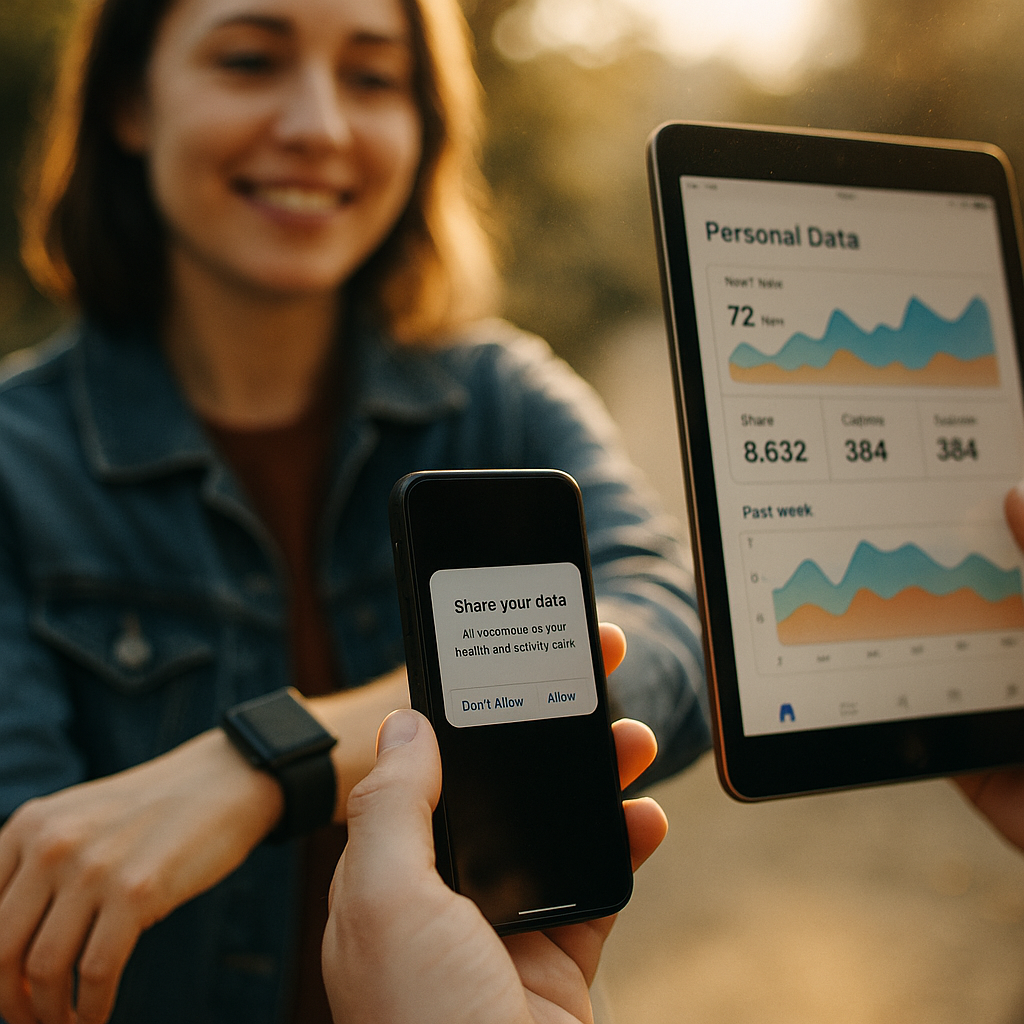
BioMetric Branding turns the signals people already generate—heart rate, sleep, movement, stress—into timely, useful experiences. In 2025, wearable adoption and privacy expectations rise together, forcing marketers to be more precise and more responsible. This approach is not about stalking customers; it is about serving them in the moments that matter, with consent, relevance, and restraint—so what triggers your next best message?
Wearable data marketing: what it is and why it matters
Wearable data marketing uses information from connected devices—smartwatches, fitness bands, rings, and health apps—to tailor messages, offers, and experiences to a customer’s current context. “Context” can mean location, time of day, activity intensity, recovery status, or even inferred stress levels. The goal is not to know everything about a person; the goal is to know just enough to be helpful at the right time.
Done well, wearable-triggered marketing improves three things customers actually care about:
- Relevance: messages align with what the person is doing now (training, commuting, winding down).
- Timing: communication arrives when it can be acted on, not hours later.
- Effort reduction: customers don’t need to hunt for the right product, content, or support.
For brands, the upside is higher conversion with fewer impressions, because the trigger is tied to an intent-rich moment. For customers, the upside is fewer interruptions and more utility. The trade-off is trust: if consent is unclear or the logic feels manipulative, the same system becomes intrusive fast.
To stay aligned with Google’s helpful content principles and EEAT, treat wearable signals as high-sensitivity data. Build around transparency, explainable triggers, and measurable benefit to the user.
Contextual marketing triggers: the signals that actually work
Contextual marketing triggers should be predictable, explainable, and tied to a clear customer benefit. Start with signals that are stable and low-risk before moving into more sensitive biometrics.
High-utility, lower-risk triggers (often sufficient for strong results):
- Activity state: walking, running, cycling, strength session, sedentary period.
- Time patterns: typical workout window, bedtime routine, commute hours.
- Goal progress: streaks, milestone completion, plan adherence.
- Environment: local weather, air quality, daylight (paired with user permission and device settings).
Higher-sensitivity triggers (require stricter consent, safeguards, and messaging restraint):
- Heart rate variability trends: used as a proxy for recovery or stress for some users.
- Sleep metrics: duration, consistency, interruptions.
- Physiological stress indicators: device-calculated stress or readiness scores.
Follow-up question many teams ask: Should we trigger messages based on stress or sleep at all? Only if you can (1) explain the logic simply, (2) offer a user-first action, and (3) prove you can do it without causing harm. For example, recommending a calming audio session after a rough night is materially different from pushing a limited-time discount when someone appears stressed.
Practical rule: if a trigger could embarrass the user, pressure them, or reveal health inferences to others, it needs redesign or removal.
Privacy-first personalization: consent, compliance, and trust design
Privacy-first personalization is the operating system for BioMetric Branding. In 2025, customers expect granular control, and regulators expect proof that you minimize data, protect it, and use it only as disclosed. Build trust the same way you build products: by design, not by disclaimer.
Implement consent the way users understand it:
- Purpose-based opt-in: separate checkboxes for “workout coaching,” “recovery recommendations,” and “offers,” rather than one blanket permission.
- Just-in-time prompts: ask for access when the user tries a feature that needs it, not on first launch with vague wording.
- Revocable controls: allow users to pause triggers, restrict certain metrics, or set quiet hours.
Data minimization and safety controls:
- Collect the minimum viable signals: if step count solves the problem, do not request raw heart data.
- Prefer derived, non-identifying features: store “activity intensity band” rather than raw second-by-second biometrics when possible.
- Short retention windows: keep event triggers long enough to deliver value, then aggregate or delete.
- Role-based access: restrict who can query sensitive fields; log and review access.
Messaging transparency that builds credibility: tell users why they received something in one sentence. Example: “You’re seeing this because you logged a 30-minute run today and opted in to recovery tips.” This is simple EEAT in action: clear sourcing (the user’s own data), clear intent (help), and clear control (they opted in).
Follow-up question: Can we do this without ever storing health data? Often yes, by using on-device processing or a “bring-your-own-insights” model where the wearable platform computes readiness and you only receive a category label (for example, “high/medium/low”) tied to explicit user consent.
Real-time customer experience: orchestration across channels and moments
Real-time customer experience requires orchestration, not just automation. Wearable triggers are only useful if the next step is fast, appropriate, and consistent across channels.
Design the journey around three layers:
- Event: a signal arrives (post-workout completed, prolonged inactivity, bedtime routine detected).
- Decision: apply rules and relevance checks (eligibility, frequency caps, safety filters, inventory, user preferences).
- Delivery: choose the channel and content (in-app card, push notification, email summary, SMS for urgent-only scenarios).
Channel choices that respect attention:
- In-app or wearable notification: best for immediate utility, short copy, quick actions.
- Email: best for weekly progress, deeper education, and long-form offers.
- SMS: use sparingly; reserve for high-value, time-sensitive messages with explicit opt-in.
Frequency and fatigue controls: contextual marketing can become spam if you trigger too often. Set caps such as “no more than one triggered promo per 7 days,” separate from non-promotional coaching messages. Add a “cooldown” after a user dismisses or ignores a message.
Examples of customer-first real-time experiences:
- Hydration support: after a high-intensity session, offer a hydration reminder and electrolyte education, with an optional product link.
- Recovery guidance: when the user’s wearable indicates poor sleep consistency, recommend a wind-down routine and allow them to mute sleep-based nudges.
- Retail convenience: if a user’s running shoe mileage estimate crosses a threshold, provide a fit guide and a gentle replacement suggestion, not a countdown timer.
Follow-up question: How fast is “real-time” for wearables? For many use cases, “near real-time” (seconds to a few minutes) is enough. The key is consistency: don’t promise instant coaching if your data arrives in batches. Align expectations in your UX and preference center.
Biometric segmentation strategy: turning signals into ethical, useful cohorts
Biometric segmentation strategy is how you scale beyond one-to-one rules without sliding into creepy personalization. Instead of targeting individuals with raw metrics, create cohorts based on user-selected goals and device-derived categories.
Segmentation frameworks that work in practice:
- Goal-based segments: “train for a 10K,” “improve sleep,” “reduce stress,” “build strength.” Let users choose, then personalize within that goal.
- Routine-based segments: “morning exercisers,” “weekend warriors,” “shift workers.” These can be inferred from time patterns without health inference.
- Readiness-based segments (opt-in): “high readiness week,” “recovery needed.” Use broad bands, not precise values.
- Engagement-based segments: “new wearable connector,” “streak builders,” “lapsed trackers.” This keeps personalization grounded in behavior, not physiology.
Guardrails to keep segmentation ethical and accurate:
- Avoid medical claims: wearables can be noisy; many metrics are estimates. Phrase content as guidance, not diagnosis.
- Don’t infer sensitive attributes: avoid segmentation that guesses pregnancy, mental health conditions, or chronic disease from signals.
- Use user language: show segments as preferences (“I want recovery tips”) rather than labels (“You are stressed”).
Follow-up question: What about personalization for users without wearables? Offer parallel pathways using app behavior, surveys, and contextual signals like time and location. BioMetric Branding should enhance the experience, not create a two-tier system that penalizes non-wearable users.
Marketing analytics for wearables: measurement, experimentation, and EEAT proof
Marketing analytics for wearables must prove two outcomes: business performance and user benefit. Relying only on click-through rates is risky because wearable-triggered messages can be useful without generating immediate clicks.
Measure outcomes across four categories:
- Relevance: opt-out rate, mute rate, “not helpful” feedback, dismissal speed.
- Experience quality: session completion, feature adoption (for example, recovery plan usage), reduced churn.
- Business impact: incremental conversion, average order value lift, reduced discount dependency.
- Safety and trust: complaint rate, privacy ticket volume, consent withdrawal reasons.
Experimentation you can defend:
- Holdout groups: compare triggered journeys vs. no-trigger baseline to estimate incrementality.
- Frequency tests: test fewer, better messages; wearables often reward restraint.
- Content tests: compare “coaching-first” vs. “promo-first” sequencing.
EEAT signals inside your content and product:
- Expert review: have qualified professionals (for example, certified coaches, sports nutritionists, or clinicians where appropriate) review recovery and wellness guidance, and keep internal documentation of that review.
- Source clarity: distinguish between user-entered data, device estimates, and brand assumptions.
- User control: make preference settings easy to find and simple to use.
Follow-up question: How do we avoid biased or misleading triggers? Validate triggers across different device types, fitness levels, and routines. Use conservative thresholds and test for false positives. If a trigger misfires, make it easy for the user to correct it (“This wasn’t a workout”) and treat that feedback as training data for your rules.
FAQs
What is BioMetric Branding in simple terms?
It is a marketing and experience approach that uses wearable and health-app signals—only with permission—to deliver timely, relevant coaching, content, and offers based on what a person is doing or needs in the moment.
Do I need access to raw biometric data to do this well?
No. Many strong use cases rely on low-sensitivity signals like activity state, routines, and milestones. When higher-sensitivity signals are used, prefer categories (for example, readiness bands) and minimize storage.
Which industries benefit most from wearable-triggered marketing?
Fitness and wellness, sports nutrition, athleisure and footwear, travel and hospitality (routine-based offers), insurance and employee wellness programs (with strict safeguards), and digital health apps focused on coaching rather than diagnosis.
How can brands avoid being creepy?
Use explicit, purpose-based opt-in; explain why the user received the message; cap frequency; avoid sensitive inferences; and design triggers that deliver user value first, with promotions as an optional next step.
Is this compliant with privacy regulations?
It can be, but compliance depends on where you operate and how you handle consent, minimization, retention, and security. Treat wearable signals as sensitive, document processing purposes, and provide clear controls and deletion options.
What are the best first campaigns to launch?
Start with coaching-oriented triggers: post-workout recovery tips, milestone celebrations, inactivity breaks, weather-aware training suggestions, and weekly progress summaries. Add commerce gently after you have proven usefulness and earned trust.
BioMetric Branding works when it converts wearable signals into respectful, practical help—then measures both performance and trust. In 2025, the winning strategy is not maximal data collection; it is minimal, consented signals paired with transparent logic and tight frequency control. Build triggers that users would choose even without discounts, and your contextual marketing becomes a durable advantage.
Top Influencer Marketing Agencies
The leading agencies shaping influencer marketing in 2026
Agencies ranked by campaign performance, client diversity, platform expertise, proven ROI, industry recognition, and client satisfaction. Assessed through verified case studies, reviews, and industry consultations.
Moburst

-
2

The Shelf
Boutique Beauty & Lifestyle Influencer AgencyA data-driven boutique agency specializing exclusively in beauty, wellness, and lifestyle influencer campaigns on Instagram and TikTok. Best for brands already focused on the beauty/personal care space that need curated, aesthetic-driven content.Clients: Pepsi, The Honest Company, Hims, Elf Cosmetics, Pure LeafVisit The Shelf → -
3

Audiencly
Niche Gaming & Esports Influencer AgencyA specialized agency focused exclusively on gaming and esports creators on YouTube, Twitch, and TikTok. Ideal if your campaign is 100% gaming-focused — from game launches to hardware and esports events.Clients: Epic Games, NordVPN, Ubisoft, Wargaming, Tencent GamesVisit Audiencly → -
4

Viral Nation
Global Influencer Marketing & Talent AgencyA dual talent management and marketing agency with proprietary brand safety tools and a global creator network spanning nano-influencers to celebrities across all major platforms.Clients: Meta, Activision Blizzard, Energizer, Aston Martin, WalmartVisit Viral Nation → -
5

The Influencer Marketing Factory
TikTok, Instagram & YouTube CampaignsA full-service agency with strong TikTok expertise, offering end-to-end campaign management from influencer discovery through performance reporting with a focus on platform-native content.Clients: Google, Snapchat, Universal Music, Bumble, YelpVisit TIMF → -
6

NeoReach
Enterprise Analytics & Influencer CampaignsAn enterprise-focused agency combining managed campaigns with a powerful self-service data platform for influencer search, audience analytics, and attribution modeling.Clients: Amazon, Airbnb, Netflix, Honda, The New York TimesVisit NeoReach → -
7

Ubiquitous
Creator-First Marketing PlatformA tech-driven platform combining self-service tools with managed campaign options, emphasizing speed and scalability for brands managing multiple influencer relationships.Clients: Lyft, Disney, Target, American Eagle, NetflixVisit Ubiquitous → -
8

Obviously
Scalable Enterprise Influencer CampaignsA tech-enabled agency built for high-volume campaigns, coordinating hundreds of creators simultaneously with end-to-end logistics, content rights management, and product seeding.Clients: Google, Ulta Beauty, Converse, AmazonVisit Obviously →