


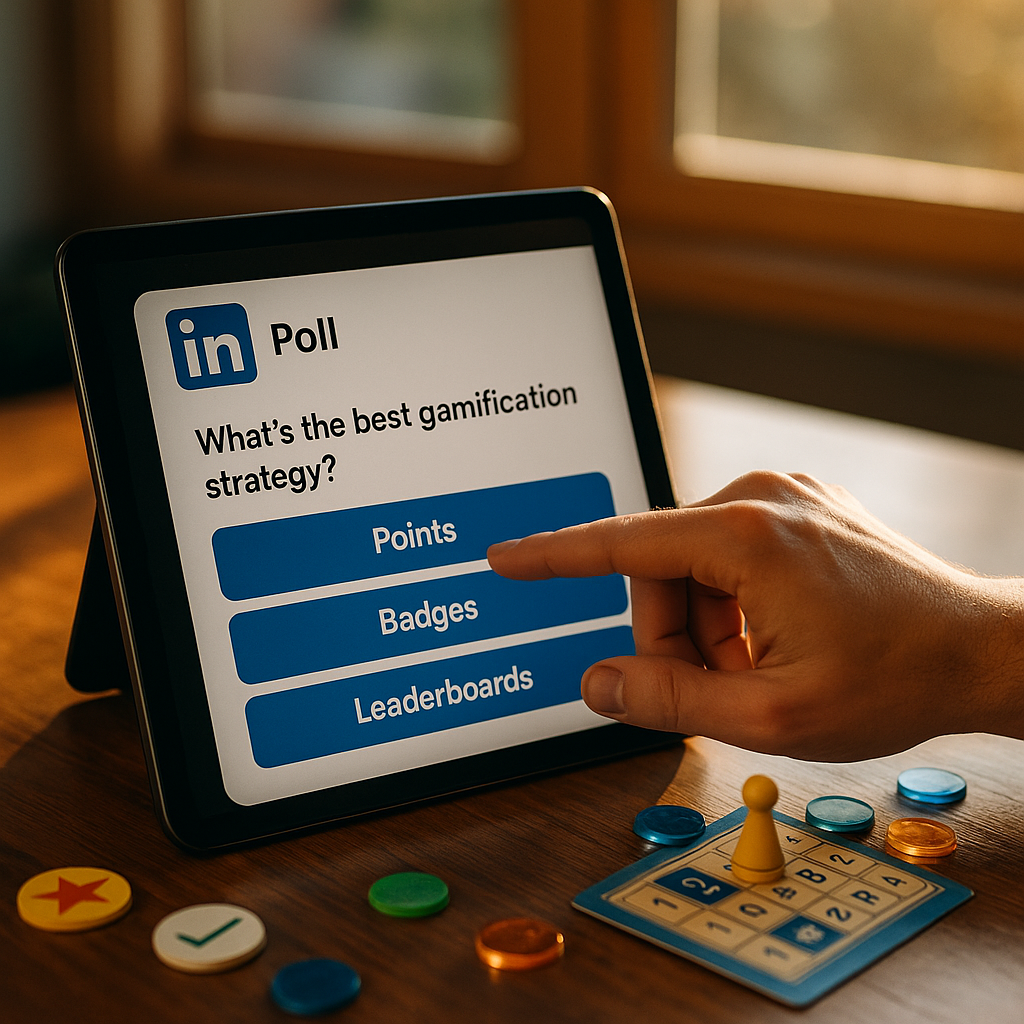
In 2025, LinkedIn rewards posts that keep people interacting, not just scrolling. This playbook for interactive polls and high engagement gamification on LinkedIn shows how to design questions, incentives, and follow-ups that spark comments, saves, and meaningful conversations without feeling gimmicky. You’ll learn what to post, how to run it, and what to measure so momentum builds week after week—ready to turn passive views into participation?
LinkedIn interactive polls: how they work and what “engagement” really means
LinkedIn polls look simple, but the mechanics behind them are specific: a poll is a low-friction micro-decision that invites a click, then often nudges the voter to justify their choice in the comments. That second step is where reach and trust compound.
On LinkedIn, “engagement” is not one metric. For practical execution, treat it as four layers, from easiest to hardest:
- Clicks: voting in a poll, expanding “see more,” clicking a link (when present).
- Light signals: reactions, follows, profile visits.
- Conversation: comments and replies (especially thoughtful ones that keep threads going).
- Commitment: shares, saves, DMs, booked calls, newsletter signups, or event registrations.
A poll that gets thousands of votes but no comments may look successful while producing little business impact. A smaller poll with 50 votes and 20 high-intent comments can be far more valuable. Decide your primary outcome before you post: insights (market research), awareness (reach), or pipeline (qualified conversations).
For EEAT (Experience, Expertise, Authoritativeness, Trustworthiness), the quickest win is to be explicit about your experience: state who the poll is for and why you’re asking. Example: “I’m updating our onboarding checklist for B2B SaaS teams—what’s the step most companies miss?” Clear intent increases quality responses and reduces low-signal voting.
Gamification for LinkedIn content: principles that drive repeat participation
Gamification on LinkedIn works when it respects the platform’s social contract: professionals want to learn, be seen, and contribute. Avoid “games” that feel like engagement traps. Instead, use lightweight mechanics that reward clarity, status, and progress.
Use these principles to design gamified posts that feel professional:
- Progress: turn a big topic into a short series (e.g., “5-day positioning sprint”). Participants return to complete the set.
- Identity: invite people to self-select (e.g., “Are you Team A or Team B?”) and explain why. Identity drives comments.
- Competence: short challenges that help people improve (e.g., “Rewrite this headline in 12 words”).
- Social proof: highlight top responses in a follow-up post and tag participants (with discretion).
- Fairness: simple rules, visible criteria, and consistent follow-through.
Keep the “stakes” aligned with LinkedIn norms. Micro-rewards beat big prizes. A strong reward is recognition: featuring 5 thoughtful answers, summarizing patterns, and crediting contributors. This builds trust and positions you as a curator of insight, not a promoter.
Also, answer the follow-up question readers silently ask: “What do I get for participating?” Include a clear value exchange in the post: “Vote, then comment with your context. I’ll share a summary of the results + a template tomorrow.” Now participation has a purpose.
Poll question ideas for LinkedIn: formats, examples, and when to use each
The best poll questions are specific, opinionated, and easy to answer quickly while still inviting nuance in the comments. You want the vote to be effortless and the explanation to be irresistible.
Use these four high-performing poll formats:
- Trade-off polls: force a choice between two valuable options. Use when: you want strong discussion. Example: “For onboarding, what matters more in week 1: speed to first win or depth of training?”
- Benchmark polls: ask about current behavior. Use when: you want market research. Example: “How often do you review your pricing page copy?”
- Scenario polls: present a realistic situation and ask what people would do. Use when: you want practical advice. Example: “Your demo no-show rate is 30%. What do you fix first?”
- Myth-buster polls: challenge a common belief. Use when: you want authority and education. Example: “Which is more important for reach: posting frequency or topic consistency?”
Poll answer options matter as much as the question. Follow these rules:
- Make options mutually exclusive so voters don’t hesitate.
- Write options at the same level (all tactics, all outcomes, or all beliefs).
- Include a “Depends” option only when necessary. It often wins and reduces insight. If you include it, require the comment: “If you vote ‘Depends,’ drop the variable that changes your decision.”
- Avoid insider acronyms unless your audience is tightly defined.
To pull higher-quality comments, add a one-line prompt under the poll: “Vote, then comment with your role and company size so we can compare apples to apples.” This single line turns a generic poll into segmented research you can reuse in a report, newsletter, or sales enablement.
LinkedIn engagement strategy: a repeatable workflow from post to follow-up
High engagement is rarely about one post. It’s a system: pre-frame the poll, run it, then convert the response into a conversation asset. Use this workflow to make polls and gamification reliable.
Step 1: Choose a narrow audience and outcome
Define who the poll is for in the first sentence: “For B2B marketers running paid LinkedIn…” or “For engineering managers hiring in 2025…”. Then decide the outcome: insights, reach, or pipeline. This keeps your follow-up focused.
Step 2: Write a strong “why now” context (2–3 lines)
Context increases trust. Share a real trigger: “We’re seeing longer sales cycles, so I’m testing which message reduces friction.” Avoid long backstory; your goal is to make the question feel earned.
Step 3: Add a comment magnet that isn’t bait
Use prompts that invite expertise, not just opinions:
- “What’s the exception where your vote doesn’t apply?”
- “If you chose B, what’s the first step you’d take?”
- “Drop your industry—does the answer change?”
Step 4: Engage in the first hour with intent
Reply to early comments with specific follow-ups. Your job is to turn single comments into threads:
- Ask for an example: “What did you change, specifically?”
- Ask for a constraint: “What budget/team size were you working with?”
- Ask for a counterpoint: “What would make you choose the opposite?”
Stay professional and curious. People can tell when you’re farming comments. You’re facilitating a discussion, like a good roundtable host.
Step 5: Publish a results post that delivers on the promise
Within 24–72 hours, post a follow-up with: the winning option, 2–3 surprising patterns, and 3 anonymized quotes or tagged shout-outs from comments. This is where authority is built: you don’t just ask—you synthesize.
Step 6: Convert engagement into a helpful next step
If the poll relates to your offer, add a low-pressure CTA in the follow-up: “If you want the checklist I used to reduce no-shows, comment ‘checklist’ and I’ll send it.” Keep it manual and human; don’t force opt-ins in the original poll. Trust first, conversion second.
Gamified LinkedIn posts: challenge templates, rules, and ethical incentives
Gamified posts work best as short “participation loops” that build habit. The key is to set simple rules and make the outcome visible. Below are templates you can run without heavy production.
Template 1: The 3-round bracket
- Post 1: Poll with 4 options (A/B/C/D). “Pick the most effective subject line angle.”
- Post 2: Top two options face off. Ask for examples and add constraints.
- Post 3: Winner + breakdown + “steal this framework.”
Why it works: progress + anticipation. People come back to see if their pick wins.
Template 2: Comment-to-level-up mini challenge
- Prompt: “Drop your headline. I’ll reply with one rewrite. If you implement it, reply ‘done’ and I’ll give you a version for a second persona.”
Why it works: competence + reciprocity. You demonstrate expertise in public, which strengthens EEAT.
Template 3: “Spot the mistake” professional puzzle
- Prompt: Share a short screenshot or text snippet (redact sensitive info). Ask: “What’s the biggest conversion leak?” Use a poll to vote on the leak.
Why it works: people enjoy diagnosing problems, and it attracts experienced practitioners.
Ethical incentives checklist
- Be transparent: if you plan to DM a resource, say so.
- Protect privacy: avoid sharing private replies; ask before quoting.
- Avoid artificial scarcity: “Only first 10 commenters” can feel manipulative unless you truly have limited capacity.
- Reward contribution, not volume: feature the most thoughtful responses, not the fastest.
Readers often wonder: “Will this hurt my brand if it feels like a game?” Not if the “game” is a structured way to learn. When the activity produces insight, templates, or clearer decisions, it reads as leadership, not gimmickry.
LinkedIn poll analytics: what to track, how to iterate, and when to stop
Polls can become noise if you don’t measure learning. Track performance at three levels: post signals, conversation quality, and downstream outcomes.
Post-level signals
- Votes-to-impressions ratio: indicates how compelling the question is.
- Comments per 100 votes: indicates whether you’re generating discussion or just clicks.
- Saves and shares: indicates usefulness and credibility.
Conversation-quality signals
- Role/industry diversity: are the right people responding?
- Specificity: are comments giving examples, numbers, constraints, or playbooks?
- Thread depth: are you getting back-and-forth, not just single statements?
Business outcomes
- Qualified inbound: DMs that reference the poll and ask for help.
- Content repurposing: can you turn results into a carousel, newsletter, webinar topic, or sales doc?
- Pipeline assists: prospects mentioning your posts on calls, or increased reply rates after engaging.
Iteration rules
- Run 3 polls in one theme before changing topics. One post can be an outlier.
- Change one variable at a time: question framing, options, audience targeting, or follow-up CTA.
- Stop when comments become generic or when your audience signals fatigue. Switch to a synthesis post that summarizes learnings and sets up the next chapter.
To strengthen trust, state limitations in your results post: “This poll reflects my network, which skews toward B2B SaaS.” That single line prevents overclaiming and makes your analysis more credible.
FAQs: interactive polls and gamification on LinkedIn
How often should I post LinkedIn polls?
For most creators and brands, 1 poll per week is enough to build a reliable participation loop without training your audience to expect only polls. If you’re launching a series, you can run 2 polls per week for 2–3 weeks, then return to a normal cadence and publish a synthesis post.
Should I include a link in a poll post?
Usually, no. Keep the poll focused on participation. If you need to drive traffic, put the link in the first comment after a few early interactions, or better, use a follow-up post that summarizes results and offers the resource. This keeps the poll’s purpose clear and protects conversation quality.
What makes a poll feel “spammy” on LinkedIn?
Polls feel spammy when they are vague (“What do you think?”), overly self-promotional, or designed to harvest clicks without delivering insight. A poll feels credible when it has a clear audience, real context, thoughtful options, and a promised follow-up that you actually publish.
How do I get more comments, not just votes?
Add a comment prompt that requires context (role, industry, company size), ask for an example, and reply with real follow-up questions that extend threads. Also, make the poll a stepping stone: “Vote, then tell us what changed your mind last time you revisited this decision.”
Can companies use gamification without hurting their brand voice?
Yes—when the “game” is framed as a structured learning activity. Use professional challenges (audits, rewrites, teardown votes, brackets) and reward participants with recognition and useful summaries. Avoid random trivia, heavy-handed prizes, or anything that conflicts with your industry’s expectations.
How do I turn poll engagement into leads ethically?
Deliver value first: publish a results breakdown and a practical resource. Then offer a clear, optional next step (template, checklist, short audit) without pressure. Keep DMs personalized and relevant to the voter’s comment. The goal is a helpful continuation of the conversation, not a sudden pitch.
Interactive polls and gamification work on LinkedIn in 2025 when you treat them as structured conversations, not tricks. Start with a precise question, make participation easy, and use thoughtful prompts to pull expertise into the comments. Then deliver a results post that synthesizes learning and offers a useful next step. Run the system weekly, measure quality, and let insight—not hype—drive engagement.
Top Influencer Marketing Agencies
The leading agencies shaping influencer marketing in 2026
Agencies ranked by campaign performance, client diversity, platform expertise, proven ROI, industry recognition, and client satisfaction. Assessed through verified case studies, reviews, and industry consultations.
Moburst

-
2

The Shelf
Boutique Beauty & Lifestyle Influencer AgencyA data-driven boutique agency specializing exclusively in beauty, wellness, and lifestyle influencer campaigns on Instagram and TikTok. Best for brands already focused on the beauty/personal care space that need curated, aesthetic-driven content.Clients: Pepsi, The Honest Company, Hims, Elf Cosmetics, Pure LeafVisit The Shelf → -
3

Audiencly
Niche Gaming & Esports Influencer AgencyA specialized agency focused exclusively on gaming and esports creators on YouTube, Twitch, and TikTok. Ideal if your campaign is 100% gaming-focused — from game launches to hardware and esports events.Clients: Epic Games, NordVPN, Ubisoft, Wargaming, Tencent GamesVisit Audiencly → -
4

Viral Nation
Global Influencer Marketing & Talent AgencyA dual talent management and marketing agency with proprietary brand safety tools and a global creator network spanning nano-influencers to celebrities across all major platforms.Clients: Meta, Activision Blizzard, Energizer, Aston Martin, WalmartVisit Viral Nation → -
5

The Influencer Marketing Factory
TikTok, Instagram & YouTube CampaignsA full-service agency with strong TikTok expertise, offering end-to-end campaign management from influencer discovery through performance reporting with a focus on platform-native content.Clients: Google, Snapchat, Universal Music, Bumble, YelpVisit TIMF → -
6

NeoReach
Enterprise Analytics & Influencer CampaignsAn enterprise-focused agency combining managed campaigns with a powerful self-service data platform for influencer search, audience analytics, and attribution modeling.Clients: Amazon, Airbnb, Netflix, Honda, The New York TimesVisit NeoReach → -
7

Ubiquitous
Creator-First Marketing PlatformA tech-driven platform combining self-service tools with managed campaign options, emphasizing speed and scalability for brands managing multiple influencer relationships.Clients: Lyft, Disney, Target, American Eagle, NetflixVisit Ubiquitous → -
8

Obviously
Scalable Enterprise Influencer CampaignsA tech-enabled agency built for high-volume campaigns, coordinating hundreds of creators simultaneously with end-to-end logistics, content rights management, and product seeding.Clients: Google, Ulta Beauty, Converse, AmazonVisit Obviously →